Being named as an executor is a significant responsibility that many Australians face without clear guidance. Executor duties in Australia involve legal obligations that can feel overwhelming if you’re unfamiliar with the process.
At Jameson Law, we’ve helped countless executors navigate these responsibilities with confidence. This guide breaks down what you need to know and do, step by step.
What Executors Actually Do
The Core Responsibilities of an Executor
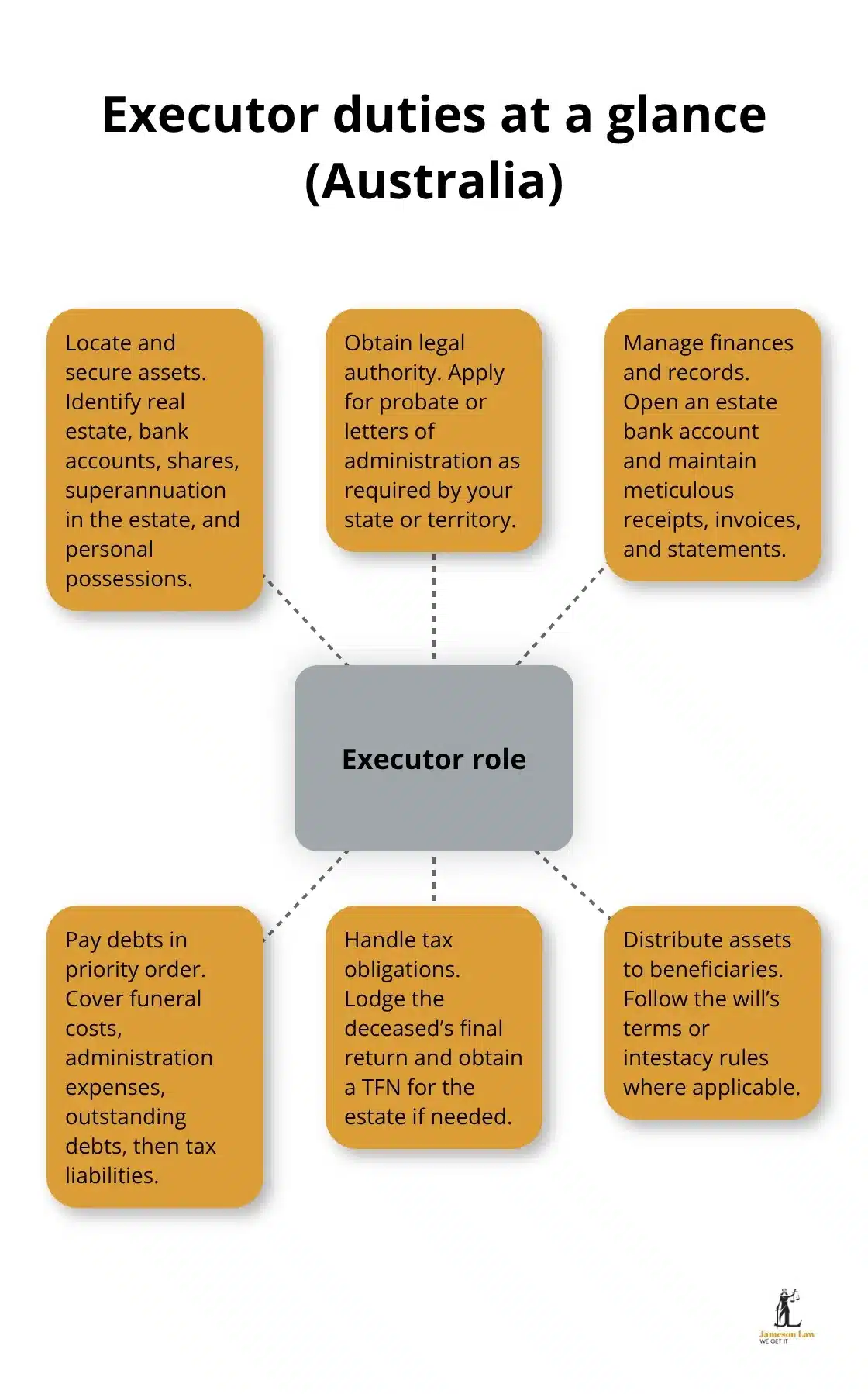
An executor’s role under Australian law is far more hands-on than many people realise. You are not simply distributing money to beneficiaries-you act as the legal representative responsible for the entire estate administration process, from locating assets to paying debts to finalising tax obligations. The NSW Trustee & Guardian outlines that executors must create a comprehensive inventory of the deceased’s assets and liabilities, including real estate, bank accounts, shares, superannuation held in the estate, and outstanding debts. This inventory work matters significantly. Getting the asset list wrong can delay distributions by months and expose you to liability claims from beneficiaries.
Obtaining Legal Authority to Administer the Estate
You must determine whether probate or letters of administration are required to access assets held solely in the deceased’s name, then apply to the relevant court for legal authority to manage and distribute the estate. For significant assets, probate is typically necessary-it provides the court’s formal validation of the will. The process varies slightly depending on whether you operate in NSW, Victoria, Queensland or another state, so understanding your jurisdiction’s specific requirements matters. Once you hold legal authority, you notify banks, financial institutions, superannuation funds, insurers and government bodies of the death, providing certified death certificates and following their verification processes.
Managing Estate Finances and Records
The financial management phase demands careful attention. You open a dedicated estate bank account, pay funeral expenses and debts in the correct order, lodge the deceased’s final tax return with the Australian Taxation Office, and arrange a tax file number for the estate if needed. You must maintain meticulous records throughout-receipts, invoices, valuations, bank statements-because these support your accounting and protect you against disputes or audits.
Executors Versus Administrators
An executor is named in the will and holds the authority to administer the estate as the deceased intended. An administrator is appointed when there is no valid will (called dying intestate), and they must follow the intestacy rules for their state or territory. Both roles carry the same core duties and legal responsibilities, but an executor has the advantage of knowing the deceased’s wishes, while an administrator works within statutory distribution rules.
Timeline Expectations for Estate Administration
The timeline for completing executor duties typically ranges from six months to two years, depending on estate complexity. Simpler estates with few assets and beneficiaries are finalised faster, while estates involving business interests, multiple properties across states, or beneficiary disputes take considerably longer. Most executors find themselves managing the role for at least twelve months. Your first step involves locating the will and understanding its terms, then seeking professional legal advice from a solicitor experienced in probate and estate administration. Understanding what lies ahead-particularly the key responsibilities you must discharge-prepares you for the practical work that follows.
What You Must Do With Estate Assets
The practical work of estate administration centres on three interconnected tasks: you must locate and secure what the deceased owned, pay what they owed, and distribute what remains. These tasks overlap and demand careful sequencing. You cannot distribute assets fairly until you know the full picture of what exists and what debts must be paid.
Valuing and Documenting Estate Assets
The NSW Trustee & Guardian confirms that you should obtain formal valuations for real estate, shares, business interests and other valuable assets to inform both distributions and tax calculations. This is not optional paperwork-valuations determine whether beneficiaries receive their fair share and protect you from future claims. Start by creating a comprehensive asset schedule that lists every property, bank account, investment and superannuation entitlement held in the deceased’s sole name. Include estimated values based on current market conditions.
For real estate, engage a licensed valuer. For shares, use ASX historical price data from the date of death. For business interests, consider a professional business valuation if the stake is significant. This foundational work typically takes four to eight weeks depending on asset complexity.
Opening an Estate Bank Account and Managing Finances
You must open a dedicated estate bank account immediately and funnel all estate income and expenses through it-never mix personal and estate funds. Notify the Australian Taxation Office, banks, financial institutions, superannuation funds and government bodies of the death within the first two weeks, providing certified death certificates. Lodge the deceased’s final tax return within the standard timeframe; the ATO confirms that estates must complete this obligation or face penalties.
Paying Debts and Liabilities in the Correct Order
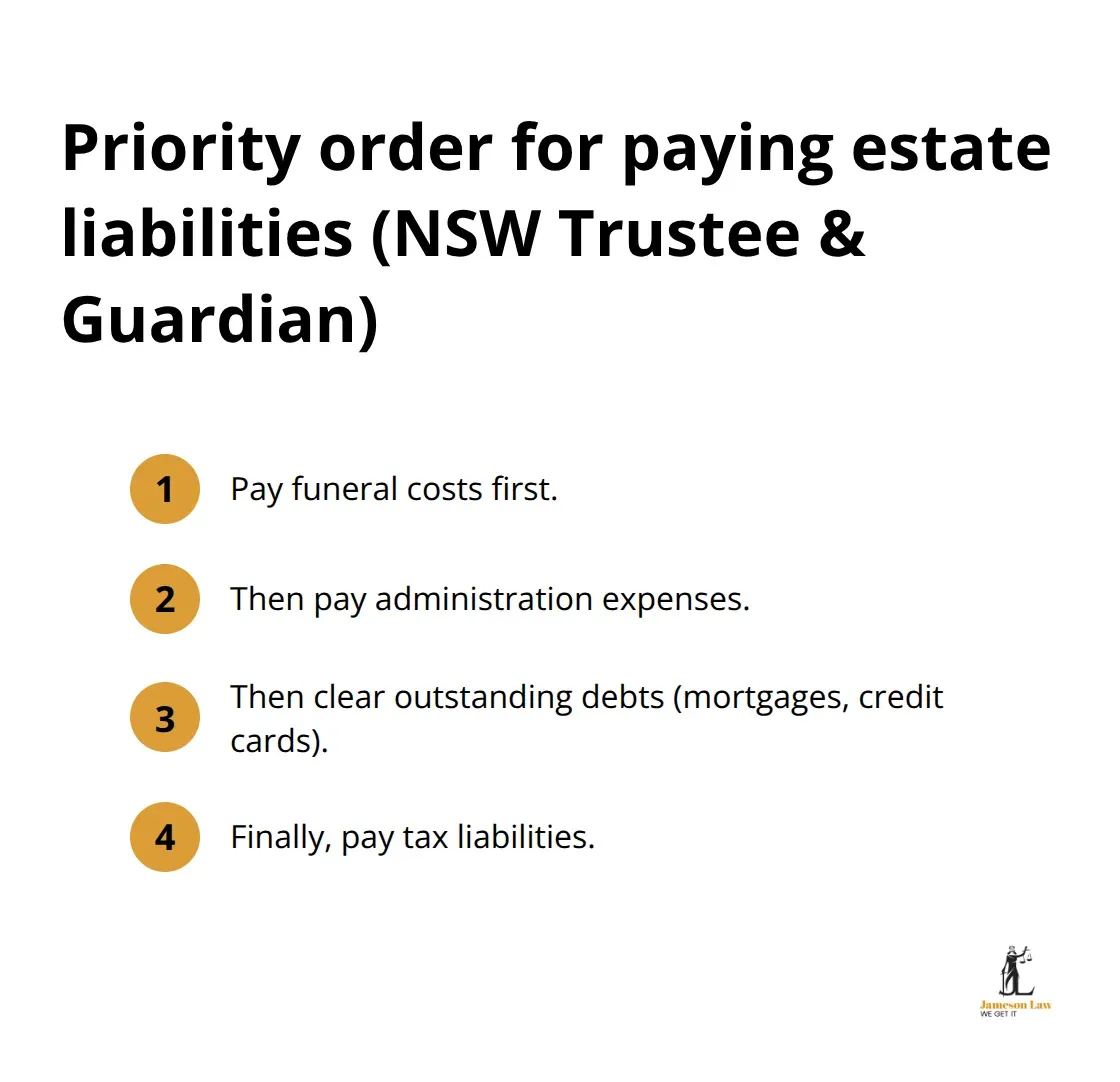
The NSW Trustee & Guardian confirms that you must identify and pay funeral expenses, debts and ongoing administration costs in proper priority order, maintained through an accurate creditors’ ledger. Pay creditors systematically: funeral costs first, then administration expenses, then outstanding debts like mortgages or credit cards, then tax liabilities. Only after these obligations are discharged should you distribute remaining assets to beneficiaries according to the will’s terms.
Maintaining Detailed Records Throughout Administration
You must maintain meticulous records throughout-receipts, invoices, valuations, bank statements and correspondence-because these documents protect you against disputes and potential audits. Many executors underestimate how long this financial management phase takes; budget for six to twelve months of active work even for straightforward estates. The complexity increases significantly when the estate holds multiple properties across different states, business interests that require ongoing management, or superannuation entitlements with specific distribution rules. Once you have secured assets, obtained valuations and paid all liabilities, you move into the final phase of your role: distributing what remains to the beneficiaries named in the will.
Common Challenges Executors Face
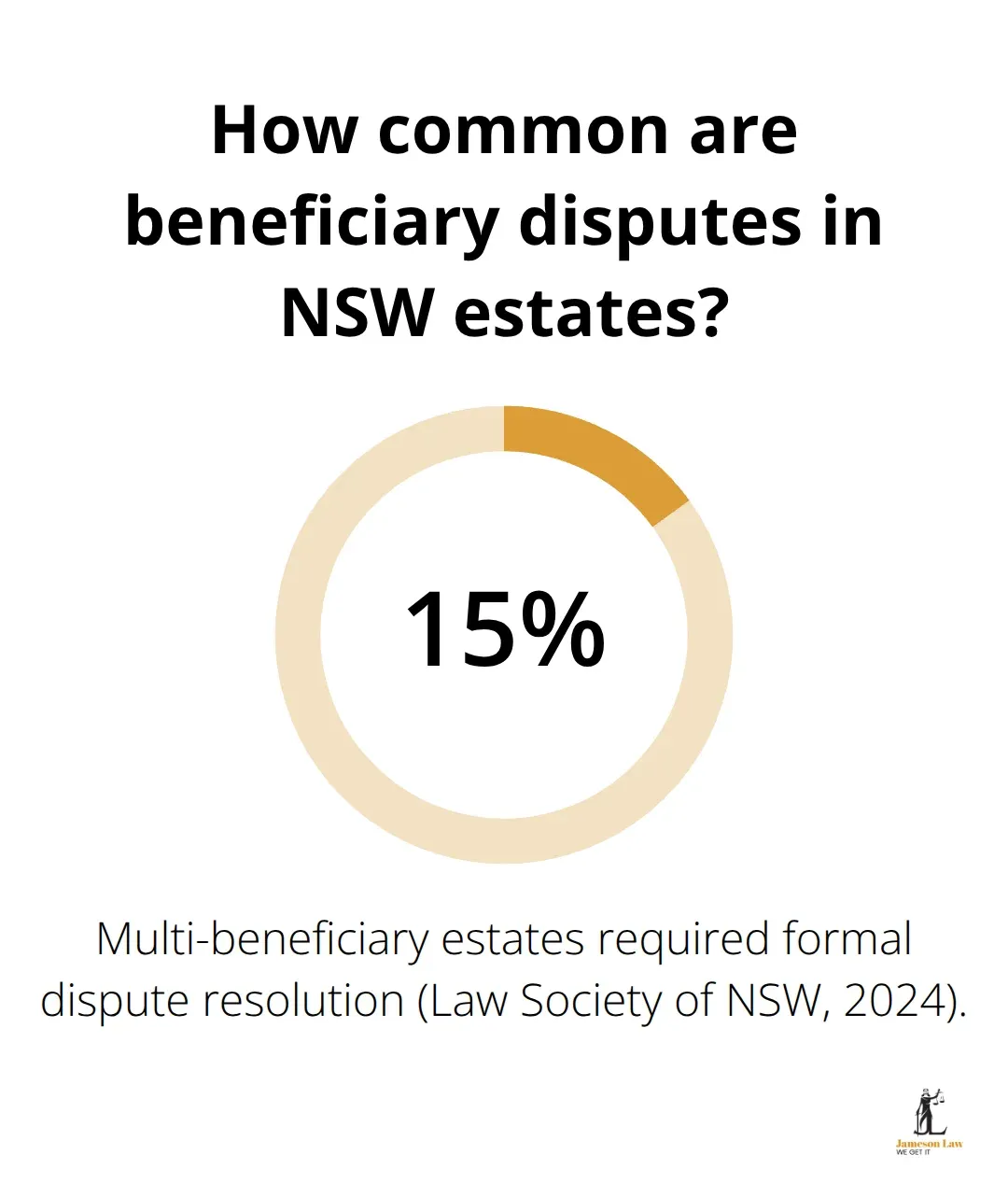
Estate administration rarely proceeds smoothly. The NSW Trustee & Guardian identifies beneficiary disputes as one of the most common complications executors face. Disagreements typically emerge when beneficiaries question how you’ve valued assets, interpret ambiguous will language differently, or believe you’ve favoured one party over another. A 2024 analysis by the Law Society of NSW found that approximately 15 percent of estates involving multiple beneficiaries experienced formal disputes requiring mediation or court intervention.
Managing Beneficiary Disputes
When conflicts arise, they stall distributions by months or years and consume significant funds in legal fees. The practical solution involves transparent communication from day one. Provide beneficiaries with detailed asset valuations, explain your reasoning for decisions, and document every significant action in writing. If tensions escalate, engage a mediator before pursuing litigation-mediation typically costs between $2,000 and $5,000 compared to court proceedings that exceed $15,000 easily. Some executors make the mistake of avoiding difficult conversations, hoping conflicts will resolve independently. This approach backfires consistently. Address concerns directly and involve professional legal advice early when disagreements emerge.
Handling Complex and Illiquid Assets
Managing complex or illiquid assets presents different practical challenges. When an estate includes business interests, farming operations, or investment properties requiring ongoing management, you cannot simply convert everything to cash immediately. Capital gains tax applies when you sell inherited assets, meaning the timing of asset disposal affects tax liability significantly. If the deceased owned a small business valued at $400,000, for example, selling it quickly might trigger substantial capital gains tax, whereas retaining it for twelve months and selling strategically could reduce tax exposure considerably.
Similarly, superannuation entitlements held in the estate follow specific distribution rules that differ from standard probate procedures-beneficiaries who receive superannuation death benefits may access tax-free treatment depending on their relationship to the deceased and the fund’s rules. Illiquid assets also complicate liability payments. If the estate owes $80,000 in debts but holds primarily investment properties worth $500,000, you must decide whether to sell property at potentially unfavourable timing or seek alternative funding.
Navigating Tax Obligations
Tax obligations compound these difficulties significantly. You must lodge the deceased’s final income tax return, manage any capital gains tax arising from asset sales, handle payroll tax if the estate operates a business, and potentially manage GST obligations. The ATO allows executors to arrange a tax file number for the estate, which you should obtain within the first month. Many executors underestimate how substantially these tax obligations affect the final distribution amount. An estate generating $50,000 in capital gains tax liability might reduce beneficiary distributions by 15 to 20 percent depending on asset values.
These interconnected challenges-disputes, complex assets, and tax complications-demand professional guidance from someone experienced in probate administration who understands how each element affects the others.
Final Thoughts
Executor duties in Australia demand careful attention to legal obligations, financial management, and transparent communication with beneficiaries. The work you undertake-locating assets, obtaining probate, paying debts, managing tax obligations, and distributing inheritances-directly affects whether beneficiaries receive their entitlements fairly and on time. Most executors underestimate the complexity involved until they face multiple properties, business interests, or family tensions simultaneously.
Professional legal assistance becomes essential when your estate involves property across multiple states, business interests requiring valuation, superannuation entitlements with complex distribution rules, or any indication of beneficiary disputes. A solicitor experienced in probate and estate administration can guide you through probate applications, advise on tax obligations, and help you avoid costly mistakes that expose you to liability claims. The cost of professional advice typically ranges from $2,000 to $8,000 depending on estate complexity, but this investment protects you and ensures distributions proceed efficiently.
We at Jameson Law specialise in wills and estate planning, and we understand the practical challenges that executor duties Australia presents. If you’re managing an estate and need guidance on your legal obligations, contact us for advice tailored to your circumstances.