


Being arrested in NSW can feel overwhelming, especially when bail decisions hang in the balance. Understanding your bail rights NSW is essential to protecting your freedom while your case progresses.
At Jameson Law, we’ve guided countless clients through bail proceedings. This guide breaks down how bail works, what courts consider, and how to present the strongest case for your release.
Understanding Bail in NSW
Bail in NSW is straightforward: it’s the process that allows a person arrested and held in custody to be released while awaiting trial, rather than staying locked up. According to NSW Courts, two main pathways exist for bail-police bail at the time of arrest and court bail decided at a magistrate hearing. The court balances two competing concerns: whether you’ll appear for court and whether public safety faces risk. This directly affects your freedom and your ability to work, care for family, and prepare your defence.
Many people misunderstand bail as punishment or a guarantee of innocence. It’s neither. Bail is simply a mechanism to keep you out of custody pending trial, provided certain conditions are met.
How Bail Conditions Work in Practice
When the court grants bail, it attaches conditions to your release. These aren’t optional suggestions. According to Legal Aid NSW, bail conditions typically include reporting to a police station, living at a specified address, surrendering your passport, and not contacting certain people. In more serious cases, NSW Department of Communities and Justice data shows that electronic monitoring or curfews may apply depending on assessed risk.
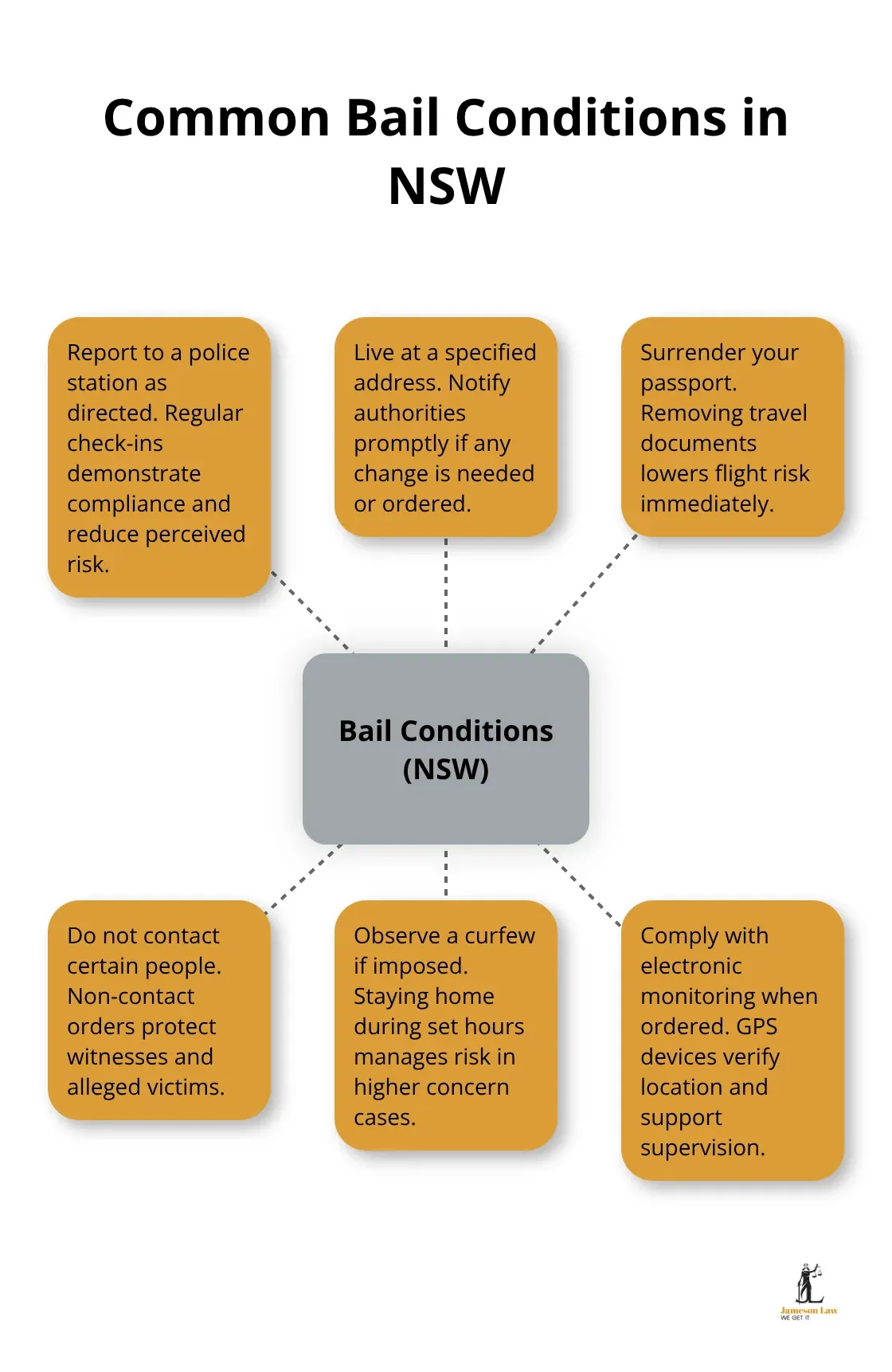
Violating a single condition can result in your bail revocation and immediate re-arrest. The court tailors conditions to your specific circumstances, so what someone else faces may differ entirely from what you face. Read every condition carefully before signing-knowing exactly what you’ve agreed to matters.
When the Court Refuses Bail
Sometimes the court refuses bail outright. Safety concerns, witness protection issues, or serious prior offences can all lead courts to deny bail entirely. According to NSW Courts, if bail is refused, you have options: you can re-apply with new information, seek a variation of terms, or consult legal counsel for next steps.
Legal Aid NSW provides free or subsidised bail advice for eligible applicants, which you should pursue immediately if you’re in this position. Staying silent or hoping the situation resolves itself wastes critical time. Understanding your procedural rights and acting quickly makes a measurable difference in bail outcomes.
Building Your Case for Release
The strength of your bail application depends on what evidence and arguments you present to the court. Your criminal history, ties to the community, and perceived flight risk all influence the outcome. Courts examine employment records, family connections, housing stability, and prior compliance with court orders (factors we’ll explore in detail in the next section). Preparing this evidence before your hearing significantly improves your chances of release.
Your First Appearance: What Happens and What You Need to Know
Your initial appearance in court sets the tone for everything that follows. In NSW, this typically occurs within three business days of arrest. At this appearance, the magistrate decides whether to grant bail, refuse it, or impose conditions. You don’t need to enter a plea at this stage-the sole focus is bail.

The magistrate will inform you of the charges, explain your rights, and give you the opportunity to apply for bail or have your legal representative do so. If you’re unrepresented, this is when you should request Legal Aid NSW assistance. The court will ask basic questions about your background, employment, and ties to the community. Answers here matter enormously.
Making a Strong First Impression
If you answer vaguely or defensively, the magistrate forms a negative impression. If you answer clearly, honestly, and in an organised manner, you signal to the court that you’re someone who will comply with conditions and appear when required. Many people underestimate this first appearance and assume bail is automatic or that the court won’t care about details. That’s dangerous thinking.
The magistrate’s initial impression, formed in minutes, often determines whether they’ll grant bail or demand a full hearing with evidence presented. Prepare before you arrive. Write down your employment details, family connections, housing situation, and any community involvement. Know your address and phone number. Bring identification and any documents that prove employment or community ties.
If you’re applying without a lawyer-which we strongly advise against-you need this preparation more than anyone else. Your presentation and organisation can shift the magistrate’s view before the hearing even begins.
The Full Bail Hearing: Evidence and Arguments
The full bail hearing occurs when the court requires more evidence or when your initial appearance doesn’t result in immediate bail. Here, both the prosecution and your defence present arguments. The prosecution must prove, on the balance of probabilities, that you pose an unacceptable risk of not appearing or that you’re a danger to the public. Your side counters this with evidence of stability, community ties, and compliance history.
Magistrates heavily weigh employment records, family relationships, length of residence, and prior court appearances. Bring payslips, letters from employers, housing documentation, and character references from people who know you well. Character references work best when they come from people in positions of responsibility-teachers, employers, community leaders-rather than close family.
Presenting Your Case Effectively
The hearing is your chance to tell your story directly. Speak clearly, answer questions fully, and avoid becoming defensive. If the prosecution raises concerns about your criminal history, don’t minimise it or make excuses. Acknowledge it and explain what has changed since then. Courts respond to honesty and evidence of rehabilitation.
If you have prior convictions but have been employed steadily for two years since release, state that fact. If you’ve completed rehabilitation programs, mention them. If you’ve maintained housing and family connections despite past difficulties, emphasise that. The magistrate wants to know whether you’re a risk today, not just what happened years ago.
Preparing Your Legal Representative
Prepare your legal representative thoroughly before the hearing. Give them every document, every reference, and every piece of evidence that supports your case. Don’t hold back information hoping it won’t come up-the prosecution will find it, and your credibility collapses when you’re caught hiding something. That destroyed credibility directly damages your bail prospects.
The strength of your bail application depends on what evidence and arguments you present to the court. Your criminal history, ties to the community, and perceived flight risk all influence the outcome. Courts examine employment records, family connections, housing stability, and prior compliance with court orders. Understanding what factors the magistrate weighs most heavily allows you to build a case that addresses each concern directly.
What the Court Actually Weighs in Bail Decisions
The magistrate deciding your bail applies a framework built on three core concerns: your history of compliance with court orders, your genuine connections to NSW, and whether you pose a flight risk or reoffending danger. Understanding exactly what evidence addresses each concern transforms your bail application from a vague plea into a strategic case.
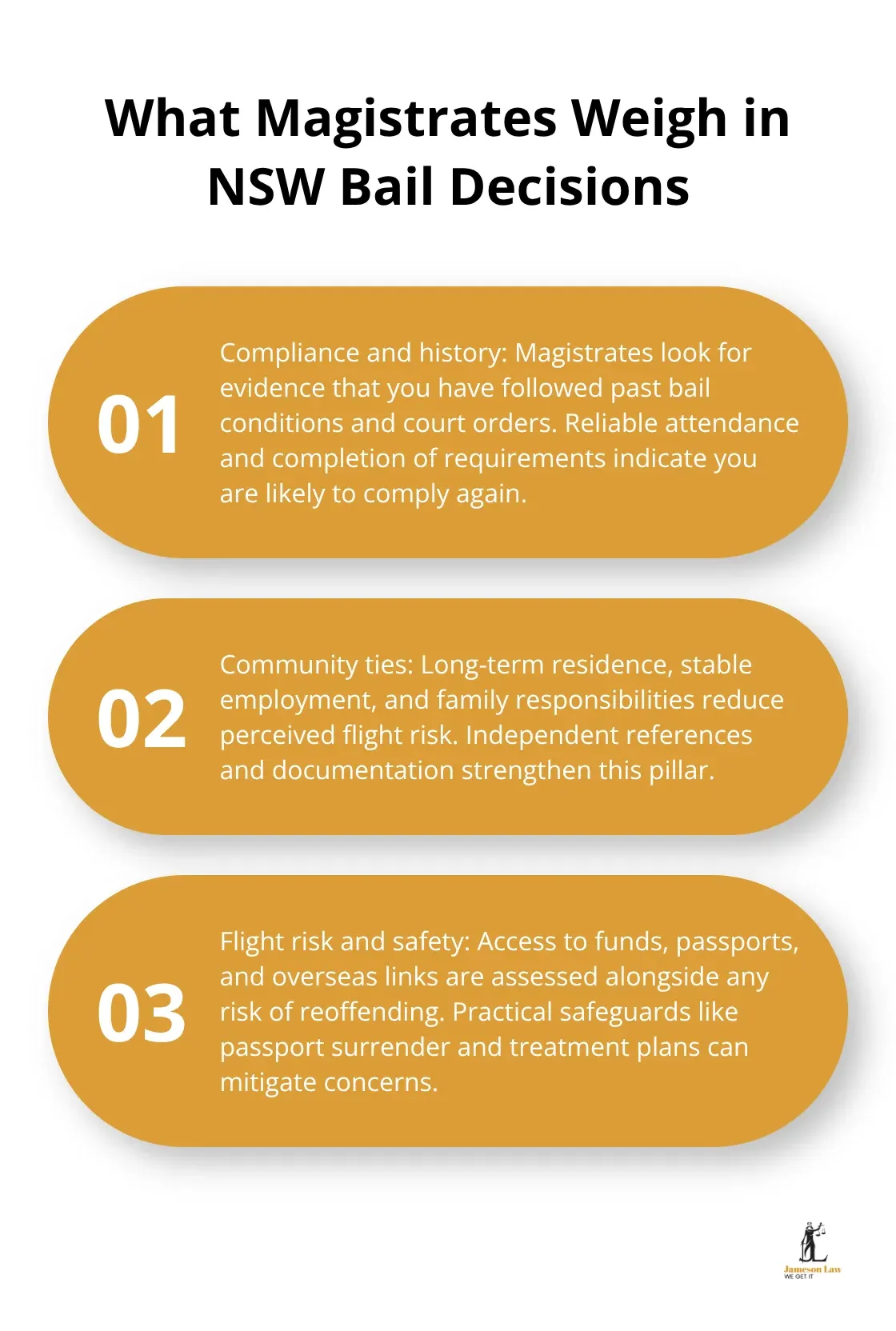
The NSW Courts framework prioritises stability and predictability, which means your job is to demonstrate you represent neither a flight risk nor a public safety concern. This requires specific, verifiable evidence rather than promises or explanations.
Criminal History and Compliance Record
Your criminal history matters, but not in the way most people assume. A single prior conviction does not automatically doom your bail application, especially if years have passed since your last offence. What magistrates actually scrutinise is whether you complied with previous bail conditions, court orders, and sentences. If you received bail five years ago and appeared for every hearing, completed your sentence without breaching conditions, and stayed out of trouble since, you have built a powerful narrative of reliability. Conversely, if you breached bail conditions before or failed to appear in court previously, the magistrate will treat your current application with significant scepticism.
Document your compliance history thoroughly. Obtain court records showing you attended every appearance, completed programs or requirements, and satisfied previous conditions without incident. If you have worked continuously since your last matter concluded, gather payslips covering at least the past 12 months. Employment stability after a conviction signals genuine rehabilitation far more effectively than simply asserting you have changed. If you completed rehabilitation programmes, counselling, or training courses since your last offence, bring certificates or letters from providers. The court wants concrete evidence of changed behaviour, not statements about good intentions.
Community Ties and Family Connections
Community ties and family connections form the second pillar of bail assessment. The stronger your roots in NSW, the less likely you are to flee. This means more than just living somewhere for a few months. Magistrates examine how long you have lived at your current address, whether you own property, your employment history in the area, family relationships, and community involvement. If you have lived in the same suburb for five years, work locally, and have children attending school nearby, you have established the kind of ties that make fleeing genuinely difficult.
Bring documentation proving length of residence: utility bills, rental agreements, or mortgage statements spanning several years. Employment letters confirming your position and length of service carry substantial weight. If you have dependent children or care responsibilities for family members, document this clearly. Character references from employers, teachers, community leaders, or long-term neighbours prove more persuasive than references from close family. These referees should address your reliability, your community involvement, and your character specifically as it relates to bail risk. A reference from your employer stating you have worked there for three years, maintained excellent attendance, and are trusted with responsibility speaks directly to magistrate concerns. A reference from a family member saying you are a good person is far less useful.
If you volunteer, hold memberships in community organisations, or participate in local activities, include evidence. The magistrate interprets community involvement as investment in staying put rather than disappearing.
Flight Risk and Reoffending Concerns
Flight risk assessment involves multiple lenses beyond just community ties. Magistrates consider whether you have access to funds that might enable you to flee Australia, whether you hold a valid passport, and whether you have family or connections overseas. If you disclose these details honestly and the court sees no genuine flight risk, you are in a stronger position. If you hide information about overseas connections or significant funds, the prosecution will uncover this, and your credibility collapses entirely. Disclose everything upfront. If you hold a passport, offer to surrender it as part of your bail conditions. If you have family overseas but no intention or means to flee, explain this context clearly.
The court also examines your likelihood of reoffending. If you face charges for a serious violent offence and have prior convictions for violence, the magistrate will treat bail applications far more cautiously than someone charged with property damage with no history of violence. Demonstrate that your current charges do not reflect your character or circumstances. If you face assault charges but have worked in community service roles, been trusted with responsibilities, or maintained stable employment for years, this context matters. If substance use contributed to your alleged offence and you have engaged with rehabilitation services or are willing to do so, present this to the court. Show the magistrate a pathway forward that reduces reoffending risk.
Final Thoughts
Navigating bail proceedings in NSW requires you to understand your rights, present credible evidence, and act decisively. Your bail rights NSW depend on demonstrating to the magistrate that you pose neither a flight risk nor a public safety concern. This means gathering employment records, securing character references, documenting community ties, and being completely honest about your circumstances.
Legal representation makes a measurable difference in bail outcomes. A lawyer experienced in bail applications knows exactly what evidence magistrates weigh most heavily, how to present your case strategically, and how to counter prosecution arguments effectively. If you cannot afford private representation, Legal Aid NSW provides free or subsidised assistance for eligible applicants, and self-representation significantly disadvantages you, especially if you face serious charges or have a criminal history.
After the magistrate determines your bail, you must comply with every condition without exception (breaching conditions results in re-arrest and potential conviction for a separate offence). If bail is refused, your lawyer can advise on re-application strategies or seeking a variation of terms. Contact Jameson Law to discuss your situation with an experienced lawyer who can guide you through this critical stage of your case.