


Fraud charges NSW carry serious consequences, and understanding the investigation and prosecution process is essential if you’re facing allegations or want to know what to expect.
At Jameson Law, we’ve guided countless clients through every stage of fraud cases, from initial police inquiries through to court proceedings and beyond.
How Fraud Investigations Start and What Happens Next
The Initial Assessment Phase
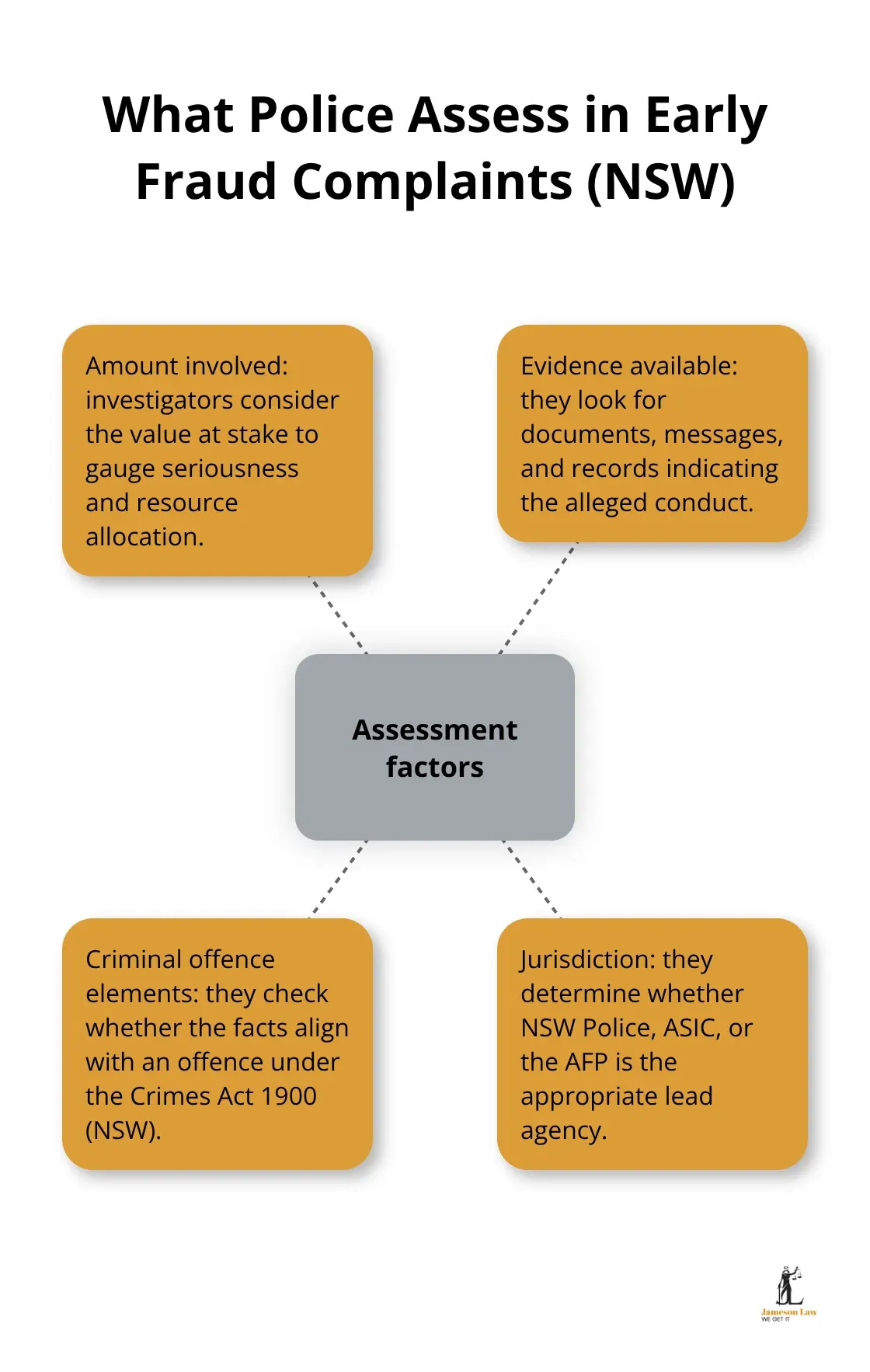
When someone reports fraud to NSW Police or a financial regulator, the process does not begin with charges or arrests. It starts with assessment. Police examine the complaint to determine whether it falls within their jurisdiction and whether sufficient grounds exist to investigate further. The Australian Securities and Investments Commission investigates corporate and financial fraud, while NSW Police handles street-level fraud and theft offences.
Police consider factors like the amount involved, the evidence available, and whether the alleged conduct actually constitutes a criminal offence under the Crimes Act 1900 (NSW). Not every complaint proceeds to a full investigation. If you’ve been accused of fraud, understanding that this assessment phase exists matters because it’s your first opportunity to provide your account to investigators.
Many people ignore initial inquiries, assuming nothing serious will happen. That approach often backfires.
Why Early Engagement Matters
Early engagement with police, ideally through a lawyer, shapes how investigators view the allegations from day one. A lawyer protects your interests during this phase by advising whether you should respond to inquiries and how to do so safely. The difference between engaging early and staying silent can significantly affect the trajectory of your case.
Evidence Gathering and Forensic Analysis
Once police decide to investigate, they begin gathering evidence in earnest. This includes obtaining bank statements, emails, text messages, financial records, and transaction histories from relevant institutions. Forensic accountants trace money flows and identify discrepancies. NSW Police and the Australian Federal Police have specialised fraud squads equipped with digital forensics capabilities. They examine computers, phones, and cloud storage for evidence of intent or knowledge of wrongdoing.
The Crown Prosecutor later reviews all this material to decide whether charges are justified. During this phase, investigators will typically contact you for an interview-this is where many cases are won or lost.
The Interview: Your Rights and Strategy
You have the right to remain silent and the right to have a lawyer present during any interview. We at Jameson Law strongly advise taking both rights. Anything you say in an interview can and will be used against you. Even if you believe you’re innocent, explaining your actions without legal guidance often creates problems.
Investigators are skilled at asking questions that seem innocent but are designed to lock you into statements that can later be contradicted or used to establish knowledge or intent. A lawyer protects you by ensuring questions are fair, stopping improper questioning, and advising when answering serves your interests versus when silence is the better strategy. This decision-whether to speak or remain silent-often determines the strength of the prosecution’s case before it reaches court.
From Investigation to Charges
The Crown’s Assessment Decision
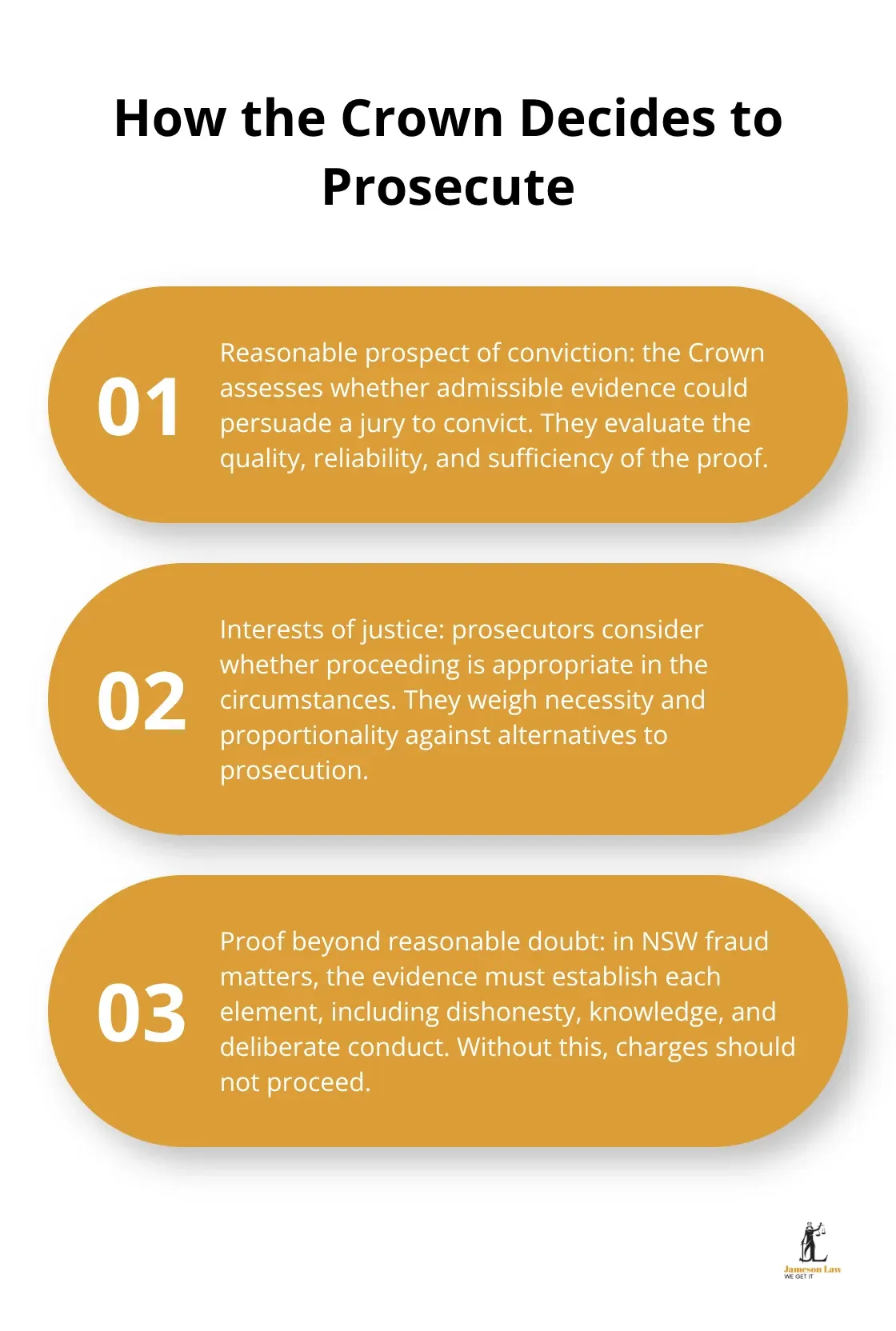
Once police complete their investigation, the Crown Prosecutor reviews all evidence to determine whether charges should proceed. This decision is not automatic. The Crown applies the two-stage test established under the Prosecution Policy of the Commonwealth: first, whether there is reasonable prospect of conviction based on admissible evidence, and second, whether prosecution serves the interests of justice. In NSW, this means the Crown examines whether the evidence proves each element of fraud beyond reasonable doubt before committing to court proceedings.
Many investigations conclude without charges because the evidence simply does not meet this threshold.
Your Window Before Charges Are Filed
If you’re under investigation, this assessment phase offers a critical window. A lawyer can present your account to the Crown before charges are filed, potentially preventing prosecution altogether. Once charges are formally laid, the case moves to court, and your options become more limited.
Court Proceedings and Jurisdiction
The Crown Prosecutor then guides the case through court proceedings, presenting evidence and examining witnesses. Fraud charges typically proceed to the District Court if the value exceeds $100,000 or if multiple offences are involved, though some matters remain in the Local Court. The prosecutor must prove every element of the fraud offence: that you dishonestly obtained a financial advantage, that you knew you were not entitled to it, and that your conduct was deliberate.
The Burden of Proof and Identifying Weaknesses
This burden of proof sits entirely with the Crown. You do not need to prove your innocence. The prosecutor’s case is only as strong as the weakest element they must establish. Many fraud prosecutions fail because prosecutors cannot prove the dishonesty element or cannot demonstrate knowledge beyond reasonable doubt. Understanding this distinction matters significantly if you’re facing charges.
Your defence strategy should target whichever element is most vulnerable in the Crown’s case, rather than attempting to prove innocence across the board. A lawyer identifies these weaknesses early and uses them to negotiate better outcomes or build a stronger defence at trial. Once the Crown’s case structure becomes clear, the real work of mounting an effective defence begins.
Building Your Defence Against Fraud Charges
Identifying Weaknesses in the Crown’s Case
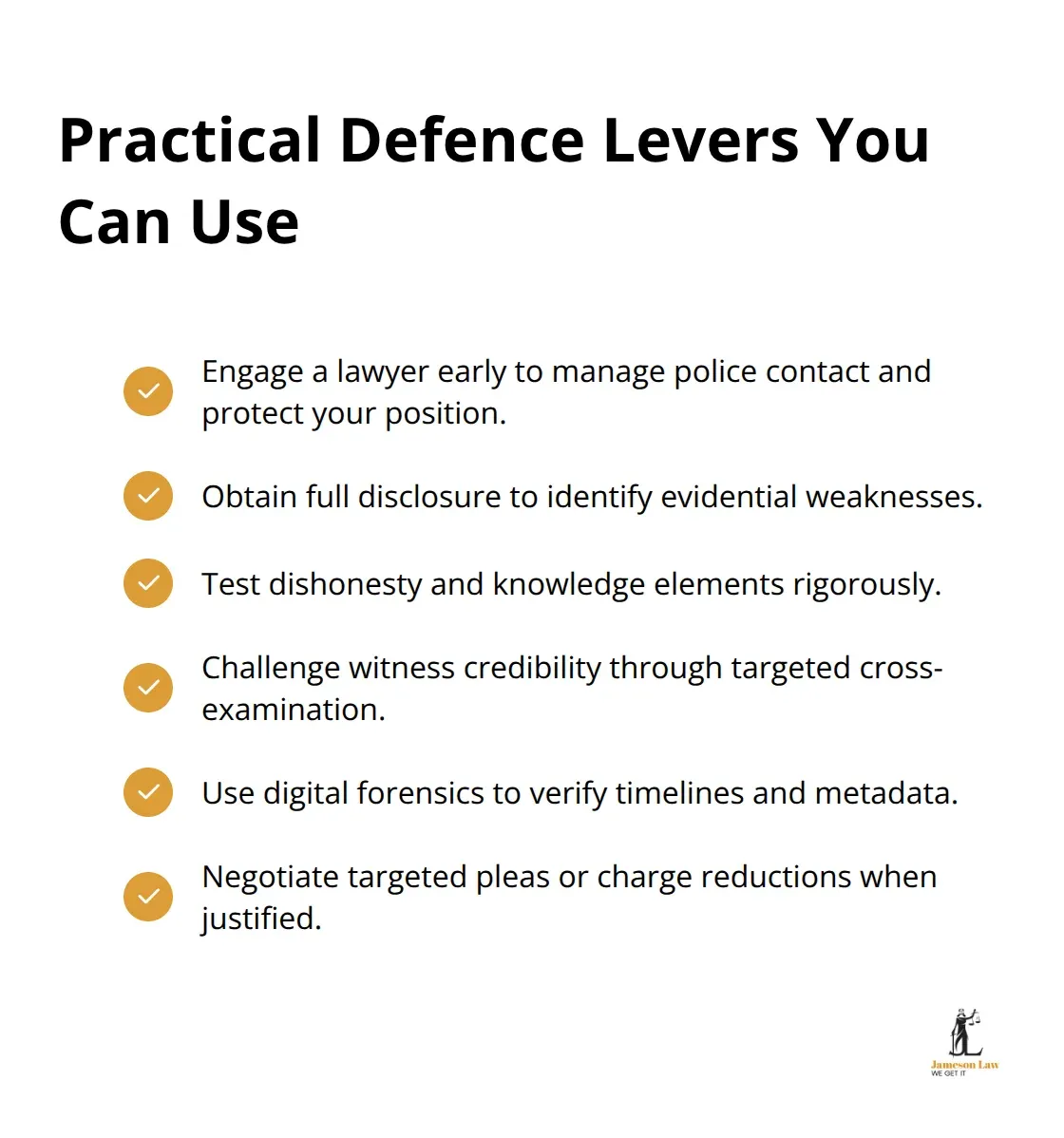
The Crown’s case against you rests on proving specific elements beyond reasonable doubt, and your defence strategy must target the weakest point in their evidence. Many fraud prosecutions collapse not because the accused is innocent, but because prosecutors cannot adequately prove dishonesty or knowledge. The first step is obtaining full disclosure of the Crown’s evidence through the committal process or pre-trial discovery. This material reveals the strength of witness statements, the quality of forensic analysis, and any inconsistencies in the Crown’s narrative.
Experienced defence counsel examines bank records, emails, and transaction histories to identify alternative explanations for conduct the Crown interprets as fraudulent. A payment that appears suspicious in isolation may have legitimate context when surrounding transactions and communications are reviewed. This contextual analysis often exposes gaps in the prosecution’s reasoning.
Challenging Witness Credibility
Witness credibility becomes critical when the Crown relies on testimony rather than documentary evidence. Cross-examination at trial can expose bias, inconsistent prior statements, or motive to fabricate. If a key witness has financial interest in the outcome or a history of dishonesty, this undermines their reliability significantly. The Crown’s case weakens considerably when jurors question whether witnesses told the truth.
Digital forensics also matters increasingly in fraud defence. Metadata from emails and documents establishes when files were created or modified, potentially contradicting the Crown’s timeline. A lawyer with forensic expertise identifies these details that generalist prosecutors often miss.
Negotiating Outcomes Before Trial
Negotiating an outcome before trial often produces better results than fighting charges at trial, particularly when the Crown’s case contains genuine weaknesses. Plea agreements in NSW fraud matters involve pleading to lesser charges, reducing the number of counts, or accepting agreed facts that minimise sentencing exposure. The Crown is willing to negotiate when they perceive trial risk, and this perception depends entirely on how well your defence identifies and articulates vulnerabilities in their case.
A strong defence statement presented to the Crown before trial can shift their assessment of conviction prospects. If your lawyer demonstrates that a critical element cannot be proven beyond reasonable doubt, prosecutors sometimes withdraw charges or accept a guilty plea to a lesser offence. This requires detailed written submissions backed by case law, not vague assertions of innocence.
Timing Your Defence Strategy
The timing of negotiation matters significantly. Engaging early, before trial preparation becomes entrenched, gives the Crown flexibility to adjust their position. Once trial dates are set and witnesses are committed, prosecutors become less willing to compromise.
Early engagement with a lawyer who understands fraud prosecution strategy positions you to influence the Crown’s decision-making before their case becomes locked in.
Final Thoughts
Fraud investigations in NSW follow a structured path from initial assessment through to court proceedings, and understanding each stage protects your interests. Police and regulators assess whether complaints warrant investigation, then move to evidence gathering and forensic analysis before deciding whether to interview you. The Crown Prosecutor reviews all material to determine if charges should proceed, applying a rigorous test about conviction prospects and the interests of justice.
The single most important factor in fraud cases NSW is early legal representation. Many people facing allegations make critical mistakes during the investigation phase by speaking to police without a lawyer, providing statements that later damage their case, or failing to present their account to the Crown before charges are formally laid. These early decisions often determine whether your case proceeds to trial or resolves through negotiation, and a lawyer protects your rights during police interviews, identifies vulnerabilities in the Crown’s evidence, and presents submissions that can prevent charges or secure better outcomes.
If you’re facing fraud allegations or are under investigation, the time to act is now. The window before charges are filed offers your best opportunity to influence the Crown’s decision-making, and we at Jameson Law have guided clients through every stage of fraud investigations and prosecutions. Contact Jameson Law to discuss your situation and protect your position before it’s too late.