


A catastrophic injury can transform your life in seconds. Medical bills, lost income, and ongoing care costs create financial pressure when you’re already facing physical and emotional recovery.
Australian law recognises this burden and provides compensation pathways to help you rebuild. We at Jameson Law understand how complex these claims become, which is why we’ve outlined the types of injuries covered, the compensation available, and the factors that influence your claim amount.
What Counts as a Catastrophic Injury
Catastrophic injuries differ fundamentally from typical personal injury claims because they alter your long-term capacity to work and live independently. Australian courts recognise three broad categories that consistently reach six-figure and seven-figure compensation awards. Spinal cord injuries represent the most common catastrophic claim, ranging from partial loss of function to complete paralysis requiring 24-hour care assistance. Traumatic brain injuries create similar devastation-Queensland government data from June 2026 shows brain injury cases reaching median awards around $1,062,351 in court judgements since 2020, with substantial variation depending on cognitive and physical outcomes. Severe burns and disfigurement claims, while less frequent, can trigger comparable compensation levels when they require extensive reconstructive surgery, ongoing skin grafting, or permanent scarring affecting employment prospects and quality of life.
Spinal Cord Injuries and Mobility Loss
Spinal cord injuries demand immediate recognition because they fundamentally reshape your earning capacity and daily functioning. A cervical spine injury affecting arm and leg movement creates vastly different long-term costs than a lower lumbar injury affecting only leg function. The critical factor courts examine is whether you’ll need paid care assistance, mobility equipment, home modifications, or vehicle adaptations-these costs compound dramatically over decades. Future earning capacity takes precedence in compensation calculations; a 35-year-old tradesperson with a spinal injury faces lost income spanning 30+ working years, which substantially exceeds a 60-year-old professional’s claim. Medical evidence becomes essential here-you’ll need specialist neurology reports that document your actual functional capacity post-injury, not just the injury level itself. Some spinal injuries show improvement over 12-24 months through rehabilitation, which can reduce future care costs and increase your return-to-work prospects.
Brain Injuries and Cognitive Outcomes
Traumatic brain injuries present unique complexity because cognitive and behavioural changes may not appear immediately and can evolve over months or years. Mild traumatic brain injury (concussion) claims rarely reach catastrophic thresholds unless you experience ongoing post-concussion syndrome affecting work performance. Moderate to severe traumatic brain injuries, however, frequently result in persistent memory problems, concentration difficulties, personality changes, or emotional regulation issues that prevent return to pre-injury employment. Court judgements consistently award substantial compensation for brain injuries because they affect earning capacity across your entire remaining working life. The Queensland data showing $1,062,351 median awards reflects cases where claimants require ongoing neuropsychological treatment, workplace support, or permanent income replacement. You’ll need comprehensive neuropsychological testing-not just CT scans or MRI results-to establish cognitive deficits and their impact on employment. Some brain injury claimants qualify for ongoing support services through the National Disability Insurance Scheme, which can offset some future care costs but does not eliminate your right to claim damages for lost earning capacity.
Severe Burns and Permanent Disfigurement
Severe burn injuries and disfigurement claims succeed because they create dual financial impacts: substantial medical and rehabilitation costs plus reduced earning capacity from scarring, mobility restrictions, or psychological trauma. Third-degree burns covering more than 10-15% of body surface area typically require multiple surgeries, skin grafting, and extended rehabilitation spanning months or years. The compensation calculation includes past and future medical expenses, lost wages during treatment and recovery, and non-economic loss for pain, suffering, and reduced life enjoyment. Disfigurement claims often succeed even with lower impairment ratings because visible scarring or contractures can prevent return to customer-facing roles or physically demanding work. You’ll need photographic evidence that documents scarring progression, medical reports that detail treatment requirements, and employment records that show actual income loss or reduced earning capacity post-injury. Psychological impacts matter significantly-anxiety, depression, or social withdrawal resulting from disfigurement strengthen your non-economic loss claim under Australian law.
What Happens Next in Your Claim
The type of catastrophic injury you’ve sustained shapes which compensation categories apply to your case and which evidence you’ll need to gather. Each injury category requires different medical specialists, different documentation, and different expert opinions to support your claim. Understanding these distinctions helps you prepare for the assessment process and ensures you don’t overlook critical evidence that could strengthen your position.
How Much Compensation Can You Recover
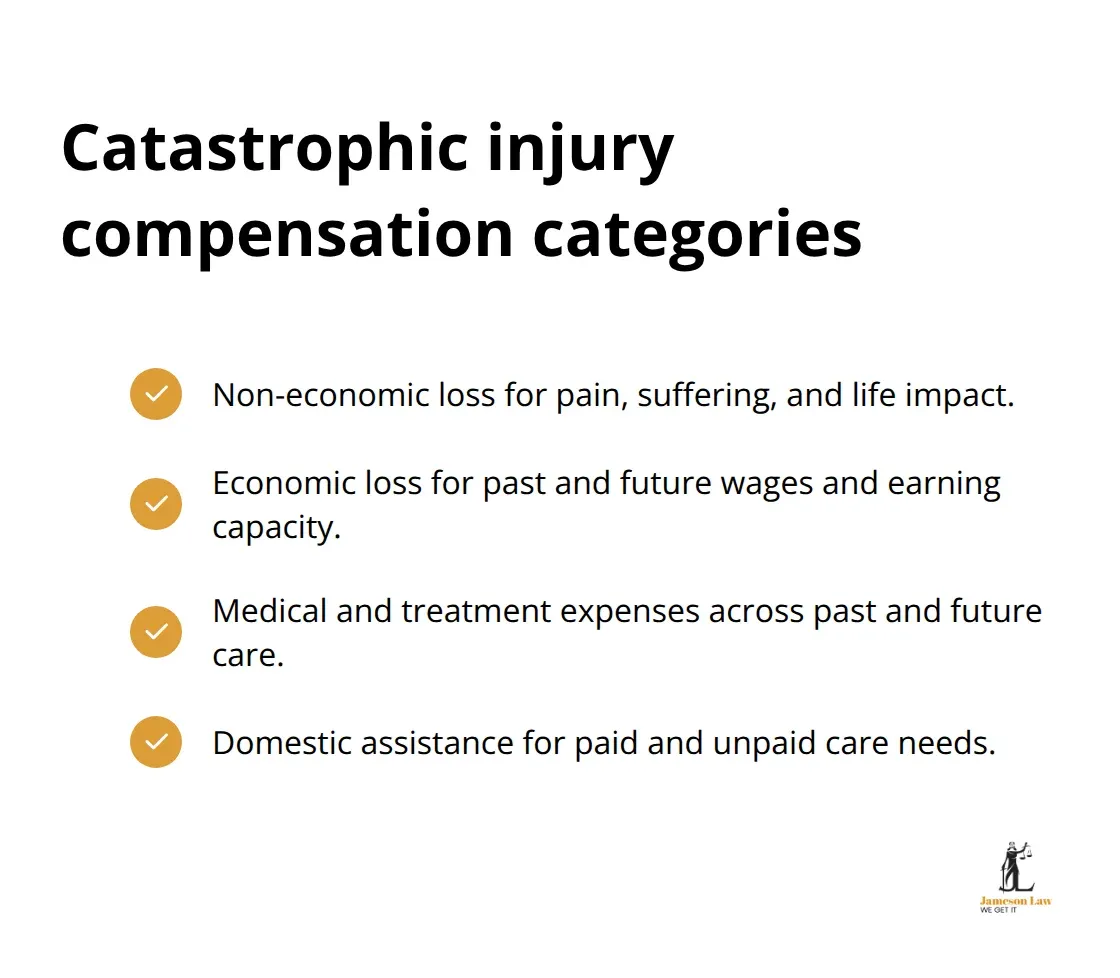
Australian law recognises four distinct compensation categories for catastrophic injuries, and understanding how each applies to your situation determines the total amount you can claim.
Non-Economic Loss: Pain, Suffering, and Life Impact
Non-economic loss covers pain, suffering, loss of life enjoyment, and psychological impacts from your injury. Under the Civil Liability Act 2002 (NSW), you can only recover non-economic loss if your injury reaches at least 15% of a most extreme case threshold-most catastrophic injuries easily satisfy this requirement. Courts assess non-economic loss by considering ongoing pain levels, reduced capacity for daily activities, psychological trauma, and expected future deterioration. The court expresses this as a proportion of a statutory maximum figure, meaning severe brain injuries or spinal cord damage typically attract substantial awards in this category.
Economic Loss: Wages and Earning Capacity
Economic loss captures past and future lost wages, reduced earning capacity, and the financial cost of your injury. If you earned $80,000 annually before your catastrophic injury and can only earn $20,000 afterwards, courts calculate the difference across your remaining working life using actuarial evidence and a discount rate prescribed under Section 14 of the Civil Liability Act 2002 (NSW). This category often dominates catastrophic injury claims because the financial gap compounds over decades.
Medical and Treatment Expenses
Medical and treatment expenses form the third category, including hospital care, surgery, physiotherapy, rehabilitation, prescriptions, and medical equipment. Catastrophic injuries frequently require ongoing treatment spanning years, so you can claim both past expenses and future medical costs supported by medical evidence.
Domestic Assistance: Paid and Unpaid Care
Domestic assistance represents the fourth category, covering both unpaid help from family members and paid care services. You can only recover gratuitous care if there’s a reasonable need caused solely by your injury and it would not have been provided otherwise under Civil Liability Act 2002 (NSW) Section 15. Paid domestic assistance requires invoices or receipts documenting cleaning, personal care, gardening, or home maintenance services.
What Your Claim Could Reach
Queensland court data shows that when catastrophic injury cases proceed to judgement, median damages across all categories reach approximately $482,697 for workplace claims and substantially higher for cases involving permanent cognitive or physical disability. NSW legislation does not impose a single damages cap across all categories, but non-economic loss operates within a statutory maximum framework, while economic loss faces restrictions based on your actual earning capacity and age. The distinction matters significantly: accepting a statutory workers compensation lump sum can prevent you from pursuing a larger common law claim later, so obtaining legal advice before settlement protects your financial recovery. Catastrophic injuries create complex damage calculations requiring specialist medical evidence, employment history documentation, and actuarial projections. The evidence you gather now determines which compensation categories apply to your specific injury and shapes the total recovery you can achieve across all applicable categories.
What Determines Your Compensation Amount
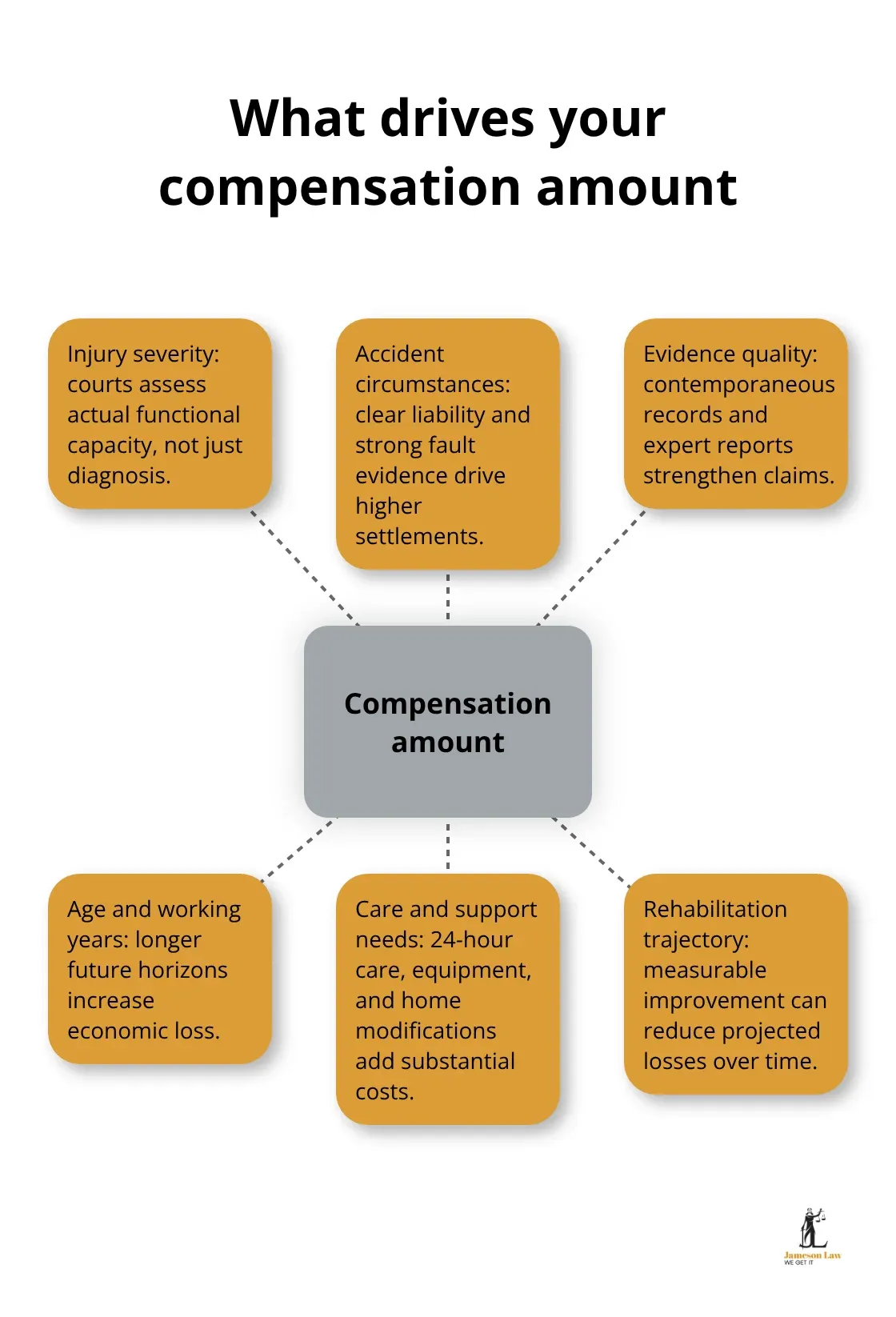
Compensation for catastrophic injury varies dramatically between claims because courts assess each case individually based on injury severity, accident circumstances, and the strength of evidence supporting liability. A catastrophic spinal cord injury claim might reach $500,000 or $2 million depending on whether you were 25 years old with 40 working years ahead or 55 years old nearing retirement. The accident circumstances matter equally-a workplace injury with clear employer negligence proceeds differently than a motor vehicle claim where fault is disputed, and this affects both your timeline and final payout. Evidence quality determines whether courts accept your medical claims, earning capacity projections, and future care costs, which means collecting the right documentation now substantially increases what you’ll ultimately recover.
How Injury Severity Shapes Your Claim Value
Injury severity extends far beyond the initial diagnosis because courts examine your actual functional capacity post-injury rather than just medical classifications. Queensland court data from 2020–2026 shows brain injury median awards of $1,062,351, but this figure masks enormous variation-some brain injuries settle for $200,000 while others reach $3 million depending on whether cognitive deficits prevent any return to work or merely reduce earning capacity. A spinal cord injury at T12 (thoracic) affecting only leg function creates vastly different earning prospects than a C5 (cervical) injury affecting arms and legs, yet both fall under catastrophic classification. Courts focus on whether you’ll need 24-hour care assistance, whether you can work from home, whether you’ll require ongoing neuropsychological treatment or mobility equipment-these practical factors drive compensation far more than the injury level itself.
Medical evidence must document your actual functional capacity at 6 months, 12 months, and 24 months post-injury because improvement during rehabilitation directly reduces future care costs and increases your return-to-work prospects, which lowers your total compensation claim. If your brain injury shows cognitive improvement over 18 months, courts will reduce future economic loss calculations, so you need specialist reassessment at regular intervals rather than relying on initial assessments completed in the acute phase.
How Accident Circumstances Influence Your Settlement
Accident circumstances shape liability strength and influence both settlement negotiations and trial outcomes significantly. A workplace catastrophic injury with clear breach of safety legislation, witness statements, and documented prior hazard reports creates overwhelming liability evidence, whereas a motor vehicle crash with disputed fault requires accident reconstruction evidence, police reports, and potentially expert engineering analysis to establish negligence. Liability strength affects settlement offers directly-insurers facing certain liability offer higher settlements to avoid trial costs and adverse publicity, whereas disputed liability claims often settle for 30–50% less because defendants maintain stronger negotiating positions.
The circumstances also determine which compensation scheme applies: a workplace injury falls under workers compensation legislation with statutory lump sums plus common law rights, a motor vehicle crash involves compulsory third party insurance with different payout structures, and a public liability incident triggers different assessment criteria entirely. You cannot proceed with economic loss calculations until liability is established, which means weak liability evidence forces you into settlement discussions before full medical evidence is collected, often resulting in substantially lower final payouts. Photograph the accident scene, weather conditions, lighting, and hazards immediately-this documentation strengthens your liability position and directly increases settlement negotiations.
What Evidence You Need to Prove Negligence
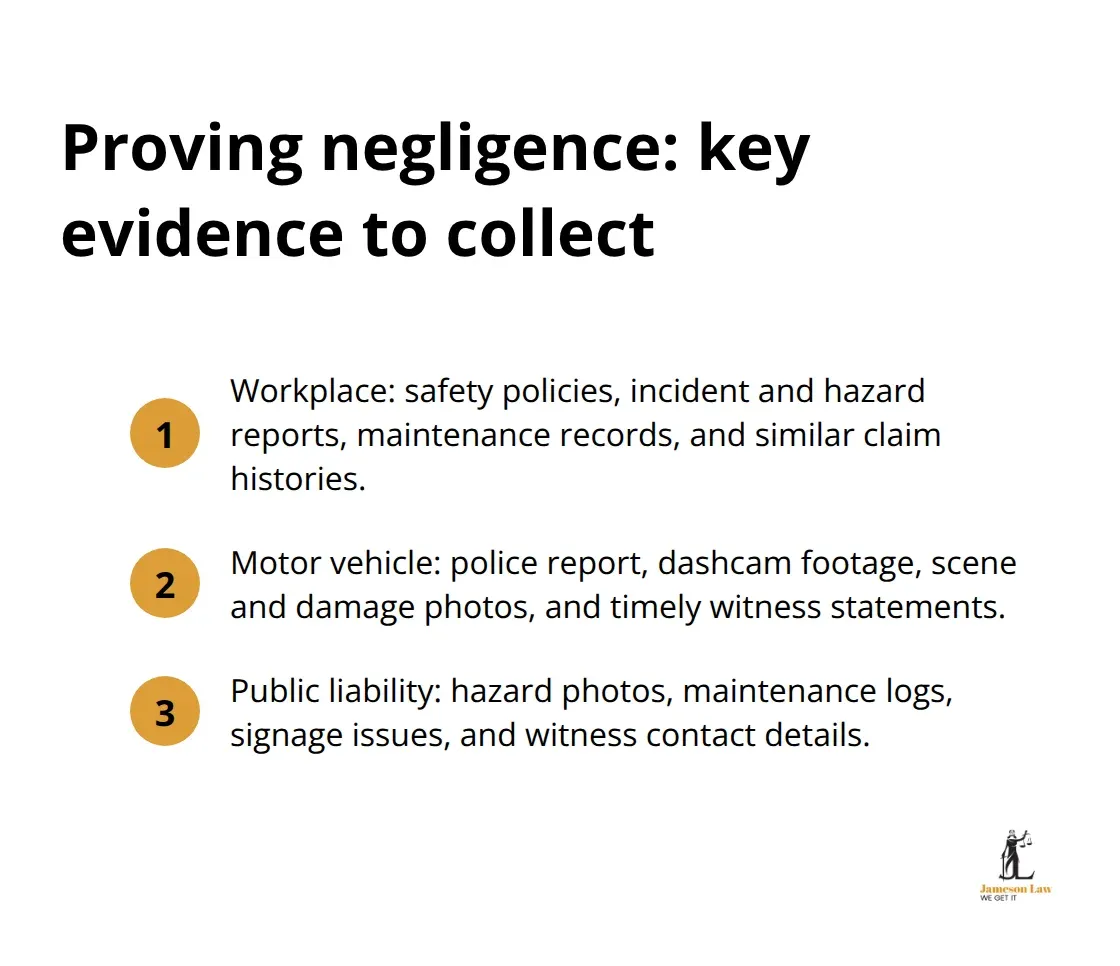
Evidence of negligence and liability requires specific documentation that most claimants overlook until months after injury. For workplace injuries, obtain copies of safety policies, incident reports, prior hazard reports, maintenance records, and any worker compensation claims for similar incidents at the same location-this evidence demonstrates whether the employer knew about the hazard and failed to control it. For motor vehicle claims, request the police accident report, obtain dashcam footage if available, photograph vehicle damage and scene conditions, and collect witness statements in writing within days of the accident while memory remains fresh.
For public liability claims, document the exact condition causing injury (wet floor, broken equipment, inadequate signage), photograph the hazard, obtain maintenance records showing whether the property owner knew about the condition, and collect witness contact details immediately. Courts assess negligence by examining whether a reasonable person in the defendant’s position would have foreseen the risk and taken steps to prevent injury-strong evidence showing the defendant knew about the hazard, had time to fix it, and failed to do so creates powerful negligence arguments. Medical evidence alone cannot establish negligence; you need documentary evidence showing the defendant’s knowledge, failure to act, and causal connection between that failure and your injury. Obtain legal advice within weeks of injury rather than months later, because early legal involvement preserves evidence, secures witness statements while memory remains fresh, and prevents defendants from destroying documentation or reconstructing accident scenes.
Final Thoughts
Catastrophic injury compensation covers four distinct categories: non-economic loss for pain and suffering, economic loss for lost wages and reduced earning capacity, medical and treatment expenses, and domestic assistance costs. Queensland court data shows median damages reaching $482,697 for workplace claims, with brain injury cases averaging $1,062,351 since 2020. Your actual recovery depends entirely on injury severity, accident circumstances, and the strength of evidence supporting negligence-a 25-year-old with 40 working years ahead will recover substantially more than a 55-year-old nearing retirement, even with identical injuries.
Legal representation fundamentally changes your outcome because lawyers understand which evidence strengthens your claim, which medical specialists you need, and how to calculate future earning capacity accurately. Courts assess negligence by examining whether the defendant knew about the hazard, had time to fix it, and failed to act-documentary evidence proving this knowledge creates powerful arguments that increase settlement offers significantly. Accepting a statutory workers compensation lump sum prevents you from pursuing larger common law claims later, which means obtaining legal advice before settlement protects your financial recovery.
We at Jameson Law provide personal injury assistance on a no win no fee basis for plaintiff claims, meaning you pay nothing unless we recover compensation for you. Contact us within weeks of your catastrophic injury rather than months later, because early legal involvement preserves evidence, secures witness statements while memory remains fresh, and prevents defendants from destroying documentation. Your next step is obtaining specialist legal advice that examines your specific injury, accident circumstances, and evidence strength to determine which compensation categories apply and what your claim could realistically recover.