


Breaking and entering charges carry serious consequences in NSW. A conviction can result in imprisonment, fines, and a permanent criminal record that affects employment and housing prospects.
At Jameson Law, we’ve helped many clients navigate these complex charges. Understanding your legal position and rights from the start makes a real difference in how your case unfolds.
What Constitutes Breaking and Entering in NSW
Legal Definition Under NSW Legislation
Breaking and entering under NSW law is defined in the Crimes Act 1900 (NSW) and involves two distinct actions: breaking a seal or barrier and entering a premises with intent to commit an offence or actually committing an offence inside. The prosecution must prove four elements beyond reasonable doubt to secure a conviction. First, you broke something-this could be a lock, window, door, or any physical barrier. Second, you gained access through that break. Third, you entered the premises. Fourth, you either stole property or committed a serious indictable offence inside, or entered with intent to do so.
A serious indictable offence is any crime carrying a maximum penalty of five years imprisonment or more. This category includes assault, sexual assault, and larceny. If the prosecution fails to prove any single element, the charge should result in a not guilty verdict.
Elements the Prosecution Must Prove
The prosecution carries the burden of proof throughout your case. They must establish each of the four elements beyond reasonable doubt. A criminal defence lawyer can identify weaknesses in the prosecution’s case and challenge each element at trial. The NSW Bureau of Crime Statistics and Research shows residential burglary remains a common property crime, often involving multiple offenders, and youth offenders constitute a significant proportion of charges, particularly in regional NSW.
Early legal advice matters because it allows you to understand the specific evidence the prosecution holds against you. Your lawyer can then prepare a targeted response to each element they attempt to prove.
Difference Between Breaking and Entering and Other Property Crimes
Breaking and entering differs fundamentally from other property crimes like simple theft or larceny. With theft, you take someone’s property without breaking into a premises-you might shoplift or steal from an unlocked vehicle. Breaking and entering specifically targets the act of forcibly gaining access to a building with criminal intent.
Aggravated break and enter under section 112(2) carries up to 20 years imprisonment when aggravating factors exist, such as being armed with a weapon, acting with others, using or threatening violence, knowing someone is present inside, or damaging property during the offence. Specially aggravated break and enter under section 112(3) carries up to 25 years when grievous bodily harm occurs or you are armed with a dangerous weapon.
NSW courts treat residential break-ins as extraordinarily serious. They consider whether occupants were present, whether violence or threats occurred, the psychological impact on victims, and whether the offence was planned or organised. This severity means most cases proceed to the District Court rather than Local Court, and the risk of imprisonment is very high, especially with aggravating circumstances present. Understanding how courts assess your specific circumstances is essential before you respond to charges.
Penalties and Sentencing for Breaking and Entering
Maximum Penalties Under NSW Law
Breaking and entering in NSW operates under a tiered sentencing structure that escalates with aggravating circumstances. Basic breaking and entering carries a maximum of 14 years imprisonment under section 112(1) of the Crimes Act 1900 (NSW). Aggravated offences under section 112(2) reach 20 years when factors like weapon possession, acting with others, violence or threats, knowing someone is present, or property damage occur during the break-in. Specially aggravated offences under section 112(3) reach 25 years when grievous bodily harm is intentionally inflicted or you are armed with a dangerous weapon. The specific maximum applies based on which category your conduct falls into, and courts in NSW District Court regularly impose custodial sentences in the mid-to-upper range for residential offences. Your actual sentence will sit somewhere below these maximums, determined by a range of factors the judge considers at sentencing.
What Sentencing Judges Actually Consider
NSW District Court judges apply consistent principles when sentencing breaking and entering offences. They assess the seriousness of what occurred inside the premises-theft of high-value items, violent assault, or sexual offences all push sentences higher. The presence of occupants during the break-in significantly increases severity because courts view this as creating greater risk and psychological harm. Whether the offence was opportunistic or carefully planned matters considerably; organised break-ins attract harsher penalties than spontaneous ones. The judge also examines your personal circumstances, including your age, employment history, family responsibilities, and whether you demonstrate genuine remorse. Prior criminal history functions as an aggravating factor that almost invariably increases the sentence imposed. Courts also consider whether you cooperated with police, pleaded guilty early, or contested charges at trial. An early guilty plea can attract a significant discount on the sentence that would otherwise apply, providing a tangible incentive to resolve matters quickly rather than proceeding to trial.
How Your Criminal Record Affects Sentencing
Your prior convictions directly influence how a judge approaches sentencing for breaking and entering. A first-time offender with no criminal history might receive a community corrections order or intensive corrections order for basic breaking and entering, whereas someone with prior property crime convictions faces a genuine prospect of full-time imprisonment. NSW courts treat repeat offenders as presenting a higher risk of reoffending, and judges explicitly consider this when setting sentences. If you have prior break-in convictions, the court views you as someone who has not been deterred by previous punishment, which justifies longer custodial terms. Conversely, if your criminal history involves unrelated offences like traffic matters or minor assault, courts may view this less seriously than prior property crimes. The time elapsed since your last conviction also matters-a conviction from 15 years ago carries less weight than one from two years ago. If you are currently facing charges and have any prior criminal history, securing legal advice early allows your lawyer to contextualise your background in the most favourable way possible and identify any factors that might mitigate the court’s assessment of your culpability.
Sentencing Options Beyond Full-Time Prison
Courts in NSW have several sentencing options available beyond full-time imprisonment. An Intensive Corrections Order (ICO) allows you to serve your sentence in the community under strict conditions, including electronic monitoring and regular reporting. A Community Corrections Order (CCO) imposes conditions such as community service, supervision, or treatment programs without imprisonment. A Conditional Release Order (CRO) releases you on conditions without a conviction being recorded, though this option applies only in limited circumstances. Section 10A of the Crimes Act provides a non-conviction option in some cases, which can significantly reduce the impact on your employment and travel prospects.
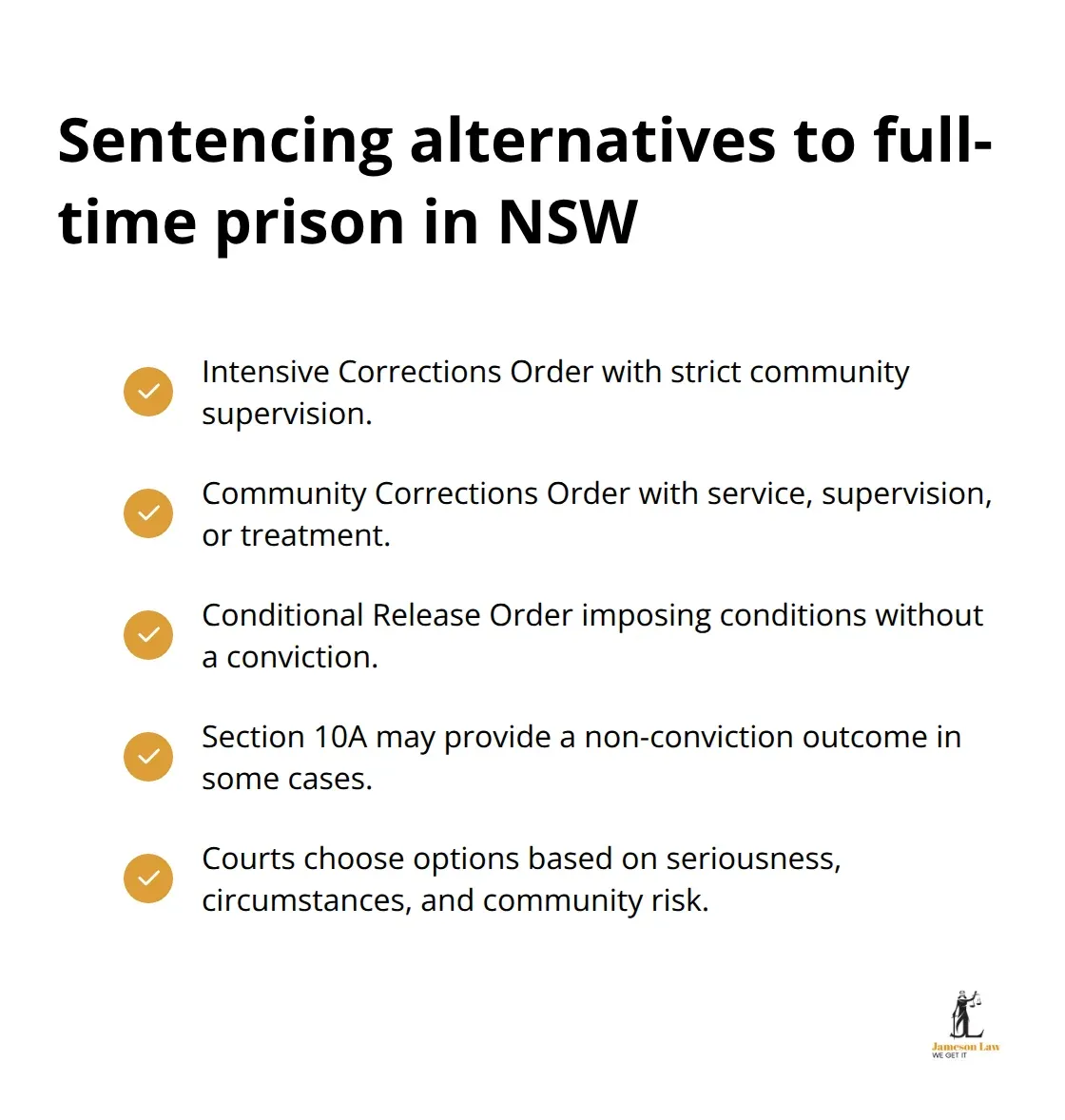
The judge’s choice among these options depends on your circumstances, the seriousness of the offence, and whether you pose a risk to the community. Understanding which sentencing pathway applies to your specific situation requires detailed legal analysis of your case.
Moving Forward With Your Defence
The sentencing framework matters because it shows you what courts actually impose in real cases, not just the theoretical maximums. Your defence strategy should account for how judges assess your particular circumstances and what factors might reduce your sentence if a conviction occurs. Early legal advice allows your lawyer to identify which aggravating factors the prosecution will emphasise and which mitigating factors might work in your favour. This preparation becomes essential when you face the decision of whether to plead guilty and potentially access a sentence discount or contest the charges at trial.
Defending Breaking and Entering Charges
The moment police charge you with breaking and entering, your response determines everything that follows. Most people make critical mistakes in this period because they do not understand their actual rights or how the legal process works. We see clients who have already damaged their cases by speaking to police without legal representation, consenting to searches, or providing statements they later regret. Your first decision must be to contact a criminal defence lawyer before answering any questions or providing any information to authorities. This single step protects your position and prevents you from inadvertently strengthening the prosecution’s case against you.
Understanding the Four Elements of Your Defence
Breaking and entering charges require the Crown to prove beyond reasonable doubt that you had no lawful authority to enter the premises. A competent defence strategy attacks one or more of these elements rather than accepting the prosecution’s version of events. You might contest whether you actually broke anything-perhaps the door was already open or you had permission to enter. You might challenge whether you gained access through the break you allegedly made. You might dispute whether you actually entered the premises or whether you committed the offence the prosecution alleges occurred inside.
Each element represents a potential weakness in the prosecution’s case, and your lawyer’s job is to identify which weaknesses exist in your specific circumstances and exploit them at trial. If the prosecution cannot prove every single element beyond reasonable doubt, the charge fails and you walk free. This happens regularly when defence lawyers properly scrutinise the evidence. When you plead not guilty, your case proceeds to trial before a judge and jury in the District Court, and the jury must unanimously agree on guilt. The prosecution carries the entire burden of proof throughout this process, not you.
How to Respond to Police Questioning
Police questioning presents an immediate danger to your defence because anything you say can and will be used against you at trial. Many people believe cooperating with police helps their situation, but this assumption is fundamentally wrong. Remaining silent is not an admission of guilt-it is a legal right that protects you. When police arrest you or detain you for questioning, you have the right to remain silent and the right to legal representation. Exercise both rights immediately.
Tell police you wish to speak with a lawyer before answering any questions. Do not explain yourself, do not try to clear things up, and do not attempt to convince police of your innocence. These conversations only provide the prosecution with ammunition. Police are trained interrogators who use sophisticated techniques to extract admissions and inconsistencies from suspects, and they will use anything you say to strengthen their case. If you have already spoken to police without a lawyer present, do not speak to them again without legal representation. Your lawyer can then advise you on the damage that has occurred and what steps to take next.
Navigating Early Guilty Plea Pressure
The Early Appropriate Guilty Plea scheme in NSW creates pressure to plead guilty quickly, but this pressure should never push you into pleading guilty before you have fully understood the prosecution’s case and explored whether defences exist. Early guilty pleas attract sentence discounts of up to 25 per cent according to NSW sentencing principles, but this discount only benefits you if guilt actually applies to your circumstances. Pleading guilty to a charge you might have defeated at trial represents the worst possible outcome.
Securing Legal Representation at the Right Time
Timing matters enormously in breaking and entering cases. Lawyers who engage early in the process can obtain police statements, examine the evidence the prosecution holds, and identify defences before you make irreversible decisions. If you wait until trial is imminent, your options narrow significantly and your lawyer has less time to prepare a proper defence. Early legal advice also allows your lawyer to negotiate with the prosecution from a position of knowledge. Sometimes the prosecution’s case contains weaknesses that warrant offering a reduced charge or discontinuance. Sometimes the evidence is so strong that pleading guilty early and accessing the sentence discount represents your best available outcome. Your lawyer can only make these assessments if they have time to examine the full brief of evidence.
Police will contact you for interview, and you must have legal representation before that interview occurs. If you cannot afford a lawyer, you may qualify for legal aid through Legal Aid NSW, which provides representation to eligible individuals facing serious charges like breaking and entering. Contact Legal Aid NSW immediately to apply. Do not delay this process thinking you will handle the matter yourself or hoping the charges disappear. They will not disappear, and self-representation in breaking and entering cases almost always produces worse outcomes than proper legal representation.
Final Thoughts
Breaking and entering charges in NSW carry severe penalties that extend far beyond any prison sentence you might serve. A criminal record affects employment prospects, housing applications, and overseas travel for years after your case concludes, making your immediate response to these charges absolutely critical. The prosecution must prove every element of their case beyond reasonable doubt, and your defence strategy should identify weaknesses in their evidence and challenge each element they attempt to establish.
Your first step must be contacting a criminal defence lawyer before police interview you or before you make any statements. This single decision protects your rights and prevents you from inadvertently damaging your case (if you cannot afford private representation, apply immediately to Legal Aid NSW for assistance). Breaking and entering cases require detailed knowledge of NSW criminal law, evidence procedures, and sentencing principles that only experienced lawyers possess.
We at Jameson Law have extensive experience defending clients facing breaking and entering charges and understand how judges approach sentencing in real cases. Contact Jameson Law today to arrange a confidential consultation with a criminal defence lawyer who can assess your specific circumstances and explain your rights.