


Workplace injury claims fail more often than many workers realise. Missing deadlines, poor documentation, and procedural mistakes can derail legitimate claims before they gain traction.
At Jameson Law, we’ve seen how preventable errors cost injured workers thousands in lost compensation. This guide shows you exactly what goes wrong and how to protect your claim from the start.
Why Claims Get Rejected Before They Start
The 14-Day Decision Window
The insurance company issues its decision to accept or reject your claim within 14 days of receiving it. This tight timeframe means errors made in the weeks before lodgement can sink your claim before assessment even begins. Three patterns consistently lead to rejections, and all of them are preventable.
Insufficient Documentation and the Evidence Problem
When you lack medical records showing the injury happened at work, the insurer has no evidence to accept liability. A doctor’s report that fails to mention your workplace or the specific incident leaves the insurer with reasonable doubt about the connection between your job duties and the harm you suffered.
Your First Certificate of Capacity matters more than many workers realise. This document establishes your work capacity immediately after injury and must be in hand before your employer lodges the claim. Without it, you lose critical evidence about your condition at the time of injury. Your employer must lodge the claim within 6 months of the injury date under the Workers Compensation and Injury Management Act 2023. If they delay, the insurer may refuse late claims, and penalties apply to your employer.
Procedural Deadlines and Reporting Failures
Failure to report the injury promptly creates a credibility problem with the insurer. If you tell your employer about an injury weeks later, they question whether it actually happened at work or whether you’re connecting it to a pre-existing condition. Immediate reporting, ideally in writing and documented in your employer’s injury register, establishes that the incident occurred and was serious enough to warrant attention at the time.
The Real Cost of Mistakes
A deferred decision, where the insurer asks for more information, can delay your income compensation for months. If you miss the deadline to provide requested documents, your claim can be deemed abandoned. Workers lose weeks or months of wages while disputes drag on, and medical expenses pile up without compensation.
The solution requires action on multiple fronts. Seek medical treatment immediately after injury and ensure your doctor documents the workplace connection in writing. Request a First Certificate of Capacity at your first appointment. Report the injury to your employer verbally and then follow up in writing, keeping a copy for yourself. Gather evidence from the day of injury: witness names, photos of hazards, emails mentioning the incident, and any incident reports your workplace creates. Store these documents separately from your employer’s files.
If your employer delays lodging the claim, contact them in writing asking for confirmation of the lodgement date and the insurer’s name. This creates accountability and a paper trail. Most rejections happen because workers treat the claim process as a formality rather than a legal proceeding that requires evidence and precision. The 14-day acceptance window is not flexible, and insurers have no incentive to give you the benefit of the doubt when documentation is weak.
Understanding what happens after lodgement-and how insurers assess your evidence-reveals why the groundwork you lay before submission determines your outcome.
Building a Stronger Claim from Day One
Medical Records Form Your Foundation
Medical records are the foundation of everything. The insurer won’t accept your claim without clear evidence that your injury happened at work, and a doctor’s report that fails to connect your symptoms to your workplace incident hands the insurer a reason to reject you outright. When you see a doctor after an injury, tell them explicitly how the incident occurred and what you were doing when it happened. Ask them to write this detail into their notes and their report.
Your First Certificate of Capacity serves as official documentation of your work capacity at that moment, and it must accompany your claim when your employer lodges it. If your doctor doesn’t mention the workplace connection, ask them to add it before you leave. Many rejections stem from vague medical records that leave the insurer uncertain whether your injury is work-related or pre-existing. A specific, detailed report eliminates that doubt entirely.
Organise Your Medical Documentation
Keep copies of every medical report, scan result, specialist letter, and prescription record. Store these separately from your employer’s files so you have them if disputes arise later. This separation protects you if your employer loses documents or if the insurer questions what evidence you submitted. A well-organised medical file means you can respond quickly when the insurer asks for clarification or additional information.
Written Communication Creates Your Paper Trail
Your written communications with your employer matter far more than verbal conversations. Tell your employer about the injury verbally first, but follow it up with an email or written note within 24 hours, stating the date, time, location, and nature of the incident. An employer must report an injury to their insurer within 48 hours of becoming aware of the injury or illness, but don’t rely on them to remember.
Request written confirmation of the lodgement date and the insurer’s name once they’ve submitted it. If they delay beyond two weeks, send them a written reminder. Keep copies of all injury notifications, requests for information, and responses from your employer. Document every conversation with your employer about the injury, including dates, names of people involved, and what was discussed.
Respond to Insurer Requests on Time
When the insurer contacts you requesting additional information, respond within the timeframe they specify-missing these deadlines can result in your claim being deemed abandoned. Store all documents in a folder you control, not one your employer manages. Having organised, detailed records means you can respond fast if they ask questions (and they often do).
This paper trail protects you if your employer disputes what happened or if the insurer later questions whether you reported the injury promptly. The strength of your claim depends on evidence you gather and preserve in the weeks immediately following your injury. What happens next determines whether the insurer accepts or rejects your claim-and how you respond to that decision shapes your path forward.
Protect Your Claim Before the Insurer Decides
Understand Your Legal Entitlements
The Workers Compensation and Injury Management Act 2023 grants you specific rights, but those rights only matter if you exercise them correctly. Most injured workers fail to understand that their legal position weakens with every day of inaction after an injury occurs. You’re entitled to weekly income compensation if you cannot work, medical and health compensation for reasonable treatment expenses, and-if your injury causes permanent impairment-a lump-sum settlement. The insurer cannot refuse these benefits if your claim meets the legal requirements. What determines your outcome is whether you’ve built a record that proves it does.
Create an Undeniable Paper Trail
The moment an injury happens, your job is to create documentation that connects the incident to your workplace and your resulting harm. An email to your employer within 24 hours stating the date, time, location, and nature of the injury costs nothing but prevents the insurer from later claiming uncertainty about when they learned of it. A medical report that explicitly states you were injured at work-not a report that merely describes your symptoms-is the difference between acceptance and rejection. The insurer will scrutinise every gap in your documentation and use silence or vagueness as grounds to defer or deny your claim.
Your First Certificate of Capacity must be obtained at your first medical appointment and delivered to your employer before they lodge the claim. This document provides non-negotiable evidence of your condition immediately after injury. Medical records that lack workplace connection hand the insurer a reason to reject you outright. When you see a doctor, tell them explicitly how the incident occurred and what you were doing when it happened, then ask them to write this detail into their notes and their report.
Manage Your Own Documentation
Do not wait for your employer to manage the claim process on your behalf. Keep copies of your First Certificate of Capacity, your Claim Form, and every medical report you receive. Store these documents in your own folder, not your employer’s system. This separation protects you if your employer loses documents or if the insurer questions what evidence you submitted. A well-organised medical file means you can respond quickly when the insurer asks for clarification or additional information.
Document every conversation with your employer about the injury, including dates, names of people involved, and what was discussed. Request written confirmation of the lodgement date and the insurer’s name once they’ve submitted your claim. If they delay beyond two weeks, send them a written reminder. When the insurer requests additional information, respond within their specified timeframe-missing these deadlines gives them grounds to abandon your claim.
Take Action if Your Claim Is Rejected or Deferred
Contact WorkCover WA directly if you have questions about your rights or if your employer hasn’t lodged within 14 days of the injury. You can reach them on 1300 794 744 between 8:30am and 4:30pm.
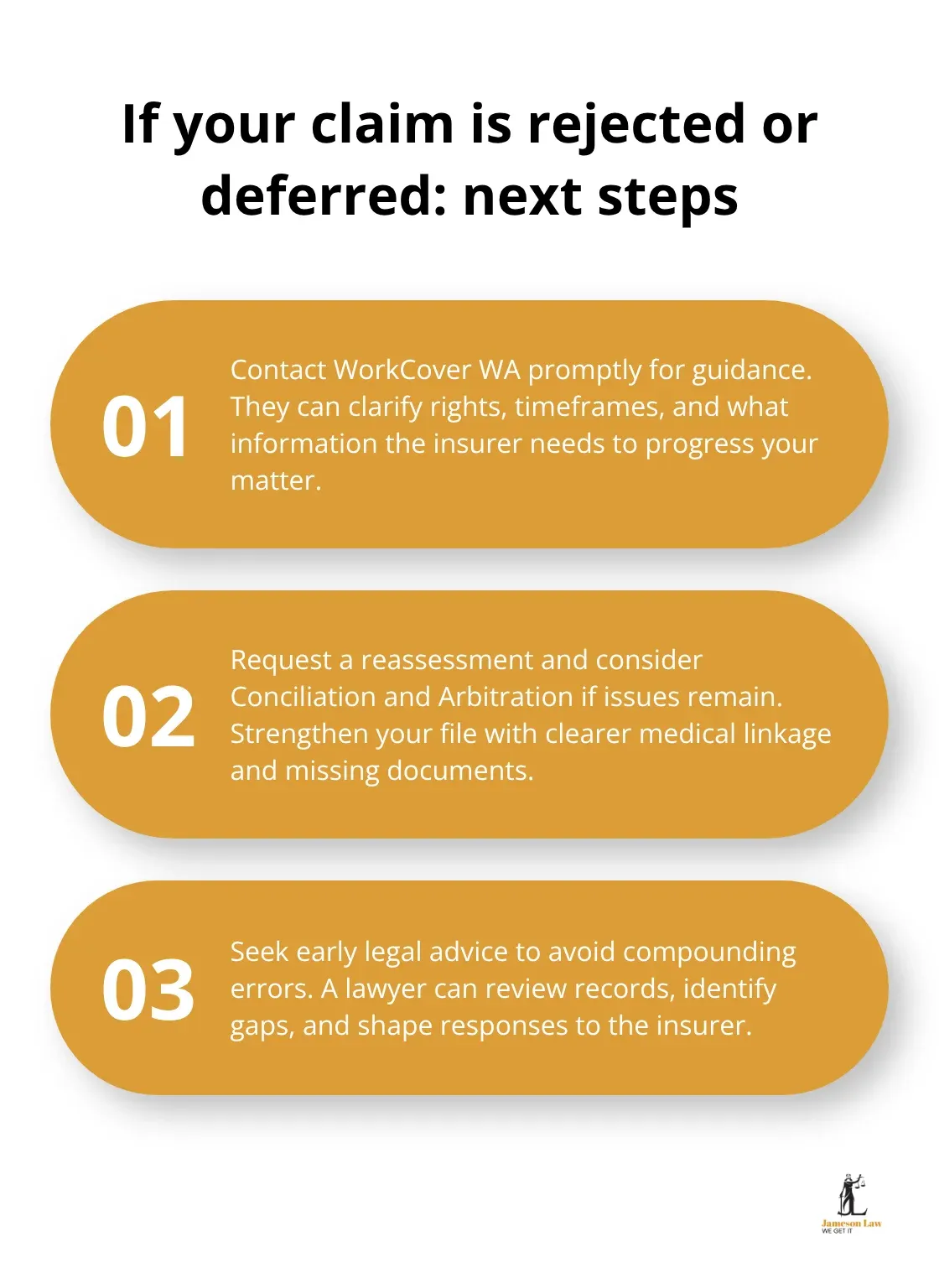
If your claim is rejected or deferred, you have the right to request a reassessment and, if necessary, lodge with Conciliation and Arbitration. Many workers assume rejection is final. It isn’t. A rejected claim can be overturned if you gather stronger evidence or correct procedural errors.
Seeking legal advice early-ideally within the first month after injury-protects you from making mistakes that become impossible to fix later. A lawyer can review your medical records, identify weaknesses in your documentation, and ensure your response to the insurer’s questions strengthens rather than weakens your position.
Final Thoughts
Workplace injury claims fail when workers treat them as administrative tasks rather than legal proceedings that demand precision and evidence. The pattern repeats itself: injured workers delay reporting, provide vague medical information, miss deadlines, and lose documentation. None of these mistakes are inevitable. Each one is preventable if you act immediately after injury.
The first 24 hours determine your outcome more than the weeks that follow. Report your injury to your employer verbally and in writing on the same day it happens, see a doctor and ensure they document the workplace connection explicitly in their notes, and request your First Certificate of Capacity at that appointment. These three actions create the foundation that determines whether your claim succeeds or fails. Your responsibility continues after lodgement: keep copies of every document your employer submits, respond to insurer requests within their specified timeframes, and store your records separately from your employer’s files so you control access to them.
If your claim is rejected or deferred, rejection is not final. You can request a reassessment and lodge with Conciliation and Arbitration if necessary, and many workers abandon legitimate claims because they assume rejection is permanent when it isn’t. Seeking legal advice early protects you from mistakes that become impossible to fix later-a lawyer can identify weaknesses in your documentation, ensure your responses to the insurer strengthen your position, and guide you through appeals if your claim is rejected. Contact Jameson Law to discuss your claim and protect your legal rights from the start.