


An Apprehended Violence Order (AVO) breach carries serious legal consequences that can affect your freedom, career, and future. At Jameson Law, we’ve seen how quickly a breach can escalate into criminal charges with penalties ranging from fines to jail time.
Understanding AVO breach consequences is essential if you’re facing allegations or want to know where you stand. This guide walks you through what happens after a breach, your legal rights, and how to protect yourself.
What Penalties Apply to Breaching an AVO
A breach of an Apprehended Violence Order in NSW is a criminal offence under section 14 of the Crimes (Domestic and Personal Violence) Act 2007, and the consequences are severe. The maximum penalty is two years imprisonment and/or a fine up to $5,500. However, what you actually face depends entirely on the circumstances of your breach and whether you have prior convictions. The court considers the seriousness of the breach, whether violence or threats occurred, your compliance history, and the impact on the protected person when deciding your sentence.
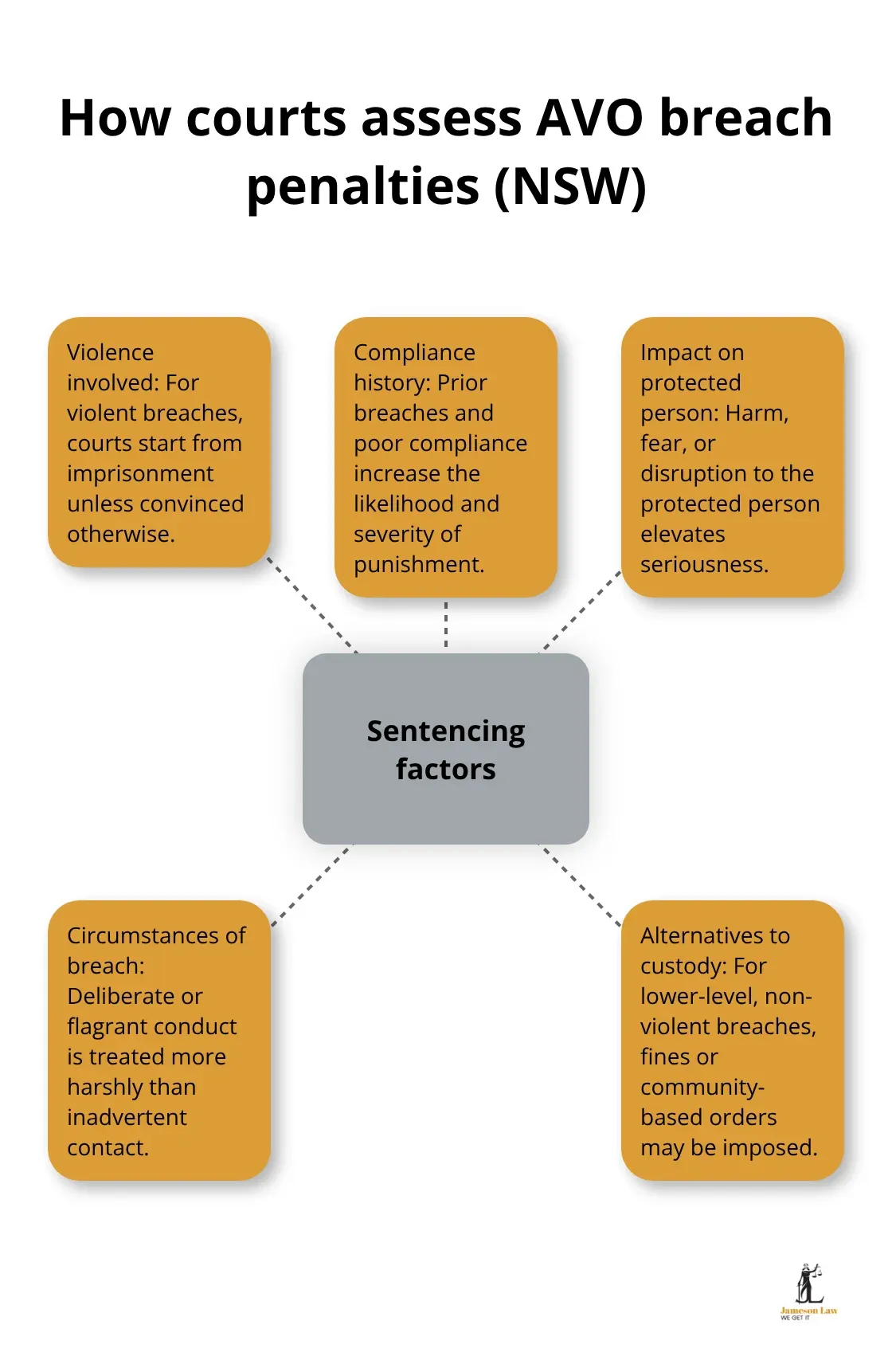
If your breach involves violence, the court’s starting point is imprisonment unless it’s convinced otherwise. For non-violent or lower-level breaches, courts may impose fines or community-based orders instead of jail time.
Criminal Records and Career Impact
The distinction between violent and non-violent breaches matters significantly because a conviction for breaching an AVO affects employment, professional licensing, visa eligibility, and career prospects. Roles requiring no criminal convictions-particularly in government, teaching, aged care, or childcare-may become unavailable after conviction. Some professional licences are revoked or suspended following a breach conviction, and even roles without formal restrictions often reject applicants with violent offence convictions.
What Happens After Police Arrest You
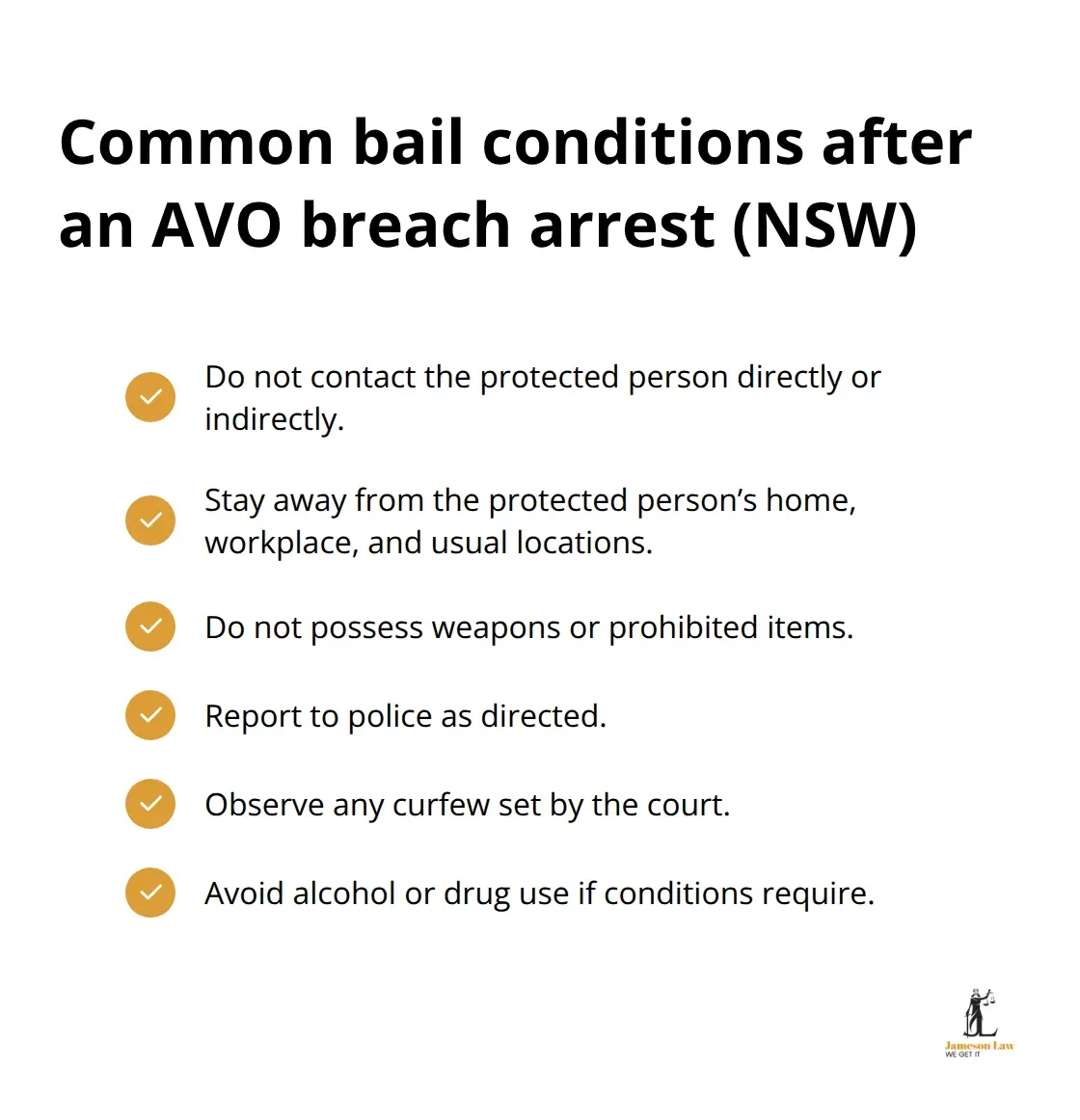
When police arrest you for breaching an AVO, they have mandatory arrest powers and can hold you until a court appearance. You must appear before the Local Court within 48 hours, where bail is decided. The prosecutor will argue for strict bail conditions or remand, while your legal representative argues for release. Many people facing breach charges receive bail with conditions such as staying away from the protected person’s home or workplace, not contacting them directly or indirectly, and not possessing weapons. Breaching bail conditions while awaiting trial creates additional criminal charges and dramatically worsens your position at sentencing.
Sentencing Outcomes for First and Repeat Breaches
The court also considers whether you’ve breached AVOs before, as repeat breaches attract harsher penalties. A first breach with no violence might result in a fine of $500 to $2,000 without conviction, but repeat breaches or those involving violence typically lead to conviction with fines of $1,000 to $5,000, community service orders of 40 to 100 hours, or immediate imprisonment of one to six months. Without legal representation, conviction rates exceed 85% because fewer defences are identified and presented effectively.
Professional Qualifications and Employment Prospects
The employment consequences extend beyond immediate job loss. A breach conviction appears on your criminal record permanently, and employers conducting background checks will see it. Many organisations now conduct police checks as standard practice, making it difficult to secure employment in regulated industries. If you hold professional qualifications-as a teacher, nurse, accountant, lawyer, or similar-your regulatory body may initiate disciplinary proceedings separate from the criminal court process. Some qualifications require you to declare convictions, and failure to do so constitutes professional misconduct. Immigration status is also affected if you’re not an Australian citizen, as a breach conviction can trigger visa cancellation or deportation proceedings.
The practical reality is that obtaining employment after a breach conviction requires significant effort, often limiting you to roles where background checks are minimal. This is why early legal intervention is critical. About 20 to 30 per cent of cases are withdrawn or dismissed with proper representation, and skilled lawyers can negotiate charge reductions or section 17 dismissals with undertakings, particularly for first offenders with good prospects. The difference between conviction and dismissal determines whether you have a criminal record at all-which is why understanding the legal process that follows your arrest matters so much for your future.
What Happens After Police Arrest You for Breaching an AVO
Arrest and Your First Court Appearance
Police hold mandatory arrest powers for AVO breaches in NSW, which means they can arrest you without a warrant and hold you until your first court appearance. Within 48 hours of arrest, you must appear before the Local Court, where a magistrate decides whether to grant bail. The prosecutor will push for strict conditions or remand in custody, arguing that you pose a risk to the protected person or that you might breach conditions again. Your legal representative argues for release, highlighting your ties to the community, employment, family responsibilities, and any lack of prior offences. The magistrate weighs both sides and makes a bail decision on the spot.
Bail Conditions You Must Follow
Common bail conditions include staying away from the protected person’s home or workplace, not contacting them directly or indirectly through any means, not possessing weapons, and reporting to police on specified dates. If you breach bail conditions while awaiting trial, the court could change your bail conditions or your bail could be revoked, which severely damages your position at sentencing. Strict compliance with every bail condition is non-negotiable from the moment you’re released.
The Court Timeline and Your Rights
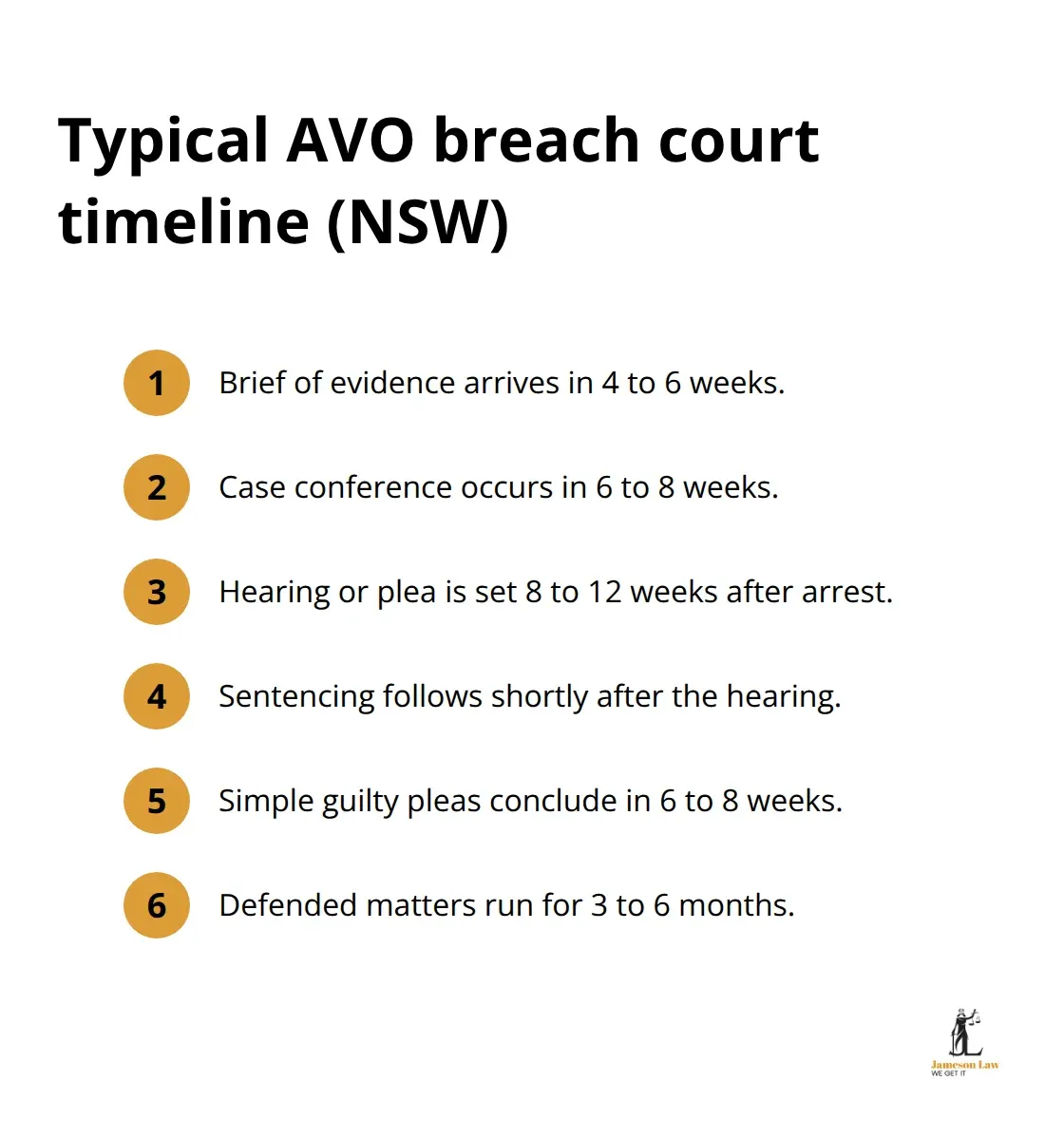
After your first court appearance, the timeline moves quickly but deliberately. The brief of evidence typically arrives within 4 to 6 weeks, followed by a case conference with the prosecutor in 6 to 8 weeks where your lawyer can negotiate charge reductions or withdrawals. A hearing or guilty plea hearing occurs around 8 to 12 weeks after arrest, with sentencing shortly after. For simple guilty pleas, the entire process takes 6 to 8 weeks; defended matters generally run 3 to 6 months.
Throughout this period, you have the right to legal representation, the right to examine prosecution witnesses, the right to present your own evidence and witnesses, and the right to silence.
Proving the Breach and Building Your Defence
The prosecution must prove the breach beyond reasonable doubt, which means they must establish that you knowingly contravened the order. If you weren’t served with the AVO or genuinely didn’t know it existed, that’s a defence worth pursuing with legal advice. Early legal intervention is critical because evidence can disappear and witness memories fade, so the sooner your lawyer gathers supporting documentation, interviews witnesses, and challenges prosecution evidence, the better your prospects. With proper legal representation, many first-time AVO breach charges result in Section 10 dismissals where no conviction is recorded.
The strength of your defence depends on how quickly you act after arrest. Your lawyer needs time to investigate the circumstances, identify weaknesses in the prosecution case, and explore whether defences apply to your situation.
How the Prosecution Proves a Breach and What Defences Actually Work
The Burden of Proof and Knowledge Requirements
The prosecution carries the burden of proving your breach beyond reasonable doubt, which is a higher standard than many people realise. To secure a conviction, they must establish that you knowingly contravened the AVO-meaning you were aware the order existed and deliberately breached it. Knowledge is established through evidence that you were served with a copy of the order or were present in court when the magistrate made it. This creates your first realistic defence: if you were never served and genuinely had no knowledge the AVO existed, the prosecution cannot prove the essential element of knowledge, and the charge should fail.
Gathering Evidence to Challenge the Prosecution Case
This defence requires solid evidence-witness statements, postal records, or documentation showing you weren’t present at the order hearing. Collecting this material immediately after arrest is vital because evidence can disappear and witness memories fade quickly. The prosecution must also prove the specific breach itself, whether that’s a contact breach through messages, a location breach by attending restricted premises, or destruction of property. If the evidence is weak-unclear timestamps, ambiguous messages, or unreliable witnesses-your lawyer can challenge it during cross-examination. Courts regularly dismiss or withdraw breach charges when prosecution evidence doesn’t meet the beyond reasonable doubt threshold, particularly when your legal representative identifies inconsistencies early and forces the prosecutor to confront weaknesses before trial.
Mitigating Factors That Reduce Penalties
Mitigating factors can reduce penalties significantly even when a breach is proven. Courts consider your compliance history before the breach, your personal circumstances, your employment situation, family responsibilities, and prospects for rehabilitation. A breach that occurs months after the AVO was issued, with no prior contraventions, carries less weight than repeat breaches. If the breach was inadvertent-you didn’t intend to breach but circumstances led to it-that matters more than deliberate, flagrant violations. The seriousness of the breach itself varies enormously: a single accidental text message differs vastly from sustained harassment or physical violence.
Building a Strong Mitigation Case
Presenting compelling mitigation requires preparation. Your lawyer needs character references from employers, family members, or community organisations; evidence of counselling or mental health treatment you’ve undertaken; documentation of stable employment or study; and any other material showing you’re not a danger to the protected person. Without legal representation, most people fail to gather this material, resulting in harsher sentences because the court sees no evidence of rehabilitation prospects. 20-30% of cases with strong defences are withdrawn or dismissed entirely with proper legal representation because skilled lawyers negotiate with prosecutors, identify genuine defences, and present mitigating factors persuasively.
The Critical Role of Early Legal Intervention
The difference between conviction and dismissal-or between prison time and a community-based order-often comes down to whether you had legal representation at the case conference stage, where prosecutors make withdrawal decisions based on the strength of evidence and your lawyer’s advocacy. Acting quickly after arrest gives your legal team the best opportunity to investigate thoroughly, challenge weak evidence, and negotiate with the prosecution before trial.
Final Thoughts
Breaching an Apprehended Violence Order carries consequences that extend far beyond the courtroom-a conviction affects your employment prospects, professional qualifications, visa status, and criminal record permanently. The penalties range from fines to imprisonment, and the court’s approach depends entirely on whether violence occurred, your compliance history, and the circumstances surrounding your breach. Understanding AVO breach consequences helps you recognise why acting quickly matters so much for your future.
If you’re facing breach allegations, your immediate priority is to act within the first 48 hours after arrest because evidence deteriorates and witness memories fade rapidly. Strict compliance with bail conditions is non-negotiable, as breaching them creates additional charges and severely damages your position at sentencing. Document everything related to your case, including dates, times, locations, and any communications that might be relevant to your defence.
The prosecution must prove your breach beyond reasonable doubt, which means genuine defences exist in many cases-you might not have been served with the AVO, you might have been unaware it existed, or the evidence against you might be weak. With proper legal representation, 20 to 30 per cent of cases are withdrawn or dismissed entirely, and your lawyer can identify weaknesses in the prosecution case, gather mitigating evidence, and negotiate with prosecutors at the case conference stage. Contact Jameson Law immediately if you’ve been arrested or charged with breaching an AVO, because the sooner you seek legal advice, the better your prospects of achieving the best possible outcome.