

Your visa is one of your most valuable assets in Australia. A single mistake-missed work obligations, incomplete financial declarations, or health issues-can trigger cancellation and derail your plans.
At Jameson Law, we’ve helped countless visa holders understand what puts their status at risk and how to protect it. This guide covers visa cancellation prevention strategies that actually work, from documentation practices to compliance requirements you need to know.
What Actually Gets Visas Cancelled
Visa cancellation happens when the Department of Home Affairs decides you’ve breached visa conditions, provided false information, or no longer meet the requirements for your visa type. The reality is that cancellation grounds fall into distinct categories, and understanding which ones apply to your visa matters enormously.
False Information and Documentation Failures
Providing incorrect or false documents during your application represents the most common trigger we see across all visa types. The Department treats false or misleading information as a serious breach, and they conduct verification checks on applications long after grant. You must submit genuine, verifiable documentation with proper certified translations when documents aren’t in English. Even unintentional errors on financial declarations or employment history can trigger cancellation if the Department views them as material misrepresentations. This ground applies regardless of your visa type, making it the single largest cancellation risk across student, skilled migration, business, and partner visas.
Condition Breaches That Lead to Cancellation
Each visa type carries specific conditions that you must follow without exception. Student visa holders face cancellation if they fail to maintain satisfactory course attendance or academic progress-their institution can cancel their Confirmation of Enrolment, which automatically jeopardises visa status. Work hour limits for students are strictly monitored, and exceeding these limits triggers cancellation action. Regional Sponsored Migration Scheme visa holders must commence employment within six months and complete two years with their sponsoring employer; failure on either count results in cancellation. Business visa holders must actually establish and operate their business as promised, not simply hold the visa without trading. Working holiday visa holders who exceed allowed work hours or breach other condition restrictions face cancellation. Partner visa holders must maintain the genuine relationship circumstances that formed the basis of their visa grant.
Character Issues and Undisclosed Changes
Character concerns rank third among cancellation grounds and include criminal convictions or associations that contradict Australia’s character requirements. The Department assesses character not just at visa grant but throughout your stay, and new criminal activity or serious associations can trigger cancellation action. You must notify the Department of significant changes to your circumstances-relationship breakdown, course changes, employment changes, or address changes-because failing to disclose these changes can itself become grounds for cancellation. Health issues discovered after grant (particularly if they weren’t disclosed in your original application) can also lead to cancellation. Financial declaration failures occur when you misrepresent your financial capacity or fail to update the Department about substantial changes to your financial circumstances.
Which Visa Types Face the Highest Risk
Student visas represent the largest cancellation cohort because attendance and academic performance requirements are strict and monitored closely by educational institutions. Regional Sponsored Migration Scheme visas face high cancellation rates when visa holders don’t commence employment within the required timeframe or fail to complete two years with their sponsoring employer. Business and investor visas carry substantial risk because the Department conducts compliance checks to verify you’re genuinely operating the business you promised. Skilled migration visas can be cancelled if circumstances change so fundamentally that you no longer meet the points or requirements you held at grant. Working holiday visas, whilst often shorter-term, get cancelled when holders exceed allowed work hours or breach condition restrictions. Partner visas face cancellation if the relationship circumstances change or if either partner provides false information about the relationship’s authenticity.
Understanding Your Specific Cancellation Risk
The consequences of visa cancellation extend far beyond losing your legal status in Australia. You become an unlawful non-citizen the moment cancellation takes effect, which means detention and removal become possible unless you obtain another valid visa, pursue a review, or depart voluntarily within 28 days. A three-year entry ban typically follows cancellation, which blocks future visa applications and can affect your ability to return to Australia for years after the ban expires.
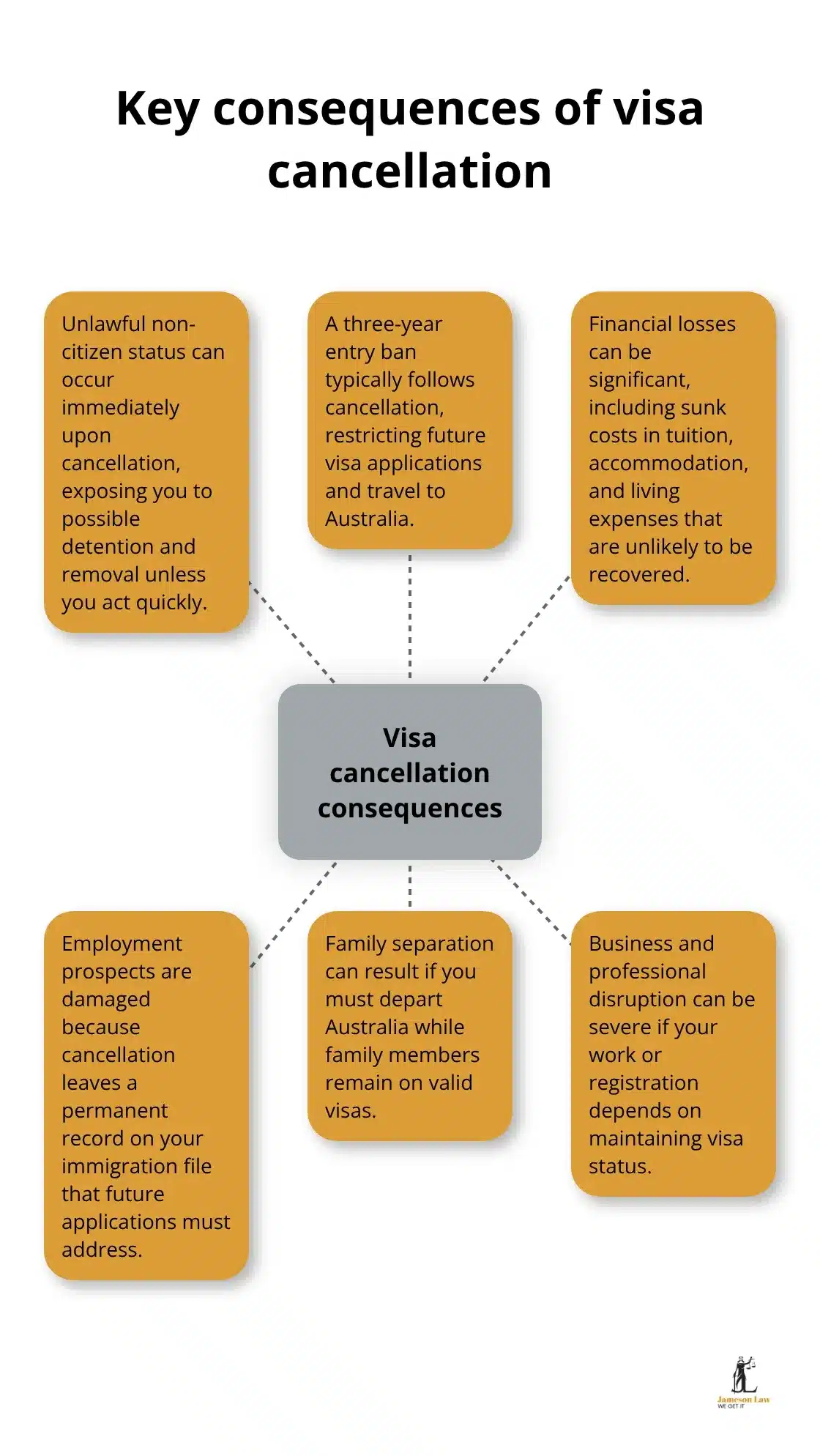
Your financial investment in tuition, accommodation, and living costs disappears if you’re studying. Employment prospects suffer because cancellation creates a permanent record on your immigration file that affects all future applications. Family separation occurs if your visa cancellation means you must leave Australia whilst family members remain. Professional and business disruption can be catastrophic if you’re operating a business or holding professional registration that depends on visa status.
Understanding which grounds apply to your specific visa type allows you to focus your compliance efforts where they matter most. The next section outlines the key compliance requirements that actually prevent cancellation action.
How to Stay Compliant With Your Visa Conditions
Compliance is not negotiable, and the Department of Home Affairs conducts verification checks continuously throughout your visa period. The difference between visa holders who maintain their status and those who face cancellation comes down to one factor: consistent adherence to every condition attached to your visa. This section outlines the specific compliance obligations you must meet, depending on your visa type, and the documentation practices that protect you when the Department requests evidence of your compliance.
Work and Study Obligations That Matter
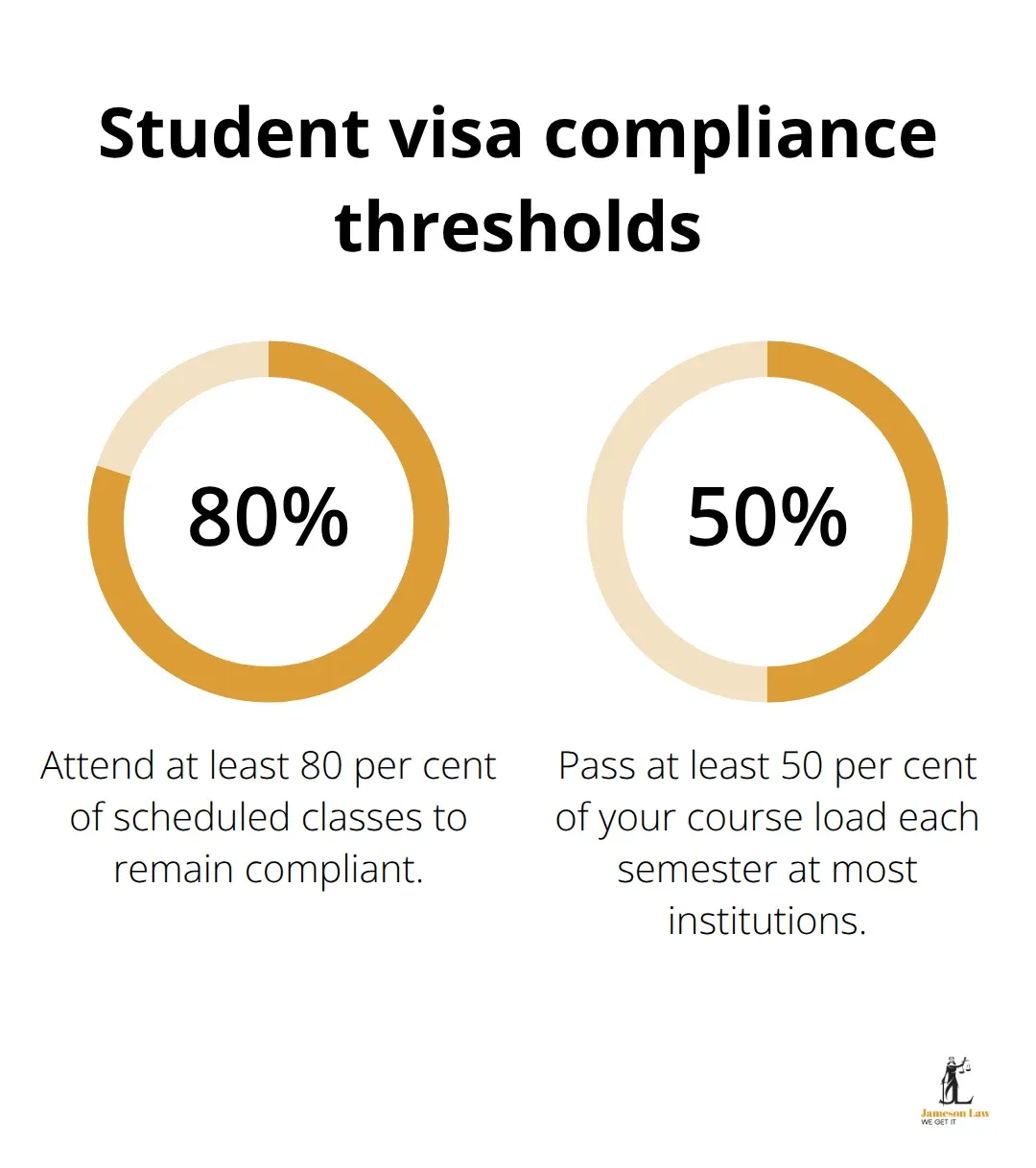
Student visa holders must maintain full-time enrolment in an approved course and satisfy satisfactory course attendance and academic progress requirements. Your institution monitors these metrics closely and reports failures directly to the Department through your Confirmation of Enrolment. Course attendance failures remain the leading cause of student visa cancellations. You must attend at least 80 per cent of your scheduled classes unless your institution grants formal exemption, and you cannot assume that missing classes will go unnoticed. Academic progress expectations vary by institution, but most require you to pass at least 50 per cent of your course load each semester.
Work hour restrictions limit international students to 20 hours per week during the academic term and full-time hours during official breaks. Many students exceed these limits without understanding that their employer and institution both report work hours to immigration authorities. Track your actual work hours weekly and cross-reference them against your employment contract to catch discrepancies before the Department does.
Regional Sponsored Migration Scheme visa holders face a different but equally strict obligation: you must commence employment with your sponsoring employer within six months of visa grant and complete a minimum of two years in that role. The Department has been explicit that employment must genuinely commence, not simply be arranged or offered. Many visa holders delay starting work thinking they have flexibility, only to discover that the six-month clock is absolute. Once employment starts, you cannot change employers or reduce your hours without triggering cancellation grounds. Keep detailed employment records (payslips, tax documents, and written confirmation from your employer of your start date and ongoing employment status) to prove continuous compliance. Business visa holders must establish and operate the business they nominated in their application within a reasonable timeframe. The Department conducts compliance checks to verify that your business is genuinely trading and generates income. Maintain comprehensive business records, tax returns, and bank statements that prove continuous operation. Working holiday visa holders must comply with work hour restrictions specific to their visa subclass and cannot engage in prohibited employment such as certain agricultural or labour hire roles.
Financial Declarations and Record-Keeping
Financial misrepresentation ranks among the top cancellation grounds, yet many visa holders fail to update their financial circumstances or provide false information about their capacity to support themselves. Partner visa holders and skilled migration visa holders must maintain financial capacity that matches their original application. If your financial situation deteriorates significantly, notify the Department rather than hoping they won’t discover the change. Organise bank statements, tax returns, and financial declarations chronologically so you can demonstrate your financial status at any point during your visa period. Student visa holders must hold sufficient funds to support their tuition and living expenses for their course duration. The Department may request evidence of financial capacity for student visas Australia, particularly if you apply for extensions or if your circumstances change. Maintain this amount in a dedicated account and avoid using these funds for purposes other than your authorised stay. If you work in Australia, declare all income to the Australian Taxation Office and provide tax returns as evidence of your financial compliance. Sponsor-dependent visa holders must ensure their sponsor maintains financial capacity to support them. If your sponsor’s financial circumstances deteriorate, contact an immigration lawyer immediately because sponsor financial failure can trigger cancellation of dependent visas.
Character Maintenance and Health Obligations
Character concerns extend beyond criminal convictions to include associations, financial irresponsibility, and failure to disclose changes to your circumstances. Avoid any criminal activity, regardless of how minor it may seem, because the Department assesses character throughout your entire visa period. A traffic infringement, drink-driving charge, or assault allegation can all trigger character-based cancellation action. Notify the Department promptly of significant personal changes: relationship breakdown, change of address, change of employment, course changes, or any legal proceedings against you. Failing to disclose these changes constitutes a separate ground for cancellation even if the underlying change itself would not trigger cancellation. Health issues discovered after your visa grant can lead to cancellation if they create unacceptable health risks to the Australian community or if you misrepresented your health status in your original application. If you develop a serious health condition during your stay, consult an immigration lawyer before reporting it to the Department because the timing and manner of disclosure affects cancellation risk. Maintain comprehensive personal records (your current address, contact details, employment information, and any legal matters affecting you) and update your address with the Department within 14 days of any move, as failure to maintain current contact details can result in cancellation notices being issued without your knowledge.
When Documentation Gaps Create Risk
The Department requests evidence of your compliance at various points during your visa period, and gaps in your documentation create immediate risk. You must produce payslips, employment contracts, course transcripts, attendance records, and financial statements on demand. Many visa holders discover too late that they lack the documentation needed to prove compliance with conditions they actually met. Maintain a dedicated folder (physical or digital) containing all documents related to your visa compliance, organised by category and date. Update this folder monthly rather than scrambling to locate documents when the Department issues a Notice of Intention to Consider Cancellation. If the Department requests information, respond within the specified timeframe with complete, accurate documentation and clear written explanations of how your circumstances align with your visa conditions. Incomplete or late responses signal non-cooperation and strengthen the Department’s case for cancellation.
The next section addresses what happens when compliance issues emerge and how to respond effectively to protect your visa status.
Protecting Your Visa When Problems Emerge
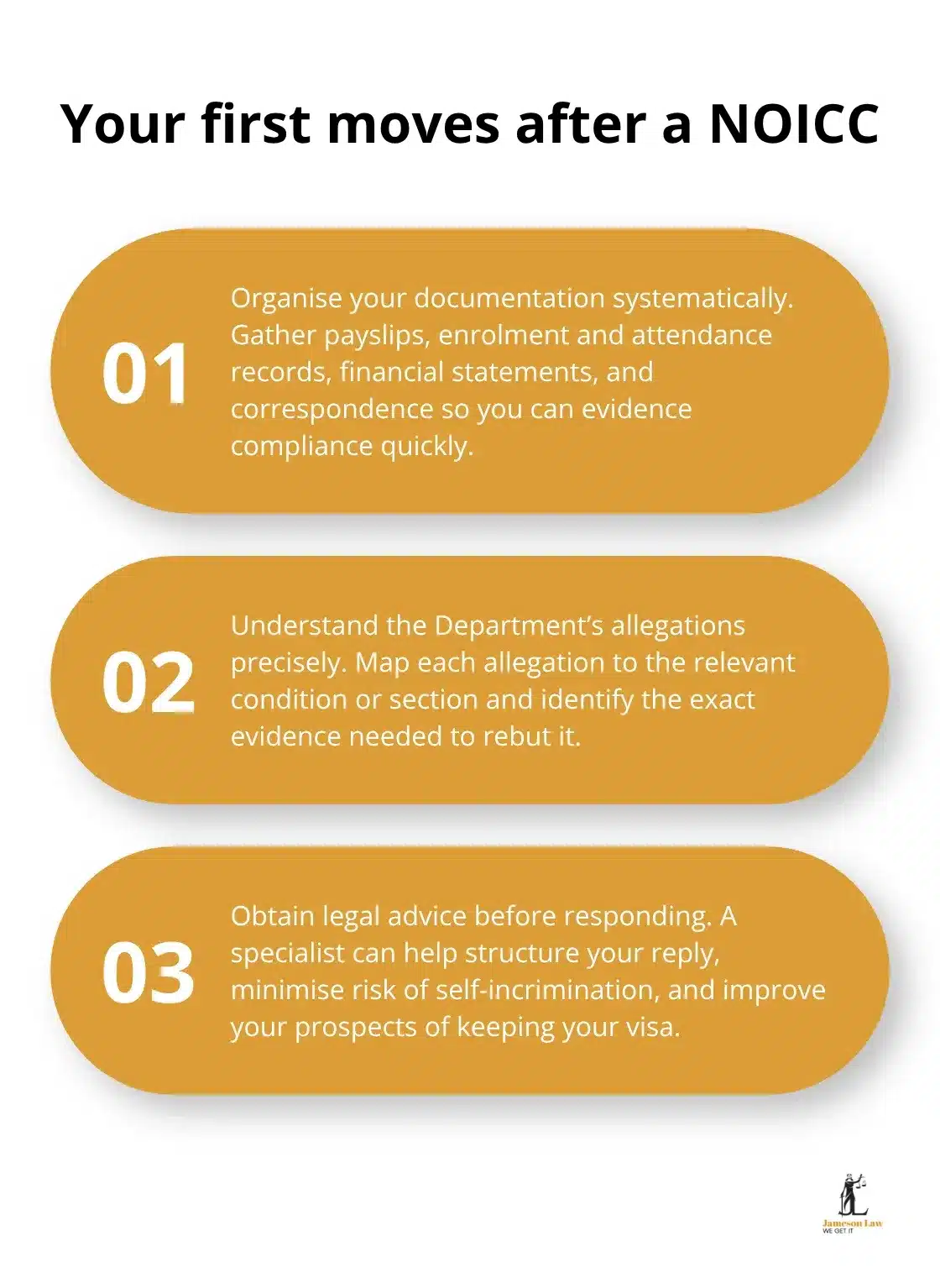
The moment you receive a Notice of Intention to Consider Cancellation from the Department of Home Affairs, your response determines whether you keep your visa or lose it entirely. We have seen visa holders panic at this stage and submit weak responses that virtually guarantee cancellation, whilst others provide structured, evidence-backed replies that convince the Department to withdraw cancellation action. The difference lies in three practical actions you must take immediately: organise your documentation systematically, understand exactly what the Department is alleging, and obtain legal advice before you respond. You typically have five working days to respond in writing, and responses must be in English or accompanied by certified translations.
This timeframe is absolute, and late responses are treated as non-responses, so your first action when receiving a NOICC is to calendar the deadline and work backwards from that date.
Building a Documentation System That Protects You
Start building your documentation system now, not when the Department contacts you. Create a dedicated folder (digital is preferable because it’s searchable and portable) organised by category: employment records, educational records, financial documents, character-related documents, health records, and communications with the Department. Within each category, arrange documents chronologically so you can instantly locate evidence of your compliance at any specific date. For employment, this means monthly payslips, employment contracts, tax documents, and written confirmation from your employer of your role, hours, and employment status. For education, maintain course transcripts, attendance records, marks, and formal communications from your institution. For finances, keep bank statements covering your entire visa period, tax returns, and evidence of funds transfers. Update this folder monthly rather than annually, because gaps in your documentation create immediate risk. When the Department requests information, you should produce a complete, organised response within 48 hours rather than scrambling to locate documents. Many visa holders lose their visa not because they breached conditions but because they cannot prove they complied. The Department operates on a principle of verification: they ask for evidence, and your failure to produce it counts against them. If you work part-time, track your actual hours weekly in a spreadsheet and compare them against your employment contract. If you study, request your attendance records from your institution monthly and verify they match your own records. If you receive income from multiple sources, maintain separate folders for each income stream with clear documentation of dates, amounts, and purposes.
Understanding Your Cancellation Notice and Responding Strategically
When you receive a NOICC, read it three times and identify the specific ground or grounds the Department is alleging. The notice will reference sections of the Migration Act 1958 and explain which condition you allegedly breached or which information you allegedly provided falsely. Your response must address each ground individually and specifically, not generally. If the Department alleges you failed to maintain course attendance, your response should include attendance records from your institution proving you attended at least 80 per cent of classes, along with written confirmation from your institution that you met all attendance requirements. If the Department alleges you provided false information about your employment history, your response should include employment contracts, payslips, tax documents, and written statements from employers covering the entire period in question. Generic responses stating that you have complied with conditions do not work because the Department needs specific evidence. Structure your response in numbered sections that directly correspond to the numbered grounds in the NOICC. For each ground, provide three elements: a clear statement addressing the allegation, documentary evidence supporting your position, and an explanation of how your circumstances align with visa conditions or why the alleged breach does not apply to your situation. The Department also considers hardship when deciding whether to cancel, so include information about the consequences of cancellation for you and your family, but frame this as additional context rather than the primary basis for your response. If you have complied with conditions, lead with compliance evidence. If circumstances have changed so the grounds for cancellation no longer apply, explain what has changed and provide evidence of that change. The Department of Home Affairs receives thousands of NOICC responses annually, and the responses that succeed are those that make the Department’s job easier by providing clear, organised, evidence-backed answers to specific allegations.
When Professional Legal Guidance Becomes Essential
Obtain legal advice before submitting your NOICC response if the cancellation ground relates to false information or character concerns, because these grounds carry the highest risk and require strategic responses that protect you from creating additional problems. If you cannot identify why the Department issued the NOICC, legal advice is essential because responding to an unclear allegation can backfire. If your circumstances are complex (multiple employment changes, course extensions, relationship changes), the strategic framing of your response matters enormously and legal advice helps you present your situation in the strongest possible way. An immigration lawyer can review your NOICC, advise you on the strength of the Department’s case, and help you prepare a response that maximises your chances of keeping your visa. Legal advice also covers your review rights if the Department ultimately decides to cancel, because merits review through the Administrative Appeals Tribunal remains available for many cancellation decisions, and judicial review may be available if procedural errors occurred. Do not wait until after cancellation to seek legal advice, because your options narrow considerably once your visa is is cancelled. If you become an unlawful non-citizen, you have 28 days to either obtain another valid visa, pursue a review, or depart Australia voluntarily. Pursuing a review after cancellation is significantly harder than preventing cancellation in the first place, so the timing of legal intervention matters. The cost of obtaining immigration legal advice before responding to a NOICC is substantially less than the cost of dealing with visa cancellation, detention, removal proceedings, or the three-year entry ban that typically follows cancellation.
Final Thoughts
Visa cancellation prevention rests on consistent compliance with every condition attached to your visa and meticulous documentation of that compliance. Your documentation system becomes your strongest defence, and you must build it now rather than scrambling to locate records after receiving a Notice of Intention to Consider Cancellation. Monthly updates to your compliance records take minimal time but eliminate gaps that the Department interprets as non-compliance.
Proactive visa management also means recognising when circumstances change and notifying the Department rather than hoping they will not discover the change. Relationship breakdown, employment changes, course extensions, address changes, and financial deterioration all require disclosure, because the Department views failure to report these changes as a separate ground for cancellation (independent of whether the underlying change itself would trigger cancellation). Even minor changes to your circumstances carry risk if you do not report them.
If you receive a NOICC, if your circumstances are changing in ways that might affect your visa status, or if you are uncertain whether you meet your visa conditions, contact our immigration law team for advice tailored to your specific situation. Early legal intervention protects your visa status and prevents the three-year entry ban and other consequences that follow cancellation. Your visa is too valuable to leave to chance.