Securing a resident visa in Australia is one of the most significant decisions you’ll make. The pathway to permanent residence involves multiple visa options, each with different requirements and timelines.
At Jameson Law, we’ve guided hundreds of people through this process. We’ll walk you through the main visa pathways, eligibility criteria, and practical steps to strengthen your application.
The Three Main Pathways to Permanent Residence
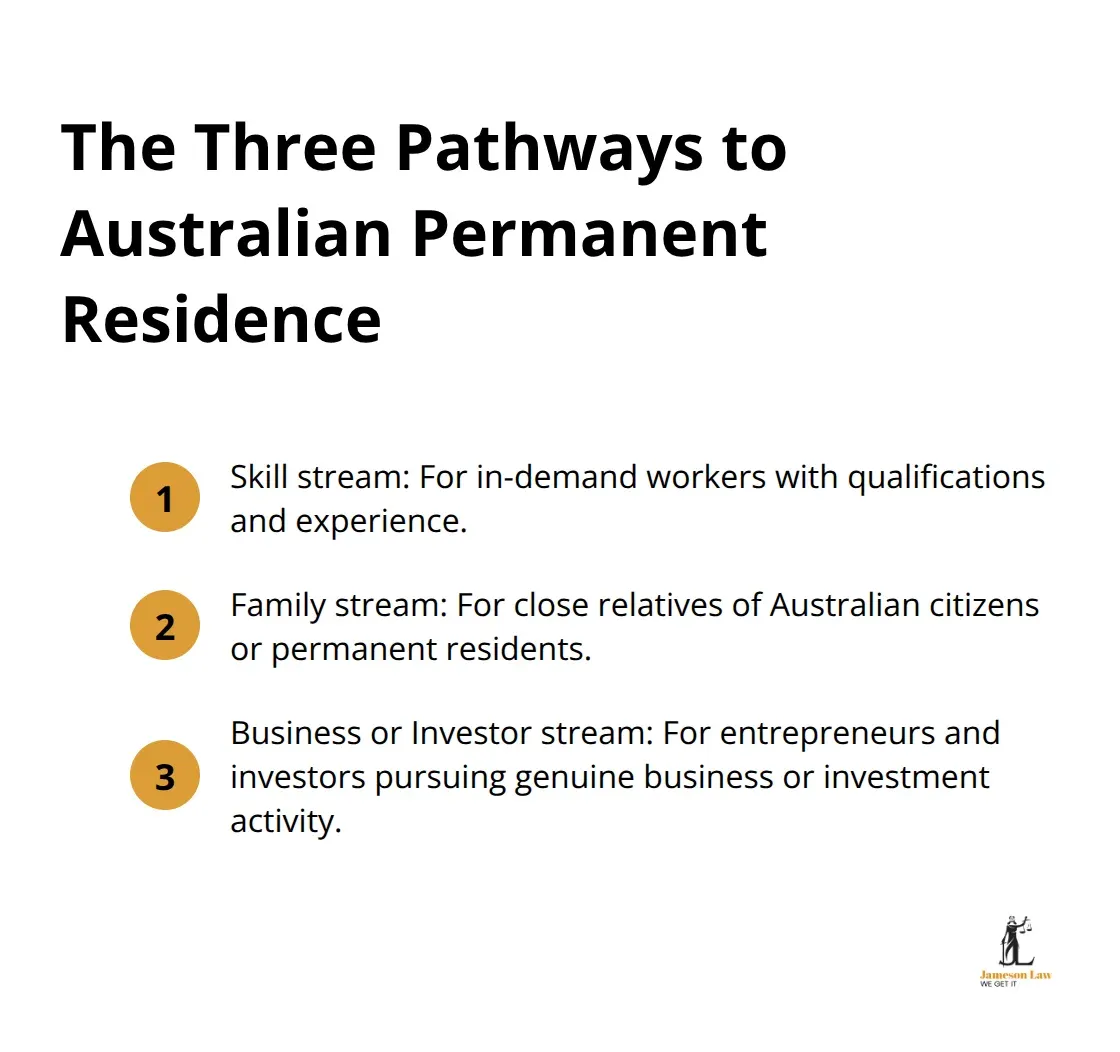
Australia’s permanent migration system offers three distinct pathways, and your choice determines your eligibility criteria and timeline. The Skill stream targets workers with in-demand qualifications and experience, the Family stream enables migration for close relatives of Australian citizens or permanent residents, and the Business or Investor stream serves entrepreneurs and investors.
Understanding the Skill Stream
The Department of Home Affairs structures the Skill stream into six main categories for 2024–25: Employer Sponsored, State or Territory Nominated, Regional Skilled Independent, Global Talent (Independent), Business Innovation and Investment, and Distinguished Talent. Each operates with different requirements and processing speeds.
Subclass 189 (Skilled Independent) allows you to obtain direct permanent residency without employer sponsorship if you meet points requirements. Subclass 190 (Skilled Nominated) requires state sponsorship and typically processes faster than 189. Subclass 491 (Skilled Work Regional Provisional) grants you a five-year provisional visa in regional areas, which you can convert to permanent residency if you meet ongoing conditions.
How Points Determine Your Success
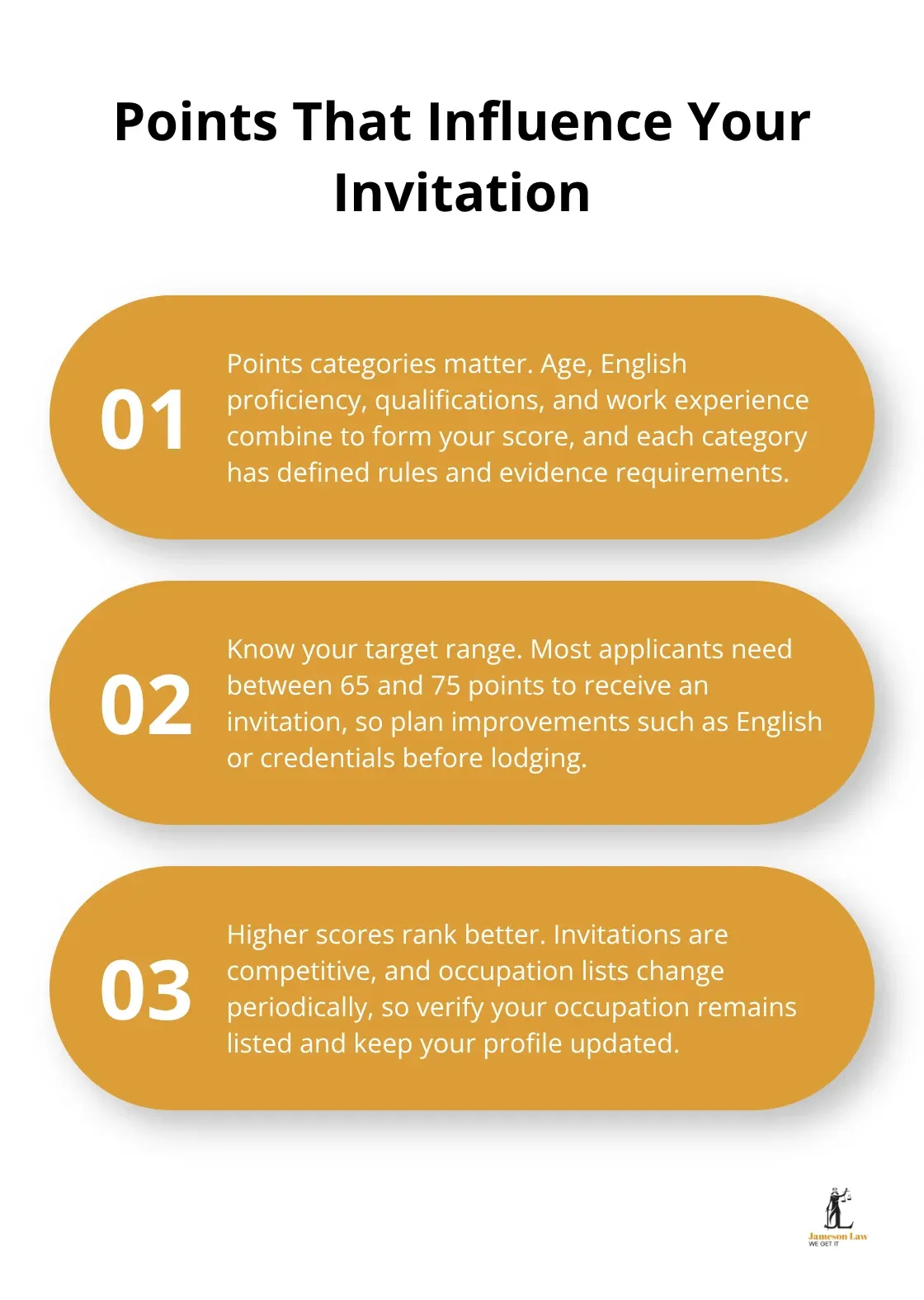
The Department of Home Affairs awards points across several categories: age (with 25–32 year-olds scoring highest), English language proficiency, educational qualifications, and work experience in your nominated occupation. Most applicants need between 65 and 75 points to receive an invitation, though in-demand occupations sometimes invite at lower scores.
Your points directly affect your invitation chances. A higher score improves your position in the selection pool, particularly when occupations attract many applicants. The occupation lists (SOL, CSOL, and ROL) update periodically, so you should verify that your occupation remains listed before investing time and money into your application.
Family and Business Pathways
The Family stream moves faster for some applicants but depends entirely on having a qualifying relative willing to sponsor you. You can migrate as a partner, parent, child, or other eligible family member of an Australian citizen or permanent resident. This pathway removes the points requirement entirely, replacing it with relationship verification and financial capacity checks.
If you own a business or hold investment capital, the Business Innovation and Investment category exists as an alternative. This pathway involves higher financial thresholds and stricter assessment criteria than the Skill stream, requiring you to demonstrate genuine business activity or investment commitment.
Processing Times and Costs
Processing times vary significantly by visa subclass and current Department of Home Affairs workload. Subclass 189 typically takes 8–12 months from invitation to grant, while Subclass 190 can take 6–10 months due to state sponsorship reducing the overall assessment burden. Subclass 491 processing averages 8–12 months.
Application costs in 2026 range from approximately AUD $4,750 for Subclass 189 to AUD $4,900 for Subclass 190, plus partner and dependent fees. The Department of Home Affairs updates its Migration Program planning levels annually, directly affecting how many visas are available in each category. You should check the current planning levels on the Department of Home Affairs website before committing to your application, as quotas shift based on economic need and policy changes. Understanding which pathway aligns with your circumstances-whether through skills, family connections, or business activity-shapes every decision that follows in your migration strategy.
Building Your Path Forward
Prove Your Skills to the Department
Your skills mean nothing on paper until you prove them to the Department of Home Affairs. You must request a skills assessment from the relevant assessing authority for your nominated occupation. This assessment confirms that your qualifications meet Australian standards and is non-negotiable for every skill stream application. Different occupations have different assessing bodies, so you should verify which organisation assesses your field before paying the assessment fee, which typically ranges from AUD $500 to AUD $1,500 depending on your occupation. The skills assessment process takes 4–12 weeks on average, so you need to factor this into your timeline immediately.
Secure Your English Language Results
Simultaneously, you should gather your English language test results. The Department of Home Affairs accepts IELTS, TOEFL, PTE, and Occupational English Test scores. Most applicants targeting Subclass 189 or 190 need at least competent English, meaning IELTS 6.0 overall or equivalent. However, if you aim for a higher points score, proficient English (IELTS 7.0 or higher) adds 10 bonus points and significantly improves your invitation chances. Test scores remain valid for three years, so if your current results are older than that, you will need to retake the test.
Calculate Your Points Before You Apply
Beyond skills and English, you must calculate your exact points score before you invest further time and money. Use the Department of Home Affairs points calculator and be ruthlessly honest about where you stand. If you sit at 60 points when 70 is typical for your occupation, adding a qualification or boosting your English score becomes your priority, not submitting an application and hoping. This is where many applicants waste money on applications that have virtually no chance of invitation.
Select Your Visa Subclass Based on Reality
Once you understand your points position, you should select your visa subclass based on your actual circumstances, not your preferences. If you have a state willing to nominate you and your occupation appears on the Skilled Occupation List, Subclass 190 is statistically faster than 189, processing in 6–10 months versus 8–12 months according to current Department of Home Affairs timeframes. If you commit to regional Australia for at least five years, Subclass 491 opens doors for occupations that may be harder to access under 189 or 190. The trade-off is the provisional nature of 491, but if your current points score sits below your target, this pathway often requires fewer points. You should never choose a visa subclass because it sounds prestigious. Choose it because it matches your points, your willingness to relocate, and your occupational demand.
Gather Documents That Meet Strict Standards
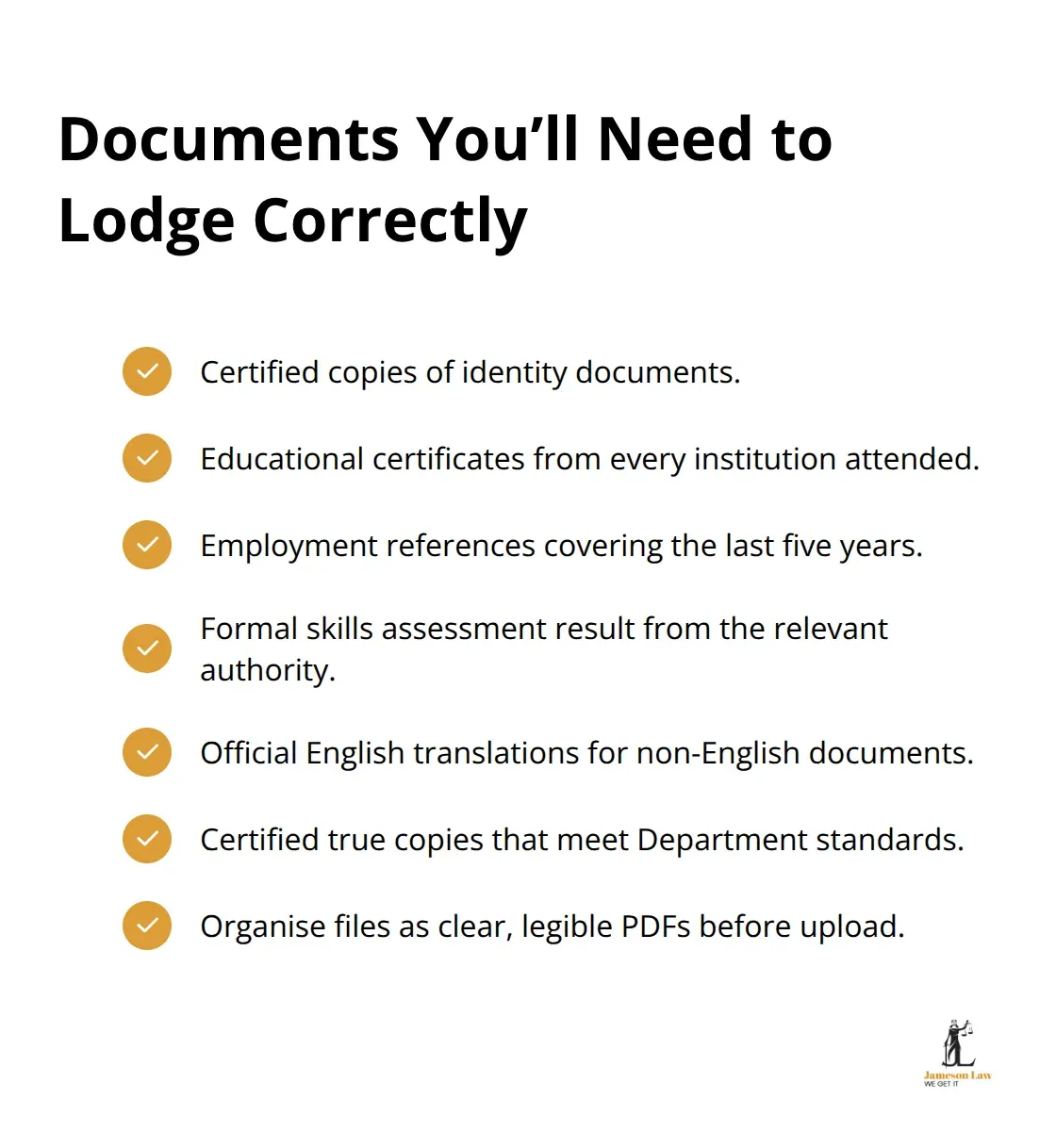
You must collect your documents simultaneously with your skills assessment and English testing. You will need certified copies of your identity documents, educational certificates from every institution you have attended, employment reference letters from your last five years of work history, and your skills assessment results once complete. The Department of Home Affairs is ruthless about document quality. Every document from a non-English-speaking country must be officially translated, then certified as a true copy.
A single missing certification or a poor-quality photocopy causes delays that stretch your application assessment by weeks or months. You should start collecting these documents now, even if you are months away from applying.
Employment references matter more than most applicants realise. Your referee should be someone who directly supervised you and can speak to your day-to-day work in your nominated occupation. A generic reference from a human resources department stating you worked there carries minimal weight. A detailed reference from your former manager describing your specific skills and responsibilities in your field strengthens your application considerably. If you have changed jobs frequently, you should prepare reference letters from multiple employers covering your most recent five-year period in your nominated occupation. With your skills assessment complete, your English results in hand, your points calculated, and your documents organised, you move into the formal application phase where accuracy and completeness determine whether the Department of Home Affairs invites you to proceed or requests additional information.
Submitting Your Application Without Errors
Complete Your Application with Precision
The moment you click submit on ImmiAccount, your application enters the Department of Home Affairs assessment queue. From this point forward, accuracy matters more than speed. A single error or omission triggers a request for further information, which delays your assessment by weeks or months. Applications stall when applicants misread a question or provide incomplete employment history. The Department of Home Affairs processes thousands of applications monthly, and yours receives attention only when it meets their completeness standards.
Start by logging into ImmiAccount and downloading the official visa application form for your chosen subclass. Read every question twice before answering. The form asks specific questions about your work history, qualifications, and personal circumstances. If a question asks for the last five years of employment, provide exactly that, not six years or three years. If the form requests certified copies of documents, submit certified copies, not originals or uncertified photocopies. The Department rejects incomplete applications and returns them for correction, which resets your processing timeline.
Address Your Employment History Accurately
Your employment history section demands particular attention. List every job you held during the relevant period, including the exact dates, your job title, and the organisation name. If you worked part-time or casually, state this clearly. The Department uses your employment history to verify your work experience points, so inconsistencies between your application and your skills assessment create red flags. Ensure your nominated occupation on your application matches exactly with the occupation code from your skills assessment. A mismatch, even a minor one, causes the Department to request clarification.
Upload every document the form requires, in the specified format. The Department accepts PDF files, and your documents must be legible. Poor-quality scans or photographs of documents result in rejection requests. If you have documents from overseas, include the official English translation alongside the original language version. Submit your application with at least two weeks remaining on your current visa if you hold one in Australia. This timing allows you to lodge a bridging visa application immediately if needed, maintaining your legal status while assessment proceeds. The Department of Home Affairs takes 1–3 weeks to acknowledge receipt of your application and assign it a case officer.
Complete Health and Character Assessments
Health and character assessments begin after the Department confirms your application is complete. You must arrange a medical examination with a Department-approved civil surgeon, not your general practitioner. The Department publishes the list of approved civil surgeons on its website, and you contact them directly to book an appointment. Medical examinations cost approximately AUD $300–$500 and take 30–60 minutes. The civil surgeon uploads your medical results directly to the Department, so you do not need to submit these yourself.
Simultaneously, the Department requests your police clearance. Australian police clearances come through your state police service, while overseas clearances come from the relevant authorities in countries where you have lived for more than 12 months in the last ten years. Police clearances take 2–4 weeks to obtain and cost AUD $30–$100 depending on your state. Once you receive your clearance, upload it to ImmiAccount immediately. The Department assesses your character based on criminal history, immigration compliance, and financial conduct. A minor traffic infraction rarely affects your application, but dishonesty in your visa application, previous visa cancellations, or serious criminal convictions create genuine obstacles. If you have any concerns about your character assessment, consult with a migration lawyer before submitting your application.
Respond to Further Information Requests
After the Department receives your health and character results, your case officer conducts a final review of your entire application, comparing your documents against the visa criteria. If the Department asks for further information, respond within 28 days. Missing this deadline may result in your application being refused.
Once the Department grants your visa, you receive a notification letter confirming your permanent resident status, your visa grant date, and any conditions attached to your visa. Your permanent residency becomes effective on the date specified in the letter, and you can work and access services as a permanent resident from that date forward.
Final Thoughts
Your path to permanent residence in Australia requires precision, patience, and honest self-assessment. The three main pathways-Skill, Family, and Business-each demand different preparation, but all share a common requirement: accuracy at every stage. You cannot recover from a poorly completed application or missing documents by working harder later, and the Department of Home Affairs processes your application once, so errors compound into delays measured in months.
The most common mistakes applicants make involve submitting applications before they are genuinely ready, misrepresenting employment history or qualifications, or choosing a visa subclass based on preference rather than eligibility. When you reach the application stage, you must respond to every Department request within the 28-day timeframe, complete your health and character assessments promptly, and treat these requirements as mandatory components of your resident visa Australia application rather than obstacles to overcome reluctantly. If your circumstances are complex-previous visa cancellations, gaps in employment history, overseas qualifications, or character concerns-you should seek professional legal advice before applying, as a migration lawyer identifies risks that you might miss.
We at Jameson Law provide immigration law services to help you navigate this process with confidence and clarity. Contact us if you need guidance on your resident visa Australia application or have concerns about your eligibility.