Becoming an Australian citizen is a significant milestone, but the path to citizenship eligibility Australia isn’t always straightforward. Many applicants don’t realise they’re missing key requirements until their application is rejected.
At Jameson Law, we’ve helped countless people navigate this process successfully. This guide breaks down exactly what you need to qualify, what documents to prepare, and where most applications go wrong.
What Makes You Eligible for Australian Citizenship
Permanent Residency Status
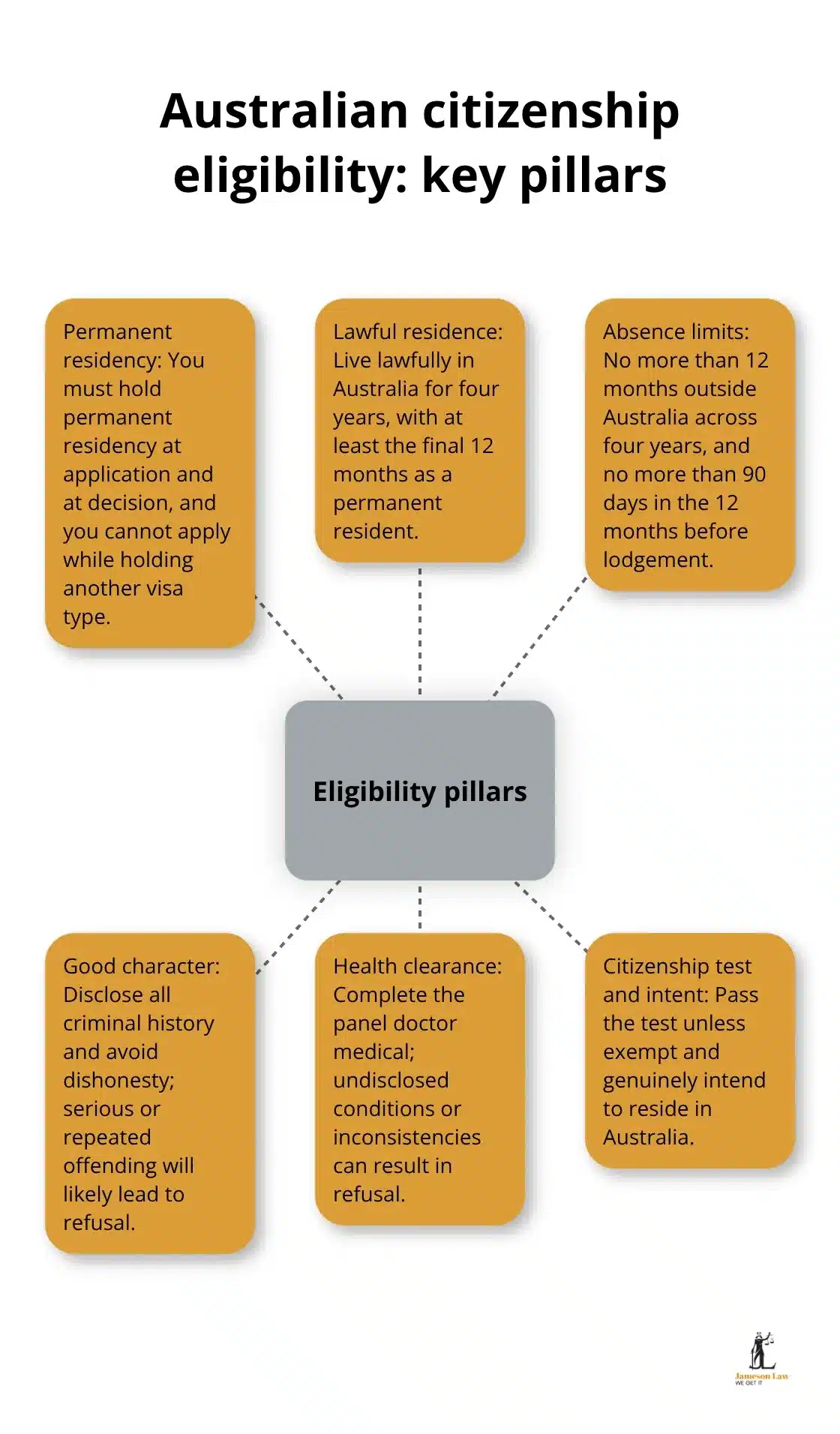
The path to citizenship starts with one non-negotiable requirement: you must hold permanent residency status at the time you apply and at the time the Department of Home Affairs makes its decision. This isn’t a technicality-it’s the foundation of the entire process. If your visa lapses between application and approval, your application faces refusal. Permanent residency allows you to remain in Australia indefinitely, but citizenship takes that further by granting voting rights, an Australian passport, and automatic entry to the country. The Department of Home Affairs requires that you cannot hold another visa type and apply for citizenship simultaneously.
Residency Duration and Absence Limits
Once you have permanent residency locked in, the clock starts on the next critical requirement: your residency duration. Adults who became permanent residents on or after 1 July 2007 must have lived lawfully in Australia for four years immediately before applying. Within those four years, you must have held permanent residency for at least the final 12 months. The mathematics seems straightforward, but absences complicate everything. You cannot be absent from Australia for more than 12 months in total across the four-year period, and you cannot be absent for more than 90 days in the 12 months immediately before lodging your application. Most applicants underestimate how those absences add up. A three-month holiday to visit family, a month-long business trip, and a two-week conference attendance can quickly approach or exceed that threshold. The Department of Home Affairs holds the final say on what counts as an absence-even brief trips out of Australia count against you.
Calculating Your Residence Eligibility
The Residence Calculator tool on the Department of Home Affairs website helps you estimate your eligibility, but understand that this tool provides guidance only. The department’s actual decision relies on data it holds at the time you lodge your application, not the calculator’s output. If you need precise travel records, you can request your international movement records free of charge from the department, which gives you documented proof of every entry and exit. Maintaining detailed records of your residence and absences demonstrates four years of lawful residence and the required time as a permanent resident.
Character, Health, and the Citizenship Test
Beyond residency, character and health requirements filter out applicants who pose risks to the community. Good character assessment examines criminal history, fraud, and conduct that suggests you won’t respect Australian laws. A single conviction doesn’t automatically disqualify you, but serious crimes, dishonesty offences, or a pattern of offending will almost certainly lead to refusal. Health requirements focus on whether you have conditions that create a significant cost to Australia’s health or aged care services. These assessments happen alongside your application, and transparency matters here-failing to disclose health information or criminal history gives the department grounds to refuse you even if the underlying issue might have been manageable.
The citizenship test requires you to demonstrate knowledge of Australia’s values, institutions, and history unless you’re under 18, over 60, or have a substantial impairment. The test isn’t designed to trick you; it’s genuinely testing whether you understand what it means to live as an Australian citizen. Finally, you must intend to reside in Australia. This doesn’t mean you can never leave, but you must have a genuine commitment to making Australia your home. The combination of these requirements-permanent residency status, four years of lawful residence with strict absence limits, good character, health clearance, test readiness, and genuine commitment to residing here-creates a comprehensive eligibility framework. Missing even one element can result in refusal, which is why the next step involves understanding exactly what documents and evidence the Department of Home Affairs expects from you.
Getting Your Documentation Ready
The Department of Home Affairs will not request documents piecemeal-they expect a complete file from the start. You must prove your identity, your permanent residency status, your residence history, your character, and your health clearance. Submitting incomplete documentation triggers delays that can extend your timeline by months.
Identity and Permanent Residency Documents
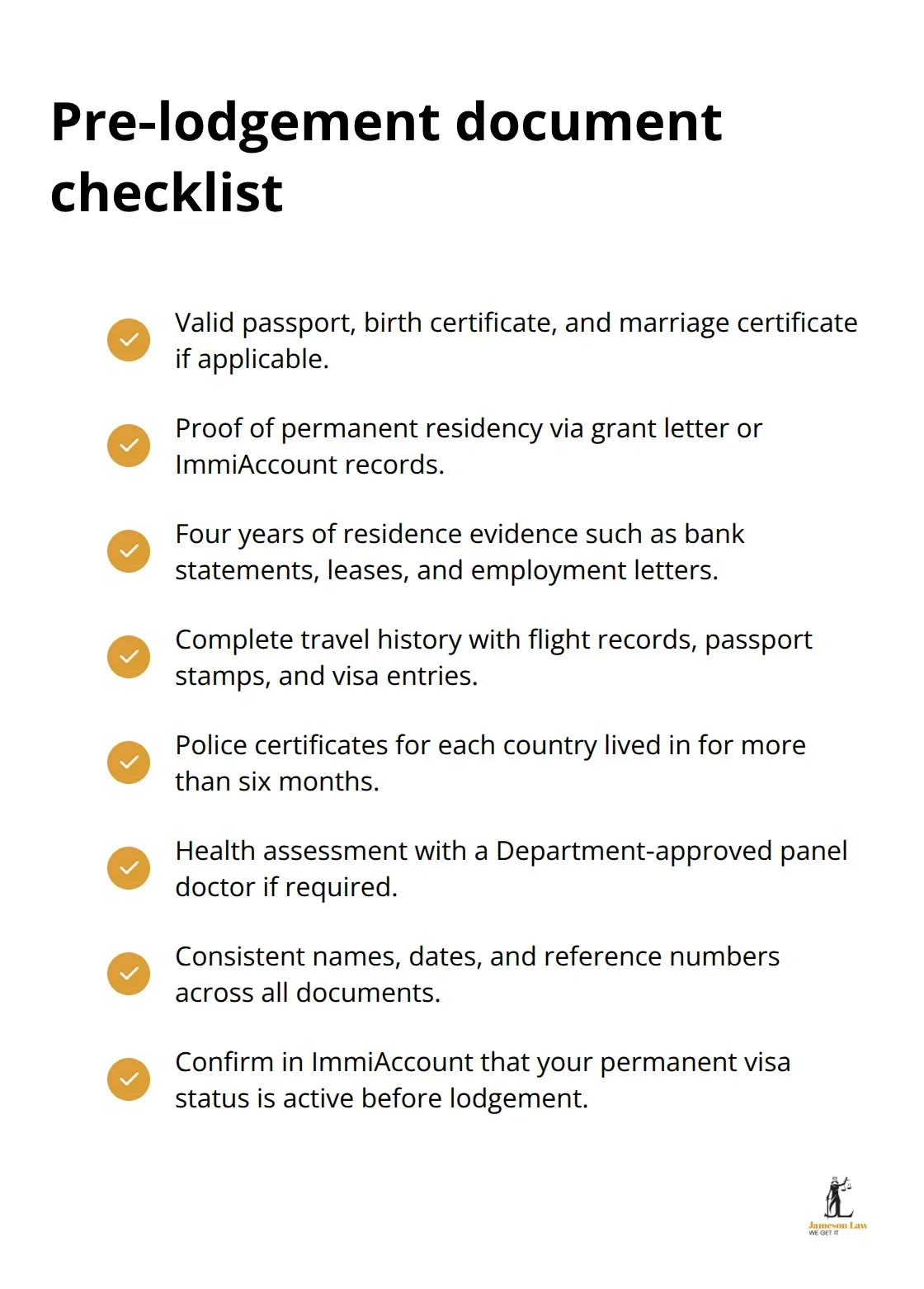
Your passport, birth certificate, and marriage certificate (if your name has changed) form the foundation of your identity proof. Your permanent residency visa grant letter or ImmiAccount records showing your permanent visa details are non-negotiable. The Department uses these documents to verify that you hold the required status at both application and decision stages. Without clear evidence of permanent residency, the Department will refuse your application immediately.
Residence and Travel Documentation
Bank statements, rental agreements, utility bills, and employment letters spanning the four years you’ve lived in Australia establish your physical presence and continuous connection to the country. The Department holds international movement records, but providing your own travel documentation-flight bookings, passport stamps, visa entry records-strengthens your application and prevents disputes about your absence calculations. Documentation errors cause significant delays; one applicant’s missing employment letter pushed their application into a second request cycle, adding three months to their timeline. Another applicant listed incorrect passport numbers across their documents, triggering a verification process that held up their decision for weeks. Check every date, every name spelling, and every reference number multiple times before lodging.
Character and Health Assessment Documents
Character assessment requires police certificates from every country where you lived for more than six months. If you have had any criminal convictions or charges, you must disclose them fully and honestly. Attempting to hide a conviction will guarantee refusal, even if the conviction itself might have been manageable with proper explanation. Health assessments require a medical examination from a panel doctor approved by the Department. This examination differs from your regular GP visit-the panel doctor conducts a comprehensive assessment and forwards results directly to the Department. You cannot see these results yourself, so accuracy matters enormously. If you have any health conditions that might be relevant, inform your panel doctor before the examination.
Lodging Your Application and Tracking Progress
You lodge your application through ImmiAccount, and the Department processes new citizenship applications with a median timeframe of approximately four to six months (though this varies depending on application complexity and whether the Department requests additional information). The application fee sits at a fixed amount set by the Department-check the current fee on the Department of Home Affairs website before lodging, as fees change periodically. Incomplete applications face delays because the Department will issue a request for further information, and you will have a limited timeframe to respond. Missing documents, inconsistent information between documents, or unclear residence calculations trigger these requests regularly. Once you lodge, you cannot withdraw and reapply without losing your application fee, so verify everything before hitting submit.
Track your application status through ImmiAccount, where you will see updates on whether the Department has requested additional documents or made a decision. The Department notifies you of your decision by mail and through ImmiAccount simultaneously. If your application receives approval, you will receive a citizenship certificate and an invitation to a citizenship ceremony, where you will take the pledge and officially become an Australian citizen. The Australian Electoral Commission then enrols you on the electoral register. This enrols you because voting is both a right and a legal obligation for Australian citizens. If your application faces refusal, the Department provides reasons in writing, and you have the right to seek a review through the Administrative Appeals Tribunal if you believe the decision was wrong. Understanding why your application was refused helps you determine whether to reapply or pursue alternative pathways to residency and citizenship.
Why Citizenship Applications Get Refused
Residency Miscalculations and Absence Limits
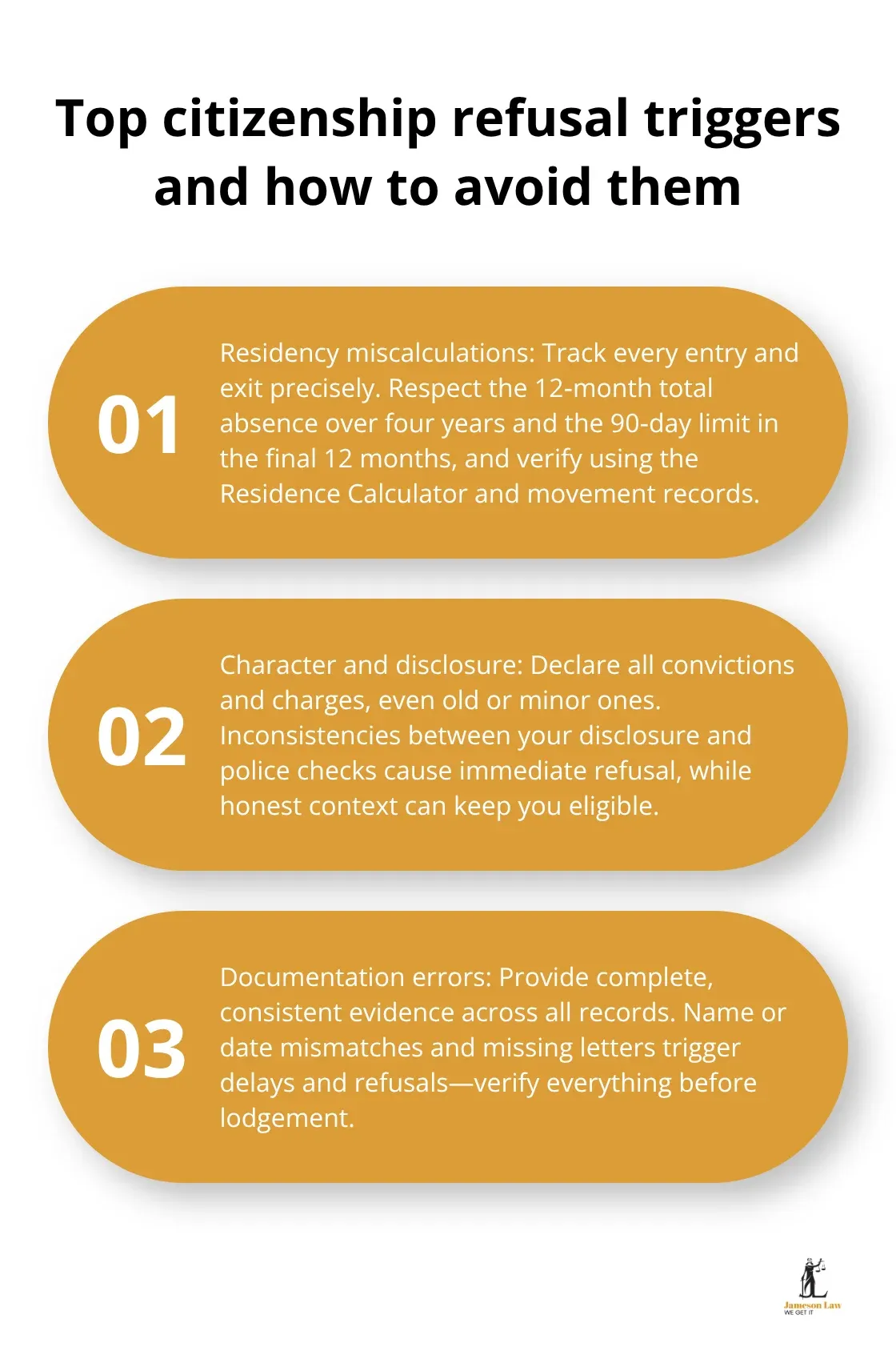
The Department of Home Affairs refuses citizenship applications for specific, preventable reasons. Residency miscalculations top the rejection list because applicants frequently underestimate their absences or miscount their permanent residency period. The four-year residence requirement isn’t negotiable, and the Department’s records take precedence over your calculations. If you’ve been absent for more than 12 months across those four years, your application faces refusal regardless of whether you’ve lived in Australia for 3 years and 11 months otherwise.
The 90-day absence limit in the 12 months before applying creates additional complexity because travel that seems minor in isolation compounds quickly. A four-week holiday, a two-week business trip, and a ten-day family visit totals 52 days, leaving you only 38 days of remaining absence allowance. Applicants who don’t track their movements carefully hit this ceiling without realising it. The Department holds international movement records, but if your personal records contradict the Department’s data, the Department’s records win. You cannot argue your way out of a miscalculation.
Character Assessment and Dishonesty
Character assessment rejections stem from undisclosed or inadequately explained criminal history, and dishonesty during the application process compounds the problem substantially. A single drink-driving conviction from ten years ago might be manageable with proper context, but attempting to hide it guarantees refusal. The Department conducts police checks across every country where you’ve lived for more than six months, and inconsistencies between your disclosure and police records trigger immediate refusal on character grounds.
Fraud, dishonesty offences, violence-related convictions, and drug-related offences carry particular weight because they suggest you won’t respect Australian law or community standards. Even charges that didn’t result in conviction must be disclosed honestly. Health assessment rejections happen when applicants fail to disclose relevant medical conditions or when panel doctors identify conditions that create significant cost to Australia’s health system. You cannot see the panel doctor’s report, so transparency before the examination matters enormously.
Documentation Errors and Inconsistencies
Documentation rejections represent the single most common cause of refusal, and these rejections are entirely preventable through careful preparation. Missing documents, inconsistent information across documents, and calculation errors trigger requests for further information that delay your application by weeks or months. Name spelling inconsistencies between your birth certificate, passport, and employment records create verification problems that hold up decisions. Employment letters with incorrect dates or missing signatures get rejected outright because the Department cannot verify your residence.

Utility bills and rental agreements older than three months sometimes get questioned because the Department prefers recent proof of your current address. Bank statements with redacted account numbers occasionally get rejected because the Department cannot verify the account holder’s identity. Applicants who lodge incomplete applications face a request for further information, and you typically have 28 days to respond. Missing this deadline results in refusal.
Critical Errors Before and After Lodgement
One critical error involves lodging applications without confirming your permanent visa status remains active at the time of lodgement. If your permanent visa lapses between application preparation and actual lodgement, your application becomes invalid before the Department even opens your file. Check your ImmiAccount immediately before clicking submit to confirm your permanent visa status shows as active.
Another preventable error involves providing travel documentation that contradicts your residence claims. If you claim continuous residence in Australia but submit airline tickets showing you were overseas for periods you didn’t disclose, the Department refuses your application for providing false information. Your international movement records request should be obtained before you lodge your application so you can reconcile any discrepancies with your own recollection. Applicants who wait until after lodgement to discover movement record errors find themselves unable to correct the problem effectively.
Final Thoughts
You now understand the core requirements for Australian citizenship eligibility. Permanent residency status, four years of lawful residence with strict absence limits, good character, health clearance, and genuine commitment to residing in Australia form the foundation of your application. Before you proceed, review each requirement against your own circumstances, check your permanent visa status through ImmiAccount to confirm it remains active, and calculate your absences honestly using your travel records and the Residence Calculator tool.
If you’ve determined you meet the citizenship eligibility Australia requirements, your next step involves lodging your application through ImmiAccount with complete documentation. Incomplete applications trigger delays that extend your timeline by months, and once lodged, you must track your progress through ImmiAccount and respond promptly to any requests for further information within the 28-day timeframe. If the Department approves your application, you’ll receive a citizenship certificate and an invitation to a citizenship ceremony where you’ll take the pledge and officially become an Australian citizen.
If you’re uncertain about any requirement, have undisclosed criminal history, health concerns, or complex residence calculations, seeking professional legal advice before lodging protects you from preventable refusals. We at Jameson Law provide immigration law assistance to help you navigate citizenship applications with confidence, and the cost of professional guidance is minimal compared to the cost of a refused application and the time required to reapply.