


![Why Injured Workers Should Report Incidents Immediately [2026]](https://jamesonlaw.com.au/wp-content/uploads/emplibot/Why-Injured-Workers-Should-Report-Incidents-Immediately-_2026__1789016759.jpeg.avif)
A workplace injury can derail your life, but your workplace rights in NSW include specific protections-if you act fast. Reporting your incident immediately isn’t just good practice; it’s a legal requirement that directly affects whether your claim gets approved.
Delays in reporting create problems that are hard to fix later. We at Jameson Law have seen too many workers lose valid claims because they waited too long or didn’t follow the right steps.
Legal Timeframes for Reporting Workplace Injuries
Notification Requirements Under NSW Workers Compensation Law
NSW workers compensation law gives you a strict timeline, and missing it costs you everything. You must notify your employer of your workplace injury as soon as possible-ideally on the day it happens or within 24 hours at the latest. The Workers Compensation Act 1987 NSW doesn’t specify an exact deadline for initial notification, but delays create immediate problems. Your employer’s insurer will question whether you’re telling the truth about when the injury occurred, and disputes over timing often lead to claim rejections. Treat notification like an emergency, not an administrative task you handle when convenient.
Deadlines for Lodging Claims with SIRA
Once you notify your employer, you have 6 months from the date of injury to lodge your claim with the State Insurance Regulatory Authority (SIRA). This sounds generous until you realise that gathering medical evidence, obtaining your employer’s cooperation, and collecting the right documentation takes weeks, not days. If you wait 5 months and then discover your GP didn’t document the injury properly or your employer disputes the incident, you’ll run out of time.
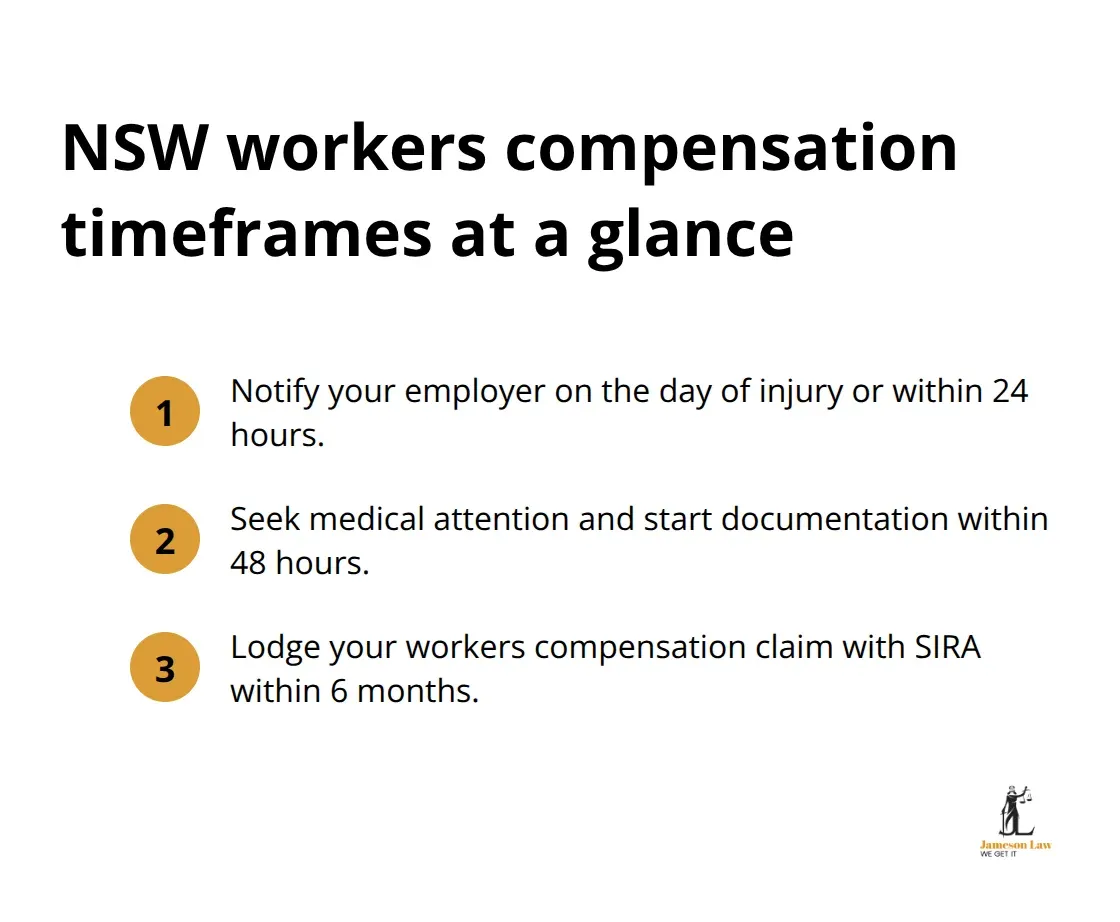
The 6-month window applies whether your injury is obvious or takes time to develop-a back injury from lifting might feel minor on day one but require surgery by week three, yet the clock started ticking on day one.
Consequences of Delayed Reporting
Missing the 6-month deadline is catastrophic. SIRA will reject your claim outright, and you lose your right to weekly compensation, medical treatment coverage, and lump sum payments unless you can convince a court that you had a valid reason for the delay. Courts rarely accept excuses like being too injured to lodge paperwork or not understanding the process-ignorance of the law isn’t a defence. Some workers try to lodge after the deadline expires and discover they cannot recover compensation for the months they waited, even if their injury is completely genuine and work-related.
The insurer will argue you delayed deliberately to manufacture evidence or inflate your claim, and without a strong legal argument about why you missed the deadline, you’ll lose. Early reporting also protects you because it creates a contemporaneous record. Your employer’s incident register, your medical records from the first appointment, and witness statements from colleagues all carry more weight when they’re recorded immediately rather than reconstructed months later. Delayed reporting makes your claim look suspicious, and insurers exploit that perception to deny legitimate claims.
Why Immediate Action Matters
Start the process today, not tomorrow. The steps you take in the first 24 hours determine whether your claim survives or fails, which is why understanding what happens after you report your injury is equally important.
Why Immediate Reporting Protects Your Claim
Creating an Official Record That Stands Up to Scrutiny
The moment you report your injury, you create an official record that an insurer cannot challenge later. Your employer’s workers compensation incident register becomes a dated document showing exactly when you notified them, what happened, and who witnessed it. This contemporaneous record carries enormous weight in disputes because it was created when events were fresh, not reconstructed months after the fact when memories fade and details blur.
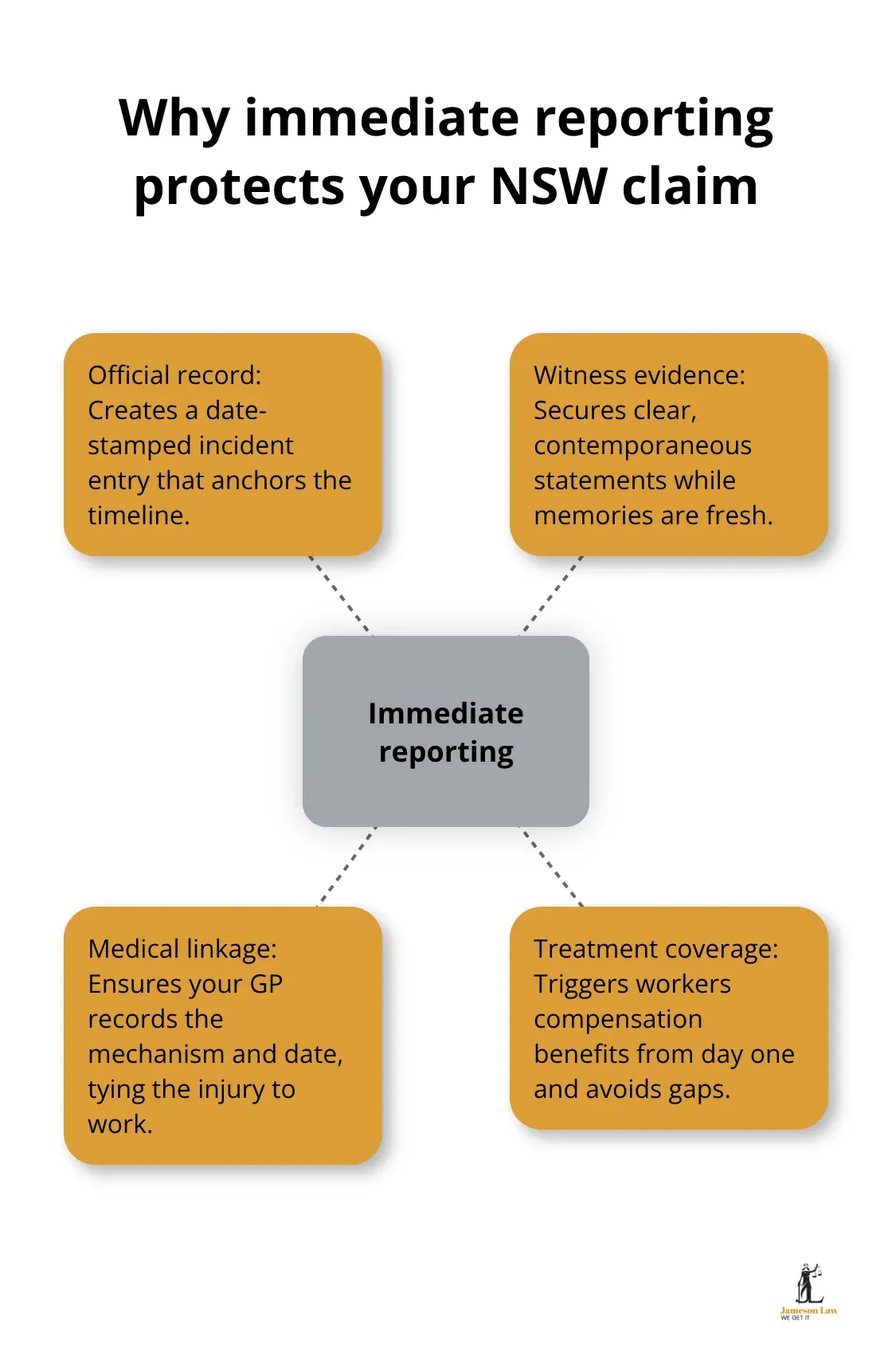
Insurers know that workers who report immediately are telling the truth, while delayed reports trigger automatic suspicion.
Capturing Witness Statements While Details Remain Fresh
When you notify your employer on the day of injury or within 24 hours, you capture witness statements while colleagues remember the incident clearly. A workmate who saw you fall from scaffolding or heard the machinery malfunction will provide a far more detailed and credible account within hours than they will six months later when they’ve forgotten the specifics. The insurer will scrutinise any gap between injury and reporting as evidence that you’re fabricating or exaggerating your claim, regardless of how genuine your injury is. Immediate notification protects you because it locks in the most reliable evidence available.
Establishing Medical Evidence of Work-Related Injury
Your medical records must establish that your injury occurred at work and on a specific date. When you seek treatment immediately after an incident, your GP or hospital will document the mechanism of injury, your account of what happened, and the date of the incident in your clinical notes. These records become legally binding evidence of when your injury happened and how it occurred. If you wait two weeks before seeing a doctor and then claim the injury happened at work, the medical record shows a two-week gap that the insurer will exploit to argue your injury wasn’t work-related or was caused by something else in the interim.
Securing Treatment Coverage From Day One
Early medical documentation also protects your treatment coverage. When you delay reporting and then seek private medical treatment at your own expense, you’ll struggle to recover those costs later because the claim wasn’t lodged within the proper timeframe. The insurer will argue you should have notified them sooner, and NSW courts have consistently rejected claims where workers delayed reporting beyond what’s considered reasonable without a compelling excuse. Immediate action ensures your treatment is covered under workers compensation from the outset, preventing costly gaps in your medical care and financial support.
How to Report Your Workplace Injury the Right Way
Notify Your Employer Immediately
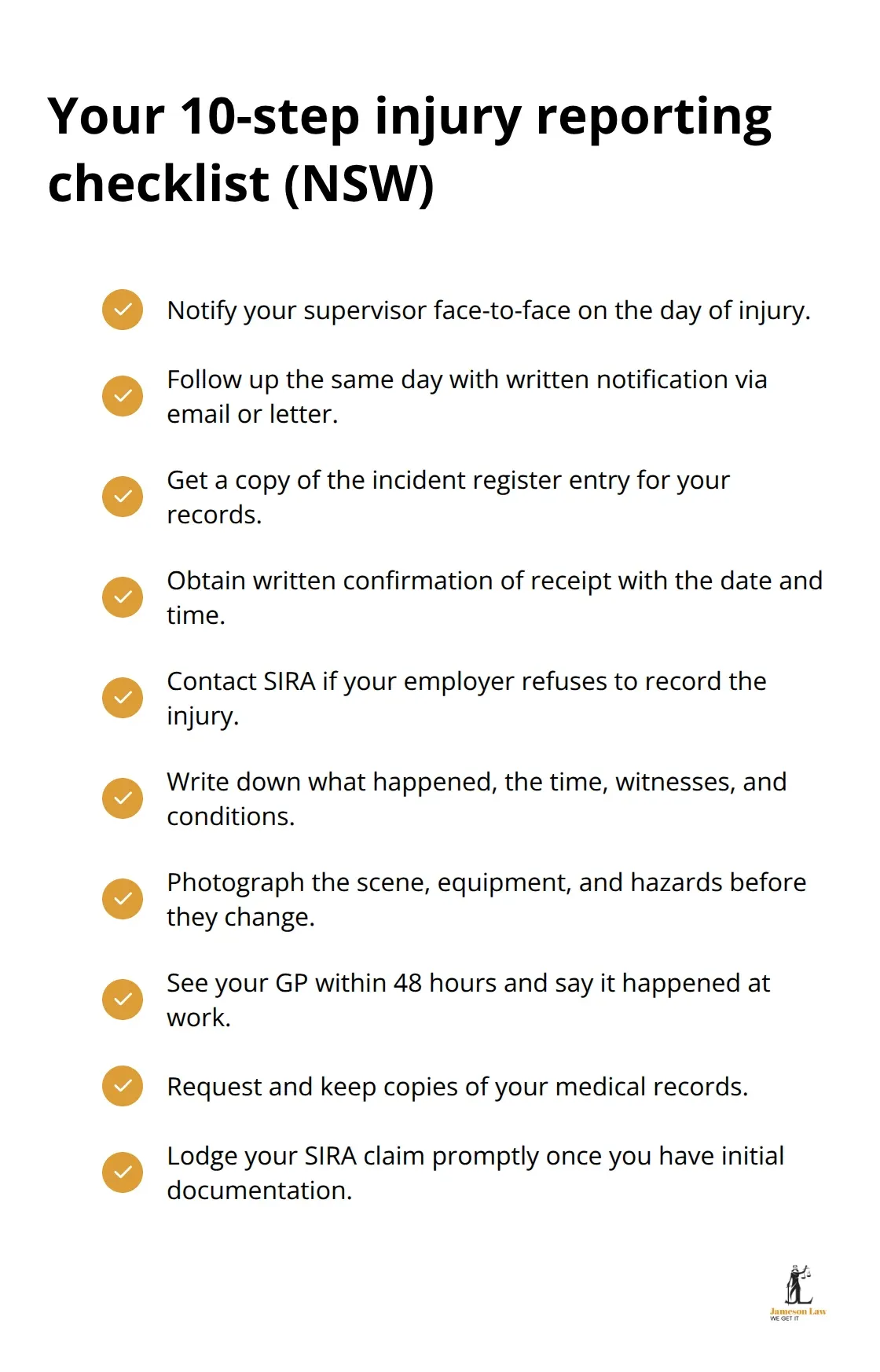
The first 24 hours after your workplace injury determine everything. You must notify your employer or supervisor face-to-face on the day of injury, then follow up with written notification the same day via email or letter. Your employer must record this notification in their workers compensation incident register, and you need a copy of that record for your own files. Do not assume your employer will remember a casual conversation or that they will lodge the paperwork on your behalf.
You must obtain written confirmation that your employer received your notification, including the date and time you reported the incident. If your employer refuses to record your injury or claims they never received your notification, contact SIRA directly because they can intervene. Workers who notify verbally and then cannot prove it later discover that their claim gets rejected on the grounds that no formal notification occurred.
Document Everything at the Scene
You must write everything down immediately after your injury happens. Document what happened, the exact time, who witnessed it, what you were doing, and any environmental factors like wet floors or faulty equipment. This written account becomes evidence if disputes arise later, and it prevents memory gaps that insurers exploit.
You should take photographs of the scene, the equipment involved, or any hazards that contributed to your injury before they get cleaned up or repaired. These visual records carry substantial weight in claim assessments because they show conditions exactly as they existed when your injury occurred.
Seek Medical Attention Within 48 Hours
Medical documentation must start within 48 hours of your injury, and this means seeing a doctor, not waiting to see a specialist. Your GP will document the mechanism of injury, your account of the incident, and the date in your clinical notes, creating legal evidence that your injury is work-related and occurred on a specific date.
You must tell your doctor explicitly that your injury happened at work because this detail must appear in your medical records. If you delay seeking treatment beyond a few days, the gap between injury and medical consultation becomes ammunition for insurers to argue your injury developed from something other than work. After your GP appointment, you should obtain a copy of your medical records and keep them in a safe place because you will need them when you lodge your SIRA claim. Do not rely on your doctor’s office to send records to anyone; you must request them yourself and maintain your own copies.
Lodge Your Claim With SIRA
Within the six-month window, you must contact SIRA to lodge your formal workers compensation claim. You can lodge online through the SIRA website, and the process requires your employer’s details, your injury information, and your medical evidence. Do not wait until month five to start gathering documents because requests for medical records take weeks, and your employer might dispute facts if you rush the process.
You should lodge your claim as soon as you have your GP’s initial assessment and your employer’s confirmation of notification. If you are unsure whether your injury qualifies for workers compensation or whether you have followed the correct steps, Jameson Law can review your situation and guide you through the lodgement process to prevent costly errors that result in claim rejection.
Final Thoughts
Reporting your workplace injury immediately forms the foundation of your entire claim. The six-month deadline to lodge with SIRA remains firm, and delays create problems that courts will not overlook. Your workplace rights in NSW depend on you acting within the first 24 hours: you must notify your employer, document the incident, and seek medical attention. These steps create the contemporaneous evidence that insurers cannot challenge later.
Missing the notification window gives insurers ammunition to dispute your claim, while delayed medical records create gaps that suggest your injury was not work-related. Courts have consistently rejected claims where workers delayed reporting without compelling reasons, regardless of how genuine the injury was. Your credibility rests on speed, and the evidence you gather in those first hours will determine whether your claim succeeds or fails.
If you have already reported your injury and need guidance on lodging your SIRA claim, or if you are unsure whether you have followed the right process, Jameson Law can review your situation and help you avoid costly errors that result in claim rejection.