


Personal injury claims require solid documentation to succeed. Without the right paperwork, insurers and courts won’t take your case seriously, and you risk losing compensation you deserve.
We at Jameson Law have helped countless clients navigate the injury claim process by gathering the correct evidence from day one. This guide walks you through exactly which documents you need to build a strong claim.
Medical Records Tell Your Injury Story
Your medical documentation forms the backbone of any personal injury claim in Australia. Insurers and courts need concrete evidence that your injury exists, how severe it is, and what treatment you’ve received. Without detailed medical records, you’re asking decision-makers to accept your word alone-and that rarely succeeds. Start gathering these documents immediately after your injury, even before you contact a lawyer. The sooner you have a complete medical file, the stronger your position becomes.
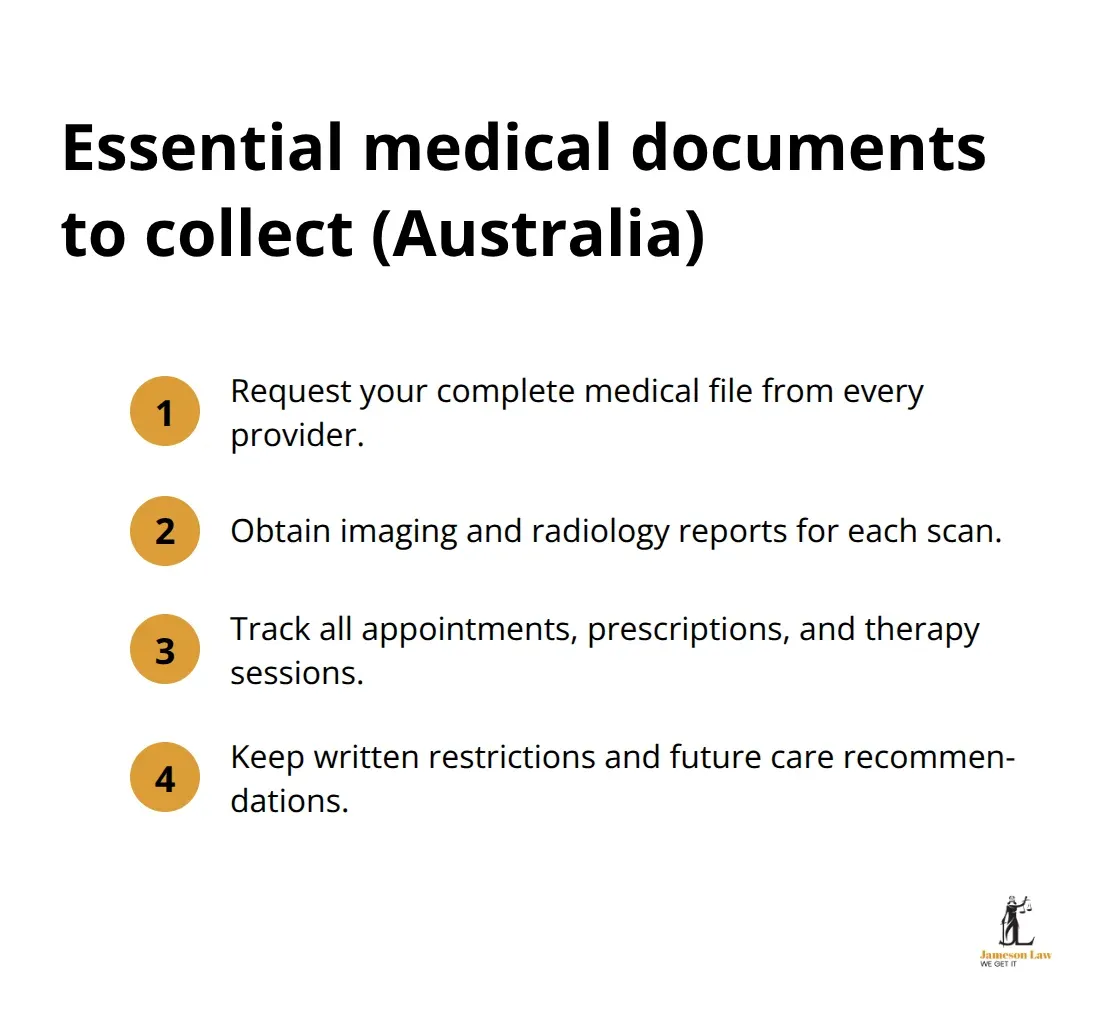
Request Your Complete Medical File
Request your full medical file from every healthcare provider who treated you following the injury. This includes your GP, specialists, physiotherapists, psychologists, and any hospital or clinic where you received care. Under Australian privacy law, you have the right to access these records within 30 days of requesting them. Don’t settle for a summary-ask for the complete file including consultation notes, clinical observations, and any handwritten comments from medical staff.
Gather Diagnostic Reports and Imaging
Diagnostic reports matter enormously in personal injury claims. If you’ve had imaging done (X-rays, MRI scans, ultrasounds, or CT scans), obtain copies of both the images and the radiologist’s report. These visual confirmations of injury carry significant weight with insurers because they show objective evidence rather than subjective complaints. Keep every pathology report, blood test result, and specialist assessment.
Document Your Treatment Pattern
Treatment records should document every appointment, every prescription, every recommendation for ongoing care. Courts and insurers look at the frequency and nature of your treatment to understand injury severity. If you’ve attended physiotherapy twice weekly for six months, that pattern demonstrates a genuine, substantial injury.
Collect receipts for private treatment costs alongside your Medicare records. This documentation serves dual purposes-it proves the extent of your injury and establishes the financial losses you’ve incurred.
Preserve Medical Restrictions and Recommendations
Keep records of any rehabilitation programmes, return-to-work plans, or restrictions your medical team recommended. If your doctor advised you to avoid heavy lifting or recommended modified duties at work, that written guidance strengthens your claim significantly. Many claimants overlook future medical costs, but this documentation is essential. If your treating doctors have written recommendations for ongoing physiotherapy, counselling, or specialist reviews, gather those letters and keep them safe. These projections of future treatment needs directly translate to compensation amounts in your claim.
With your medical evidence secured, you now need to establish what actually caused your injury and who bears responsibility for it.
Proof of Liability and Incident Details
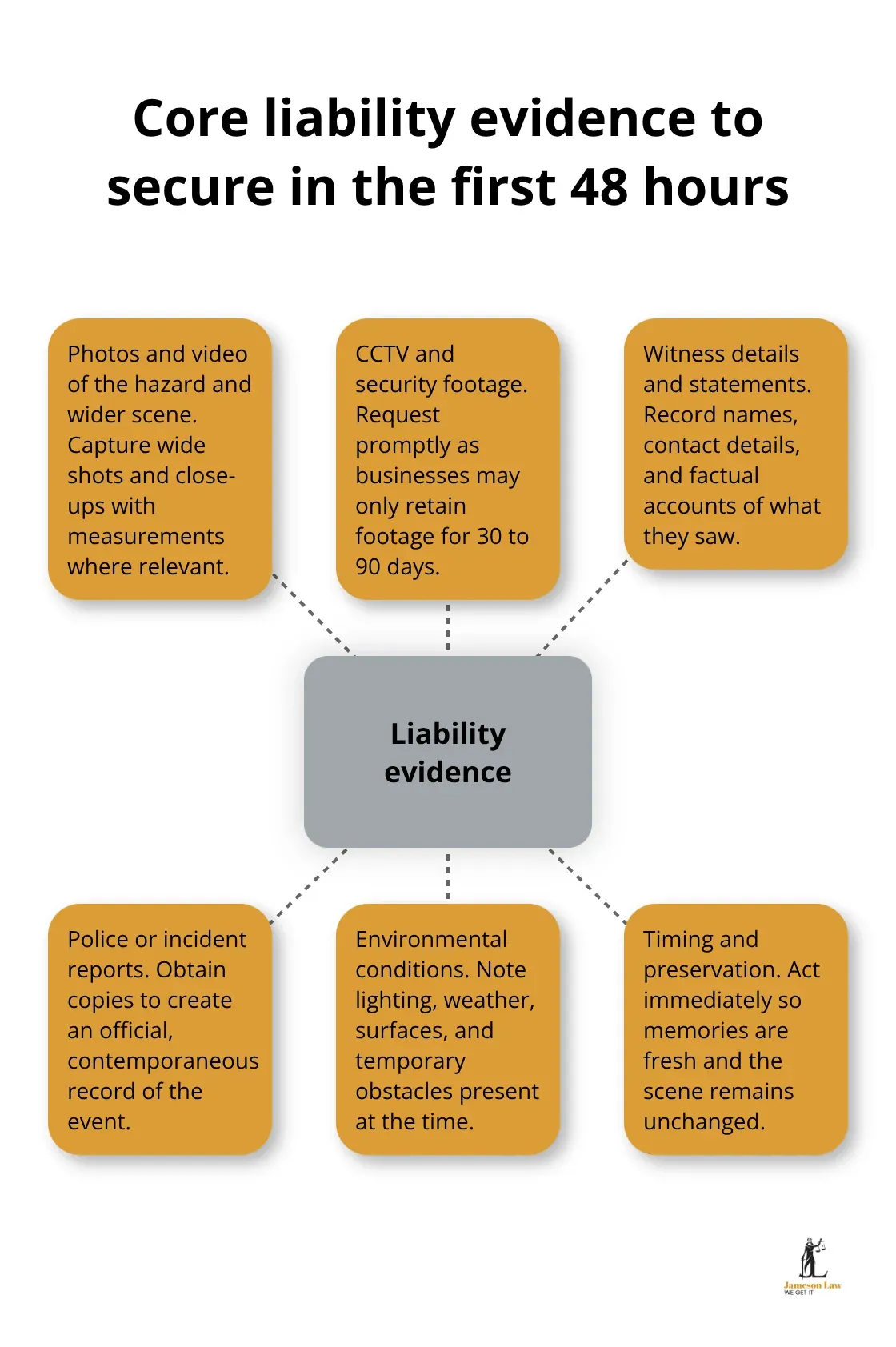
Establishing liability is where your claim either gains momentum or stalls. Medical records prove you’re injured, but liability documentation proves someone else caused that injury. Insurers won’t pay without clear evidence of fault, and courts require solid proof before awarding compensation. Start collecting liability evidence immediately after the incident because details fade, witnesses move, and scenes change. The first 24 to 48 hours are critical-this is when memories remain sharpest and physical evidence stays undisturbed. Most claimants wait weeks or months before gathering this material, which weakens their position considerably.
Photographs taken days after an incident show different conditions than those taken immediately. Witness contact details become impossible to locate once people disperse. Police reports filed promptly contain fresher observations than those filed later.
Photograph and Video the Scene
Photograph and video evidence carries substantial weight in personal injury claims because it shows objective conditions rather than relying on memory. You should take photos and videos of the accident scene, the hazard that caused your injury, any environmental factors like poor lighting or wet surfaces, and your injuries themselves. Include wide shots showing the overall scene and close-ups showing specific hazards. If a footpath was uneven, photograph the exact defect with measurements if possible. If poor lighting contributed to a fall, photograph the area at the same time of day the incident occurred.
Video footage from nearby security cameras holds invaluable value-businesses often retain this footage for 30 to 90 days, so request it quickly if the incident occurred on commercial premises. You should document weather conditions at the time, road conditions, or any temporary obstacles. Store these photographs and videos safely and ensure they carry date stamps.
Collect Witness Statements
Witness statements provide independent accounts of what happened. You should obtain names, phone numbers, email addresses, and written statements from anyone who saw the incident. Ask them to describe what they observed, not their opinions about fault. A witness statement saying “I saw the claimant slip on a wet floor” carries more value than the claimant’s account alone. If witnesses are reluctant to provide written statements, record their contact details and note what they told you immediately after the incident.
Obtain Police and Incident Reports
Police reports or incident records create an official account that courts recognise. If police attended the scene, obtain a copy of the incident report-these reports document officer observations and often include statements from witnesses and involved parties. For workplace incidents, obtain copies of incident reports filed with your employer or workplace safety representatives. For motor vehicle accidents, obtain the police report and the other driver’s insurance details. These official records establish a contemporaneous account created by someone without a stake in the outcome, which carries significant credibility weight.
With liability evidence secured, you now need to demonstrate the financial impact your injury has created.
Financial and Employment Documentation
Your injury has almost certainly cost you money beyond medical bills. Lost wages from time off work, out-of-pocket expenses for treatment, and future care costs all form legitimate parts of your compensation claim. Insurers expect detailed financial documentation because they scrutinise every dollar you claim. Without receipts, wage statements, and cost projections, you’ll struggle to recover what you’ve actually lost.
Start gathering financial evidence immediately because employers change records retention practices, receipts fade, and memory becomes unreliable over time. Most claimants underestimate their financial losses simply because they haven’t documented expenses thoroughly.
Compile Wage Loss Statements from Your Employer
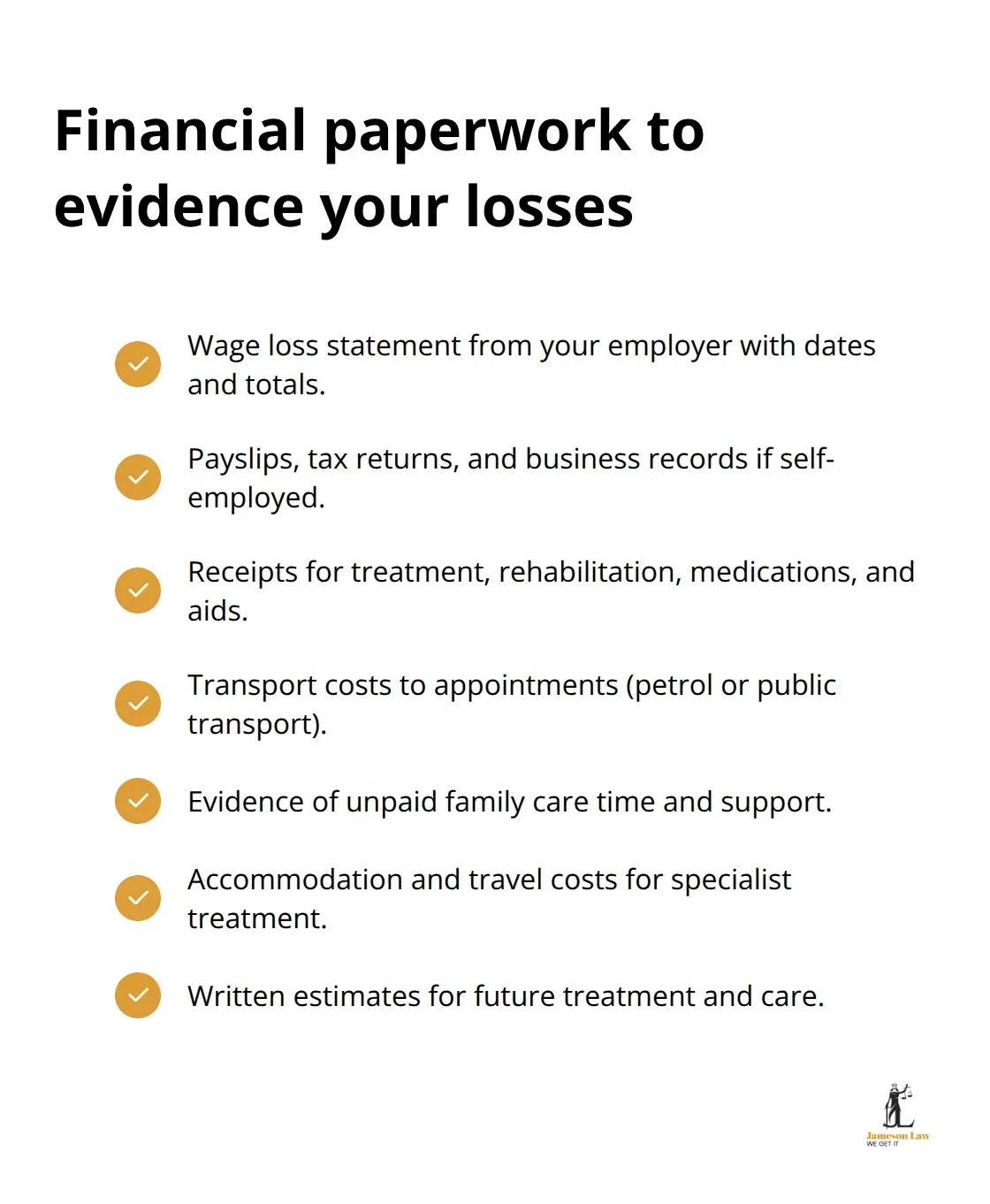
Request a detailed wage loss statement from your employer covering the exact period you couldn’t work due to your injury. This statement should show your ordinary hourly rate or salary, the dates you were absent, and the total wages lost. If you’ve taken unpaid leave or used accumulated leave to cover injury time, your employer’s records will prove this.
Wage loss calculations must reflect your actual earnings at the time of injury, not an average or estimate. Request the statement in writing and ask your employer to specify whether you received any payments during your absence such as workers compensation or sick leave.
If you’re self-employed, gather your business records, tax returns, and accounting documents showing income loss during your recovery period. Some claimants experience reduced hours rather than complete absence from work, so document the exact reduction in hours and corresponding income loss with payslips as proof.
Gather Receipts for Out-of-Pocket Expenses
Collect every receipt for costs you’ve paid privately for medical treatment, rehabilitation, medications, and medical aids. This includes physiotherapy sessions not covered by Medicare, private psychology consultations, orthotics, mobility aids, home modifications, and prescription medications. Keep receipts even for items that seem minor because they accumulate significantly.
If you’ve paid for transport to medical appointments, document these costs with petrol receipts or public transport tickets. If a family member took unpaid leave to care for you or drive you to appointments, that care has a quantifiable value in your claim. Document accommodation costs if you travelled interstate for specialist treatment.
Australian courts recognise that injury-related expenses extend far beyond GP visits, so thorough documentation of every expense strengthens your claim considerably.
Document Future Care and Treatment Costs
Your claim should include projected costs for ongoing treatment and care you’ll need after settlement. Obtain written reports from your treating doctors outlining recommended future physiotherapy, specialist reviews, counselling sessions, or ongoing medication. If your injury requires future surgery or ongoing management, request cost estimates from medical providers.
Life expectancy tables and inflation rates apply to future care calculations, so your legal team needs clear medical evidence of what treatment you’ll actually need. Some claimants receive settlement without calculating future costs adequately, then face financial hardship when they need ongoing care years later. Ask your treating medical team to provide detailed recommendations about the duration and frequency of future treatment they anticipate you’ll require based on your injury type and recovery progress.
Final Thoughts
Medical records establish the reality of your injury, liability evidence proves fault, and financial documentation quantifies your losses. You’ve now learned how to collect these materials thoroughly from the start, which transforms your injury claim process from uncertain to compelling. Incomplete documentation weakens even legitimate claims, so your strength comes from having all three categories complete and organised.
The injury claim process in New South Wales involves complex legal requirements and strict timeframes that you cannot ignore. Missing deadlines or gathering insufficient evidence can cost you thousands in compensation, which is why starting your documentation immediately after your injury occurs matters so much. Don’t wait for legal advice before photographing the scene or requesting medical records-every photograph, receipt, statement, and report builds your case incrementally.
We at Jameson Law specialise in personal injury claims and understand exactly which documents insurers scrutinise and which evidence courts find most persuasive. We work on a no win, no fee basis for plaintiff claims, meaning you pay nothing unless we recover compensation for you. Contact Jameson Law to discuss your claim with experienced lawyers who understand the injury claim process inside and out.