


If you’re facing criminal charges in NSW, sentencing guidelines NSW will shape your outcome more than you might realise. These guidelines aren’t optional suggestions-they’re the framework judges use to determine penalties, and understanding them can make a real difference to your case.
At Jameson Law, we’ve seen how sentencing guidelines directly impact our clients’ futures. The difference between knowing what to expect and walking into court unprepared can be significant.
How Sentencing Guidelines Shape Your Case
Sentencing guidelines in Australia form statutory frameworks that judges and magistrates must follow when determining penalties. In NSW, the Crimes (Sentencing Procedure) Act 1999 and the Sentencing Act 1991 establish the legal foundation for how courts apply these guidelines. The guidelines operate as concrete tools that set penalty ranges for specific offences, and courts must explain their reasoning when they depart from established ranges. The maximum penalty for an offence sets the legal ceiling, while standard sentencing practices establish a baseline. This means your sentence will almost always fall within a predictable range, determined by law rather than a judge’s personal preference. Understanding where your case sits within that range matters because the difference between a community-based order and custodial time often comes down to how aggravating or mitigating factors are weighted against the guideline baseline.
What the Guidelines Actually Control
NSW courts apply guidelines through a structured process. First, they identify the offence category and corresponding penalty range, then they adjust within that range based on your circumstances.
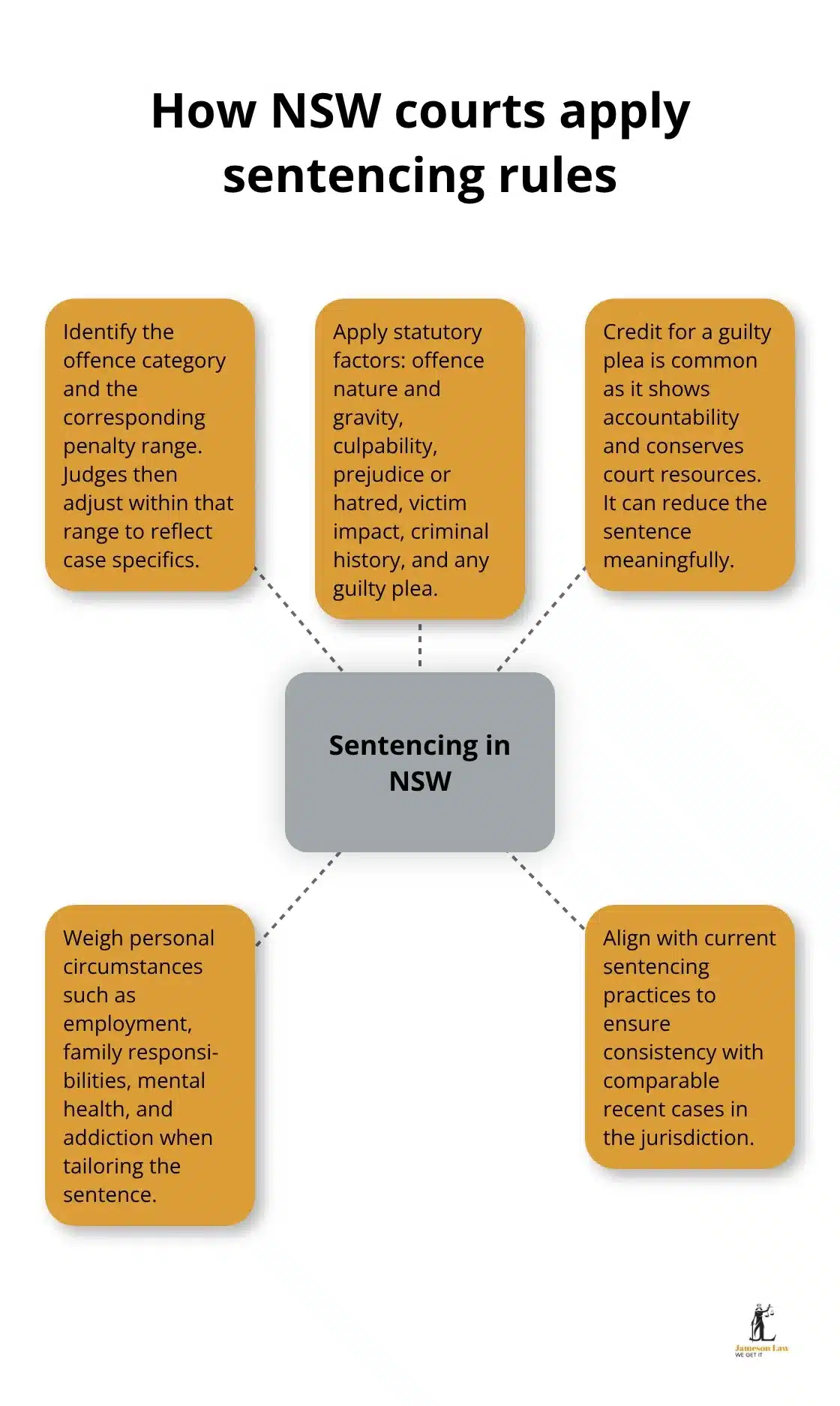
The Sentencing Act 1991 lists specific factors courts must consider: the nature and gravity of the offence, your culpability, whether the crime involved hatred or prejudice, victim impact, your criminal history, and whether you pleaded guilty. A guilty plea typically reduces your sentence, sometimes significantly, because it demonstrates accountability and saves court resources. Your personal circumstances matter too-employment status, family responsibilities, mental health issues, and addiction problems can all move your sentence downward if properly presented. Courts also apply four core principles: parsimony (the sentence must be no more severe than necessary), proportionality (punishment must match the offence’s seriousness), parity (similar offences receive similar sentences), and totality (if you face multiple charges, the combined sentence must be just). These principles prevent arbitrary outcomes and create consistency across cases, which means your lawyer can reliably predict sentence ranges before you enter the courtroom.
How Judicial Discretion Works Within Boundaries
Judges and magistrates have discretion, but it operates within strict boundaries set by legislation and precedent. They cannot sentence below the minimum or above the maximum penalty, and they must apply the statutory factors. Discretion matters most when courts weigh aggravating and mitigating factors against your specific circumstances. An offence involving group involvement or significant victim harm typically attracts harsher sentences, while early guilty pleas, rehabilitation efforts, and strong family support can reduce them substantially. Current sentencing practices also influence outcomes-courts track how similar cases have been sentenced recently and try for consistency. This is why historical sentencing data matters; if you can show that comparable offences in your jurisdiction resulted in community-based orders rather than prison time, that evidence strengthens your case. Judicial discretion also allows courts to tailor sentences to your vulnerabilities and personal needs, which is why thorough preparation of your personal circumstances statement proves essential.
Why Sentencing Data Shapes Your Defence Strategy
Historical sentencing outcomes provide the foundation for realistic case planning. NSW courts publish sentencing statistics and snapshots by date and offence type, which allow your lawyer to identify the actual ranges courts apply in practice. These data tools reveal patterns that statutory guidelines alone cannot show-they demonstrate how courts have weighted factors in cases similar to yours. When you face charges, your legal team should analyse comparable cases from your jurisdiction to establish what sentence range you can realistically expect. This analysis informs whether to pursue a guilty plea (which typically reduces sentences), contest certain facts, or prepare comprehensive mitigation material. The gap between the statutory maximum and what courts actually impose in practice can be substantial, and understanding that gap changes how you approach your case. Courts also consider whether your offence falls at the lower, middle, or upper end of the guideline range, and this positioning depends heavily on how your circumstances compare to previous cases.
Moving Forward With Your Case
The structured nature of sentencing guidelines means your outcome is not arbitrary or unpredictable. Courts follow established frameworks, apply statutory factors consistently, and explain their reasoning. This predictability allows your legal team to prepare a targeted defence strategy that addresses the specific factors courts will weigh. The next step involves understanding which aggravating and mitigating factors apply to your particular charges and how to present them most effectively to the court.
What Actually Moves Your Sentence Up or Down
How Aggravating Factors Push Sentences Higher
Sentencing guidelines establish a baseline, but aggravating and mitigating factors determine where within that range your sentence actually lands. Courts must consider specific circumstances that either increase or decrease penalties, and understanding which factors apply to your case shapes realistic case planning.
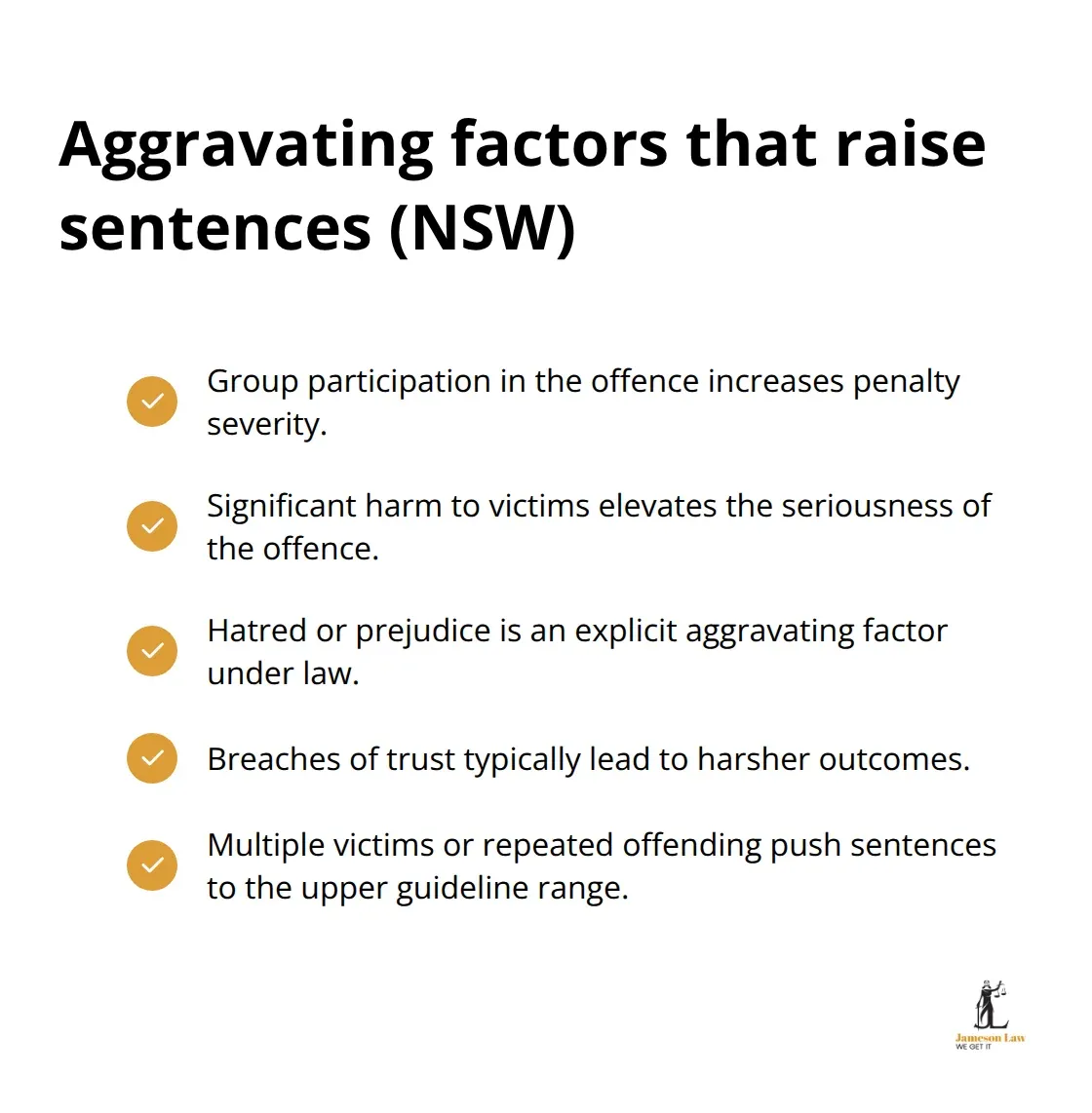
Aggravating circumstances that push sentences higher include offences involving group participation, significant harm to victims, crimes motivated by hatred or prejudice, and breaches of trust. The Sentencing Act 1991 explicitly names hatred or prejudice as an aggravating factor that courts treat seriously, which means if your offence involved discrimination based on race, religion, disability, sexuality, or gender identity, the court will impose a harsher sentence than it would for an identical offence without that element. Victim impact also matters substantially-courts consider the direct injury, loss, or suffering the victim experienced, and if a victim provides an impact statement, that evidence often strengthens the prosecution’s case for a higher sentence. Multiple victims or repeated offending within the same incident typically results in sentences at the upper end of the guideline range.
Mitigating Factors That Reduce Your Sentence
Mitigating factors that reduce sentences include early guilty pleas, genuine remorse, rehabilitation efforts, stable employment or education, strong family support, mental health issues or addiction that contributed to the offence, and cooperation with authorities. An early guilty plea can reduce your sentence depending on the offence type and when you enter the plea, which is why your legal team should evaluate this option early. Your personal circumstances matter significantly-if you have caring responsibilities, stable housing, mental health treatment already underway, or employment prospects, these factors demonstrate to the court that you’re not a risk to reoffend and that community-based supervision will work.
Criminal History as a Sentencing Determinant
Your criminal history operates as a separate but critical sentencing factor that courts weigh heavily. First-time offenders typically receive sentences at the lower end of the guideline range or even below it, while offenders with prior convictions for similar offences face substantially harsher sentences. Courts view prior criminal history as evidence of your failure to comply with previous court orders and as a strong indicator that general deterrence is necessary.
If your previous convictions are dated or unrelated to the current offence, your lawyer should emphasise that distinction, as courts distinguish between a single old conviction and multiple recent convictions for similar crimes. The nature of your prior offences matters too-previous violence convictions make courts more cautious about community-based orders for violent offences, while theft convictions increase sentences for dishonesty crimes. However, courts also recognise rehabilitation; if you’ve spent years without reoffending and have demonstrable evidence of changed behaviour, that can mitigate the impact of historical convictions.
Using Sentencing Data to Build Your Defence
The gap between your last conviction and current offence matters significantly-a ten-year gap suggests genuine rehabilitation, whereas a six-month gap suggests ongoing criminal behaviour. When preparing your case, your legal team should analyse your full criminal history, analyse how courts have sentenced similar offenders with comparable histories, and develop a narrative about rehabilitation if your history includes prior convictions. Courts publish sentencing snapshots and statistics showing actual outcomes for offenders with prior convictions in your jurisdiction, so realistic expectations depend on understanding not just the guidelines but how courts actually sentence people with your specific criminal history profile.
This analysis of your personal circumstances, criminal history, and the aggravating or mitigating factors specific to your charges forms the foundation for the next critical step: understanding what sentence types courts actually impose and how those types affect your life after sentencing.
What Sentence Types Will You Actually Face
NSW courts impose different sentence types depending on offence severity, your criminal history, and the aggravating or mitigating factors in your case. Understanding which sentence types courts typically use for your offence category matters because the difference between a community-based order and full-time custody fundamentally changes your life. The Crimes (Sentencing Procedure) Act 1999 establishes the available sentence options, and courts select from these based on how they’ve weighted the sentencing principles and factors we discussed earlier.
Custodial and Community-Based Sentences
Custodial sentences (immediate imprisonment or sentences with a non-parole period) apply to serious violent offences, repeat offenders, or offences involving significant harm. Community-based orders, including conditional release orders with supervision requirements, apply when courts assess that you’re not a danger to the community and that rehabilitation is achievable without custody. Intensive correction orders sit between these extremes, requiring you to serve time in the community under strict conditions rather than in prison. Suspended sentences, where imprisonment is imposed but not served immediately, apply when courts want to signal the seriousness of your conduct while offering you a final opportunity to avoid custody. Fines operate as the lowest-level penalty for minor offences or when courts assess that financial penalty adequately reflects the offence’s seriousness. The sentence type courts select depends directly on how they’ve rated your culpability and the offence’s gravity within the guideline range.
How Courts Work Backwards From Maximum Penalties
Sentencing guidelines establish penalty ranges by working backwards from the maximum penalty set by legislation. For example, an offence carrying a maximum of ten years imprisonment might have a standard sentencing range of three to six years for mid-range offending, with lower-end cases receiving community-based orders and upper-end cases approaching the maximum. Courts identify where your specific circumstances place you within that range, then select an appropriate sentence type.
Real Outcomes Versus Maximum Penalties
An offence of assault occasioning bodily harm carries a maximum of five years imprisonment, but NSW courts actually impose custodial sentences in fewer than half of cases; most result in community-based orders or suspended sentences for first-time offenders without aggravating factors. Theft offences show similar variation: maximum penalties range from five to ten years depending on value and circumstances, but courts impose custody in only around 30 per cent of cases overall, with first offenders typically receiving fines or community orders. Driving under the influence carries a maximum of ten years for aggravated cases, yet most standard cases result in fines, licence disqualifications, and possibly community service rather than custody.
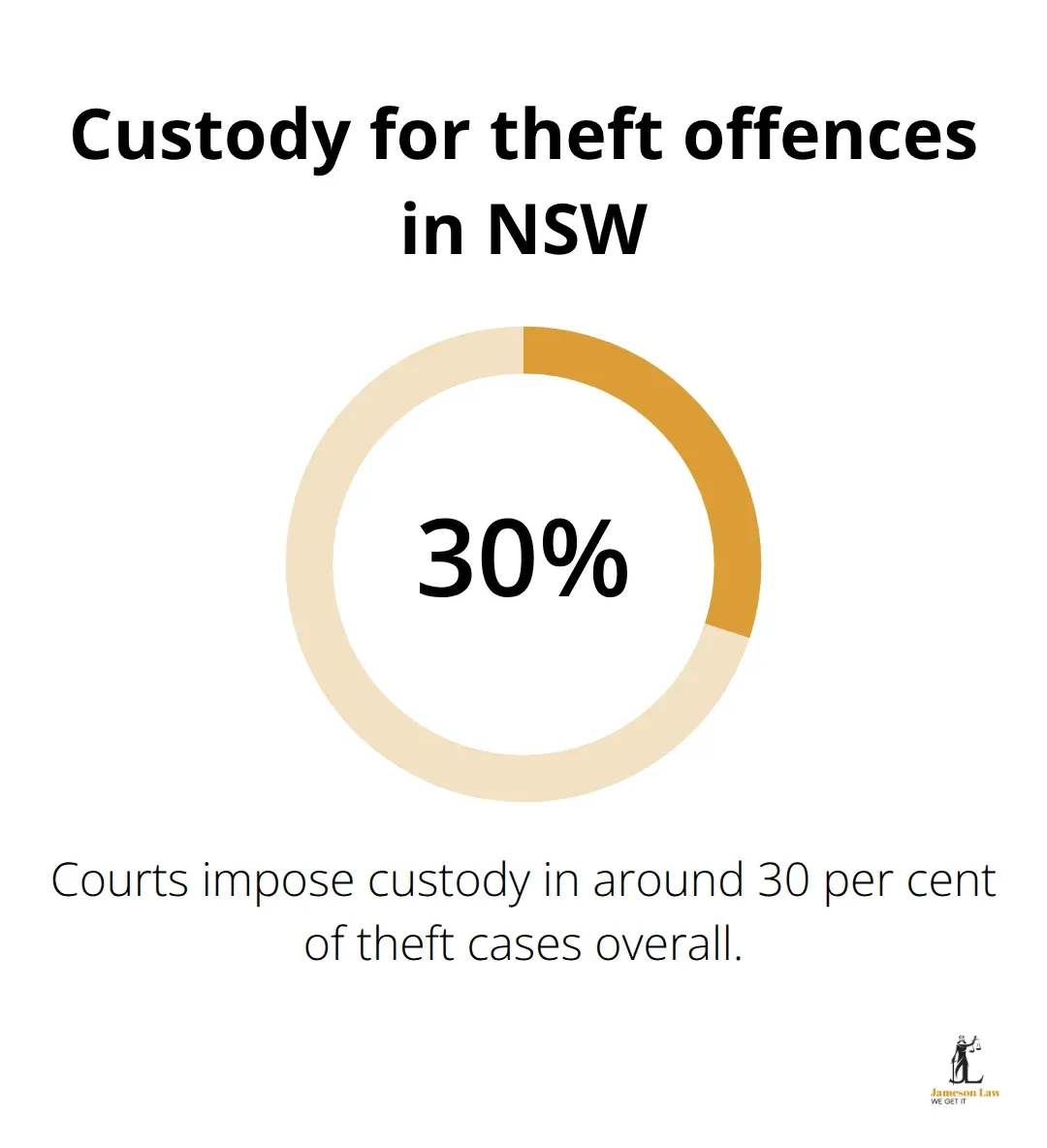
This gap between the maximum and what courts actually impose reflects how sentencing guidelines operate in practice; the maximum represents the worst possible case, not the typical outcome.
Using Sentencing Data for Realistic Expectations
When your lawyer assesses your case, they should compare your circumstances not to the maximum penalty but to the actual sentence ranges courts have imposed for similar offences in your jurisdiction. NSW publishes sentencing snapshots that show actual outcomes by offence type and offender characteristics, which means your realistic expectation depends on understanding the data courts themselves use when sentencing similar cases.
Final Thoughts
Sentencing guidelines NSW operate as the framework that determines your outcome, but they’re not mysterious or arbitrary. Courts follow structured processes, apply statutory factors consistently, and must explain their reasoning when they sentence you. The difference between understanding how these guidelines work and walking into court unprepared often determines whether you receive a community-based order or custodial time.
Your sentence depends on where your circumstances fall within the guideline range for your offence. Aggravating factors like victim harm or hatred-motivated conduct push sentences higher, while mitigating factors like early guilty pleas, rehabilitation efforts, and strong personal circumstances pull them lower. Your criminal history matters significantly, but courts recognise that rehabilitation is possible, especially if years have passed since your last conviction (the gap between your last conviction and current offence demonstrates whether genuine change has occurred).
We at Jameson Law provide practical criminal law advice that helps you understand your realistic options and what to expect from the sentencing process. Contact us to discuss your case and develop a strategy that addresses the specific factors courts will weigh when determining your sentence.