


A dangerous driving NSW charge can derail your life in seconds. The penalties are severe, the consequences extend far beyond the courtroom, and the stakes demand proper legal guidance.
At Jameson Law, we’ve helped countless clients navigate these charges and understand their options. This guide breaks down what the law considers dangerous driving, the penalties you face, and the defence strategies that actually work.
What the Law Actually Considers Dangerous Driving
Dangerous driving under NSW law is defined in the Crimes Act 1900 as operating a vehicle in a manner that is dangerous to the public, having regard to all the circumstances of the case. This isn’t about a single mistake or momentary lapse. The courts assess your entire driving pattern, the road conditions, traffic density, and what a reasonable driver would do in those circumstances. NSW Courts have consistently held that dangerous driving requires conduct that falls significantly below acceptable standards.
Speed Alone Doesn’t Tell the Whole Story
Speed limits exist, but courts examine whether you drove appropriately for the actual conditions present. The critical question in a dangerous driving charge is whether your speed was dangerous relative to those specific circumstances. Driving at 60 km/h in a residential area during school hours carries different weight than the same speed on an empty highway. Courts examine whether you maintained proper control of your vehicle, kept adequate following distances, and responded appropriately to hazards.
How Weather and Road Conditions Change What’s Reasonable
Rain, fog, heavy traffic, or night-time driving all alter what constitutes reasonable speed. A driver who maintains control, responds to hazards, and adjusts their speed to match conditions demonstrates responsible behaviour. Conversely, a driver who fails to adapt their speed or following distance to deteriorating conditions (even if technically within the speed limit) may face dangerous driving charges. The legislation focuses on whether your driving created an objective risk of harm to others, not just whether an accident occurred.
Fatigue and Impairment Strengthen Charges Significantly
Fatigue significantly impairs driving ability. If you operated a vehicle while fatigued to the point where you couldn’t maintain control or respond to road conditions, this strengthens a dangerous driving charge substantially.
Driving under the influence of alcohol or drugs receives particular severity from prosecutors. Any operation of a vehicle with a blood alcohol concentration above the legal limit, combined with dangerous manner, creates a strong foundation for these charges. The combination of impairment and dangerous conduct is what prosecutors focus on most aggressively.
Understanding the Full Picture Courts Consider
The courts don’t isolate one factor in isolation. They examine your entire driving pattern, the specific road environment, traffic density, and what a reasonable driver would have done in those exact circumstances. This comprehensive approach means that even if you weren’t speeding, you could still face dangerous driving charges if your overall conduct fell significantly below acceptable standards.
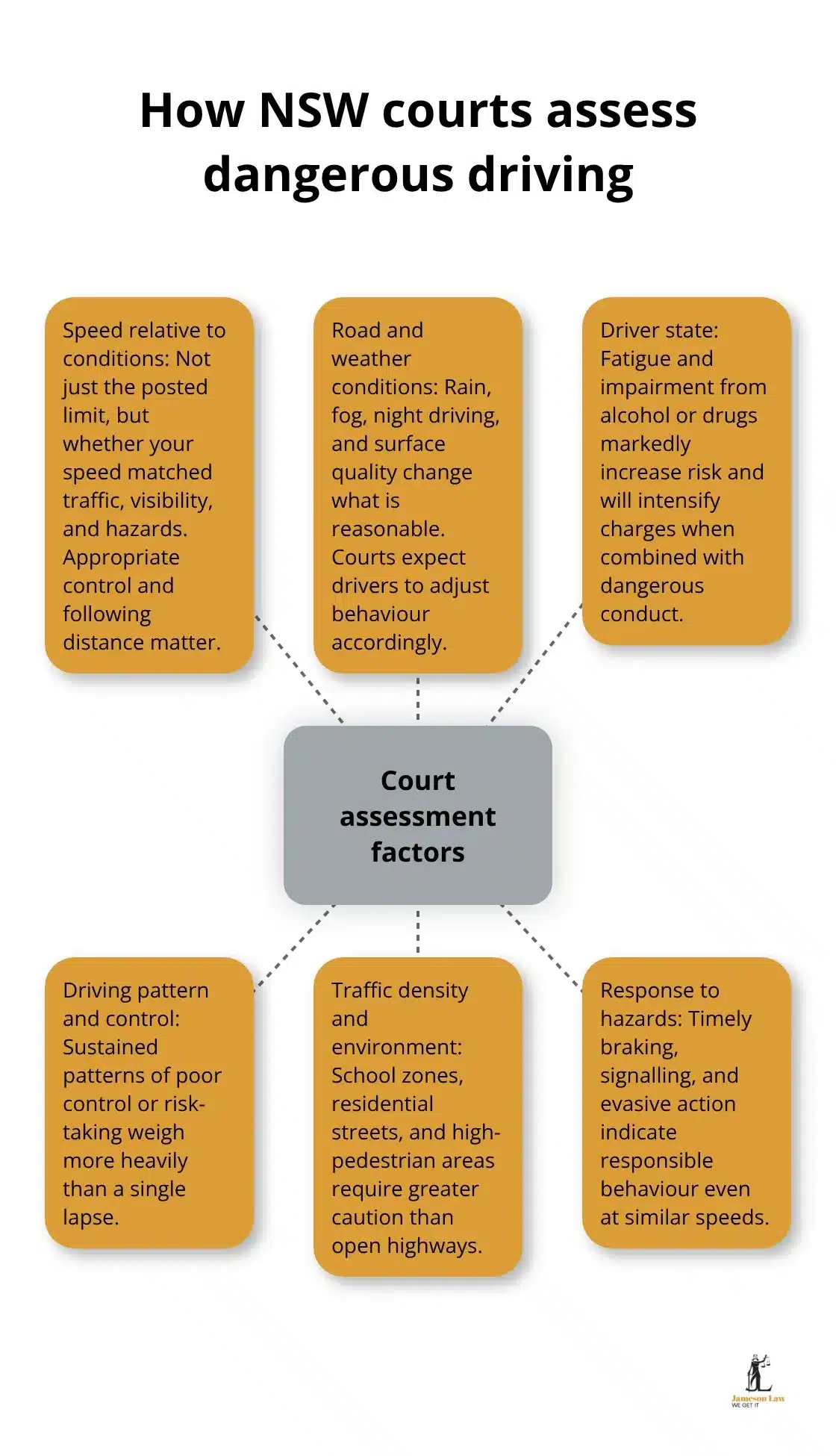
Understanding how courts weigh these factors is essential when you’re facing charges, which is why the specific circumstances of your case determine your available defences and options.
Penalties and Consequences for Dangerous Driving
A dangerous driving conviction in NSW carries penalties that extend far beyond a fine or a few months without a licence. The Crimes Act 1900 sets maximum imprisonment at 10 years for dangerous driving causing death, and up to 5 years for standard dangerous driving charges. NSW courts impose prison sentences ranging from 6 months to several years depending on aggravating factors like prior offences, excessive speed, or presence of passengers. Fines typically range from $3,300 to $3,850 for a first offence, but courts can impose significantly higher penalties if your driving caused injury or property damage.
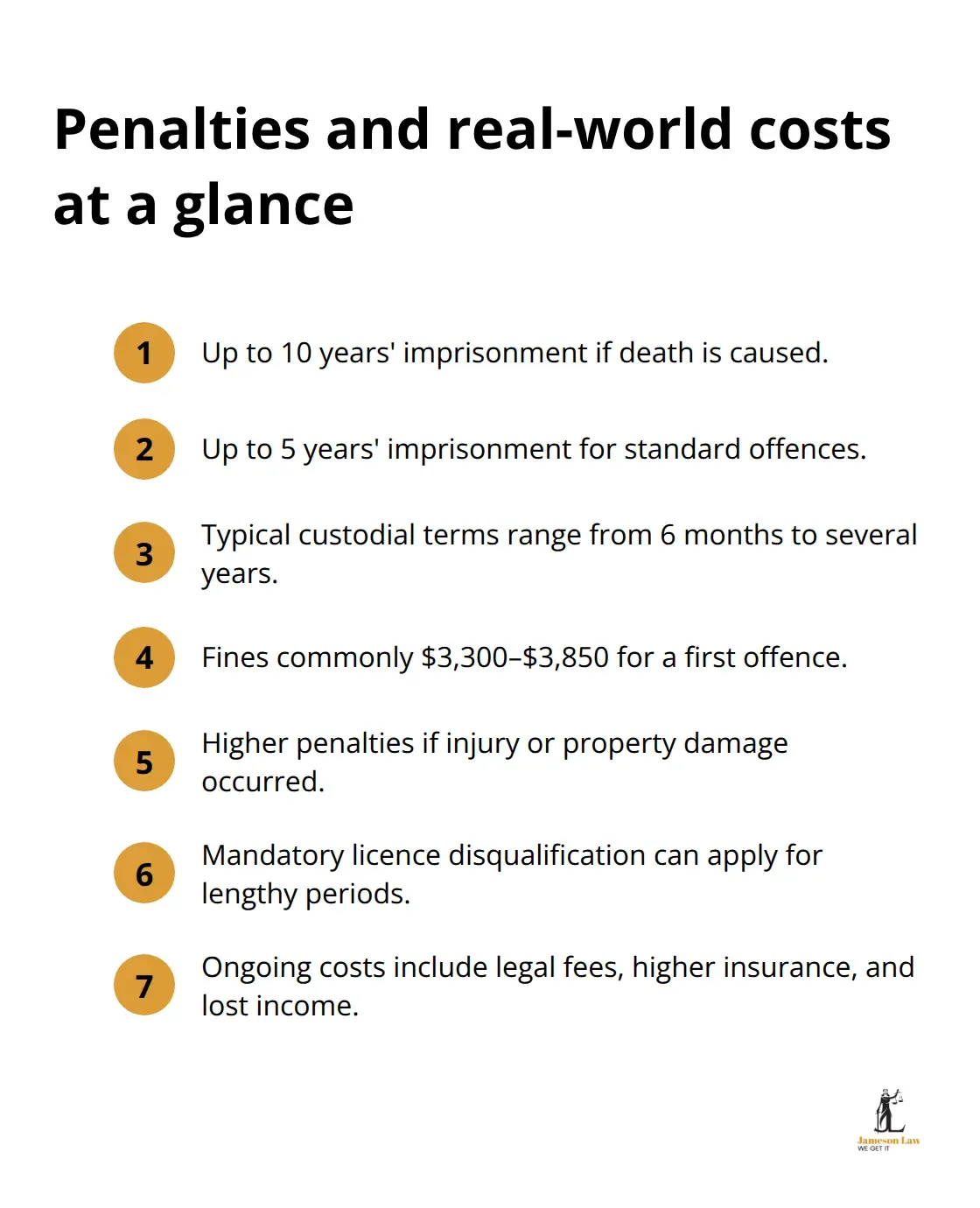
Legal defence costs, increased insurance premiums (if you can obtain coverage at all), and lost income from imprisonment or licence suspension accumulate quickly.
Licence Disqualification Creates Immediate Hardship
Mandatory licence disqualification for dangerous driving ranges from a minimum of 12 months to indefinite periods, depending on the court’s assessment of your circumstances and any prior traffic history. The disqualification period begins from the date of conviction, meaning you cannot legally drive regardless of hardship or employment impact. NSW courts show little sympathy for licence suspension cases involving dangerous driving, particularly when you operated a vehicle recklessly. Attempting to drive while disqualified compounds your legal problems significantly, adding charges under the Road Transport Act 2013 that carry their own penalties and fines.
If your employment depends on a valid licence, disqualification effectively ends your career in that field until the period expires. Tradespeople, delivery drivers, sales representatives, and professional drivers face complete income loss during disqualification periods. NSW courts rarely grant early licence restoration through special circumstances applications for dangerous driving convictions.
Employment Consequences Extend Beyond Immediate Income Loss
Employers conducting background checks discover dangerous driving convictions, and many organisations maintain policies prohibiting employment of individuals with serious driving offences regardless of when the conviction occurred. Teaching, childcare, healthcare, finance, and government positions all conduct background checks that reveal serious driving offences. Some professional bodies maintain their own conviction disclosure requirements that extend beyond standard employment screening. A dangerous driving conviction can permanently exclude you from certain careers or require you to disclose the conviction on job applications indefinitely.
The conviction also affects professional licensing in fields like nursing, law, and accountancy. Financial institutions sometimes deny credit applications to applicants with recent serious convictions, complicating property purchases or business loans.
Insurance Premiums and International Travel Complications
A dangerous driving conviction makes obtaining motor vehicle insurance extremely difficult for years after your licence is restored. Standard insurers reject applicants with recent serious driving convictions, forcing you toward specialist high-risk insurers who charge premiums 3 to 5 times higher than standard rates. These elevated premiums continue for approximately 5 to 10 years following conviction, depending on the insurer’s underwriting policies.
International travel becomes complicated if you hold a criminal conviction, as many countries require visa applications to disclose serious offences or may deny entry entirely. These compounding consequences (financial, professional, and personal) accumulate far beyond the initial court penalty, which is why understanding your legal options before conviction becomes critical.
Defending Against Dangerous Driving Charges
The moment you face dangerous driving charges, your instinct might push you toward accepting responsibility or hoping the matter resolves quickly. This approach costs people their freedom, their careers, and their financial security. The prosecution must prove beyond reasonable doubt that your driving was dangerous, and this burden of proof creates genuine opportunities for effective defence. The specific circumstances of your case determine whether you have viable defences available, and identifying these early makes the difference between conviction and acquittal.
Evidence Gathering Starts Immediately
Evidence collection begins the moment charges are laid, not weeks later when memories fade and footage disappears. Dashcam recordings, witness statements, vehicle maintenance records, and road condition documentation all become critical to your defence. If police stopped you, their procedures matter significantly-improper breath testing protocols, faulty equipment calibration, or procedural breaches can render evidence inadmissible.
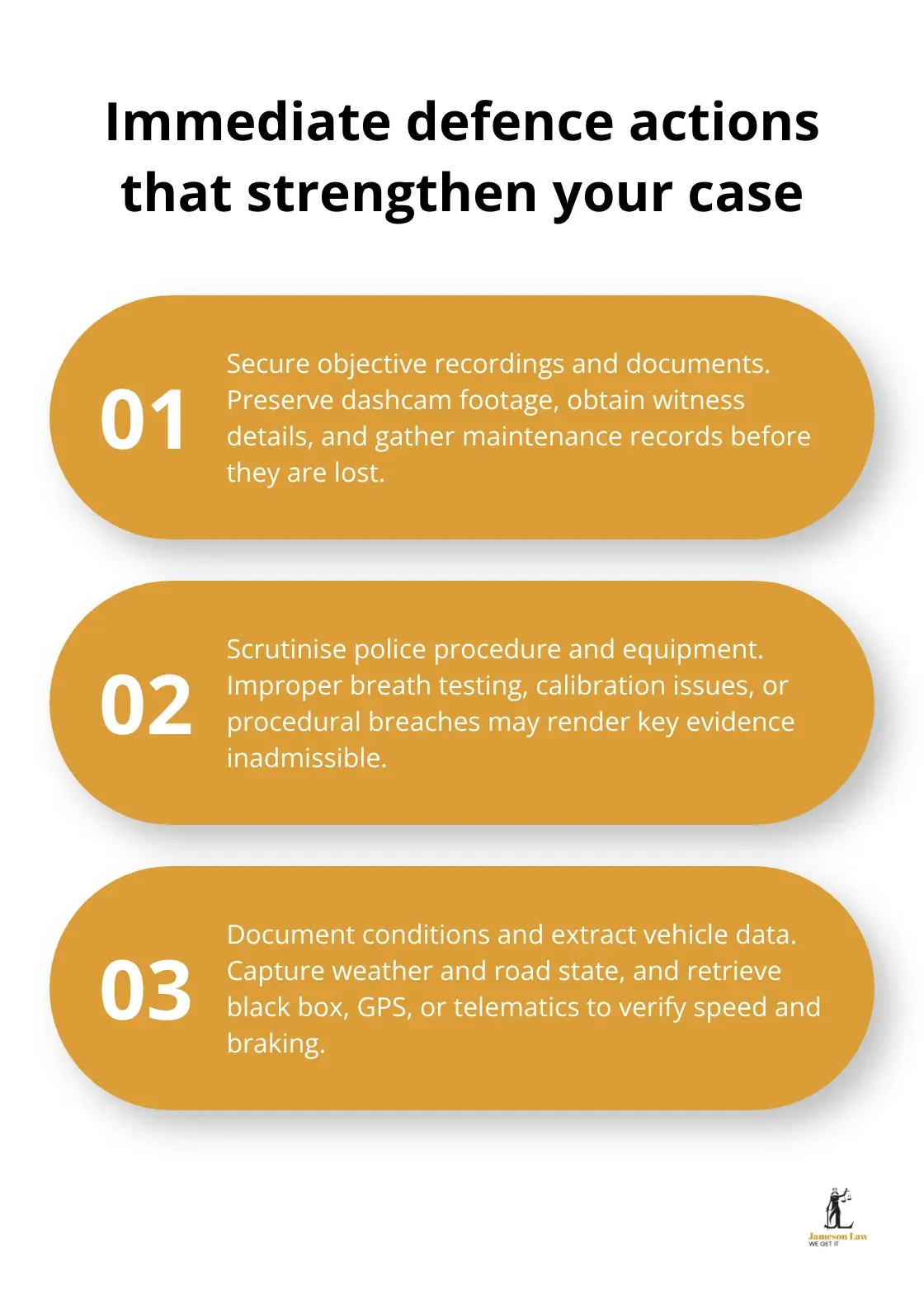
Weather conditions at the time of the incident often prove essential to your defence, particularly if you faced charges despite driving at reasonable speeds for prevailing conditions.
Medical evidence showing you were not fatigued, toxicology reports proving you were under the legal limit, or expert testimony about vehicle defects all support viable defence positions. Vehicle data from your car’s black box, GPS records, or telematics systems can establish your actual speed and braking patterns, contradicting police estimates or witness recollection. We at Jameson Law recommend securing these records within days of charges, as they’re often overwritten or lost within weeks.
Challenging the Prosecution’s Case
The prosecution’s case often relies heavily on witness accounts, and these accounts frequently contain inaccuracies or contradictions that undermine their narrative. Police statements claiming you travelled at dangerous speeds can be challenged through independent speed analysis. Witness statements can be contradicted through cross-examination. The prosecution’s case often depends on assumptions rather than concrete evidence, and identifying these gaps requires legal expertise and immediate investigation.
Early Legal Representation Changes Outcomes
Waiting to seek legal representation until your court date arrives is a critical mistake. Criminal defence lawyers need time to obtain police evidence, identify procedural breaches, locate witnesses, and develop your defence strategy. Most people facing dangerous driving charges don’t understand that the prosecution must disclose its evidence to your lawyer weeks before trial, and this disclosure period is when your defence becomes strongest. Early legal involvement allows your lawyer to challenge weak evidence before trial, negotiate with prosecutors from a position of strength, and sometimes resolve matters without conviction.
Why Self-Representation Fails
Representing yourself in dangerous driving charges is extraordinarily risky-the courts don’t give you credit for being your own lawyer, and procedural errors cost you defences permanently. The difference between conviction and acquittal often comes down to whether your legal representation identified evidentiary weaknesses early enough to challenge them effectively. A lawyer experienced in NSW dangerous driving cases understands local prosecutors and judges, providing significant tactical advantages that self-representation cannot match.
Final Thoughts
Dangerous driving NSW charges threaten your freedom, career, and financial stability in ways that extend far beyond the courtroom. The law does not require an accident to occur-prosecutors need only prove your driving fell significantly below acceptable standards and created objective risk to others. Understanding what constitutes dangerous driving, the penalties courts impose, and your available defences gives you the foundation to protect yourself effectively.
You possess substantial rights in these matters. You have the right to challenge the prosecution’s evidence, to obtain disclosure of their case before trial, and to present your own defence. The burden of proof rests entirely with prosecutors, and this burden is high-many dangerous driving charges contain evidentiary weaknesses that skilled legal representation can expose and exploit. Early intervention by a lawyer experienced in NSW traffic and criminal law often changes outcomes dramatically, sometimes preventing conviction entirely, sometimes negotiating reduced charges, and sometimes securing lighter penalties than courts would otherwise impose.
Contact Jameson Law to discuss your specific circumstances with a lawyer who understands dangerous driving law. The sooner you obtain legal advice, the sooner your lawyer can gather evidence, identify procedural breaches, and develop your defence strategy. Waiting costs you time and opportunity, as the difference between conviction and acquittal often depends on actions taken in the first days after charges are laid.