


Proving personal injury negligence requires more than just saying someone was careless. You need solid evidence and a clear understanding of what the law actually demands.
At Jameson Law, we’ve helped countless clients build strong negligence claims by focusing on four essential elements. This guide walks you through exactly what you need to prove, how to gather the right evidence, and what obstacles you might face along the way.
What You Need to Prove in a Negligence Claim
The law in New South Wales sets out four specific elements you must prove to win a negligence claim. Under the Civil Liability Act 2002 (NSW), courts will not award compensation unless you demonstrate all four. This is not theoretical-it shapes every piece of evidence you gather and every argument you make.
Establishing Duty of Care
First, you must show the defendant owed you a duty of care. This sounds abstract, but it is concrete. If you slip on a wet floor in a supermarket, the store owner owes you a duty to keep the floor safe. If a doctor treats you, they owe you a duty to provide competent care. If a builder performs work on your home, they owe you a duty to do the work properly. The key is identifying the legal relationship that creates the obligation. Courts recognise duty of care in common scenarios-occupiers to visitors, drivers to other road users, employers to employees, professionals to clients-but if your situation is unusual, you will need to prove foreseeability and proximity between you and the defendant. Under the Civil Liability Act, a person does not owe a duty of care to warn of an obvious risk.
Proving Breach of Duty
Second, you must prove the defendant breached that duty. This means showing they failed to meet the standard a reasonable person would have met in the same circumstances. Section 5B of the Civil Liability Act sets the test: would a reasonable person have taken precautions? Courts weigh the likelihood and seriousness of harm against the burden of taking those precautions. If a retailer knew their floor was slippery and fixing it cost $200, a court will likely find a breach if they did nothing. Documentation is your weapon here-collect photographs of hazardous conditions, maintenance records, safety protocols, and incident reports.
Establishing Causation
Third, you must prove causation in negligence claims. You must prove the breach caused your injury, not just that it happened around the same time. This requires two steps under NSW law: factual causation (but for the breach, would you have been injured?) and scope of liability (should the law hold the defendant responsible for this type of harm?). Medical evidence is essential. Your treating doctor’s report links your injury to the incident, and an independent medical examination creates a strong causal chain. Without this, you have only circumstantial connection.
Quantifying Your Damages
Fourth, you must quantify your damages. This means proving actual financial loss-medical bills, lost wages, ongoing care costs, and pain and suffering. Keep every receipt, medical invoice, and payslip. Record lost income by date and amount. If you require future care, obtain expert assessments of those costs. Courts will not award compensation for vague or unsubstantiated losses. The Civil Liability Act caps non-economic loss (pain and suffering) and limits loss of income to three times the average weekly earnings in some cases, so understanding these caps early helps you value your claim realistically.
Time Limits and Immediate Action
Most negligence claims in NSW must start within three years of discovering the injury and its link to the defendant’s actions. This deadline is absolute for most claimants, though minors and people with disabilities have different rules. The three-year window means gathering evidence and obtaining legal advice quickly is not optional-it is essential to preserving your right to claim. Once you understand what you must prove, the next step is knowing where to find the evidence that supports each element.
What Evidence You Actually Need to Gather
Medical Reports Form the Foundation of Your Claim
Your treating doctor’s report establishes the direct link between the incident and your injury-this is non-negotiable. However, a treating doctor’s report alone rarely satisfies courts. You need an independent medical examination from a specialist in your injury type. If you suffered a back injury, an orthopaedic surgeon must conduct the IME. If you have psychological harm, a psychiatrist must assess you. These independent reports carry weight because they come from doctors with no stake in your outcome.
Obtain these reports early, ideally within three to six months of the incident, because memories fade and medical records become harder to access. Keep every medical invoice, prescription receipt, and therapy bill-these documents prove the financial impact of your injury and support your damages claim. If you require ongoing treatment, ask your doctor to provide a prognosis and cost estimate for future care, as courts will factor this into your compensation.
Witness Statements Require Immediate Action
Witness statements hold significant power, but only if you gather them properly. Contact witnesses within days of the incident, not weeks later, because their recollection deteriorates rapidly. Obtain their full details-name, phone number, address, email-and ask them to write down what they saw in their own words, then sign and date it.
Photographs of the incident scene provide essential evidence of the breach. If you slipped on a wet floor, photograph the hazard, the lack of warning signs, and the area around it. Take photos from multiple angles and include timestamps. If the defendant later claims they fixed the hazard or posted a warning, your photographs prove otherwise. Document the scene within 24 hours if possible; courts understand that hazards may be remedied quickly. If you cannot return to the scene, ask a friend or family member to take photographs on your behalf.
Financial Records Demand Precision and Detail
Keep records of your lost income with payslips, emails from your employer confirming time off, and a letter from your employer stating your regular wages. If you are self-employed, bank statements and tax records demonstrate your lost earnings. Do not rely on rough estimates-courts demand specificity.
Record every out-of-pocket expense: transport to medical appointments, medication costs, aids and equipment you purchased, and modifications to your home or vehicle. A spreadsheet with dates, amounts, and descriptions creates a clear financial picture. If your injury affects your ability to work long-term, obtain an occupational assessment that quantifies your future earning capacity loss. This expert evidence translates your injury into financial terms that courts recognise and award.
Building Your Evidence Timeline
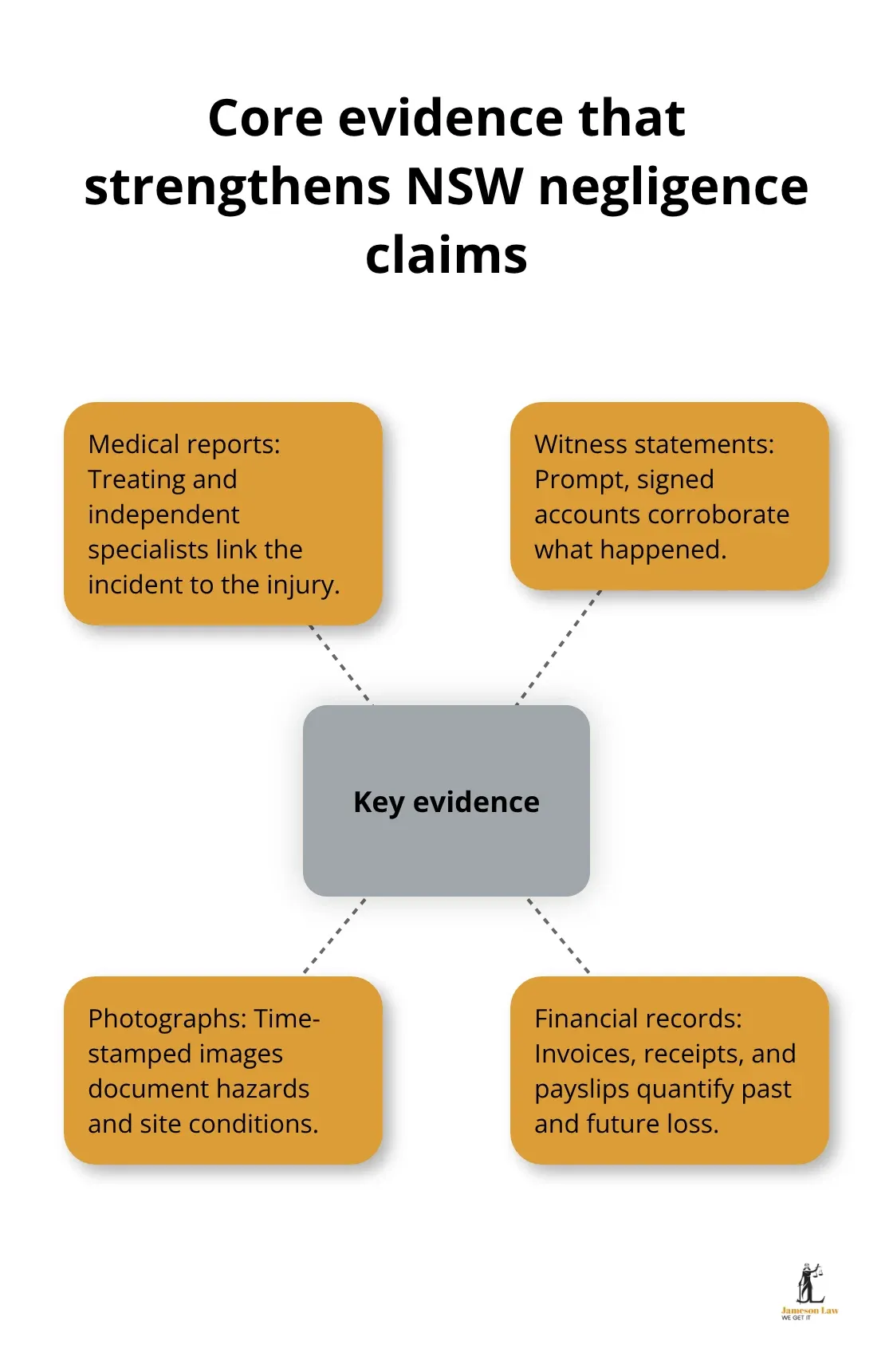
The strength of your negligence claim depends on how systematically you collect and organise evidence. Medical reports establish causation, witness statements corroborate your account of events, photographs document the hazard or breach, and financial records quantify your loss. Each piece of evidence supports one or more of the four elements you must prove. When you present these materials to a lawyer or court, they form a coherent narrative that connects the defendant’s breach directly to your injury and financial harm.
The next challenge lies in anticipating how the defendant will attack your evidence and what defences they may raise.
Common Defences Defendants Raise Against Negligence Claims
Defendants rarely accept responsibility without a fight, and understanding their common defences will help you anticipate weak points in your claim and strengthen your evidence before they exploit them.
How Defendants Attack Causation
The most frequent challenge you will face is causation. A defendant will argue that your injury resulted from something else entirely, or that multiple factors contributed to your harm in ways that break the causal chain. If you suffered injury in a car accident and had a pre-existing back condition, the defendant’s lawyer will claim your pain would have worsened anyway, regardless of their client’s negligence.
This is where independent medical evidence becomes your strongest tool. An orthopaedic surgeon’s report that specifically states the defendant’s actions directly caused or materially aggravated your injury defeats this argument far more effectively than your own account. Courts apply the eggshell skull rule under NSW law, meaning the defendant takes you as they find you, but you must still prove the breach caused additional harm beyond your pre-existing condition.
Obtain detailed medical reports that separate your baseline condition from the injury caused by negligence. Quantify the additional loss and reference this distinction explicitly in your claim. Your treating doctor should provide a prognosis that isolates the defendant’s contribution to your current state.
Comparative Negligence and Your Own Conduct
Comparative negligence presents a second major obstacle. The defendant will argue you contributed to your own injury by not taking reasonable steps to protect yourself. If you slipped on a wet floor but were not watching where you walked, they will claim you were partly at fault. Under the Civil Liability Act 2002 (NSW), courts can reduce your compensation proportionally to your contribution to the harm.
The solution is straightforward: gather evidence that demonstrates you took reasonable care. If you walked at a normal pace on what appeared to be a dry floor, witness statements confirming this undermine the defendant’s claim that you were careless. If you wore appropriate footwear and did not rush, photograph your shoes and document the conditions. Courts assess comparative negligence on the balance of probabilities, so your evidence must show a reasonable person in your position would have acted the same way.
The Obvious Risk Defence
Defendants invoke obvious risk arguments under Section 5H of the Civil Liability Act, asserting that you assumed the risk by participating in an inherently dangerous activity or ignoring a warning. This defence rarely succeeds if the defendant’s conduct went beyond the obvious risk itself. A sporting injury from normal play may be an obvious risk, but an injury from defective equipment is not.
A warning sign near a hazard does not eliminate liability if the defendant negligently created the hazard in the first place. Gather evidence showing the risk was not obvious, or that the defendant’s breach exceeded what a reasonable warning could address. Document the absence of warnings if none existed, and obtain expert evidence that the hazard was not apparent to a reasonable person in your circumstances.
Final Thoughts
Proving personal injury negligence requires you to establish four distinct elements that work together seamlessly. You must show that the defendant owed you a duty of care, breached that duty, caused your injury through that breach, and caused quantifiable financial loss. Courts will not award compensation unless you present evidence that satisfies all four elements under the Civil Liability Act 2002 (NSW).
Documentation separates successful claims from failed ones. Medical reports from independent specialists, witness statements gathered promptly, photographs of the incident scene, and detailed financial records transform your account into compelling proof that courts recognise and reward. Defendants will challenge your evidence at every turn, so you must anticipate their arguments about causation, comparative negligence, and obvious risk before they raise them. Contact Jameson Law for a confidential discussion about your personal injury negligence claim and what your circumstances might be worth, as time limits apply and early legal advice protects your rights.