Securing permanent residency in Australia requires understanding multiple pathways, realistic timelines, and specific eligibility criteria. The process varies significantly depending on whether you’re applying through skilled migration, family sponsorship, or business investment channels.
At Jameson Law, we’ve guided countless applicants through these complex requirements. This guide breaks down your options and what to expect at each stage.
Three Pathways to Australian Permanent Residency
Australia offers three primary routes to permanent residency, each with distinct eligibility criteria and processing expectations. The pathway you choose depends on your circumstances-whether you have in-demand skills, family connections in Australia, or capital to invest in a business venture. Understanding which pathway aligns with your situation is the first step toward realistic planning.
Skilled Migration: The Points-Based Route
Skilled migration remains the most common pathway, accounting for the majority of permanent residency grants. This route requires your occupation to appear on the Skilled Occupation List within an eligible ANZSCO unit group. If your occupation qualifies, you must obtain a formal skills assessment from a recognised assessing authority, which typically takes four to eight weeks and costs between 300 and 800 Australian dollars depending on your field. The assessment validates that your qualifications and experience meet Australian standards for your profession. Without this assessment, your application will not progress.
Median processing times for skilled permanent visas reached approximately 13 months as of April 2026, though this varies based on your visa subclass and whether your occupation falls within priority areas. Employer-sponsored skilled visas currently receive faster processing under Ministerial Direction No. 105, which prioritises employer-sponsored positions in regional areas, healthcare and teaching roles, and visas from accredited sponsors.
State Sponsorship Through NSW
If you’re considering state sponsorship, understand that NSW nomination for subclass 190 operates on an invitation-only basis through SkillSelect. You cannot apply directly-you must submit an Expression of Interest and wait for NSW to invite you during their invitation rounds, which occur throughout the financial year with no publicly announced dates. If NSW invites you, you have 14 days to respond with valid documents, and this deadline cannot be extended. After you pay for nomination, your assessment typically completes within six weeks.
Given the exceptionally high demand for NSW nomination, you should explore alternative pathways alongside state sponsorship rather than relying solely on invitation.
Family Sponsorship: Relationship-Based Pathways
Family sponsorship allows Australian citizens and permanent residents to sponsor relatives for permanent residency. Partner visas represent the most common family pathway, but processing takes considerably longer than skilled migration. According to the Department of Home Affairs, partner visas show a median processing time of approximately 18 months. The relationship evidence you provide faces rigorous scrutiny-authorities examine joint financial documents, long-running communication records, and statutory declarations from people who know you as a couple to verify the relationship is genuine and ongoing.
Misrepresentation in relationship evidence can result in permanent visa refusal under the Migration Act 1958, making authenticity essential. Other family visas exist for adult children, aged parents, and siblings, though many operate under caps or queuing systems and aren’t included in published processing time guides. Before you pursue family sponsorship, verify whether the sponsor meets the eligibility requirements and whether you have a no further stay condition on your current visa-if you do, you cannot remain in Australia beyond the specified period to apply for permanent residency.
Business and Investment: Capital-Backed Options
Business and investment visas suit applicants with substantial capital and a genuine commercial plan. These visas typically require capital ranging from approximately 200,000 to 500,000 Australian dollars depending on the subclass you pursue. Your application must include a robust, evidence-backed business plan that demonstrates genuine commercial viability and a meaningful contribution to the Australian economy. Simply having capital isn’t sufficient-authorities examine your business experience, the market demand for your proposed venture, and whether your plan stands up to scrutiny.
Processing timelines vary by subclass, but these applications generally take longer than skilled migration because of the complexity of assessing business viability. State governments also offer their own business migration pathways with different capital thresholds and requirements, so you should research your state’s specific programme before you commit.
What Comes Next in Your Application
Each pathway leads to different documentation requirements and assessment processes. Your next step depends on which route matches your circumstances, and understanding those specific requirements will shape how you prepare your application materials and timeline.
How Long Does Permanent Residency Really Take?
Skilled Migration Timelines
Processing times for Australian permanent visas vary dramatically depending on your pathway, and understanding the realistic timeline for your situation matters far more than knowing the average. According to the Department of Home Affairs, skilled permanent visas have a median processing time of approximately 10 months as of April 2026, but this figure masks significant variation. Employer-sponsored skilled visas often move faster because nomination and visa applications can be lodged together, reducing overall processing time.
If your occupation falls within priority areas under Ministerial Direction No. 105 (employer-sponsored positions in regional areas, healthcare roles, or teaching positions), you may see faster outcomes. However, if your occupation sits outside these priorities, you could face considerably longer waits. The single most effective action you can take is lodging a complete application with all required supporting documents from day one. Incomplete applications trigger requests for further information, and each delay extends your timeline.
The Department of Home Affairs makes this clear: simultaneous lodgement of complete nomination and visa applications significantly improves processing efficiency. Do not submit your application assuming you can provide missing documents later.
Family Sponsorship and Extended Waits
Family sponsorship visas operate on entirely different timelines. Partner visas show a median processing time of approximately 18 months, making this the slowest pathway to permanent residency. The Department of Home Affairs prioritises older and more complex applications first, which means newer applications sit in queue longer. This matters because you cannot plan your life around an 18-month figure-some applications take two years or longer depending on when you lodge relative to processing priorities.
The relationship evidence you submit faces rigorous scrutiny during this extended period. Authorities examine joint financial documents, long-running communication records, and statutory declarations from people who know you as a couple. Misrepresentation in this evidence can result in permanent visa refusal under the Migration Act 1958, so authenticity throughout the waiting period remains essential.
State Sponsorship Uncertainty
NSW state sponsorship through SkillSelect introduces another variable: invitation rounds occur throughout the financial year with no publicly announced dates, meaning you could wait months before receiving an invitation. Once invited, you have 14 days to respond, and if you miss this window, you lose your invitation with no extension possible. After you pay the nomination fee, expect approximately six weeks for assessment completion.
The reality is that state sponsorship adds uncertainty to your timeline because invitation depends on how many other applicants compete within your ANZSCO unit group and how NSW ranks your Expression of Interest against theirs. Given this unpredictability, you should not structure your life plans around NSW nomination alone.
Documentation and Processing Efficiency
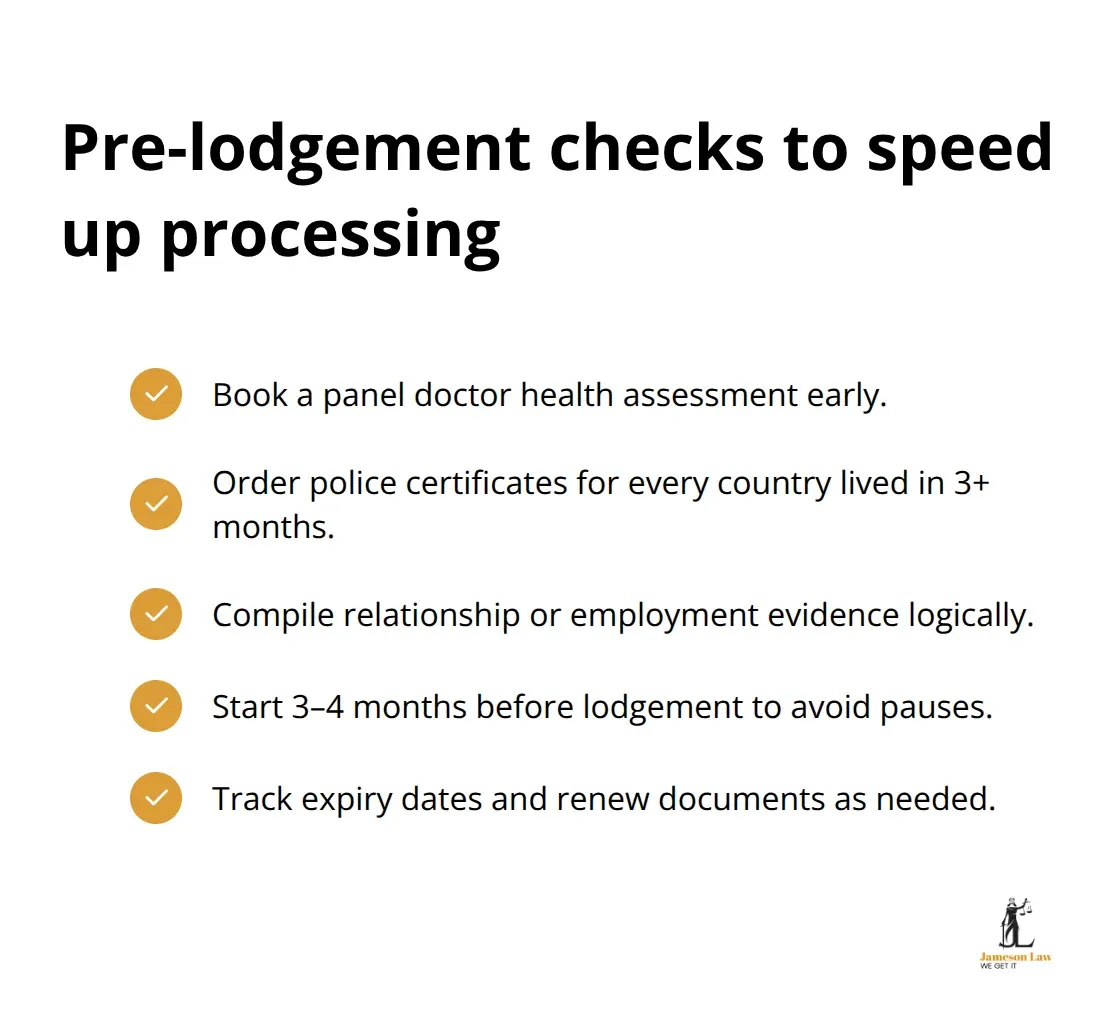
Health checks and character checks process in parallel with your visa assessment, which means issues discovered during these checks can pause your entire application until resolved. This is why gathering police certificates from every country you have lived in for more than three months, health assessments with panel doctors, and relationship documentation well in advance matters significantly. Start collecting these materials 3–4 months before you lodge your application.
Your visa processing queue position is also influenced by priority processing under Ministerial Direction No. 105. Some applications move faster based on visa type and occupation, not merely on lodgement date. This means two applications lodged on the same day can have vastly different processing speeds depending on the applicant’s circumstances.
What Determines Your Actual Wait
The median figures published by the Department of Home Affairs represent the midpoint of all applications, not a guarantee for your case. Your actual wait depends on whether your occupation qualifies for priority processing, whether you lodge a complete application, whether health or character checks raise issues, and where your application sits in the processing queue relative to older applications. Understanding these variables helps you set realistic expectations rather than planning around published medians that may not reflect your specific situation.
What You Actually Need to Satisfy Before Lodging
Health and Character Assessments
Health and character assessments form non-negotiable hurdles that many applicants underestimate in their planning. The Department of Home Affairs processes these checks in parallel with your visa assessment, which means delays in either area pause your entire application. You cannot lodge your visa and handle health matters later-authorities will not progress your case until both are cleared.
Start collecting health documentation at least three to four months before lodging. You’ll need a health assessment from a panel doctor authorised by the Department of Home Affairs, and costs typically range from 300 to 500 Australian dollars depending on your age and medical history. Bupa Medical Visa Services operates as one recognised provider, though others exist across Australia.
Police certificates from every country where you’ve lived for more than three months are equally essential. These take time to obtain-some countries process requests within weeks, others take months. If you’re applying with a partner, both of you need separate health and character checks. One delayed certificate holds up both applications.
English Language Requirements
English language proficiency standards vary significantly by visa type and occupation, but this area demands specificity rather than assumptions. For skilled migration visas, you generally need competent English under the Migration Regulations, which means either passing an approved test like IELTS, TOEFL, or PTE with specified band scores, or holding qualifications from approved English-speaking countries (Australia, Canada, the United States, or the United Kingdom).
Financial Documentation Across Pathways
Financial documentation requirements shift dramatically depending on your pathway. Skilled migration applicants must demonstrate funds to support themselves during processing and settlement, though no fixed amount exists-authorities assess this case-by-case based on your circumstances and whether you have a job offer.
Family sponsorship requires the sponsor to meet financial requirements proving they can support the applicant without reliance on government assistance. The sponsor’s income, assets, and existing dependents all factor into this assessment.
Business and investment visas demand the most extensive financial documentation: evidence of capital source, tax returns covering multiple years, accountant-prepared statements, and detailed financial projections for your proposed venture.
Employment Documentation Standards
Employment documentation for skilled visas must include references from current and previous employers covering your entire work history in your nominated occupation, payslips and tax returns spanning multiple years, and performance reviews if available. For employer-sponsored visas, your Australian employer must provide a detailed sponsorship statement outlining your role, salary, and employment conditions.
Do not submit vague or generic employment letters-authorities scrutinise these heavily. The Department of Home Affairs expects documentation that proves every claim in your application. Incomplete or poorly evidenced applications trigger requests for further information, and each round of requests extends your processing timeline by weeks or months.
Lodging Complete Applications
Gathering this documentation before lodging is not optional-it’s the primary mechanism that determines whether your application moves forward efficiently or stalls repeatedly. You must submit documentation that substantiates every claim you make in your application.
Final Thoughts
Permanent residency Australia requires you to match your circumstances to the right pathway, understand realistic timelines, and submit complete documentation from day one. Skilled migration offers the fastest route for applicants with in-demand occupations, typically taking around 10 months when you lodge applications with all required materials. Family sponsorship provides a relationship-based alternative but demands patience, with partner visas averaging 18 months and rigorous scrutiny of relationship evidence.
Your actual wait depends on whether your occupation qualifies for priority processing, whether you lodge a complete application, and whether health or character checks raise issues. Start collecting documentation three to four months before you lodge-police certificates, health assessments, employment references, and financial documentation all take time to obtain. Incomplete applications trigger requests for further information that extend your timeline by weeks or months.
Assess which pathway aligns with your situation and take the next step that matches your circumstances. If you need clarity on eligibility, help gathering documentation, or guidance through the application process, Jameson Law provides immigration law assistance to help you navigate these requirements and avoid costly mistakes.