

Navigating temporary visa Australia requirements can feel overwhelming, especially when you’re unsure which pathway suits your situation. Whether you’re planning a holiday, seeking work experience, or filling a skilled role, understanding the rules is essential.
At Jameson Law, we’ve guided thousands of people through the temporary visa process. This guide breaks down the main visa types, key requirements, and common pitfalls so you can move forward with confidence.
Your Temporary Visa Options in Australia
Visitor Visas for Short-Term Stays
Australia offers several temporary visa pathways, each designed for different purposes and circumstances. The visa you need depends on why you’re coming to Australia and how long you plan to stay. Selecting the right pathway from the start saves time and money.
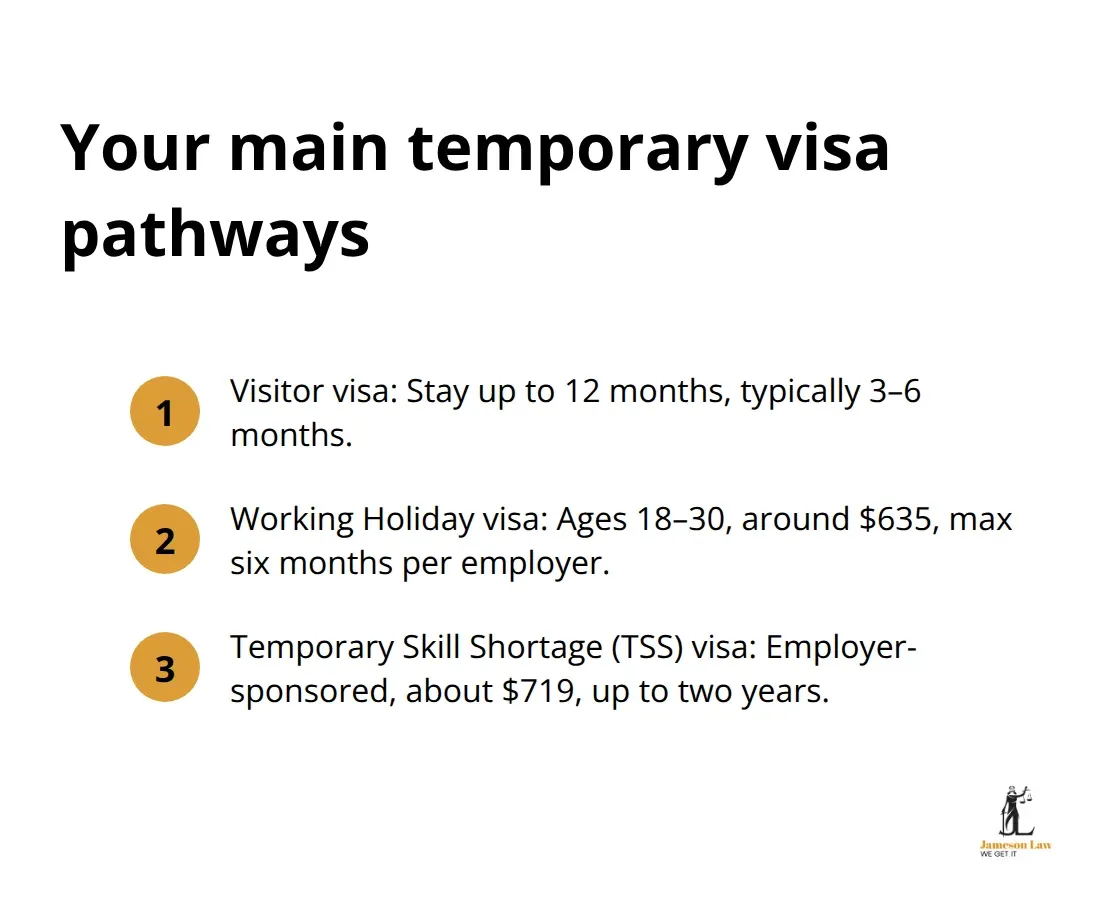
Visitor visas suit people planning short-term stays for tourism, business meetings, or visiting family. The standard Visitor visa allows stays up to 12 months, though most tourist arrivals receive permission for three to six months. In 2022–23, there were 7,025,366 temporary visas granted across all categories.
If you’re visiting Australia purely for leisure or family reasons and have no intention to work, a visitor visa is straightforward and typically costs between $190 and $1,325 depending on the stream you choose.
The eVisitor and Electronic Travel Authority options provide cheaper alternatives for eligible nationalities, costing $20 each, though these carry stricter conditions around work and study restrictions.
Working Holiday Visas for Young Travellers
Working Holiday visas open different opportunities if you’re a young person aged 18 to 30 from a participating country. These visas allow you to work and travel simultaneously, making them popular with people seeking temporary work experience rather than permanent settlement. The visa typically costs $635.
The flexibility to change employers multiple times without visa sponsorship represents a key advantage. However, most working holiday visas restrict you to working for the same employer for no more than six months, which Home Affairs enforces strictly. This limitation affects your employment options and requires careful planning around your work arrangements.
Skilled Temporary Visas and Employer Sponsorship
Skilled temporary visas and employer sponsorship programs operate differently because your employer essentially vouches for you. The Temporary Skill Shortage visa requires an Australian employer to sponsor you for a specific role. Your employer must demonstrate they cannot find an Australian worker for the position, and you must meet the skill level requirements listed on the relevant occupation list.
This visa costs $719 and allows stays of up to two years, with the possibility of renewal. Employer-sponsored roles typically offer better employment security than working holiday positions, but you remain tied to your sponsoring employer throughout your visa period. If your employer terminates your sponsorship, you generally have only 28 days to secure alternative sponsorship or leave Australia.
Understanding these three main pathways helps you identify which visa type aligns with your circumstances. Each option carries different costs, conditions, and flexibility levels. The next section examines the specific requirements you must meet to qualify for any temporary visa.
Key Requirements for Temporary Visa Applications
Home Affairs assesses three main factors when reviewing your temporary visa application. You must demonstrate you meet health standards, pass character checks, and satisfy financial requirements. Failing any one of these areas results in visa refusal, regardless of how strong your other qualifications are.
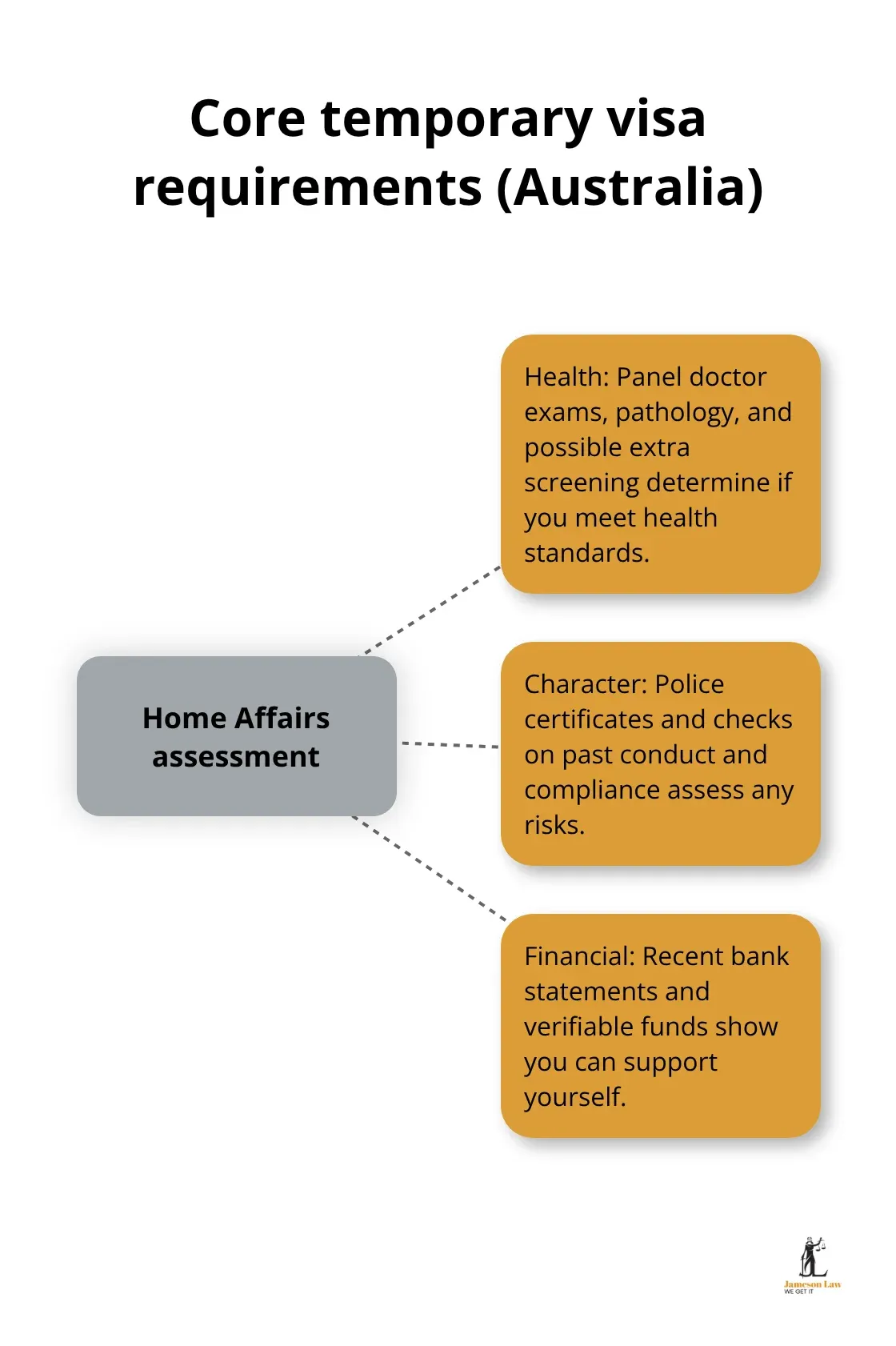
Health assessments examine whether you have communicable diseases or conditions requiring ongoing Australian healthcare resources. Character assessments investigate your criminal history, fraud convictions, and immigration compliance across all countries where you’ve lived. Financial evidence proves you can support yourself without becoming a burden on Australian welfare systems. Home Affairs takes these requirements seriously because they protect public health, community safety, and fiscal responsibility.
Health Examinations Are Stricter Than You Think
Most temporary visa applicants underestimate health assessment requirements until Home Affairs requests additional medical testing. You must obtain a health examination from a panel doctor approved by Home Affairs, not your regular GP. Panel doctors follow specific protocols and use particular pathology labs, which costs between $300 and $500 for the full assessment. The examination includes chest X-rays, blood tests for HIV and syphilis, and general health screening. You must disclose any pre-existing medical conditions. Hiding health issues during your application constitutes misrepresentation and can result in permanent visa cancellation and exclusion from future Australian visas. Some nationalities face additional screening requirements based on tuberculosis prevalence in their country of origin. Processing times vary significantly depending on whether your results are straightforward or require specialist review, potentially adding weeks to your application timeline.
Financial Evidence Requires Specificity
Home Affairs demands concrete proof of funds, not vague statements about your financial capacity. You must provide bank statements covering the last three to six months that show consistent deposits and available balances. The amount required depends on your visa type and intended stay length, but generally ranges from $2,000 to $20,000 for temporary visas. Funds held in term deposits or investment accounts count, but Home Affairs scrutinises sudden large deposits made shortly before your application. If a sponsor or family member provides your funds, statutory declarations and their bank statements prove the money is genuinely available to you. Employment letters showing your salary provide supporting evidence but cannot replace bank statements. Currency conversion matters if you hold funds overseas, as Home Affairs uses the exchange rate on the application date. Insufficient financial evidence remains one of the most common reasons for temporary visa refusal, yet proper documentation preparation prevents this outcome entirely.
Character Assessment Investigations Go Deep
Home Affairs conducts thorough character assessments that extend beyond your criminal record. The assessment examines fraud convictions, immigration compliance across all countries where you’ve lived, and your general conduct history. You must declare all criminal matters, even minor offences or traffic violations in some circumstances. Dishonesty in your application-whether intentional or through omission-triggers automatic refusal and potential permanent exclusion. Home Affairs obtains police certificates from countries where you’ve lived for extended periods (typically six months or more). Processing these certificates can take considerable time, particularly if you’ve lived in multiple countries. Any discrepancies between your application and official records raise red flags that require explanation and additional documentation.
Documentation and Visa Conditions Shape Your Stay
Your visa grant letter specifies conditions you must follow throughout your stay in Australia. These conditions typically restrict your work arrangements, study options, and travel permissions. You cannot work beyond the hours specified on your visa, and breaching this condition can result in cancellation. If you plan to study while on a temporary visa, your visa conditions must permit this activity. Some visas require you to maintain health insurance throughout your stay, and you must provide proof of continuous coverage. Travel outside Australia may trigger automatic cancellation of certain visa types, so you must understand your specific conditions before leaving the country. Overstaying your visa-even by a single day-creates serious consequences including future visa refusals and potential deportation proceedings.
Understanding these requirements positions you to prepare a strong application and comply with your visa conditions once approved. The next section examines the mistakes that applicants commonly make when navigating these requirements.
Common Temporary Visa Mistakes to Avoid
Misrepresenting Your Circumstances Destroys Your Application
Misrepresenting your circumstances on a temporary visa application destroys your case instantly. Home Affairs cross-checks every detail you provide against official records, and discrepancies trigger automatic refusal. Many applicants omit minor criminal matters thinking they won’t matter, but even traffic fines or spent convictions must be declared if requested.
If you’ve been convicted of any offence, regardless of how minor, disclose it completely. Omitting information you knew you should declare constitutes misrepresentation, and Home Affairs treats this far more seriously than the original offence itself. Once you misrepresent facts, Home Affairs records this against your character assessment permanently.
Future visa applications face rejection simply because you’ve demonstrated dishonesty. You cannot rehabilitate a misrepresentation finding easily, and it may exclude you from Australian visas indefinitely. If your circumstances are complicated-previous convictions, health conditions, or financial irregularities-disclose everything transparently with supporting documentation rather than hiding information and hoping Home Affairs won’t find it.
Incomplete Documentation Leads to Automatic Rejection
Health and character failures often result from applicants providing insufficient evidence rather than actual disqualification. You might genuinely meet the health requirements, but if you don’t obtain your health examination from an approved panel doctor, Home Affairs rejects your application outright. The same applies to character assessments-you must obtain police certificates from every country where you’ve lived for six months or longer, and many applicants either skip countries or obtain certificates from the wrong authority.
Home Affairs processes applications systematically, and if your documentation is incomplete, they won’t give you the benefit of the doubt. Financial evidence requires particular attention because sudden large deposits before your application trigger suspicion. If someone gifts you money, provide their statutory declaration and their bank statements showing the funds came from legitimate sources.
Overstaying and Breaching Work Conditions
Overstaying your visa or breaching work conditions represents a serious mistake with lasting consequences. Your visa conditions specify exactly how many hours you can work per week, and exceeding this limit gives Home Affairs grounds for immediate cancellation.
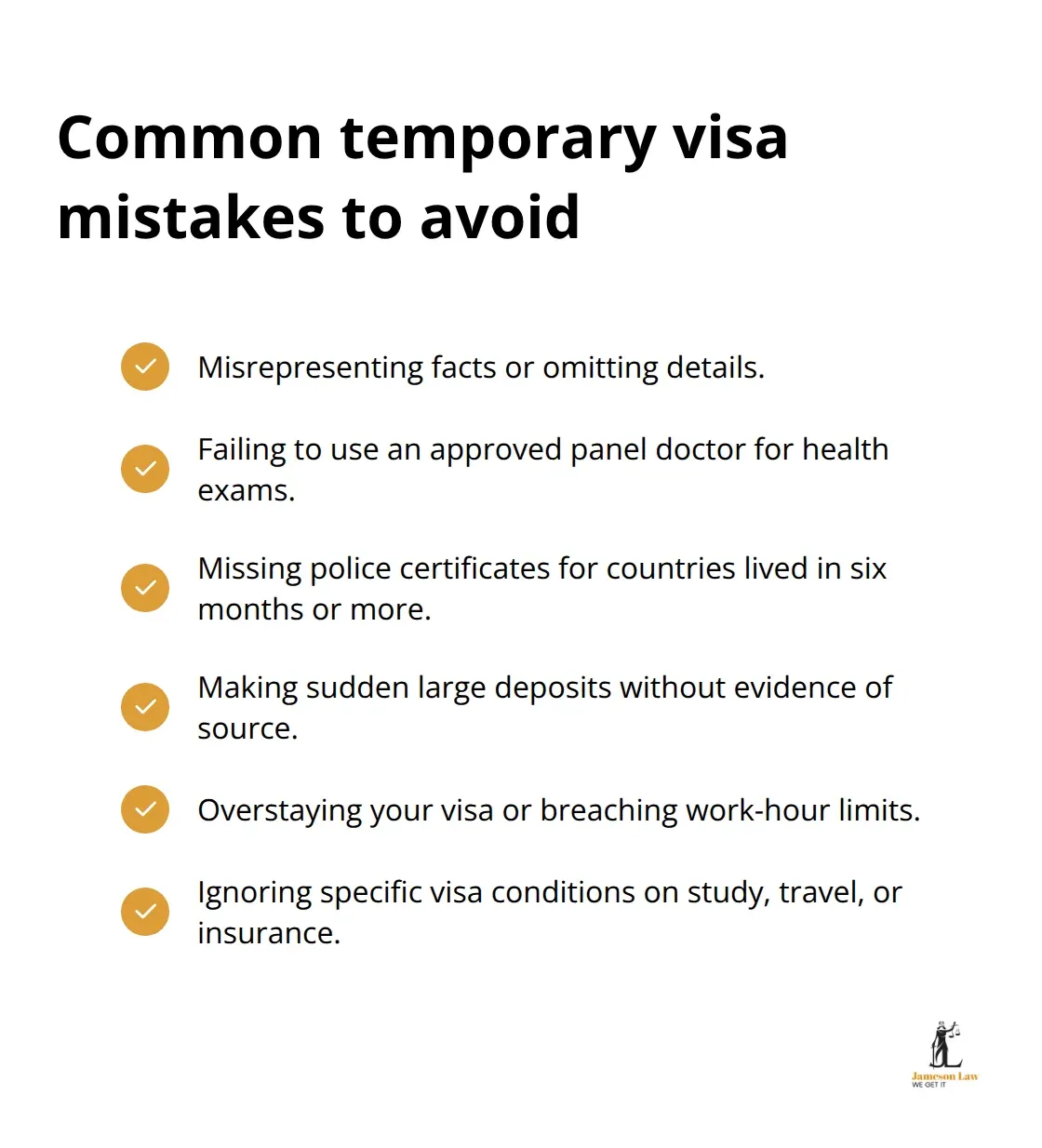
Even one day of overstay creates a record that affects all future visa applications, and multiple breaches can result in deportation proceedings.
Track your visa expiry date carefully and apply for extension or departure well before it expires. Work hour restrictions apply strictly, and Home Affairs investigates breaches through employer records and tax office data. If you work beyond your permitted hours (even unintentionally), you risk cancellation and future visa refusals regardless of your otherwise strong application.
Final Thoughts
Temporary visa Australia requirements demand careful attention across health assessments, character checks, and financial evidence. You cannot afford to get any one of these wrong, as Home Affairs will refuse your application regardless of how well you meet the other criteria. Your visa conditions are not suggestions-they are legal obligations that you must follow throughout your stay.
Breaching your conditions through overstaying, working beyond permitted hours, or studying without authorisation creates permanent records that affect every future visa application you submit. Even minor violations carry serious consequences, including cancellation and potential deportation. The mistakes we’ve outlined-misrepresenting information, providing incomplete documentation, and breaching conditions-are entirely preventable with proper preparation and transparency about your circumstances.
If your situation involves complications like previous criminal matters, health conditions, or complex financial arrangements, professional guidance makes the difference between approval and refusal. We at Jameson Law specialise in immigration law and can review your circumstances, identify potential issues before you apply, and guide you through the entire process. Contact us to discuss your temporary visa Australia requirements and get it right the first time.