Australia’s temporary visa system offers multiple pathways for people wanting to live, work, or study here. Whether you’re planning a short visit, pursuing education, or building a career, understanding your options is the first step.
At Jameson Law, we help people navigate these visa categories and plan their next moves. This guide breaks down the main temporary visa types, walks you through the application process, and shows you how to transition toward permanent residence if that’s your goal.
Your Temporary Visa Options in Australia
Australia’s temporary visa system splits into three broad streams, each designed for different purposes and circumstances. Visitor visas suit people planning short stays for tourism or family visits, typically lasting three to twelve months depending on your country of origin and circumstances. Student visas form the pathway for international education, with the Australian Department of Home Affairs reporting that over 587,500 people arrived on student visas between January 2000 and August 2021. Work and skilled migration visas constitute the third stream, encompassing temporary skilled positions, regional work opportunities, and business-related visas. The Department of Home Affairs publishes quarterly reports on temporary resident skilled programmes, tracking grants and holder numbers across occupations and states, so you can access concrete data on demand patterns in your field.
Visitor Visas for Short-Term Stays
Visitor visas remain the simplest entry point if you plan a holiday, attend conferences, or visit family for a limited period. Most Commonwealth countries, including the United Kingdom, Canada, and New Zealand, qualify for streamlined processing. The Home Affairs website lists eligibility criteria and required documentation, and applications now move faster through online portals. Processing times vary by country of citizenship, but applications typically resolve within weeks rather than months. You must provide proof of funds to support yourself during your stay, a return ticket or proof of onward travel, and evidence of ties to your home country. Overstaying a visitor visa carries serious consequences including deportation, visa cancellations for future applications, and substantial financial penalties, so compliance with your visa expiry date is non-negotiable.
Student Visas and Education Pathways
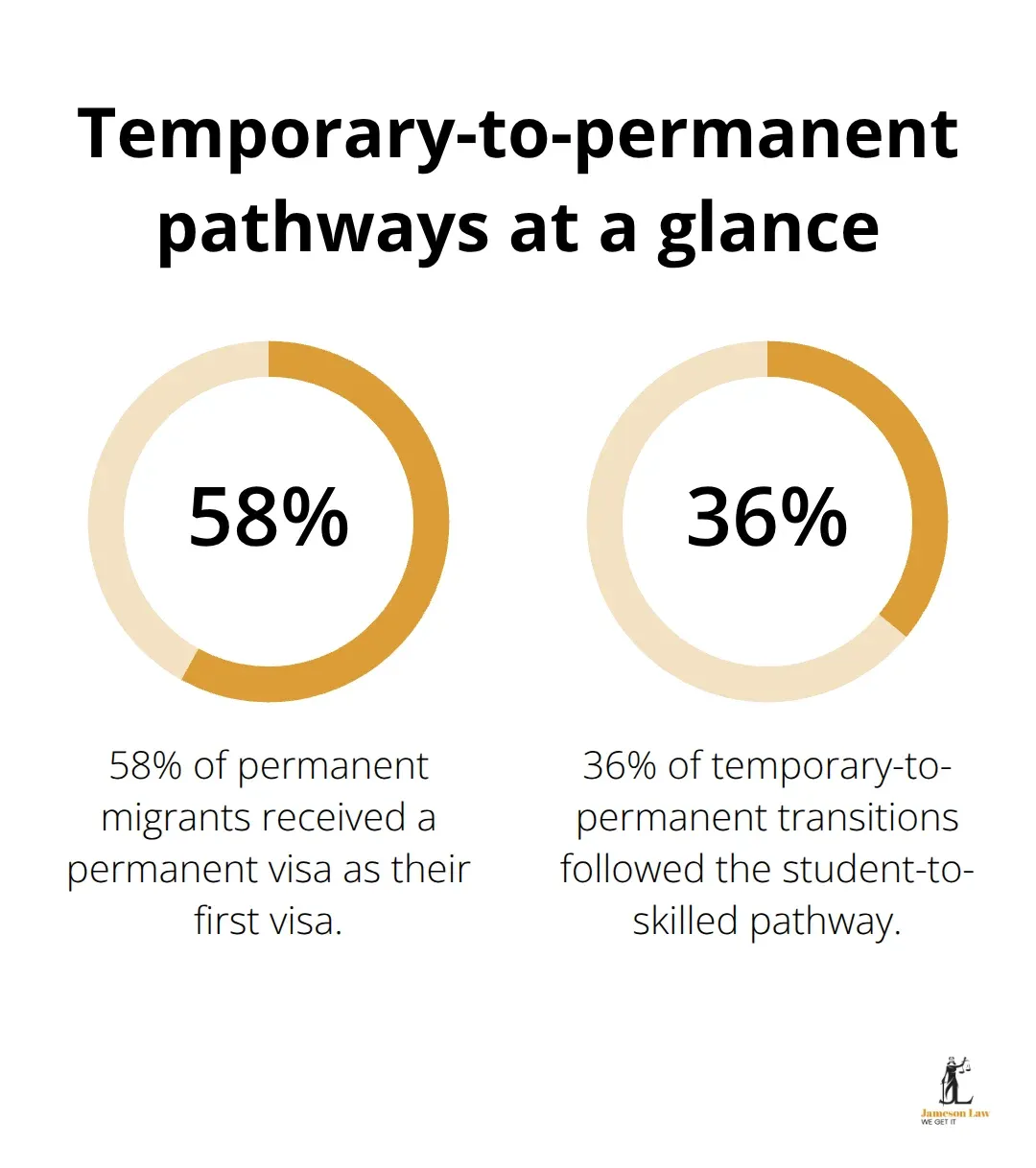
Student visas create long-term planning opportunities because they often lead to permanent residence. The data shows that 36 per cent of people who transitioned from temporary to permanent visas took the student-to-skilled pathway, making it one of the two dominant routes to permanency. Students typically hold their initial student visa for the duration of their course, ranging from one to four years depending on the qualification level. After graduation, you can access a post-study work visa, which the Department of Home Affairs data shows extends your stay for between one and three years depending on your qualification and field of study. During this post-study work period, you gain Australian employment experience and build professional networks, significantly strengthening future permanent visa applications. The most common fields among people who later gained permanent residence include Business and Management, Accounting, and Engineering. Your institution must be registered on the Commonwealth Register of Institutions and Courses for Overseas Student Education, so verify this before enrolling. Student visa holders must maintain full-time enrolment and meet academic progress requirements, with failure to do so resulting in visa cancellation.
Skilled Work and Regional Visas
The skilled migration stream offers the fastest pathway to permanency for qualified workers. Two main visa types dominate this space: the Skills in Demand visa (subclass 482) and regional provisional visas (subclasses 491 and 494). The Skills in Demand visa requires employer sponsorship and targets occupations experiencing genuine skill shortages in Australia. From December 7, 2024, the older Temporary Skills Shortage visa transitioned to the Skills in Demand framework, so you should verify that any information you review reflects current requirements. Regional visas offer an alternative route, with the Department of Home Affairs emphasising them as pathways for skilled workers willing to live outside major cities. State and territory governments nominate candidates for regional positions, and the nomination process itself can take several months. Nominated occupations vary significantly by region and industry, with the quarterly Department of Home Affairs reports showing detailed breakdowns by location, occupation, and salary levels. Professional services, construction, and healthcare dominate the skilled migration statistics, with ICT professionals and specialist managers among the most frequently nominated occupations. Visa conditions tie you to specific employers or regions for defined periods (typically two to four years), and breach of these conditions results in immediate cancellation and deportation liability.
Planning Your Next Steps
Understanding which temporary visa stream aligns with your circumstances forms the foundation for your Australian journey. Each pathway carries distinct eligibility requirements, timelines, and conditions that shape your experience. The application process itself demands careful attention to documentation and compliance, which we explore in the next section.
How to Get Your Temporary Visa Application Right
Submitting a temporary visa application demands precision because a single missing document or incomplete form section triggers rejection and delays your plans. Applicants lose months when they misunderstand what the Department of Home Affairs requires, so understanding the exact documentation your visa category demands matters far more than rushing the process.
Documentation Requirements by Visa Type
Visitor visa applications require proof of funds (bank statements typically covering three to six months), a valid passport with at least six months validity remaining, and evidence of ties to your home country such as employment contracts, property ownership, or family relationships. Student visa applications demand an offer letter from an Australian institution, proof of financial capacity to cover tuition and living expenses (currently around AUD 20,000 to 30,000 annually depending on location and course), and English language test results such as IELTS or TOEFL unless you studied in English at secondary level. Skilled work visas require occupation-specific documentation including qualifications verification, police clearance certificates, and health assessments conducted by Department of Home Affairs approved doctors. The Department of Home Affairs website lists approved doctors by location, and you must use their services-using other medical practitioners invalidates your health assessment.
Processing Timelines and What to Expect
Processing timelines vary dramatically by visa type and your country of citizenship. Visitor visas typically resolve within two to four weeks for most countries, student visas take four to eight weeks, and skilled work visas can extend to three to six months depending on sponsorship complexity. These timeframes assume you submit complete applications with all required documentation; incomplete submissions restart the clock and add weeks or months to your wait. The Department of Home Affairs processes applications in order of receipt, so early submission gives you an advantage. You can track your application status through the ImmiAccount portal, which updates as your case progresses through each assessment stage.
Understanding Your Visa Conditions
Your visa conditions define what you can and cannot do during your stay, and breaching them carries severe consequences including immediate cancellation, deportation, and future visa ineligibility. Visitor visa holders cannot work except in genuinely exceptional circumstances. Student visa holders can work maximum twenty hours weekly during semester and full-time during official breaks. Skilled visa holders must work only for their nominated employer in their nominated occupation unless their conditions explicitly permit otherwise. The Department of Home Affairs compliance data shows that condition breaches account for substantial visa cancellations annually, so treating your conditions as non-negotiable protections rather than suggestions determines whether your visa journey succeeds or derails.
Managing Changes to Your Circumstances
You can review your exact conditions on your visa grant letter and through the ImmiAccount portal. If your circumstances change-such as needing to change employers or study part-time instead of full-time-you must apply for a variation before the change occurs, not after. Waiting until after you change circumstances places you in breach of your conditions and exposes you to cancellation action. The variation process typically takes four to eight weeks, so plan ahead if you anticipate any changes to your employment, study arrangements, or personal situation. Notifying the Department of Home Affairs of changes demonstrates good faith and protects your visa status.
Moving Forward With Your Application
Once you understand your documentation requirements and visa conditions, you stand ready to lodge your application with confidence. The next section explores how temporary visas connect to permanent residence pathways, showing you how short-term decisions shape your long-term Australian future.
How Temporary Visas Lead to Permanent Residence
Most people who gain permanent residence in Australia do not arrive on permanent visas. The majority (1.7 million or 58%) of permanent migrants were granted a permanent visa as their first visa, meaning your temporary visa is not a dead end-it is often the beginning of a strategic pathway toward permanency. Two dominant routes account for roughly two-thirds of all temporary-to-permanent transitions: the student-to-skilled pathway and the temporary skilled-to-skilled pathway.
The student route takes approximately five years on average from initial student visa to permanent residence, while the skilled-to-skilled transition moves faster at around two years and ten months. These timelines matter because they shape your financial planning, career decisions, and family arrangements. If you hold a student visa, your post-study work period is not merely a grace period-it is your opportunity to gain Australian employment experience that permanent visa assessors specifically value. Employers in professional services, construction, and healthcare industries show the strongest track records of sponsoring workers toward permanency, according to Department of Home Affairs quarterly reports on skilled migration. About 450,000 people held three or more temporary visas before reaching permanency, meaning most successful applicants navigate multiple visa changes rather than jumping directly from one temporary visa to permanent residence.
Maximise Your Permanency Prospects on a Student Visa
Your temporary visa conditions actually define your best strategy for permanency. If you hold a student visa, focus on fields with demonstrated permanency outcomes: Business and Management, Accounting, and Engineering show consistently strong results in Department of Home Affairs data. During your post-study work period, secure employment in your nominated field and remain with the same employer for at least twelve months-this employment history becomes your strongest evidence of genuine skill shortage when you apply for permanent sponsorship. Your salary also matters significantly. Department of Home Affairs data shows that workers earning above the 75th percentile for their occupation in their state face substantially lower permanent visa approval times than those at lower salary levels. This is not because higher earners are automatically approved, but because they demonstrate genuine skill shortage more convincingly to assessors. If your current role pays below this threshold, consider whether advancement or role changes could strengthen your permanent visa application later.
Navigate Skilled Work Visa Pathways to Permanency
If you hold a skilled work visa, understand that your nominated occupation and employer determine your pathway options. Regional visa holders (subclasses 491 and 494) face specific conditions: you must live and work in designated regional areas for the required period, typically two years, before you become eligible to apply for related permanent visas. Compliance with these conditions is absolute-the Department of Home Affairs compliance data confirms that condition breaches trigger immediate cancellation and permanent visa ineligibility. Your employment history in your nominated occupation counts toward permanency, so every month you work outside your field during your temporary visa period is a month that does not count toward permanency. The skilled occupation list summarises the occupations Australia needs to fill skill shortages, so you can assess whether your occupation aligns with your target state’s current priorities.
Understand Points and Sponsorship Pathways
When you transition from temporary to permanent visas, you enter either a points-based skilled stream or an employer-sponsored stream. The points system assesses your age, English language ability, work experience, qualifications, and state sponsorship nomination. Age matters substantially: applicants aged 25 to 32 accumulate maximum points, while those over 45 receive zero age points, making the timing of your permanent visa application strategically important. Work experience points accumulate only for employment in your nominated occupation. Your qualification must match your nominated occupation precisely-a business degree does not qualify you for a permanent skilled visa in engineering, even if you have engineering work experience. State sponsorship nominations can overcome lower points totals, and different states prioritize different occupations based on regional labour shortages.
Leverage Employer Sponsorship for Permanent Residence
Employer sponsorship offers an alternative route if you do not accumulate sufficient points independently. Your employer must be willing to sponsor you, which requires them to demonstrate they cannot fill your position with Australian citizens or permanent residents, and they must commit to paying you at least the minimum sponsorship salary for your occupation. This is why building strong relationships with your current employer during your temporary visa period is essential-they become your sponsor when you transition to permanency. Strong employer relationships (developed through consistent performance and reliability) significantly increase the likelihood that your employer will support your permanent visa application when the time arrives.
Final Thoughts
Australia’s temporary visa system creates genuine pathways toward permanent residence when you approach it strategically. Most people who gain permanent residence started on temporary visas, and the two dominant routes-student-to-skilled and skilled-to-skilled-account for roughly two-thirds of all transitions. Your temporary visa Australia journey is not a short-term arrangement; it is the foundation of your long-term Australian future.
The application process demands precision and planning, with correct documentation, complete understanding of your visa conditions, and strict compliance determining your success. Your conditions define what you can achieve during your stay: if you hold a student visa, your post-study work period becomes your opportunity to gain employment experience that permanent visa assessors value; if you hold a skilled work visa, your employment history in your nominated occupation directly determines your permanency prospects. Age, qualifications, work experience, state sponsorship, and salary all influence your permanent visa prospects, with workers earning above the 75th percentile for their occupation facing faster approval timelines.
At Jameson Law, we help people navigate temporary visa applications and plan their transition toward permanent residence through our immigration law services. Whether you need assistance with your initial application or planning your pathway to permanency, we support your Australian journey with practical guidance tailored to your circumstances.