PUBLICATION

Traffic Offences Penalties NSW: A Practical NSW Guide

"Understand traffic offences penalties in NSW with our practical guide covering fines, demerit points, and license suspension rules."
Traffic Offences Penalties NSW: A Practical NSW Guide

A traffic offence in NSW can feel overwhelming, especially when you’re unsure about penalties, demerit points, or your legal options. The consequences range from fines to licence suspension, and understanding what you’re facing matters.

At Jameson Law, we’ve helped countless drivers navigate traffic offences penalties in NSW. This guide breaks down common offences, how the demerit points system works, and what steps you can take to protect your rights.

What You Need to Know About NSW Traffic Offence Penalties

Speeding Violations and Demerit Points

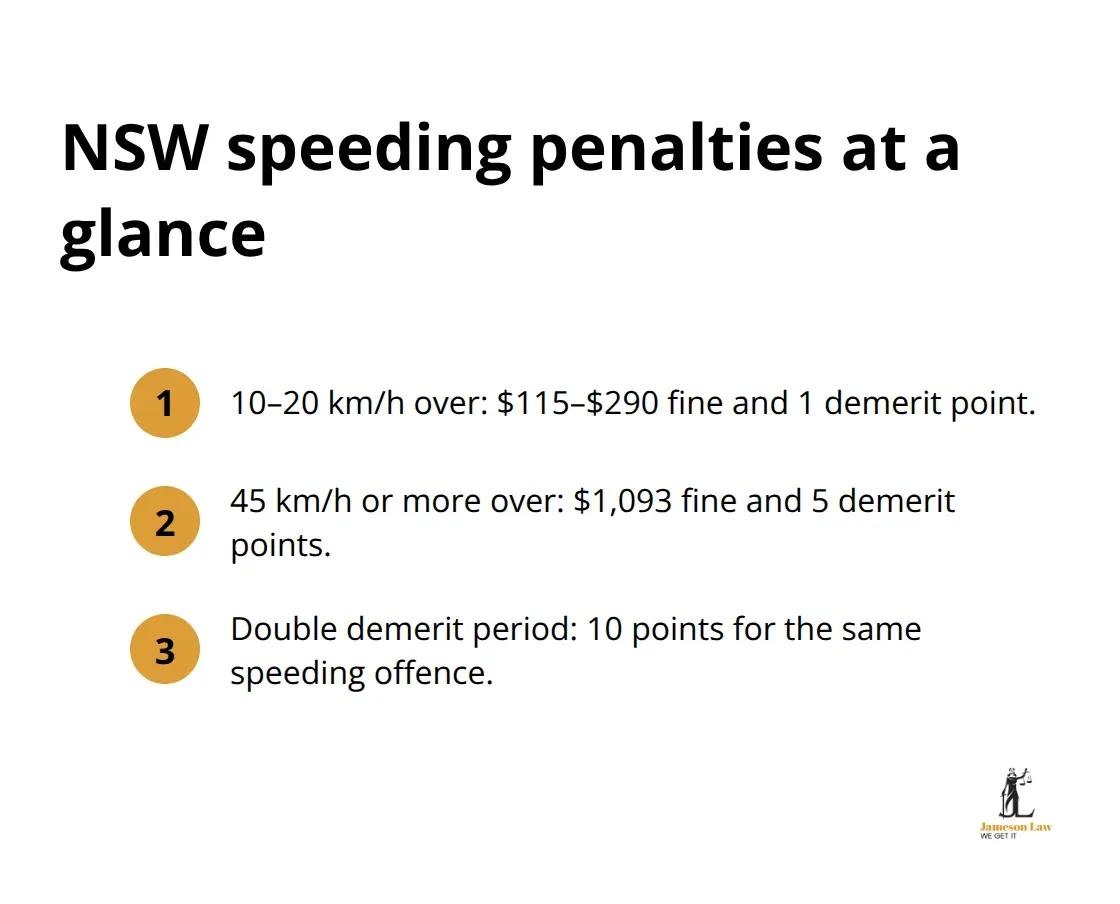
Speeding remains the most frequently detected traffic offence in NSW. Revenue NSW data shows that speeding and red-light camera offences account for thousands of penalty notices each financial year, with fines varying significantly based on how far you exceed the limit. A driver caught doing 10–20 km/h over the limit faces a $115–$290 fine and one demerit point, while exceeding the limit by 45 km/h or more results in a $1,093 fine and five demerit points.

Double demerit periods apply during certain holiday periods for speeding offences, meaning you lose ten demerit points instead of five for the same violation. Transport for NSW announces upcoming double demerit periods ahead of holidays, so checking these dates before you drive offers practical protection against unexpected penalties.

Summary of NSW speeding fines and demerit points, including double demerits

Drink Driving and Drug Driving Offences

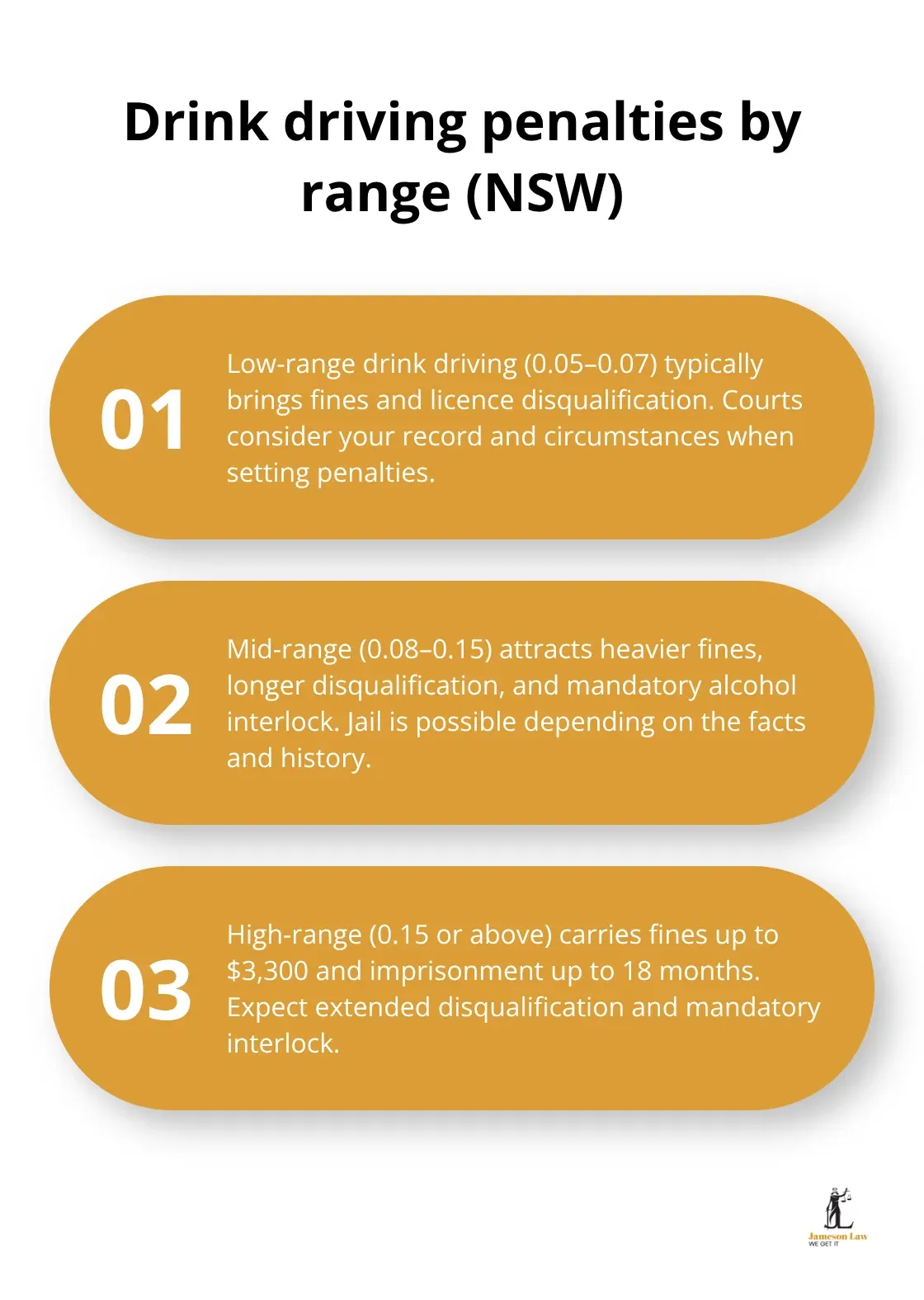
Drink driving carries far more serious consequences than speeding. Low-range drink driving, where your blood alcohol concentration sits between 0.05 and 0.07, attracts fines and licence disqualification. Mid-range drink driving (0.08–0.15) involves heavier fines, longer disqualification periods, mandatory alcohol interlock installation, and potential jail time. High-range drink driving (0.15 or above) carries fines up to $3,300, extended disqualification, mandatory interlock, and imprisonment up to 18 months.

Three-tier overview of NSW drink driving penalties: low, mid, and high range - traffic offences penalties NSW

Drug driving operates with zero tolerance-there is no safe limit. Roadside drug tests detect cannabis, MDMA, and methamphetamine, and a positive result leads to fines up to $2,200 and licence disqualification. The Alcohol Interlock Program forms part of NSW’s response to repeat drink driving, with Stage 3 factsheets available for medical professionals who guide implementation.

Dangerous Driving and Criminal Offences

Dangerous driving and negligent driving represent the upper tier of traffic offences. Dangerous driving causing injury carries a maximum penalty of up to 10 years imprisonment and mandatory licence disqualification under the Crimes Act 1900. Negligent driving results in fines and possible disqualification, with jail sentences possible if the offence causes injury. Driving while disqualified or suspended is a criminal offence carrying a maximum fine of around $3,300 and up to six months jail for a first offence.

These offences differ fundamentally from speeding or parking breaches because the courts prosecute them in Local Court rather than handling them as simple infringements. The legal response and available options shift dramatically depending on which category your offence falls into, which is why understanding your specific situation matters before you take your next step.

How Demerit Points Work in NSW

Understanding Your Demerit Point Balance

Every traffic offence in NSW carries a demerit point cost, and understanding how these points accumulate is essential because they directly determine whether you keep your licence. Transport for NSW tracks demerit points across a rolling three-year-and-four-month window, meaning older points eventually expire but recent violations stay on your record. When you commit an offence with a demerit penalty, points are added to your driving record immediately alongside your fine. Standard drivers face a limit of 12 demerit points, though professional drivers paid to drive more than 20 hours weekly can increase their threshold.

You can check your current demerit balance free of charge through your MyServiceNSW account using your driver licence details, or visit any NSW service centre with your licence in hand. This simple step takes minutes and gives you clarity on where you stand before penalties accumulate further.

How Points Accumulate and What Happens When You Exceed Your Limit

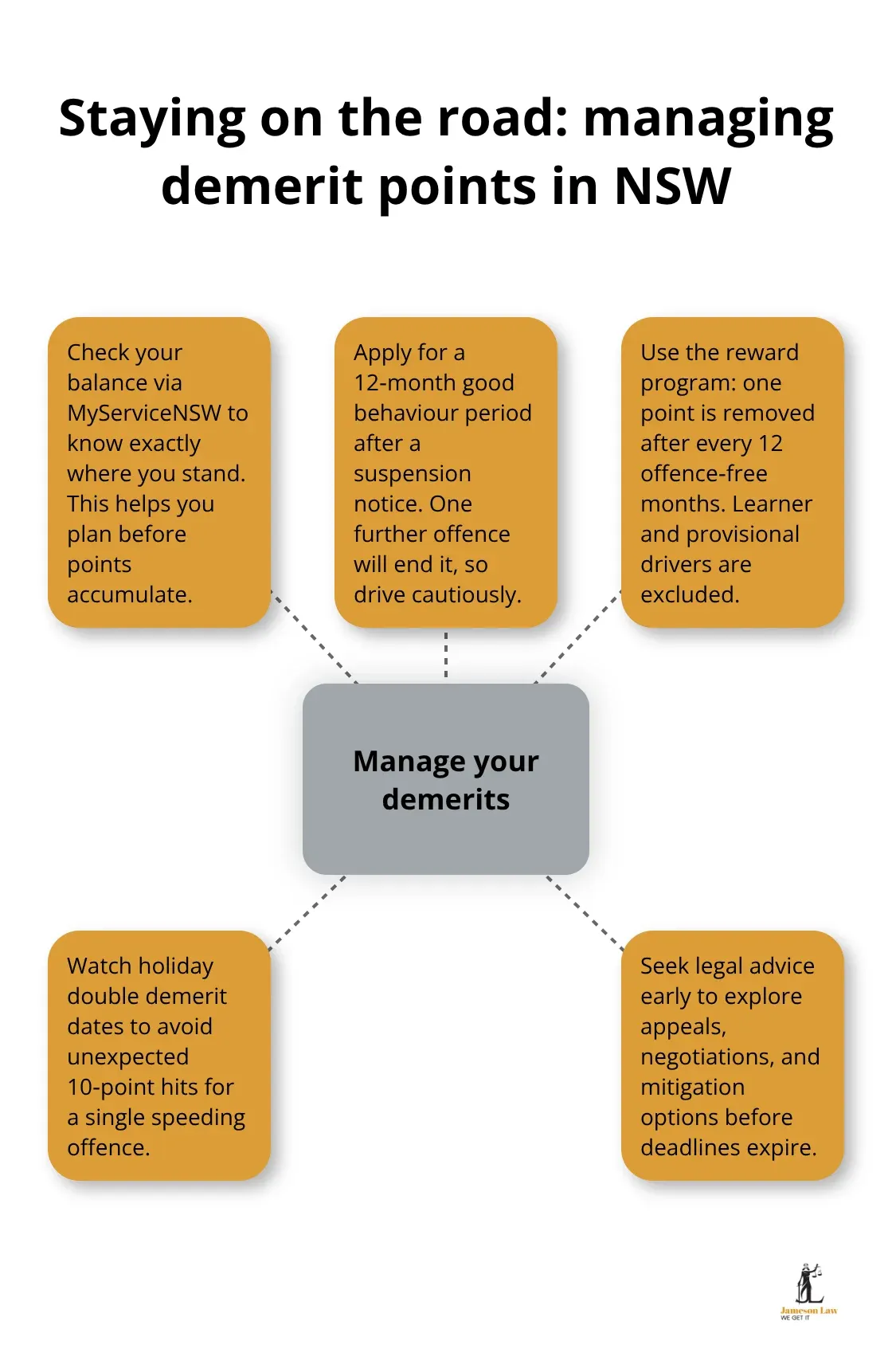
The system operates on a strict accumulation basis: exceed your limit and Transport for NSW issues a notice of suspension, removing your right to drive until the suspension period ends or you successfully appeal. Reaching your demerit limit triggers licence suspension, but NSW law provides one escape route through the good behaviour period. If you receive a suspension notice, you can apply for a 12-month good behaviour period, during which you must avoid any further traffic offences. Complete 12 consecutive months offence-free and your licence remains valid despite reaching the point threshold.

Hub-and-spoke visual of practical steps to manage demerit points in NSW - traffic offences penalties NSW

Additionally, the demerit point reward program removes one point after every 12 offence-free months, though learner and provisional drivers cannot access this benefit. Double demerit periods during holiday seasons intensify the risk significantly because a single speeding violation costs ten points instead of five, making it possible to reach your 12-point limit with just two holiday-period offences. Transport for NSW announces upcoming double demerit periods ahead of holidays, so checking these dates before you drive offers practical protection against unexpected penalties.

Serious Offences and Automatic Disqualification

A conviction for drink or drug driving, dangerous driving, or driving while disqualified carries automatic licence disqualification regardless of demerit points, operating as a separate and far more severe penalty. These disqualifications last months or years depending on the offence category and your history, and appealing a disqualification requires lodging your case in Local Court within 28 days of receiving the suspension notice. Unlike demerit point suspensions (which you can sometimes avoid through good behaviour), these criminal convictions impose mandatory disqualification periods that courts cannot waive.

Understanding which category your offence falls into matters enormously because the legal pathway and available options shift dramatically. A speeding fine operates under one set of rules, while a drink driving charge operates under an entirely different framework with far steeper consequences and limited room for negotiation. This distinction shapes everything from your immediate response to your long-term driving future, which is why your next step-understanding your rights and options when facing a traffic offence-requires careful consideration of your specific circumstances.

Your Rights and Options When Facing a Traffic Offence

Building a Defence Strategy

When you receive a traffic offence notice, you have genuine options that extend far beyond simply paying the fine. The prosecution must prove your guilt beyond reasonable doubt, which means weaknesses in evidence, procedural errors, or factual disputes can form the basis of a successful defence. Common defences include honest and reasonable mistake of fact, medical necessity, or breaches of police procedure during the detection or arrest process.

For speeding offences detected by fixed cameras, technical issues with calibration or maintenance records can undermine the evidence. For drink driving charges, the accuracy of breath testing equipment, the qualifications of the operator, and whether proper procedures were followed all matter significantly. Your first step involves obtaining copies of all police documentation, camera calibration records if applicable, and any witness statements.

Procedural Advantages and Court Representation

Most Local Courts across NSW handle these matters, and familiarity with local procedures and sentencing trends influences outcomes considerably. Magistrates retain discretion to reduce or waive licence disqualification in many cases, so presenting supporting evidence such as medical reports, employment documentation that demonstrates reliance on your licence, and programme participation records strengthens your position substantially.

The difference between contesting an offence yourself and having legal representation proves stark: self-represented drivers often miss procedural opportunities, fail to identify evidentiary weaknesses, and present submissions that courts dismiss without serious consideration. You must lodge licence suspension appeals within 28 days of receiving the suspension notice, and missing this deadline eliminates your right to challenge the disqualification in court.

Negotiating Charge Reductions

Prosecutors possess discretion to amend charges downward, withdraw allegations entirely, or recommend specific sentences to magistrates. If you face mid-range drink driving charges but the breath analysis shows a reading near the low-range threshold, your lawyer can present this argument to the prosecution and request a reduction to low-range charges, which carries substantially lighter penalties and a shorter disqualification period. For dangerous driving charges, prosecutors may agree to downgrade to negligent driving if the evidence does not clearly support the more serious allegation.

These negotiations happen outside the courtroom and require demonstrating genuine mitigation factors: stable employment, family responsibilities, medical conditions affecting your driving, or participation in rehabilitation programmes. Most traffic offences settle through negotiation rather than proceeding to contested hearings, and securing a better outcome at this stage avoids the publicity and uncertainty of a trial. Your lawyer communicates directly with the prosecution, presents your circumstances persuasively, and identifies where compromises benefit both sides.

Final Thoughts

Traffic offences penalties NSW range from minor fines to licence disqualification and imprisonment, and the consequences extend far beyond the courtroom. A speeding conviction affects your insurance premiums, a drink driving conviction impacts employment prospects and travel, and a dangerous driving conviction reshapes your entire life. Understanding which category your offence falls into and recognising that you have genuine options to contest, negotiate, or mitigate penalties matters enormously.

The demerit points system operates with little flexibility once you exceed your limit, but defences exist for many offences, prosecutors retain discretion to reduce charges, and magistrates can waive disqualification in appropriate cases. Your immediate response determines whether you access these opportunities or lose them through missed deadlines and procedural errors. The 28-day deadline for appealing licence suspension is absolute, and missing it eliminates your right to challenge disqualification in court.

Most drivers facing traffic offences underestimate their options and simply pay fines without exploring whether the evidence truly supports the allegation or whether negotiation could produce a better outcome. Professional legal representation shifts outcomes measurably because experienced lawyers identify evidentiary weaknesses, present mitigation evidence persuasively, and navigate local court procedures that self-represented drivers often overlook. Contact Jameson Law to discuss your options and explore what steps can genuinely improve your outcome.

Speak to an Expert Lawyer today

Laywers-Jameson-Law-The-best-law-firm-in-Sydney- Sydney Lawyers - Sydney
BOOK NOW

WE'RE IN IT TO WIN IT

Book your consultation

Book Now
Book Now Mobile 06 02 2025

This form submission is encrypted and secured to ensure your information remains confidential.

What our Clients

Related Publications:

What our clients say

.

Jameson Law - Voted the Best Law firm in Sydney Award

Legal Answers ... In Short

We're here to help

Our mission is to ensure our client matters are resolved successfully every time. Success to us does not simply involve winning, but moreover ensuring we take the most feasible, economic and stress-free path to help our clients achieve their goals. We fight hard for our clients, and always go by the motto: we’re in it to win it.

Jameson Law - Best Law Firm in Sydney

WE'RE IN IT TO WIN IT

Book your consultation

Call us now on (02) 8806 0866 or fill out the form below

Book Now Mobile

This form submission is encrypted and secured to ensure your information remains confidential.

WE'RE IN IT TO WIN IT

Book your consultation

Book Now Mobile 06 02 2025
lock

This form submission is encrypted and secured to ensure your information remains confidential.

Our Sydney Offices

Offices Parramatta and Sydney Jameson Law
Parramatta CBD - Head Office
jameson Law - Blacktown
jameson Law - Liverpool Office
Jameson Law - Bankstown
Court Houses We Frequent Jameson Law

Court Houses We Frequent

Balmain Local Court

Registry: Monday to Friday, 9:00am to 4:30pm

Bankstown Local Court

Court Operating Hours: 9:30am-4:30pm

Blacktown Local Court

Registry Hours: 9:00 – 4:30
Telephone Hours: 8:30 -4:30
Days open: Mon-Fri

Burwood Local Court

Registry Hours: 9:00 – 4:30
Telephone Hours: 8:30 – 4:30
Days open: Mon – Fri

Campbell Local Court

Registry Hours: 9:00 – 4:30
Telephone Hours: 8:30 – 4:30
Days open: Mon – Fri

Central Local Court

Registry Hours: 9:00 – 1:00 and 2:00 – 4:30
Telephone Hours: 8:30 – 4:30

Downing Local Court

Registry Hours: 9:00 – 1:00 and 2:00 – 4:30
Telephone Hours: 8:30 – 4:30

Wollongong Local Court

Registry Hours: 9:00 – 1:00 and 2:00 – 4:30
Telephone Hours: 8:30 – 4:30

Fairfield Local Court

Registry Hours: 9:00 – 1:00 and 2:00 – 4:30
Telephone Hours: 8:30 – 4:30

Hornsby Local Court

Registry Hours: 9:00 – 1:00 and 2:00 – 4:30
Telephone Hours: 8:30 – 4:30

Liverpool Local Court

Registry Hours: 9:00 – 1:00 and 2:00 – 4:30
Telephone Hours: 8:30 – 4:30

Manly Local Court

Registry Hours: 9:00 – 1:00 and 2:00 – 4:30
Telephone Hours: 8:30 – 4:30

Newtown Local Court

Registry Hours: 9:00 – 1:00 and 2:00 – 4:30
Telephone Hours: 8:30 – 4:30

Parramatta Local Court

Registry Hours: 9:00 – 1:00 and 2:00 – 4:30
Telephone Hours: 8:30 – 4:30

Penrith Local Court

Registry Hours: 9:00 – 1:00 and 2:00 – 4:30
Telephone Hours: 8:30 – 4:30

Sutherland Local Court

Registry Hours: 9:00 – 1:00 and 2:00 – 4:30
Telephone Hours: 8:30 – 4:30

Waverley Local Court

Registry Hours: 9:00 – 1:00 and 2:00 – 4:30
Telephone Hours: 8:30 – 4:30

Windsor Local Court

Registry Hours: 9:00 – 1:00 and 2:00 – 4:30
Telephone Hours: 8:30 – 4:30

Wollongong Local Court

Registry Hours: 9:00 – 1:00 and 2:00 – 4:30
Telephone Hours: 8:30 – 4:30

Downing Centre District Court

Registry Hours: 9:00 – 4:30
Telephone Hours: 8:30 – 4:30
Days open: Mon – Fri

Parramatta District Court

Registry Hours: 9:00 – 4:30
Days open: Mon-Fri

Penrith District Court

Registry Hours: 9:00 – 4:30
Days open: Mon-Fri

Campbelltown District Court

Registry Hours: 9:00 – 4:30
Days open: Mon – Fri

Liverpool District Court

Registry Hours: 9:00 – 4:30
Days open: Mon – Fri

Wollongong District Court

Registry Hours: 9:00 – 1:00 and 2:00 – 4:30
Telephone Hours: 8:30 – 4:30

Supreme Court New South Wales

Registry Hours: 9:00 AM – 4:30 PM
Telephone Hours: 8:30 AM – 4:30 PM
Days Open: Monday to Friday

Federal Circuit and Family Court of Australia

Registry Hours: 9:00 AM – 4:30 PM
Telephone Hours: 8:30 AM – 5:00 PM
Days Open: Monday to Friday

Federal Court

Monday to Friday, 8:30 AM – 4:30 PM

High Court

Monday to Friday, 8:30 AM – 5:00 PM

Children’s Court of New South Wales

Registry Hours: 9:00 AM – 4:30 PM
Telephone Hours: 8:30 AM – 4:30 PM
Days Open: Monday to Friday

Coroner’s Court New South Wales

Registry Hours: 9:00 AM – 4:30 PM
Telephone Hours: 8:30 AM – 4:30 PM
Days Open: Monday to Friday

Industrial Relations Commission of New South Wales

Registry Hours: 9:00 AM – 4:30 PM
Telephone Hours: 8:30 AM – 4:30 PM
Days Open: Monday to Friday

Land and Environment Court of New South Wales

Registry Hours: 9:00 AM – 4:30 PM
Telephone Hours: 8:30 AM – 4:30 PM
Days Open: Monday to Friday

WE'RE IN IT TO WIN IT

Book your consultation

Book Now
Book Now Mobile 06 02 2025
lock

This form submission is encrypted and secured to ensure your information remains confidential.