Facing bail proceedings in NSW can feel overwhelming, especially when you’re unsure of your rights and options. At Jameson Law, we’ve helped countless clients navigate bail information NSW and understand what happens next.
This guide breaks down how bail works, what conditions you might face, and the steps you can take to challenge or vary your bail arrangements.
How Bail Works in NSW
The Bail Framework and Your Options
Bail in NSW isn’t a single system-it’s a framework that offers you options depending on your circumstances and the offence you face. Under the Bail Act 2013 (NSW), bail means the authority to be at liberty while your case proceeds, but it only becomes legally effective once you sign a bail acknowledgment and meet any pre-release requirements. The moment police charge you, one of three outcomes occurs: police release you without conditions, police grant you bail with conditions attached, or police refuse bail and you must appear at the Local Court for a magistrate to decide.
As of July 2025, NSW established a centralised Bail Division within the Local Court to handle adult bail hearings. This change means most cases now process through this division rather than scatter across individual courts. The restructure was designed to speed up decisions for people in custody, standardise how bail assessment works, and allow virtual attendance through Audio Visual Link so family members can participate in hearings.
The Unacceptable Risk Test
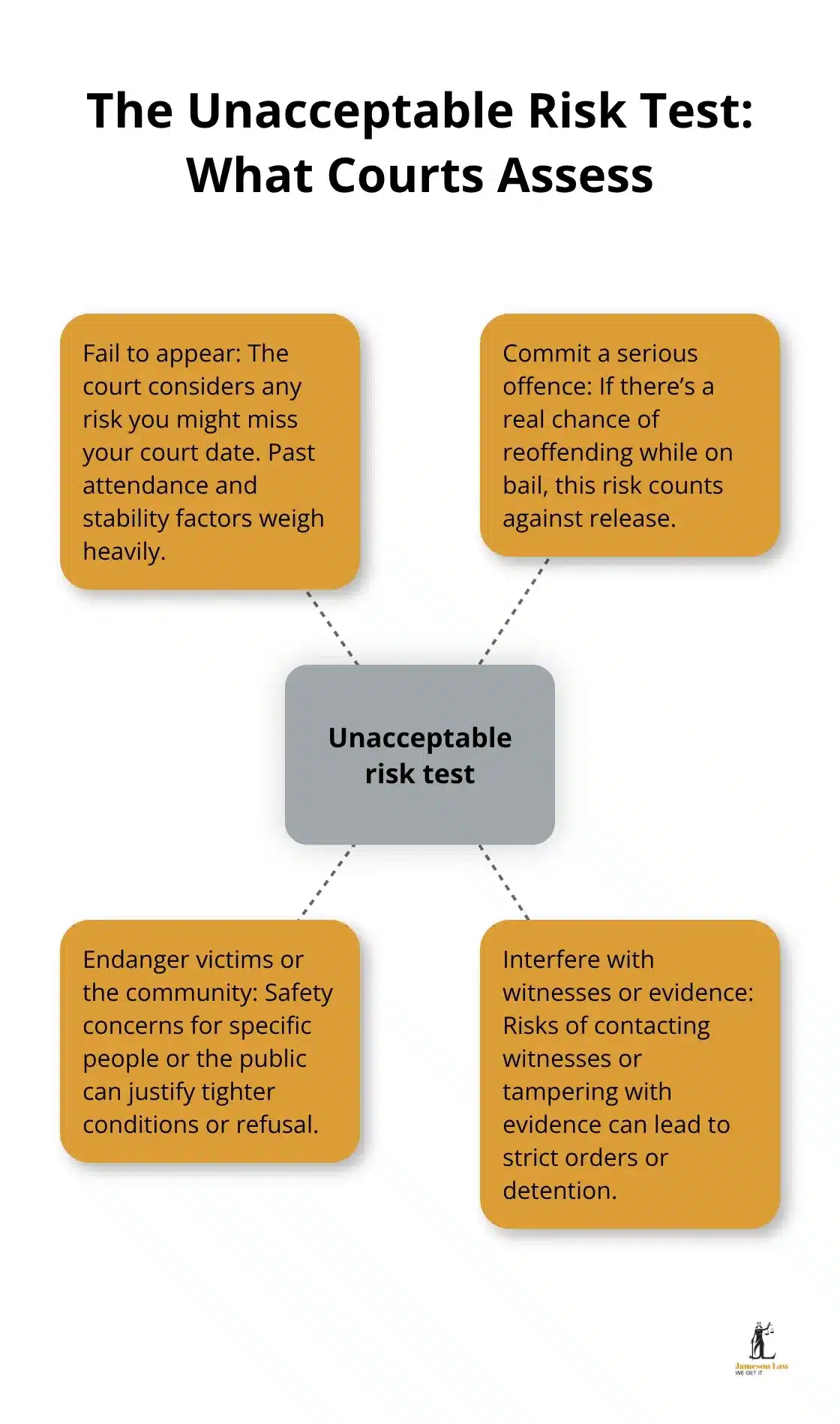
Nearly everyone charged with an offence can apply for bail. The decision hinges on what’s called the unacceptable risk test. This test asks whether an unacceptable risk exists that you’ll fail to appear in court, commit a serious offence, endanger victims or the community, or interfere with witnesses or evidence. If bail authorities cannot prove an unacceptable risk exists, bail should be granted.
The type of offence matters significantly because it determines how the risk assessment works. For general offences, the law presumes bail should be granted unless the prosecution proves an unacceptable risk. For show cause offences (which include life-penalty crimes, serious violent offences, commercial drug supply, and certain weapon offences listed in section 16B of the Bail Act), you must persuade the court that detention isn’t justified-this reverses the burden of proof. For the gravest offences, exceptional circumstances must exist before bail can be granted at all.
Who Decides Your Bail Application
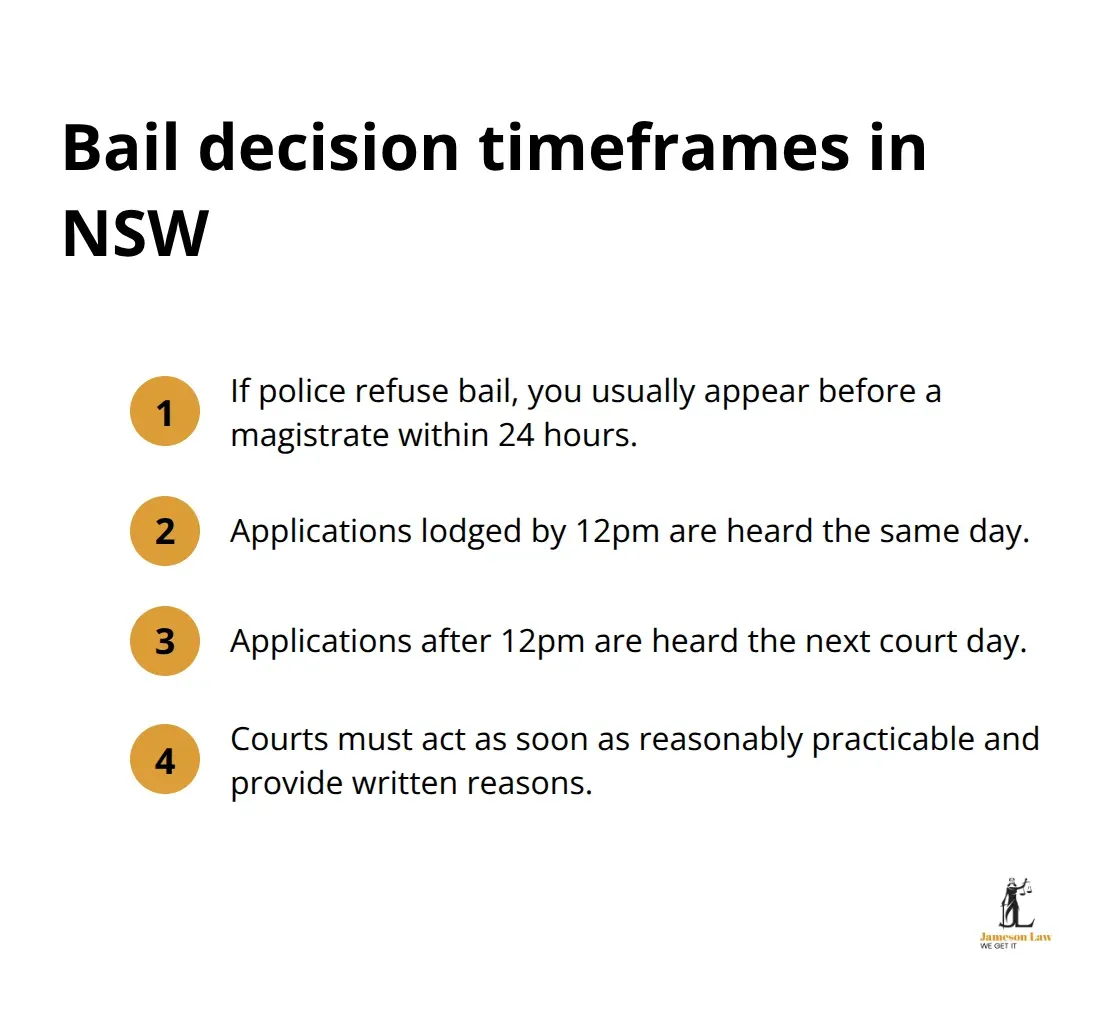
Police, magistrates, and higher courts all hold authority to make bail decisions, but the process differs at each level. If police refuse bail, you appear before a magistrate in the Bail Division, typically within 24 hours. If the magistrate refuses, you can apply to the Supreme Court, though only one bail application can usually be made at the magistrate level unless your circumstances genuinely change.
Applications submitted by 12pm receive a hearing the same day; otherwise they’re heard the next court day. The law requires all bail decisions to be dealt with as soon as reasonably practicable, and courts must provide written reasons if bail is refused or conditions are imposed. This means you’re entitled to know exactly why a decision was made and what specific concerns the court addresses with any conditions.
What Happens Next in Your Bail Proceedings
Understanding how bail decisions work sets the foundation for what comes next. Your rights during the bail process-including your right to legal representation and your ability to challenge conditions-directly affect the outcome of your application and your freedom while your case proceeds.
Your Rights in a Bail Hearing
You hold concrete legal rights during bail proceedings, and understanding them changes what happens next. The first right is access to legal representation. Under the Bail Act 2013, police must facilitate your access to a legal practitioner while you’re in custody, allowing you to communicate with a lawyer about your bail application. This isn’t optional-it’s a legal obligation. In practice, you can request a lawyer immediately after arrest, and police cannot unreasonably prevent that conversation.
How Legal Representation Strengthens Your Application
A criminal lawyer analyses the prosecution’s case, identifies the specific bail concerns the court will raise, and prepares supporting documentation like employment letters or character references that directly address those concerns. Courts hear oral submissions typically limited to 10 minutes per side in the Bail Division, and a skilled lawyer uses that time to present targeted arguments rather than general pleas. The difference between representing yourself and having legal representation is stark. Unrepresented clients facing identical charges often receive stricter conditions or detention compared to those with legal representation.
Challenging Bail Conditions That Don’t Fit Your Circumstances
Your second right is the ability to challenge bail conditions. Bail conditions must be reasonable, proportionate to the offence, not unduly onerous, and practically feasible to comply with. If the court imposes a curfew from 6pm to 6am, requires you to report three times weekly to a police station 40 kilometres from your home, and forbids contact with your flatmate while you live together, those conditions fail the proportionality test.
You can apply to vary those conditions at the Local Court by filing an Application for Variation of Bail Conditions. Some conditions-reporting requirements, residence restrictions, association prohibitions, and curfews-can be reviewed by an authorised justice after a hearing where you present evidence about why the condition is impractical or disproportionate. Other conditions imposed by higher courts require court involvement to change. The key is acting quickly. If you cannot comply with a condition, file a variation application immediately rather than breaching bail and facing arrest or revocation.
Applying for Bail Variation When Your Circumstances Change
Your third right is applying for bail variation when circumstances genuinely change. This differs from challenging existing conditions. If you’re granted bail on condition that you reside at your parents’ address, but your parents move interstate and you have no other suitable accommodation, that’s a material change. If you’re required to report to police three times weekly but secure employment requiring you to work those exact hours, that’s a circumstance change.
You can apply to vary bail by filing an application at the Local Court, and you should obtain legal advice before applying because the court will scrutinise whether the change is genuine or merely an attempt to circumvent the original decision. Importantly, only one bail application can typically be made at the Magistrates Court level unless circumstances change, so a poorly prepared variation application wastes your opportunity. The court must deal with variation applications as soon as reasonably practicable, and if bail is varied, you’ll receive written reasons explaining the decision.
Virtual Hearings and Your Right to Support
Virtual hearings through Audio Visual Link, now standard in the Bail Division, don’t diminish your rights. Research shows virtual hearings are not inherently unfair, and they allow family members to dial in and support you during the hearing, which can strengthen your application by demonstrating community ties and support networks. Understanding these three core rights-legal representation, the ability to challenge conditions, and the power to apply for variation-positions you to respond effectively when bail conditions affect your life. The next step is understanding what specific conditions courts commonly impose and what each one means for your daily obligations.
Common Bail Conditions and What They Mean
Bail conditions sit between freedom and detention. They are not punishments-courts impose them to manage identified risks, not to penalise you before trial. Understanding what each condition requires in practice matters far more than knowing its legal definition.
A reporting requirement sounds straightforward until you realise it demands you attend a police station 40 kilometres away three times weekly while working full-time. A residence condition seems simple until family circumstances change and you need to move. Non-association orders prevent contact with specific people, but the practical impact depends entirely on who those people are and what contact means under the condition’s wording.
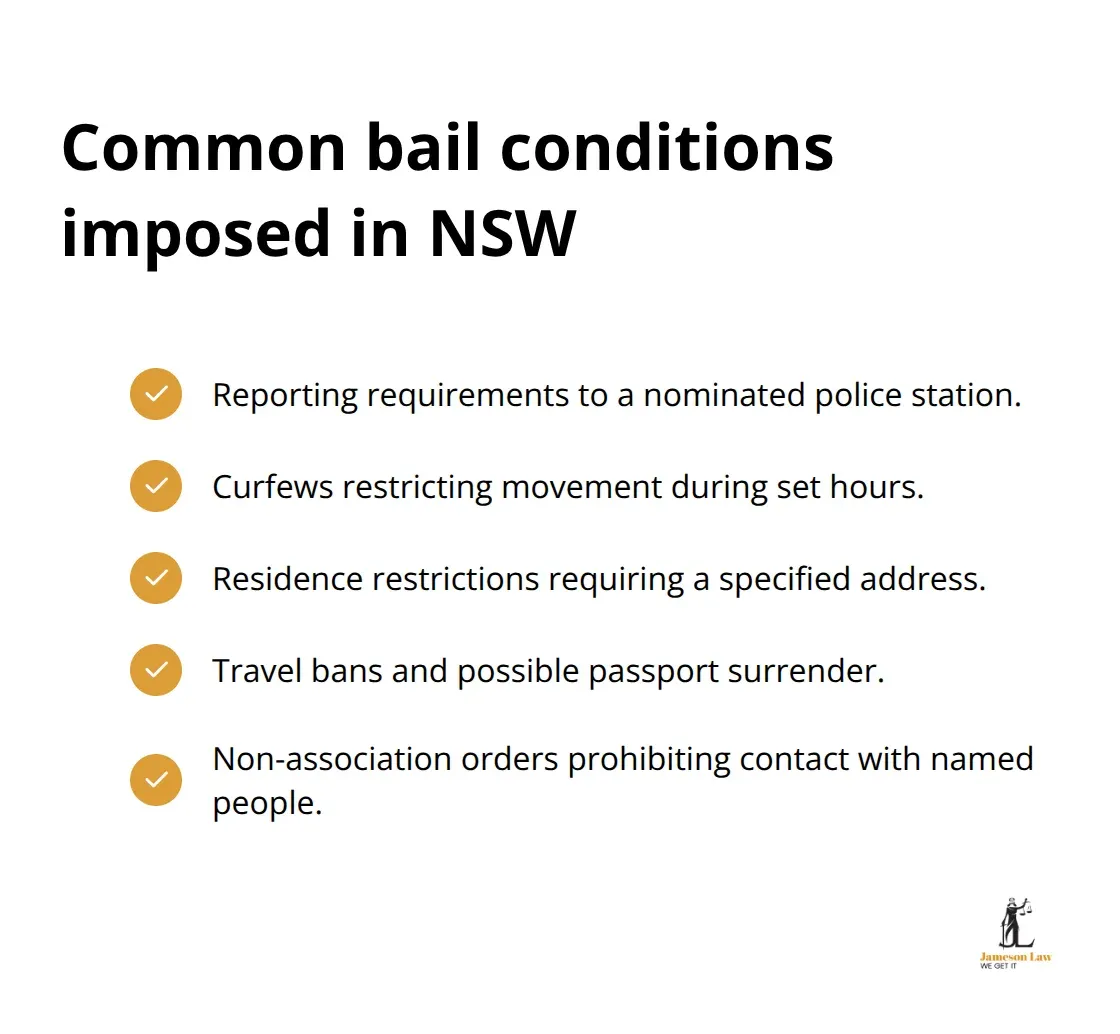
Courts in NSW commonly impose reporting requirements, curfews, residence restrictions, travel bans, and non-association orders. Each serves a specific purpose tied to the bail concerns the magistrate identified during your hearing.
Reporting Requirements and Police Station Attendance
Reporting requirements demand you attend a nominated police station on set days and times, usually between one and three times weekly depending on the offence and risk assessment. The court sets the frequency and location, and missing even one scheduled report constitutes a breach that can trigger arrest. If the station is unreasonably distant from your home or work, file a variation application immediately rather than risk non-compliance.
Some magistrates approve telephone reporting or video check-ins instead of in-person attendance, though this varies by station and offence type. Raise this option during your bail hearing if the nominated station creates genuine hardship. The court assesses whether conditions are reasonably practicable to comply with, and if you demonstrate that in-person reporting creates unmanageable conflict with your employment or caring responsibilities, magistrates often adjust the terms.
Curfews and Movement Restrictions
Curfews restrict your movement to specific hours, commonly 6pm to 6am or 7pm to 7am, meaning you must remain at your residence during those times. Courts impose curfews when they assess risk as moderate but manageable through movement restrictions rather than detention. A curfew does not prevent you from working day shifts, but it eliminates evening employment and social activities.
If your employment changes and you suddenly need to work evening hours, the curfew becomes impractical and variation is your immediate response. Do not attempt to work those hours and breach the condition-instead, apply to vary it with documentation from your employer showing the new shift times. Courts understand that employment circumstances shift, and a well-prepared variation application succeeds far more readily than defending a breach.
Residence Conditions and Address Requirements
Residence conditions require you to live at a specific address for the duration of your matter. Courts impose these to verify your whereabouts and ensure stability. You cannot move house without court permission, even to a nearby suburb. If your living situation becomes unsafe, unstable, or unsuitable, you must apply to vary the condition rather than simply relocating. The court needs to approve your new address before you move.
Provide documentation supporting your variation application-a letter from your landlord explaining why you must leave, evidence of unsafe conditions, or proof of new accommodation. Courts are more likely to approve variation when you present concrete reasons and a suitable alternative address rather than requesting removal of the condition entirely.
Travel Restrictions and Passport Surrender
Travel restrictions often accompany residence conditions, particularly for non-citizens or those with international connections. You might be prohibited from travelling beyond NSW, or restricted to a specific region within the state. Some conditions require you to surrender your passport to the court or police. If the restriction prevents you from attending genuine work obligations or family emergencies interstate, variation is available but requires documented justification.
Provide evidence of the interstate commitment-a letter from your employer, medical appointment confirmation, or documentation of a family emergency. Courts balance the bail concerns (typically flight risk) against your legitimate need to travel, and a clear explanation with supporting documents strengthens your application significantly.
Non-Association Orders and Contact Prohibitions
Non-association orders prohibit contact with named individuals, typically witnesses, alleged victims, or co-accused persons. The condition covers direct contact in person, electronic communication through phone calls, messages, emails or social media, and indirect contact through third parties. A single text message, even one expressing apology or explanation, constitutes a breach.
If you share accommodation with a named person or work alongside them, the condition becomes practically impossible to comply with without variation. Courts understand this reality and sometimes impose conditions that allow necessary contact in specific contexts, such as workplace communication only or contact through a lawyer. Read your bail acknowledgment carefully to understand exactly what contact is prohibited and whether any exceptions apply. If the condition prevents you to contact a family member, obtain legal advice before your bail hearing concludes because variation becomes harder to justify later.
Final Thoughts
Bail information NSW shows that your rights during bail proceedings are real and enforceable. You hold the right to legal representation, the power to challenge conditions that don’t fit your circumstances, and the ability to apply for variation when your situation changes. These rights exist because bail is not punishment-it’s a mechanism to manage risk while your case proceeds.
Breaching bail conditions or ignoring impractical requirements creates far worse outcomes than addressing them head-on. A single missed reporting appointment or one message to a person named in a non-association order can trigger arrest, bail revocation, and harsher penalties at trial. If a condition becomes impossible to comply with, file a variation application immediately rather than risk non-compliance.
When you face bail proceedings, securing legal representation transforms your outcome. We at Jameson Law provide criminal law assistance across NSW and understand how bail decisions affect your freedom and future-contact us to discuss your bail application and the steps you can take to secure release with manageable conditions.