PUBLICATION

Workers Compensation NSW Claims: Your Rights and Steps

"Learn your rights and next steps for workers compensation NSW claims—includes eligibility, benefits, and how to lodge your claim."
Workers Compensation NSW Claims: Your Rights and Steps

A workplace injury can turn your life upside down, but you’re not alone in facing it. NSW workers compensation laws give you specific rights, and understanding them is the first step toward protecting yourself.

At Jameson Law, we’ve helped countless injured workers navigate workers compensation NSW claims and secure the support they deserve. This guide walks you through your entitlements, the claim process, and how to handle common obstacles.

What You’re Entitled to Receive

Weekly Benefits Replace Your Lost Income

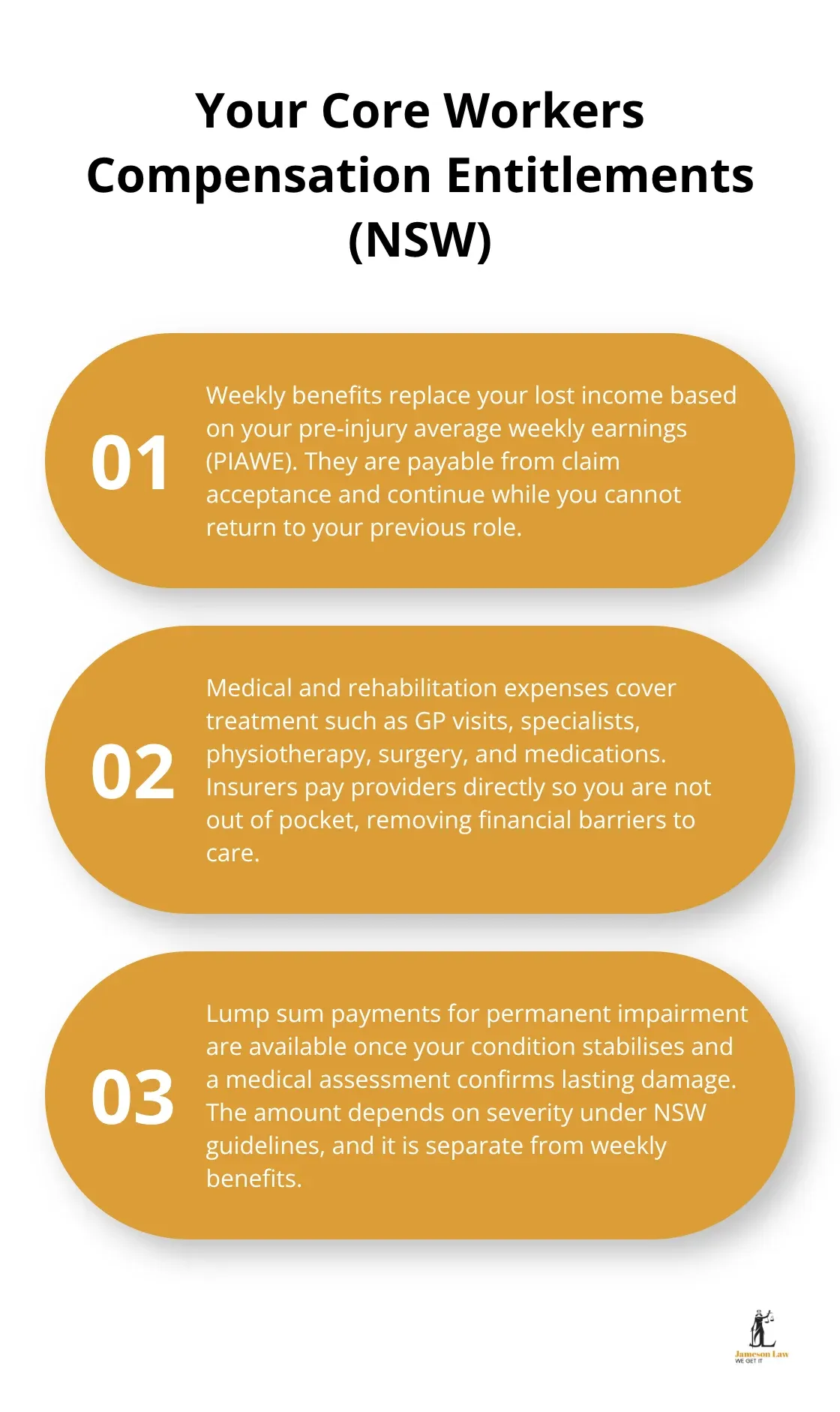
NSW workers compensation covers three main areas of financial support, and understanding what each covers helps you build a stronger claim. Weekly benefits replace your lost income while you’re unable to work, calculated on your pre-injury average weekly earnings (PIAWE). The insurer must pay these from the date your claim receives acceptance, and they continue for as long as your injury prevents you from working in your previous role.

If you’re able to do lighter duties or part-time work, your weekly payments reduce proportionally to your new earning capacity. However, this reduction is based on actual work available to you, not theoretical work. The insurer cannot reduce your payments based on work that doesn’t genuinely exist in your workplace or industry.

Medical and Rehabilitation Expenses

Medical and rehabilitation expenses cover treatment needed to support your recovery, including GP visits, specialist consultations, physiotherapy, surgery, and ongoing medications. The insurer pays these costs directly to providers, so you don’t pay upfront and then claim back. This arrangement removes financial barriers to getting the treatment you need.

Rehabilitation also includes vocational support if you need retraining for different work. The insurer must fund reasonable rehabilitation plans that give you a genuine pathway back to suitable employment. If your injury prevents you from returning to your previous role, the insurer has an obligation to support your transition into work you can actually do.

Lump Sum Payments for Permanent Impairment

Lump sum payments for permanent impairment become payable once your condition has stabilised and a medical assessment confirms lasting damage. The amount depends on the severity of your impairment against NSW guidelines, and these payments sit separately from your weekly benefits. Many injured workers underestimate what they’re entitled to here because they don’t understand the assessment process or don’t challenge low offers.

If an insurer offers a lump sum that seems too low, you can request a second opinion and lodge a dispute through the Personal Injury Commission. The key is acting within timeframes-notify your employer as soon as possible after injury, lodge your claim within six months of becoming aware of it, and don’t wait years hoping things improve on their own.

Avoiding Delays in Your Claim

Common delays happen because workers submit incomplete paperwork or missing medical information. Gather your medical evidence and a Certificate of Capacity from your doctor before lodging your claim. These three components-weekly benefits, treatment costs, and impairment payments-form your complete entitlement, and claiming all three properly is where most workers fall short.

Visual overview of weekly benefits, medical and rehabilitation expenses, and lump sum impairment payments in NSW. - workers compensation NSW claims

The next step is understanding exactly how to lodge your claim and what documentation the insurer requires from you.

How to Lodge Your Claim in Three Steps

Notify Your Employer Immediately

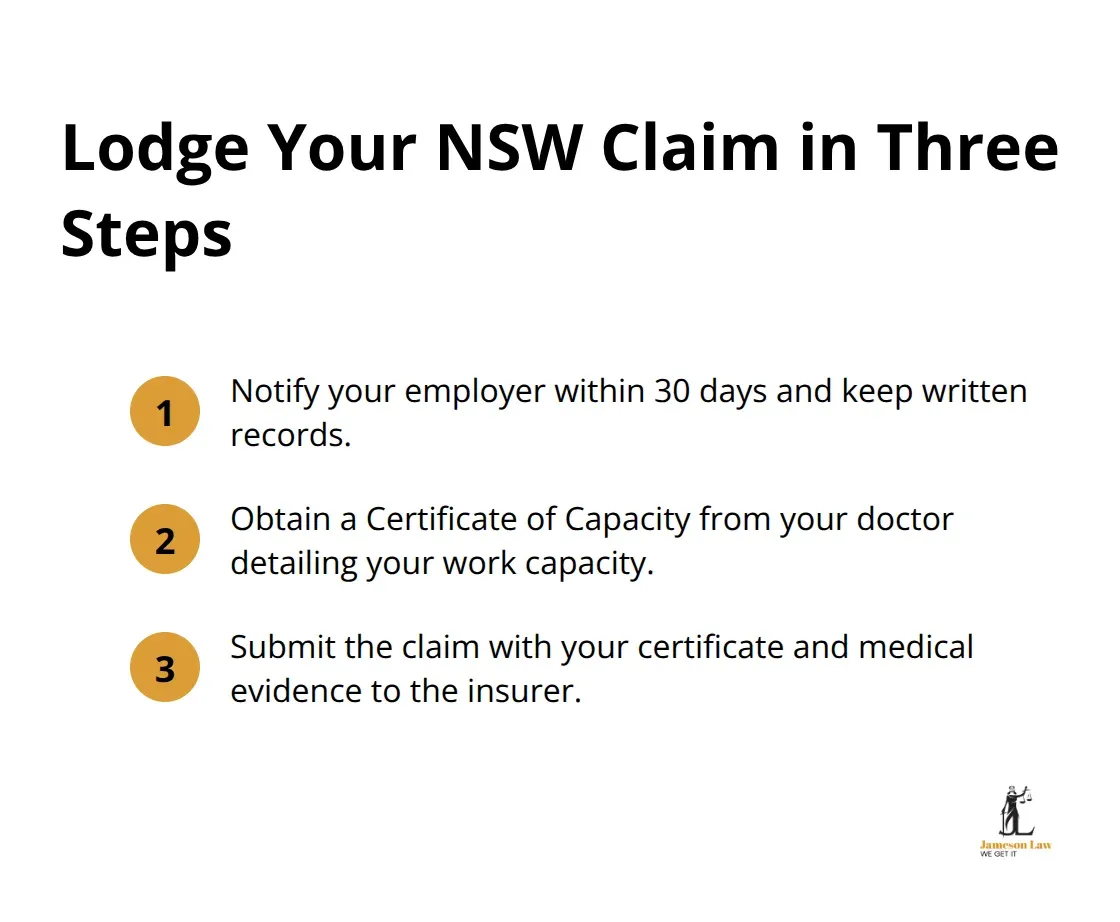
Tell your employer about your injury as soon as possible, ideally within 30 days. This notification starts the clock on your claim timeline and creates a documented record that protects you later. Don’t assume your employer already knows because you mentioned it casually or took time off.

Provide written notice, either in person with a follow-up email or by letter, stating the date of injury, how it happened, and which body part is affected. Keep a copy for your records. Your employer then has obligations under NSW workers compensation law to notify their insurer within 48 hours of becoming aware of the injury. If your employer delays or fails to notify their insurer, this doesn’t invalidate your claim, but it can create complications that slow your acceptance decision.

Obtain a Certificate of Capacity from Your Doctor

Once you’ve notified your employer, book an appointment with your GP or treating doctor to obtain a Certificate of Capacity. This document records your current medical condition, what work you can and cannot do, and your current work capacity percentage. The Certificate of Capacity is non-negotiable for your claim-without it, the insurer will ask for it anyway, which delays everything.

Bring detailed information to your doctor about your job duties, the injury mechanism, and any restrictions you’re experiencing. The more specific your doctor’s assessment, the stronger your claim foundation. Gather your medical records, including any scans, test results, or specialist reports relevant to your injury. If you’ve already seen a physiotherapist or specialist before lodging, include those reports too. This medical evidence supports your Certificate of Capacity and demonstrates that your injury is genuine and work-related.

Submit Your Claim to the Insurer

Lodge your claim with your employer’s workers compensation insurer within six months of becoming aware of your injury. You’ll need the claim form, your Certificate of Capacity, and your medical documentation. Most insurers accept claims online through their portal, by mail, or in person.

Check your employer’s workers compensation policy documents to identify the insurer’s name and contact details. Don’t wait for your employer to hand you the claim form-contact the insurer directly and request it. The insurer must decide on your claim within 21 days of receiving it. They’ll either accept it, provisionally accept it, or deny it.

Compact checklist of the three steps to lodge a NSW workers compensation claim.

Provisional acceptance means they’ve accepted liability but may request further medical information before making a final decision. If the insurer requests additional information, respond within the timeframe they provide. Common requests include updated medical reports, further specialist assessments, or clarification about your work duties. Delays often happen because workers take weeks to gather this information. Have your medical team send reports directly to the insurer to speed things up.

If your claim is denied, you have the right to request a review through the Independent Review Office or lodge a dispute with the Personal Injury Commission. These services are available to help you challenge incorrect decisions without paying legal fees upfront. Understanding what happens after the insurer makes their decision-and what obstacles you might face-helps you prepare for the next phase of your claim.

Common Challenges When Your Claim Gets Rejected

Claim rejections happen more often than injured workers expect, and most rejections stem from fixable problems rather than legitimate reasons to deny your claim. The insurer might reject your claim because medical evidence doesn’t clearly link your injury to work, your Certificate of Capacity lacks sufficient detail about your work restrictions, or you’ve missed a timeframe deadline. Some rejections occur because the insurer disputes whether your injury actually happened at work, particularly for gradual onset conditions like repetitive strain injuries or psychological injuries from workplace stress. The key difference between a rejection and acceptance is often just better documentation and a clearer explanation of how your injury happened and how it prevents you from working.

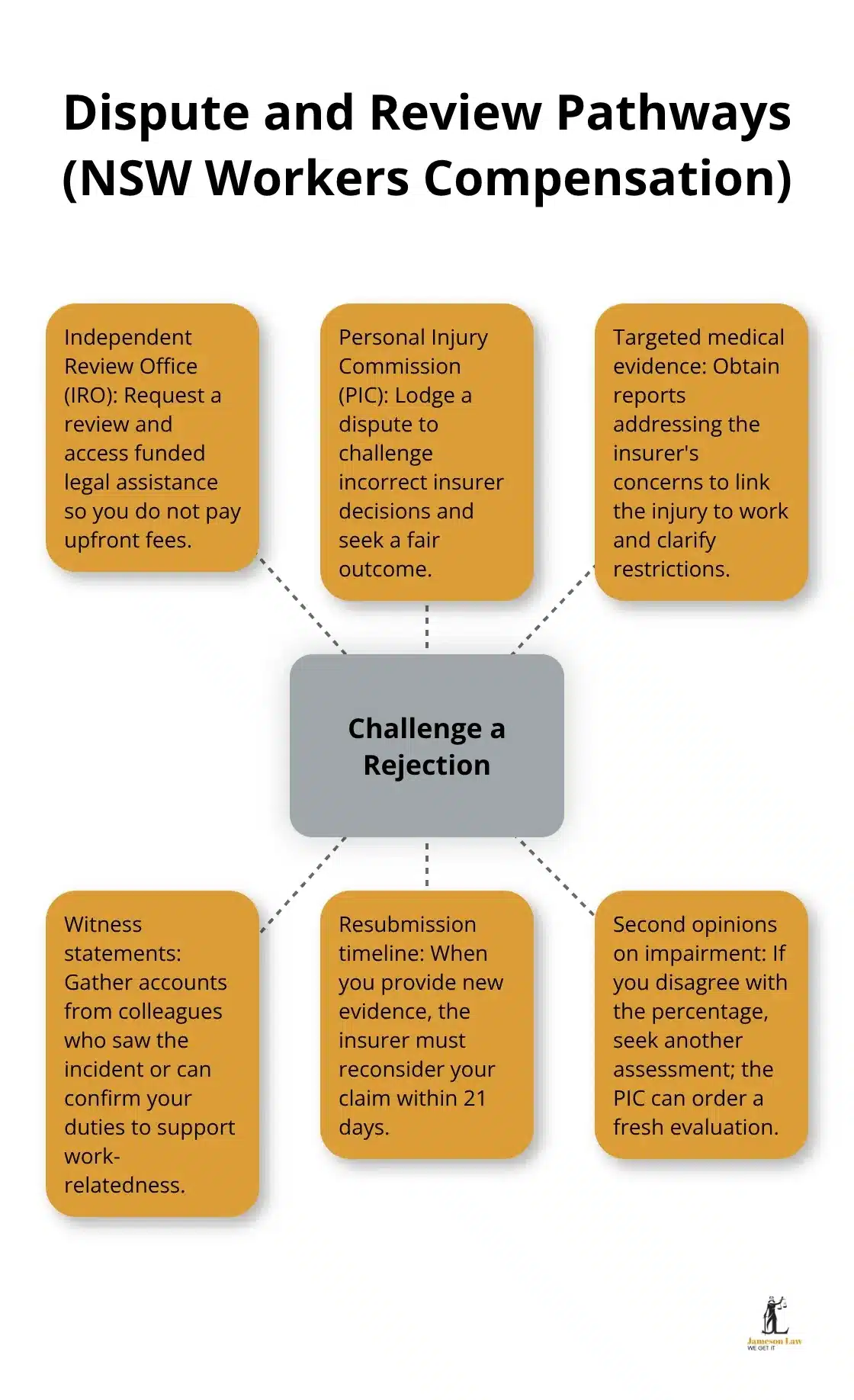
When the insurer rejects your claim, you have the right to request a review through the Independent Review Office or lodge a dispute with the Personal Injury Commission. The Independent Review Office also funds legal assistance for injured workers challenging rejections, so you don’t need to pay upfront legal fees. Most workers don’t know this option exists, which means they accept rejections that should never have happened.

Hub-and-spoke diagram showing IRO review, PIC dispute, targeted evidence, witness statements, reconsideration timelines, and second opinions. - workers compensation NSW claims

If your claim was rejected because medical evidence was incomplete, obtain a new report from your doctor specifically addressing what the insurer questioned. If the rejection relates to whether your injury is work-related, gather witness statements from colleagues who saw the incident or can confirm your work duties. Resubmit your claim with this additional evidence and clearly explain why the original rejection was incorrect. The insurer must reconsider within 21 days of receiving your new submission.

Understanding Impairment Assessments and Disputing Low Outcomes

Impairment assessments determine how much your permanent injury has reduced your capacity to work and earn, which directly affects your lump sum payment. NSW impairment guidelines use specific thresholds and assessment criteria, but insurers often interpret these guidelines narrowly in their favour. A medical assessor (usually an independent doctor chosen from an approved panel) examines you to determine your impairment assessment percentage. However, the insurer sometimes pressures injured workers to accept the first assessment result without questioning whether the assessor properly examined your condition or considered all your medical evidence. If you disagree with the impairment percentage, you can request a second opinion and lodge a dispute with the Personal Injury Commission, which has the power to order a fresh assessment if the first one was inadequate.

Before accepting any impairment assessment, obtain a copy of the full assessment report and have your treating doctor review it. Your treating doctor knows your condition far better than the assessor who examined you once, and they can identify if the assessment missed important functional limitations or misinterpreted your medical imaging or test results. If your treating doctor disagrees with the assessment outcome, document their concerns in writing and submit this to the insurer before accepting the offer. Settlement amounts for permanent impairment vary dramatically depending on the percentage assigned, so disputing a low assessment is genuinely worth your effort. An injured worker assessed at 15 per cent impairment receives substantially less than someone assessed at 25 per cent for a similar injury, yet the difference often comes down to how thoroughly the assessor examined you or how clearly your doctor explained your limitations.

Negotiating Settlement Offers That Fall Short

Insurers make opening offers on lump sums and settlement amounts knowing that many injured workers lack confidence challenging them. The insurer’s first offer is rarely their best offer, and accepting it immediately means you’ve left money on the table. Before responding to any settlement offer, calculate what your entitlements actually total based on your weekly benefits, treatment costs already paid, and your impairment assessment. If you’ve received weekly payments for twelve months at $800 per week, that’s $41,600 in income replacement alone, plus your medical and rehabilitation costs, plus your impairment lump sum. The insurer’s offer should account for all three components, not just the impairment portion. If the offer falls significantly short, respond in writing explaining why each component is insufficient and request a revised offer. Most insurers will increase their offer rather than fight a detailed written challenge, particularly if you’ve obtained supporting medical evidence.

Handling Psychological Injury Claims

Psychological injuries from workplace stress, bullying, or harassment can be claimed under NSW workers compensation, but these claims face higher rejection rates because they require robust medical documentation. Your doctor must provide detailed clinical notes explaining how the workplace events caused your psychological injury and how this injury prevents you from working. Vague descriptions won’t succeed, but specific accounts of incidents, dates, and how they affected your mental health will. Settlement negotiations for psychological injuries often take longer because insurers scrutinise these claims more carefully, so patience and persistence matter. Never accept a settlement offer under pressure or within an unreasonably short timeframe. Respond to offers thoughtfully, provide evidence supporting your position, and be willing to escalate to dispute resolution if the insurer refuses to increase their offer to a reasonable level.

Final Thoughts

Your rights under workers compensation NSW claims are clear, but claiming them requires action. You’re entitled to weekly income replacement, medical and rehabilitation costs, and lump sum payments for permanent impairment. The process itself is straightforward: notify your employer, obtain a Certificate of Capacity from your doctor, and lodge your claim with the insurer within six months of becoming aware of your injury.

Claim rejections, low settlement offers, and disputes over impairment assessments happen regularly, but they’re not the end of your claim. You can request reviews through the Independent Review Office, lodge disputes with the Personal Injury Commission, and challenge assessments with supporting medical evidence. The Independent Review Office also funds legal assistance for injured workers, meaning you don’t pay upfront fees to challenge incorrect decisions.

If your claim becomes complicated, if the insurer rejects it without good reason, or if settlement negotiations stall, contact Jameson Law to discuss your workers compensation NSW claim and understand your options. We help injured workers navigate these claims and secure the support they deserve.

Speak to an Expert Lawyer today

Laywers-Jameson-Law-The-best-law-firm-in-Sydney- Sydney Lawyers - Sydney
BOOK NOW

WE'RE IN IT TO WIN IT

Book your consultation

Book Now
Book Now Mobile 06 02 2025

This form submission is encrypted and secured to ensure your information remains confidential.

What our Clients

Related Publications:

What our clients say

.

Jameson Law - Voted the Best Law firm in Sydney Award

Legal Answers ... In Short

We're here to help

Our mission is to ensure our client matters are resolved successfully every time. Success to us does not simply involve winning, but moreover ensuring we take the most feasible, economic and stress-free path to help our clients achieve their goals. We fight hard for our clients, and always go by the motto: we’re in it to win it.

Jameson Law - Best Law Firm in Sydney

WE'RE IN IT TO WIN IT

Book your consultation

Call us now on (02) 8806 0866 or fill out the form below

Book Now Mobile

This form submission is encrypted and secured to ensure your information remains confidential.

WE'RE IN IT TO WIN IT

Book your consultation

Book Now Mobile 06 02 2025
lock

This form submission is encrypted and secured to ensure your information remains confidential.

Our Sydney Offices

Offices Parramatta and Sydney Jameson Law
Parramatta CBD - Head Office
jameson Law - Blacktown
jameson Law - Liverpool Office
Jameson Law - Bankstown
Court Houses We Frequent Jameson Law

Court Houses We Frequent

Balmain Local Court

Registry: Monday to Friday, 9:00am to 4:30pm

Bankstown Local Court

Court Operating Hours: 9:30am-4:30pm

Blacktown Local Court

Registry Hours: 9:00 – 4:30
Telephone Hours: 8:30 -4:30
Days open: Mon-Fri

Burwood Local Court

Registry Hours: 9:00 – 4:30
Telephone Hours: 8:30 – 4:30
Days open: Mon – Fri

Campbell Local Court

Registry Hours: 9:00 – 4:30
Telephone Hours: 8:30 – 4:30
Days open: Mon – Fri

Central Local Court

Registry Hours: 9:00 – 1:00 and 2:00 – 4:30
Telephone Hours: 8:30 – 4:30

Downing Local Court

Registry Hours: 9:00 – 1:00 and 2:00 – 4:30
Telephone Hours: 8:30 – 4:30

Wollongong Local Court

Registry Hours: 9:00 – 1:00 and 2:00 – 4:30
Telephone Hours: 8:30 – 4:30

Fairfield Local Court

Registry Hours: 9:00 – 1:00 and 2:00 – 4:30
Telephone Hours: 8:30 – 4:30

Hornsby Local Court

Registry Hours: 9:00 – 1:00 and 2:00 – 4:30
Telephone Hours: 8:30 – 4:30

Liverpool Local Court

Registry Hours: 9:00 – 1:00 and 2:00 – 4:30
Telephone Hours: 8:30 – 4:30

Manly Local Court

Registry Hours: 9:00 – 1:00 and 2:00 – 4:30
Telephone Hours: 8:30 – 4:30

Newtown Local Court

Registry Hours: 9:00 – 1:00 and 2:00 – 4:30
Telephone Hours: 8:30 – 4:30

Parramatta Local Court

Registry Hours: 9:00 – 1:00 and 2:00 – 4:30
Telephone Hours: 8:30 – 4:30

Penrith Local Court

Registry Hours: 9:00 – 1:00 and 2:00 – 4:30
Telephone Hours: 8:30 – 4:30

Sutherland Local Court

Registry Hours: 9:00 – 1:00 and 2:00 – 4:30
Telephone Hours: 8:30 – 4:30

Waverley Local Court

Registry Hours: 9:00 – 1:00 and 2:00 – 4:30
Telephone Hours: 8:30 – 4:30

Windsor Local Court

Registry Hours: 9:00 – 1:00 and 2:00 – 4:30
Telephone Hours: 8:30 – 4:30

Wollongong Local Court

Registry Hours: 9:00 – 1:00 and 2:00 – 4:30
Telephone Hours: 8:30 – 4:30

Downing Centre District Court

Registry Hours: 9:00 – 4:30
Telephone Hours: 8:30 – 4:30
Days open: Mon – Fri

Parramatta District Court

Registry Hours: 9:00 – 4:30
Days open: Mon-Fri

Penrith District Court

Registry Hours: 9:00 – 4:30
Days open: Mon-Fri

Campbelltown District Court

Registry Hours: 9:00 – 4:30
Days open: Mon – Fri

Liverpool District Court

Registry Hours: 9:00 – 4:30
Days open: Mon – Fri

Wollongong District Court

Registry Hours: 9:00 – 1:00 and 2:00 – 4:30
Telephone Hours: 8:30 – 4:30

Supreme Court New South Wales

Registry Hours: 9:00 AM – 4:30 PM
Telephone Hours: 8:30 AM – 4:30 PM
Days Open: Monday to Friday

Federal Circuit and Family Court of Australia

Registry Hours: 9:00 AM – 4:30 PM
Telephone Hours: 8:30 AM – 5:00 PM
Days Open: Monday to Friday

Federal Court

Monday to Friday, 8:30 AM – 4:30 PM

High Court

Monday to Friday, 8:30 AM – 5:00 PM

Children’s Court of New South Wales

Registry Hours: 9:00 AM – 4:30 PM
Telephone Hours: 8:30 AM – 4:30 PM
Days Open: Monday to Friday

Coroner’s Court New South Wales

Registry Hours: 9:00 AM – 4:30 PM
Telephone Hours: 8:30 AM – 4:30 PM
Days Open: Monday to Friday

Industrial Relations Commission of New South Wales

Registry Hours: 9:00 AM – 4:30 PM
Telephone Hours: 8:30 AM – 4:30 PM
Days Open: Monday to Friday

Land and Environment Court of New South Wales

Registry Hours: 9:00 AM – 4:30 PM
Telephone Hours: 8:30 AM – 4:30 PM
Days Open: Monday to Friday

WE'RE IN IT TO WIN IT

Book your consultation

Book Now
Book Now Mobile 06 02 2025
lock

This form submission is encrypted and secured to ensure your information remains confidential.