

A police interview can feel overwhelming, especially if you’re unsure what you’re legally allowed to do. Understanding your police interview rights in NSW is the first step toward protecting yourself during questioning.
At Jameson Law, we’ve seen how quickly situations can escalate when people don’t know their legal protections. This guide walks you through exactly what you can and can’t do when police want to talk to you.
What You Can Actually Say in a Police Interview
Silence Is Your Strongest Protection
The most powerful thing you can do in a police interview is nothing. Your right to silence is not an admission of guilt, and it is not suspicious behaviour that a court can hold against you. Under Section 89A of the NSW Evidence Act 1995, remaining silent during questioning prevents a court from drawing an unfavourable inference about your guilt. This protection exists because the burden of proof sits with the prosecution, not with you.
NSW Police arrested and charged nearly 62,000 people in the four months to March 2026, a 13 percent increase that shows how aggressively police gather evidence. That evidence does not have to come from your mouth. The moment police detain you or ask formal questions, they must issue a caution explaining your right to silence and that anything you say may be used as evidence. Many people ignore this caution because police often frame the interview as a casual conversation or suggest they simply want to hear your side of the story. This is a deliberate tactic.
Nothing said in an interview is off the record, and inconsistencies between what you say and other evidence can be examined in cross-examination later. The practical approach is straightforward: tell police, “I have received legal advice. I do not wish to participate in an interview or answer any questions.” Repeat this statement as many times as needed without justification or softening. Police cannot force you to answer substantive questions solely because you are detained.
You must provide your name, residential address, and date of birth when lawfully requested, and you may need to provide driver or vehicle details in crash scenarios. These mandatory disclosures are different from participating in questioning.
How Legal Representation Shifts the Balance
Getting legal advice before stepping into an interview room is the single most important decision you will make. Fixed-fee initial consultations are available through criminal law firms, often around $295, which costs substantially less than the cost of saying the wrong thing. A lawyer can attend the police station with you, provide pre-interview advice, and be present during questioning to object to inappropriate questions and ensure police follow the Law Enforcement Powers and Responsibilities Act 2002.
The presence of a lawyer also affects what police can later do with your silence. Under Section 89A of the NSW Evidence Act 1995, police can only use a special caution that might create an unfavourable inference if your lawyer is physically present with you at the station. Without your lawyer sitting beside you in the interview room, this power does not apply, which is why some defence lawyers advise their clients not to sit in the interview. This seems counterintuitive, but it protects your rights by preventing police from using your later reliance on facts as evidence of dishonesty.
Your solicitor can also negotiate with police before any interview happens, sometimes resulting in written responses instead of live questioning. This approach reduces the risk of self-incrimination through verbal inconsistencies or pressure tactics.
Managing Communication at the Station
Police must provide you with reasonable facilities to speak privately with a lawyer, including access to a phone, under LEPRA 2002. This is not a suggestion or a courtesy. If you request legal representation, police cannot proceed with a formal interview until you have had the opportunity to communicate with a solicitor.
You also have the right to have a friend, relative, or support person present during questioning if you are vulnerable or under 18, though this person has limited power to intervene. What you must never do is have casual conversations with police while waiting in the station. Remarks made in the corridor or during breaks can be used to build a profile of you, and these are not protected by the same caution rules as formal interviews.
Understanding Detention Limits
If police detain you, they cannot hold you solely to pressure you into an interview. NSW detention for investigation is generally limited to six hours, extendable by a further six hours only with a court warrant, and timeouts for travel or breaks do not count toward this limit. Once that period expires without charges being laid, police must release you.
The practical reality is this: your outcome is often decided before you walk into the interview room, not during it. What happens next depends on whether police have gathered enough evidence to proceed with charges, which is why the decisions you make before the interview matters far more than anything you say inside it.
Inside the Interview Room
Police interviews in NSW are formal evidence-gathering sessions, not conversations. Everything said is electronically recorded unless circumstances prevent it, and the recording becomes part of the case file that prosecutors and defence lawyers review. The moment you enter the interview room, you are in an adversarial process. Two officers are typically present, which creates psychological pressure by design. Police apply questioning techniques that range from building rapport to applying direct pressure, sometimes implying they have more evidence than they actually hold. Bluffing occurs regularly.
Your task is not to help police solve the case or explain yourself; it is to protect yourself from self-incrimination. If you have not received legal advice before the interview, you operate at a severe disadvantage.
What Police Must Tell You Before Questioning
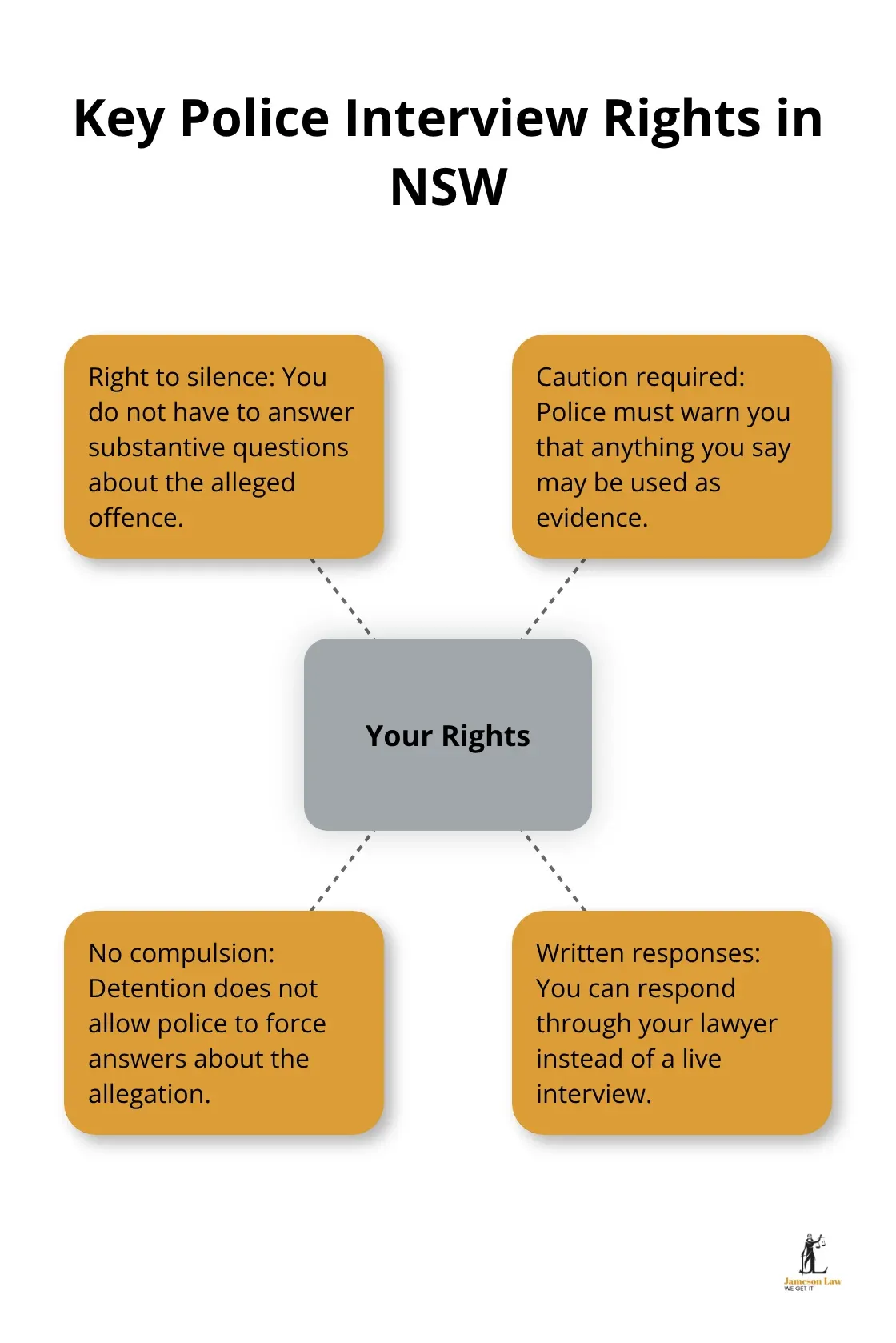
Police must provide a caution before questioning begins, explaining your right to silence and that anything you say may be used as evidence. This caution is not a suggestion. Under the Law Enforcement Powers and Responsibilities Act 2002, police cannot compel you to answer substantive questions about the alleged offence just because they detain you. You can refuse to participate entirely, or you can provide written responses through your lawyer instead of sitting in the interview room.
Many people believe attending the interview and explaining themselves will help their case. This is rarely true. Police gather evidence; courts determine guilt. Your explanation in the interview can create inconsistencies that prosecutors exploit in cross-examination, especially if your memory shifts or if new evidence emerges that contradicts what you said.
Mandatory Disclosure Versus Optional Participation
What you must disclose and what you can refuse are entirely different matters. Police often blur this line by framing substantive questions as routine enquiries. Do not fall for this tactic. You must provide your name, address, and date of birth when requested, and driver details in vehicle-related matters, but nothing beyond mandatory identification.
If you are unsure whether you must answer a specific question, your lawyer can advise you before the interview proceeds. Some people attempt to provide a written statement instead of a live interview, which reduces the pressure and gives you time to think. This approach works well if your solicitor drafts the statement and controls what is included.
Protecting Yourself Before You Arrive
Do not bring a mobile phone to the police station; currently, a device can only be ordered to be unlocked if it is seized as part of a Search or Crime Scene warrant, and your personal communications may be used to build evidence against you. Avoid casual conversations with officers while waiting; remarks made in corridors or during breaks are not protected by caution rules and can be used later.
Your detention for investigation is limited to six hours, extendable by six more hours only with a court warrant. Once that period expires without charges, police must release you. The practical approach is to tell police, “I have received legal advice. I do not wish to participate in an interview or answer any questions.” Repeat this statement as many times as needed without justification or softening.
Why Your Pre-Interview Strategy Matters More Than Your Words
Your outcome is decided by the evidence police already have and the legal strategy you choose before the interview, not by what you say inside the room. A $295 initial consultation with a criminal lawyer costs far less than the consequences of speaking without advice. The decisions you make before walking into that room determine whether police can build a stronger case against you or whether you protect yourself from self-incrimination. Once you understand what happens during questioning, the next step is recognising what mistakes people commonly make-and how to avoid them.
What Mistakes Cost You in a Police Interview
The gap between what people think they can do in a police interview and what actually protects them is where most damage occurs. Police interviews in 2026 involve technology like CCTV, GPS data, and body-worn cameras that create a permanent record of inconsistencies. Speaking without legal advice remains the most costly mistake. When you walk into an interview room without a lawyer, you operate alone against trained officers who use techniques designed to extract admissions. NSW Police arrested and charged nearly 62,000 people in the four months to March 2026, and the majority of those cases built on statements made during interviews. A qualified Australian lawyer’s 60-minute consultation costs $295 and is subject to lawyer availability, location and the type of matter. Interviews are not about fairness or truth-finding. They are about evidence collection. Police do not decide guilt; they collect material to hand to prosecutors. Anything you say becomes ammunition in that process, and silence costs you nothing legally.
Speaking Without Legal Advice
People often believe that explaining themselves will help their case. This assumption is wrong. Police gather evidence; courts determine guilt. When you answer questions without preparation or legal guidance, you create inconsistencies that prosecutors exploit in cross-examination. Your memory may shift under pressure, or new evidence may emerge that contradicts what you said. The moment you step into that room without a lawyer, every word you speak becomes evidence against you. A trained officer sits across from you, and two officers are typically present (which creates psychological pressure by design). You face this alone. The cost of a $295 initial legal consultation is negligible compared to the consequences of self-incrimination.
Confusing Mandatory Disclosure With Optional Participation
Misunderstanding what you must disclose versus what you can refuse creates serious damage. You must provide your name, address, and date of birth when lawfully requested, and driver details in vehicle-related matters, but nothing beyond mandatory identification. Many people provide inconsistent statements because they attempt to answer questions without preparation. Under Section 89A NSW Evidence Act 1995, if you later rely on a fact you failed to mention during the interview, a court can draw an unfavourable inference about your honesty-but only if police gave you a special caution in the presence of your lawyer. Without that specific procedure, your silence remains protected. Police often blur the line between what you must disclose and what you can refuse by framing substantive questions as routine enquiries. Do not fall for this tactic.
Consenting to Searches Without Understanding Your Rights
Agreeing to searches without understanding consent is another trap. Police may ask to search your phone, vehicle, or belongings, framing it as routine. You can refuse a search if police lack a warrant, though they can obtain one if they have grounds. A casual yes to a search exposes private communications or documents that police would otherwise need a warrant to access. The practical rule is simple: do not consent to anything without knowing whether police have legal authority to compel it. Your lawyer answers this question before the interview proceeds. Do not bring a mobile phone to the police station; your personal communications may be used to build evidence against you. Avoid casual conversations with officers while waiting; remarks made in corridors or during breaks are not protected by caution rules and can be used later.
How Inconsistencies Damage Your Defence
Inconsistent statements create a third category of damage. When you attempt to answer questions under pressure without time to think, your account shifts. Police record everything, and prosecutors compare your interview statement against other evidence, witness accounts, and your later testimony in court. A written statement prepared by your solicitor before the interview allows you to control what you say and avoid pressure-induced errors. This approach reduces the risk of self-incrimination through verbal inconsistencies. The moment you step into that room without legal advice, every word you speak becomes evidence, and every silence without your lawyer present remains your strongest protection.
Final Thoughts
Your police interview rights in NSW protect you from self-incrimination, but only if you act on them before police contact you. The right to silence, the right to legal representation, and the right to communicate with a lawyer before questioning are practical tools that determine whether you protect yourself or damage your case. NSW Police arrested and charged nearly 62,000 people in the four months to March 2026, and most of those cases built on statements made during interviews-your silence costs you nothing legally, while speaking without advice costs you everything.
A $295 initial consultation with a criminal lawyer costs far less than the consequences of self-incrimination through pressure, inconsistency, or misunderstanding what you must disclose versus what you can refuse. Your lawyer attends the station with you, objects to inappropriate questions, ensures police follow the Law Enforcement Powers and Responsibilities Act 2002, and sometimes negotiates written responses instead of live questioning. This preparation shifts the balance entirely in your favour and protects your police interview rights from the moment police contact you.
If you face a police interview, contact Jameson Law immediately. We provide criminal law advice across NSW and understand how police interviews work in 2026, where CCTV, GPS data, and body-worn cameras create permanent records of every inconsistency. Call us now-do not wait until you are at the station.