

Moving to Australia involves multiple steps, and understanding the migration to Australia process is essential before you start. We at Jameson Law have guided countless people through this journey, and we know the system can feel overwhelming without clear guidance.
This guide breaks down each stage so you know exactly what to expect and what documents you’ll need along the way.
Which visa path suits your migration goals
Skilled migration visas lead Australia’s intake
Australia’s migration system offers several distinct pathways, and selecting the right one significantly affects your application timeline and success rate. The Department of Home Affairs administers three main visa categories that account for the vast majority of skilled and family-based migration to Australia.
Skilled migration visas dominate Australia’s intake. The points-based system awards points for age, English language ability, work experience, and qualifications, with applicants needing to reach a threshold score to receive an invitation to apply. As of 2026, the Skilled Independent visa (subclass 189) remains the most popular option because it requires no sponsorship from an employer or state government.
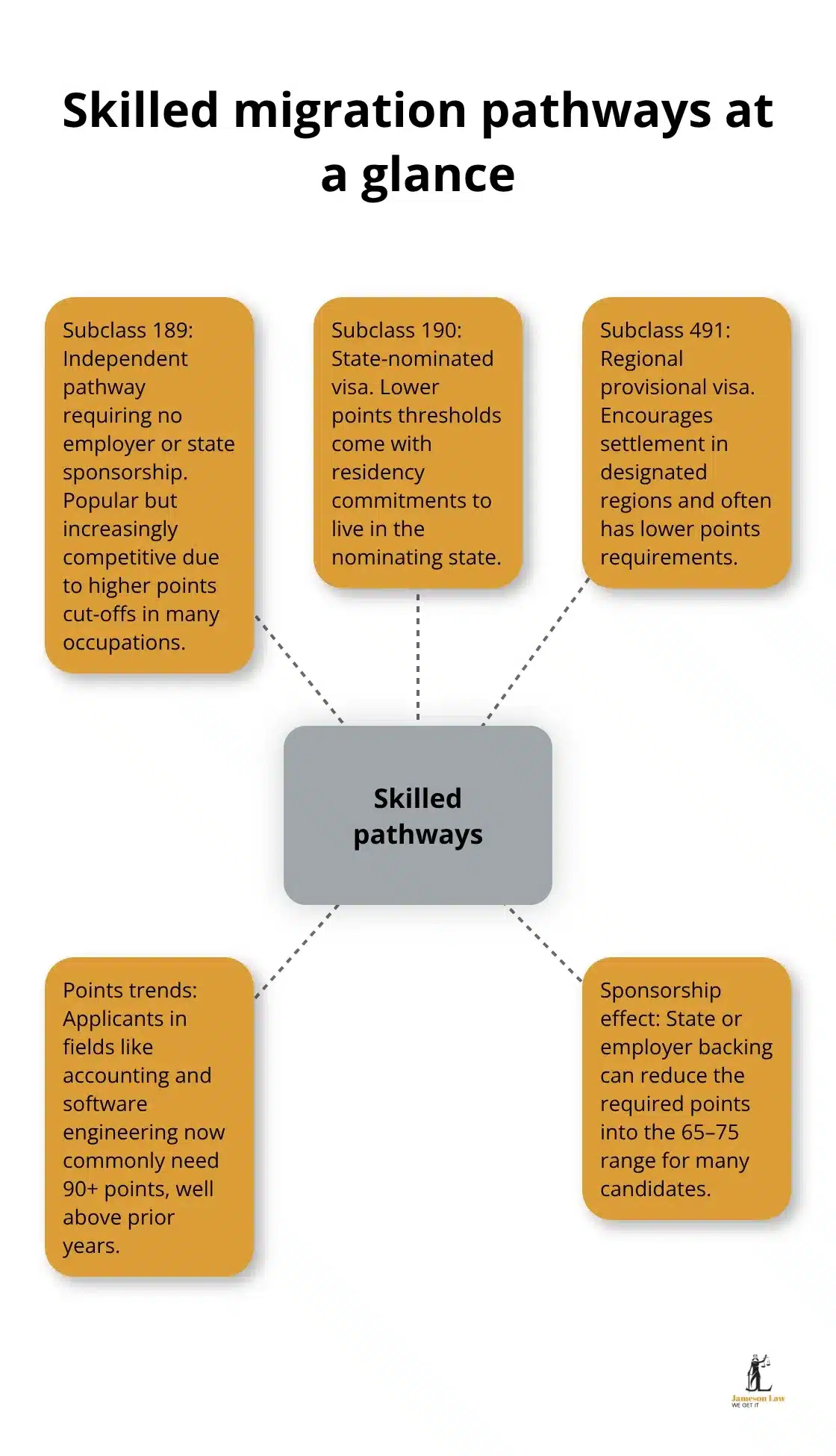
However, the points required have increased significantly over recent years-applicants in fields like accounting and software engineering now typically need scores above 90 points, whereas several years ago 65 points was competitive.
State and employer sponsorship lower your points threshold
Sponsored visas like the Skilled Nominated visa (subclass 190) and Skilled Work Regional visa (subclass 491) offer lower points thresholds, often in the 65 to 75 range, because you have either state or employer backing. The trade-off is substantial: state sponsorship visas come with residency commitments, typically requiring you to live in a specified state for at least three years. Employer-sponsored visas follow a different pathway entirely and do not rely on the points system at all. Your employer must demonstrate they cannot find an Australian citizen or permanent resident for the role, and the position must meet minimum salary thresholds that vary by occupation.
Partner and family visas take a different route
Partner visas (subclass 309 or 100) allow Australian citizens or permanent residents to sponsor their spouse or de facto partner, though the sponsorship process is lengthy, typically taking 12 to 24 months or longer depending on the visa subclass. Skilled migration visas vastly outnumber family-sponsored visas in Australia’s overall intake, reflecting the government’s preference for points-tested applicants. Parent visas exist but involve substantial costs, with fees reaching tens of thousands of dollars, making them far less common. Child visas allow Australian citizens or permanent residents to sponsor dependent children from previous relationships.
Your circumstances determine which pathway works
Your age, qualifications, work history, family connections, and financial capacity all shape which option is realistic for you. The Department of Home Affairs website provides visa outcome data, but interpreting it requires understanding which occupations are in demand and which states actively sponsor in your field. Many people struggle to identify which pathway genuinely fits their circumstances because the rules interact in complex ways. Once you understand which visa category aligns with your situation, the next step involves preparing the documentation and evidence that visa officers will assess.
Building your application foundation
Preparing a migration application requires precision and attention to detail that most people underestimate until they start gathering documents. The Department of Home Affairs receives thousands of applications monthly, and incomplete or poorly organised submissions create delays that can stretch your timeline by months. Applicants who fail to structure their documentation clearly or lack critical evidence often face requests for further information that extend processing times significantly. Your application is essentially a case you build for why you meet the visa requirements, and every document serves as supporting evidence.
Collecting documents before you lodge
You must identify which documents your specific visa category requires, as requirements vary significantly between skilled, sponsored, and family visas. The Department of Home Affairs website lists mandatory documents, but you also need supporting evidence that proves claims in your application. For skilled migration, this includes your passport, birth certificate, police clearance certificates from every country you’ve lived in for more than three months, and evidence of your work history such as employment contracts, payslips, and references from previous employers.
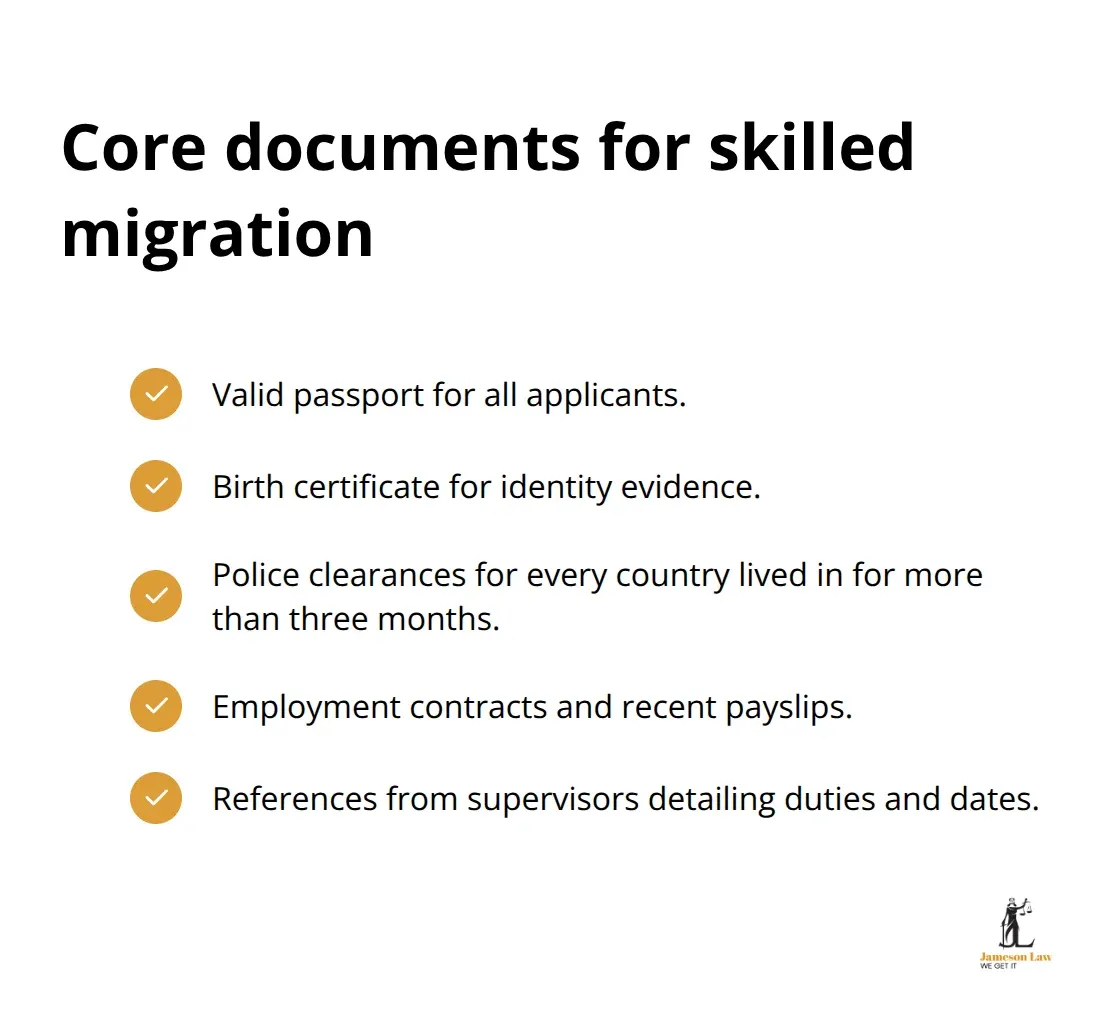
Employment references should come from supervisors or managers who can verify your specific duties and the dates you worked, as vague references often prompt visa officers to request clarification.
Qualification documents require certified copies of your degree, diploma, or other credentials, along with academic transcripts showing your grades and completed units. If your qualifications came from overseas, you need official documents issued by the educational institution itself, not just photocopies. Many applicants collect documents haphazardly and then discover months later that they lack original certified copies or that an employer has closed down and can no longer provide references. You should gather documents immediately after deciding to migrate, as obtaining police clearances from multiple countries or securing employment references from previous roles takes considerable time.
For partner visas, relationship evidence becomes central to your case, and you must demonstrate genuine commitment through documents such as joint bank statements, shared lease agreements, photographs together, and statutory declarations from people who know your relationship. The Department of Home Affairs assesses relationship evidence critically, and vague or minimal documentation triggers additional scrutiny that delays processing.
Skills assessments determine your eligibility
Skills assessments are mandatory for most skilled visa applicants and represent a formal evaluation that your qualifications and work experience meet Australian standards for your nominated occupation. Each occupation has a designated assessing authority, and finding the correct one matters because submitting to the wrong authority wastes time and money. Accountants apply through CPA Australia, Chartered Accountants Australia and New Zealand, or the Institute of Public Accountants depending on their background. IT professionals use the Australian Computer Society, engineers use Engineers Australia, and health professionals have different bodies depending on their discipline.
Skills assessments typically cost between 500 and 2,000 dollars and take 4 to 12 weeks to complete, though some authorities process faster during low-demand periods. The assessment examines your qualifications against Australian requirements and compares your work experience to determine whether you meet the standard expected of someone working in that occupation in Australia. Many applicants receive conditional assessments that require additional documentation or clarification, extending the process by several weeks. Your assessment outcome directly affects your points score and visa eligibility, making it one of the most significant hurdles in the application process.
If your qualifications came from overseas, the assessing authority often requires evidence that your qualification is equivalent to an Australian qualification, which sometimes involves additional verification steps. Some applicants hold qualifications that don’t perfectly align with their nominated occupation, and assessing authorities may determine that supplementary qualifications or additional work experience is needed to meet the standard. You should plan for skills assessment early to prevent surprises later and allow time to gather additional evidence if the authority requests it.
Health and character clearance timing
Health examinations and police clearances must go through authorised channels, and submitting medical examinations or police checks obtained outside the official process results in rejection. Department of Home Affairs panel doctors conduct health examinations, and you can only use doctors on their official panel list. Health examinations assess whether you have any conditions that would make you ineligible, including certain infectious diseases, mental health conditions requiring treatment, or physical disabilities that would create significant costs for Australian health services.
The medical examination costs between 300 and 500 dollars and results remain valid for 12 months from the date of examination. Police clearances from Australia and every country you’ve lived in for more than three months are mandatory, and obtaining clearances from overseas authorities takes substantial time. Some countries process requests within weeks while others take several months, and you cannot rush these processes. Character requirements extend beyond police clearances and include assessment of your conduct, including any involvement in serious criminal activity, fraud, or dishonesty.
If you have had any criminal history, even minor offences, you must declare them fully and honestly. Failing to declare matters you believe are resolved or minor creates far greater problems than disclosing them upfront, as visa officers can refuse applications based on dishonesty even if the underlying conduct might otherwise be acceptable. Health and character clearances remain valid for 12 months, so timing your application to ensure these clearances stay current throughout processing prevents delays caused by expired documentation. Many applicants complete health and character requirements too early and then face the frustration of clearances expiring before their application is processed, requiring them to repeat expensive and time-consuming processes.
Once you have gathered your documents, completed your skills assessment, and obtained your health and character clearances, you move into the formal application phase where you lodge your visa and navigate the Department of Home Affairs assessment process.
Submitting Your Application and Managing the Wait
Lodging your application through the correct channel
The online ImmiAccount portal is now the standard lodgement method for most visa types, and submitting through paper creates unnecessary delays that can extend processing by weeks. When you lodge online, the Department of Home Affairs receives your application instantly and assigns it a transaction reference number that allows you to track progress. Many applicants make critical errors during lodgement by uploading documents in unsupported formats, providing incomplete information in mandatory fields, or failing to declare matters that visa officers later discover, triggering refusal decisions based on dishonesty rather than the underlying issue. Your application is locked once submitted, so you cannot modify information without requesting to do so through the system, and such requests often slow your case.
Understanding processing timeframes for your visa type
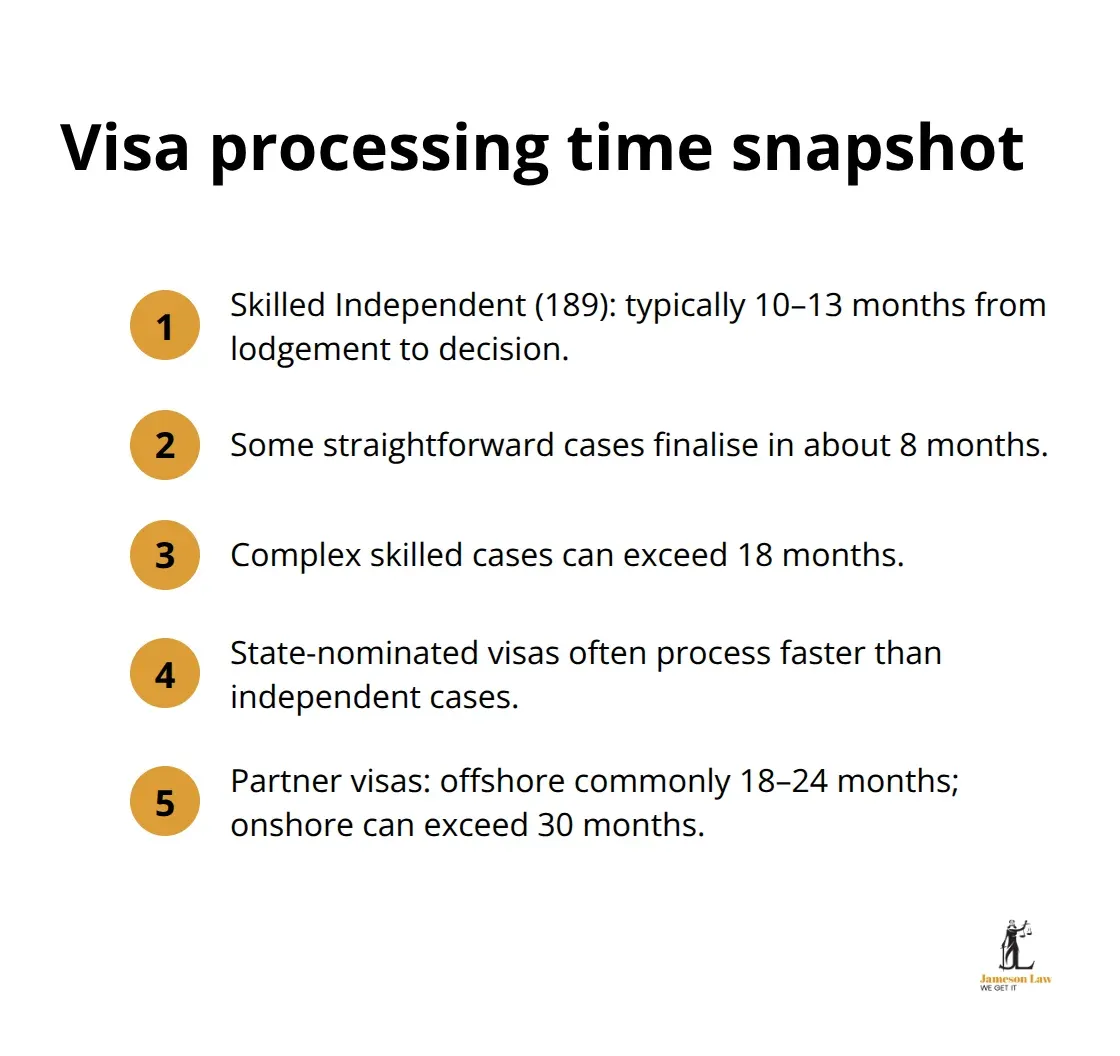
Processing timeframes vary dramatically between visa types and depend entirely on the Department’s workload and whether your application is straightforward or requires additional investigation. The Department of Home Affairs publishes processing time statistics, and skilled independent visas typically take 10 to 13 months from lodgement to decision, though some cases resolve in 8 months while complex cases exceed 18 months. State-sponsored visas often process faster because the state has already endorsed your nomination, reducing the Department’s assessment burden. Partner visas remain the slowest category, with offshore applications routinely taking 18 to 24 months, and onshore applications sometimes exceeding 30 months because the Department conducts more thorough relationship verification.
Responding to information requests promptly
During processing, the Department may request additional information or clarification on specific matters, and responding promptly to these requests prevents your application from stalling. Delayed responses to information requests are among the most common reasons applications take far longer than the published timeframes suggest. If the Department requests documents, provide them within the stated timeframe, typically 28 days, as missing deadlines can result in refusal. Some applicants fail to respond to information requests because they assume the Department will follow up, but the system does not work that way-the responsibility falls entirely on you.
Understanding your visa conditions after grant
Once your visa is granted, the Department issues a grant notification through your ImmiAccount, and this notification is your proof of visa status. Modern Australian visas are digital records held in the Department’s system rather than physical documents. Your grant notification includes your visa conditions, which you must understand and comply with immediately. Some visas impose work restrictions, study restrictions, or residency obligations that you must observe from the moment the visa is granted. If your visa includes a requirement to live in a particular state or region, breaching that requirement can result in visa cancellation, so clarifying your obligations before you travel is essential.
Preparing for arrival in Australia
You should obtain a character reference or visa details letter from the Department before arriving in Australia, as some employers or organisations request proof of your visa status. The Department provides this documentation through ImmiAccount, and obtaining it takes only a few days. Once you arrive in Australia, you must notify the Department of your address within 28 days if your visa is subject to that requirement, and failing to do so can result in penalties or visa issues. Setting up a mailing address, tax file number application, and bank account should happen within your first weeks in Australia, and these practical steps often matter more to your settlement success than the visa process itself.
Final Thoughts
The migration to Australia process demands careful planning across multiple stages, but understanding each step removes much of the uncertainty that makes the journey feel overwhelming. You now know which visa pathways exist, what documents you need to gather, how skills assessments work, and what happens after you lodge your application. Starting early and collecting documents methodically prevents months of delays caused by slow overseas authorities or incomplete submissions.
Your migration timeline depends heavily on which visa category you pursue and how thoroughly you prepare before lodging. Skilled independent visas typically take 10 to 13 months, though applicants who provide unclear information often wait considerably longer, while state-sponsored visas process faster because the state has already endorsed your nomination. Once your visa is granted, understanding your conditions matters immediately because some visas restrict where you can work, study, or live, and breaching these conditions can result in visa cancellation.
The Department of Home Affairs website provides official information on visa requirements and processing timeframes, though interpreting the rules for your specific circumstances often requires professional guidance. We at Jameson Law provide immigration law services to help you navigate visa applications and understand your obligations, particularly if your migration involves complex family circumstances, previous visa refusals, or character or health concerns. Contact Jameson Law to discuss your migration situation with experienced immigration lawyers who can assess your circumstances and guide you through the application process.