PUBLICATION

Wills Probate NSW Overview: Essentials for Estate Planning

"Learn the essentials of wills and probate in NSW to plan your estate effectively and protect your family's future."
Wills Probate NSW Overview: Essentials for Estate Planning

Dealing with a loved one’s estate after they pass away involves navigating probate—a legal process that many Australians find confusing. Understanding this wills probate NSW overview helps you know what to expect and how to protect your family’s interests during a difficult time.

At Jameson Law, our highly experienced estate team has guided countless families through this process. This guide breaks down probate step-by-step so you can move forward with clarity in 2026.

What Probate Means and Why It Matters

Probate is the formal legal process that validates a will and authorises the executor to manage the deceased’s estate. In NSW, the Supreme Court issues a document called a Grant of Probate, which provides the necessary authority to collect assets, settle debts, and distribute the remainder to beneficiaries.

Not every estate requires probate. Key scenarios where it may be bypassed include:

  • Joint Assets: Assets held as joint tenants (e.g., family homes) pass automatically to the survivor.
  • Small Estates: Some financial institutions may release funds for modest accounts without a formal grant.
  • Non-Estate Assets: Superannuation and life insurance often sit outside the estate and follow individual policy/fund trust rules.

Who Applies for Probate?

The executor named in the will carries the responsibility for the probate application. This role is significant and requires organisational skill and financial diligence. If an executor has passed away, renounced their role, or is unable to act, a beneficiary may apply for Letters of Administration (will annexed).

The Probate Process in NSW

The probate application process is time-sensitive. Under Supreme Court Rules, you have six months from the date of death to lodge your application. Lodging early is highly recommended to avoid the requirement of an Affidavit of Delay.

Step Action Required
1. Gathering Original will, death certificate, asset/debt lists, and executor details.
2. Lodging Submit Summons, Affidavit, and Inventory of Property via NSW Online Registry.
3. Advertising Publish notice in the Online Registry to alert creditors/claimants.

Preparing and Using the Grant

Once the Supreme Court issues the Grant, it becomes your legal “key” to the estate. You use this grant to:

  • Access and close bank accounts.
  • Sell or transfer real estate through the Land Titles Office.
  • Collect insurance proceeds and investment holdings.

You should not distribute the estate immediately. It is standard practice to allow a three-month creditor period after the grant is advertised to ensure unknown debts do not emerge later, shielding you from potential personal liability as an executor.
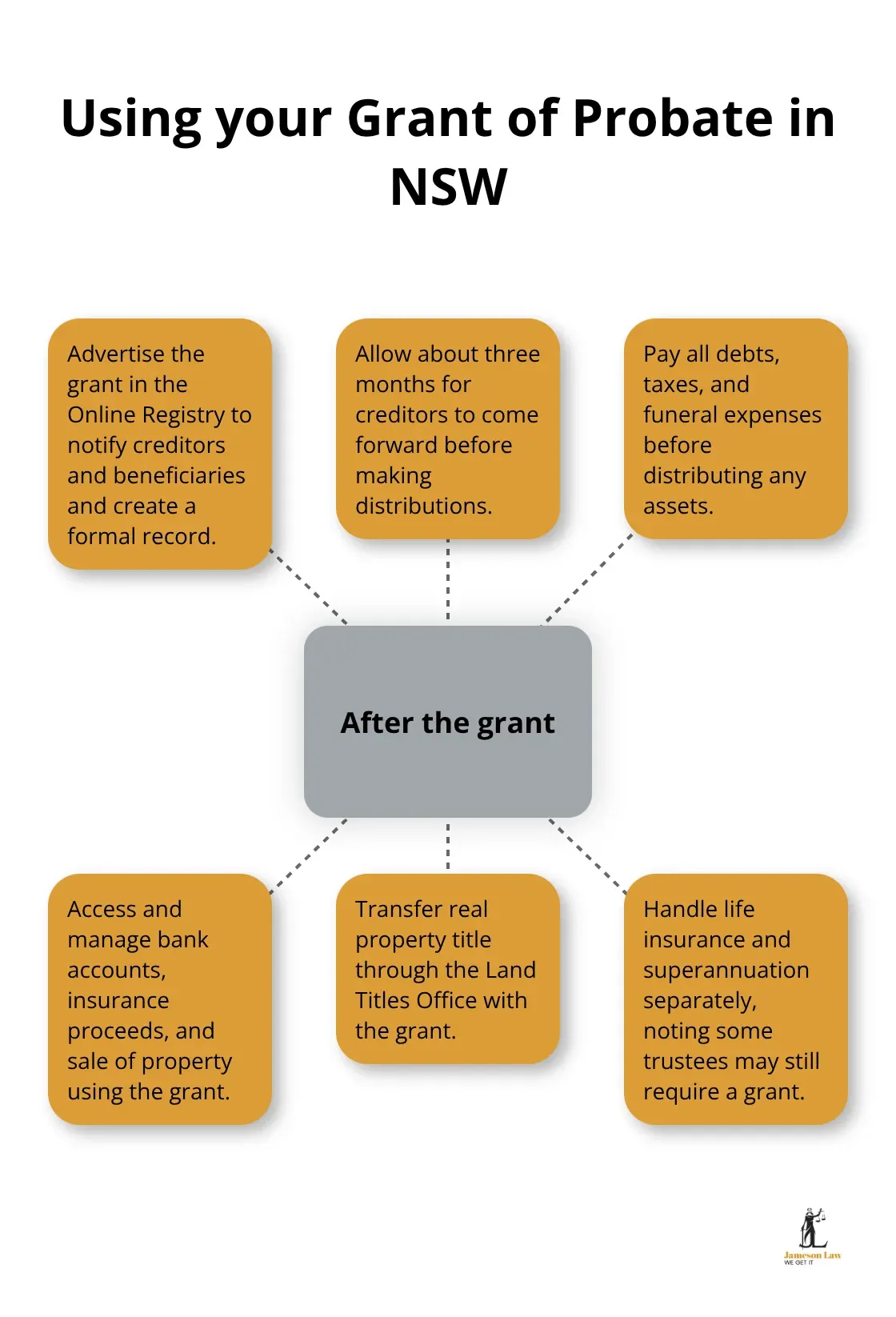
Visualisation of executor actions after receiving the grant of probate.

Common Challenges in NSW Probate

Disputed Wills and Caveats

A caveat is a formal notice filed with the court that can block your probate application for six months. This forces the matter into a litigated environment where a judge must determine the validity of the will. These proceedings are costly and time-consuming, often requiring expert evidence regarding the deceased’s testamentary capacity at the time of signing.

Requisitions and Dismissals

The Court issues “requisitions” when the application is incomplete or contains technical errors (e.g., missing signatures on the Inventory of Property). You must respond promptly; prolonged failure to address these results in the automatic dismissal of your application, forcing you to pay new filing fees and restart the entire process.
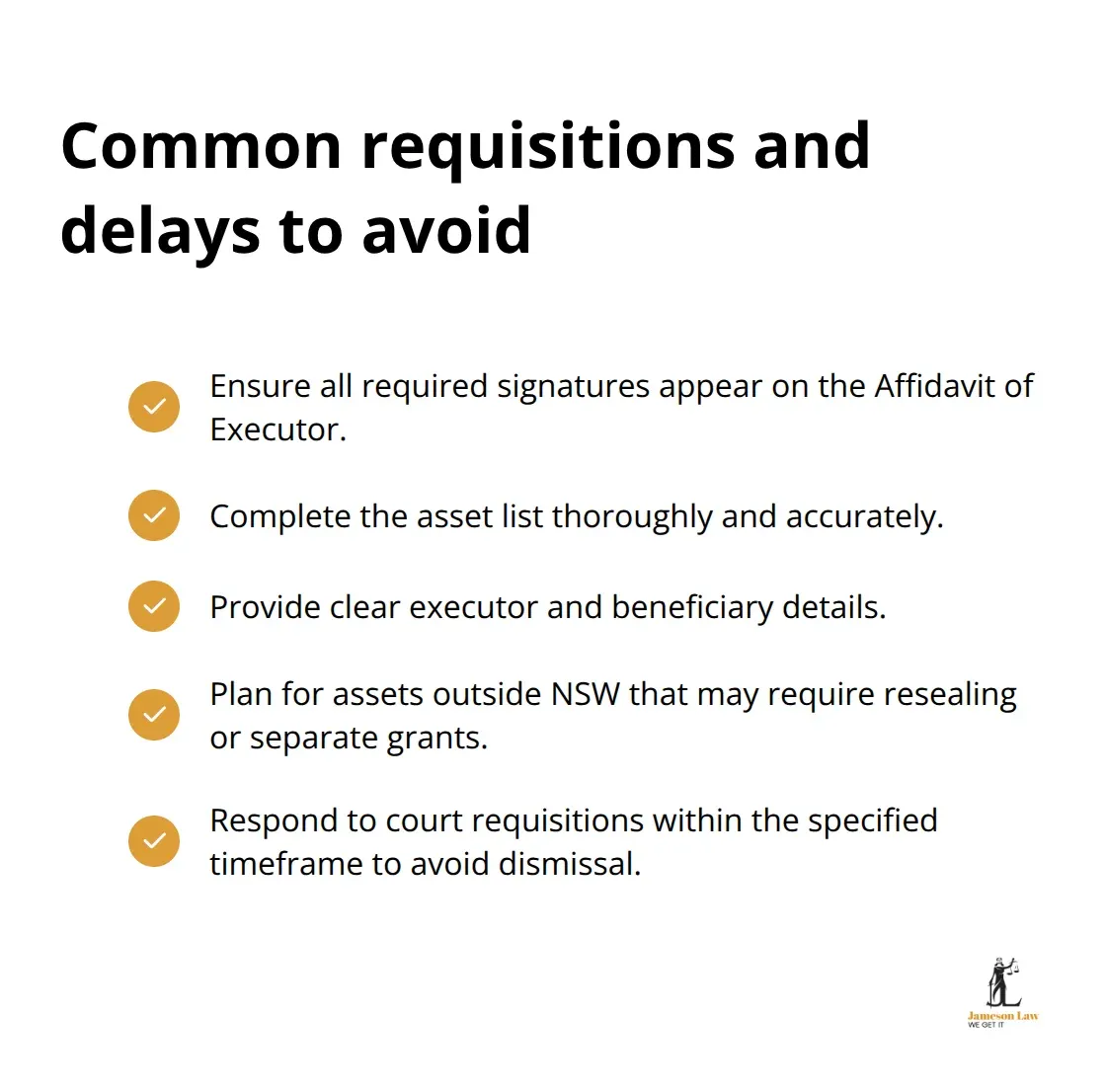
Checklist of frequent NSW probate pitfalls.

Managing Estate Liabilities

As executor, you must settle funeral expenses, taxes (ATO), and utility bills before finalising distributions. If you distribute funds to beneficiaries before satisfying creditors, you may be held personally liable for those debts. Professional legal oversight during the distribution phase provides essential protection for executors.

Final Thoughts

Probate in NSW is designed to protect family interests and creditor rights, but the administrative burden is significant. The six-month window from the date of death is your primary deadline—meeting it is crucial for a smooth transition of assets.

Whether you are navigating straightforward probate or dealing with a contested estate, preparation is your greatest asset. Uncontested applications through the online system are relatively efficient, but disputes, informal wills, or complex asset structures quickly escalate the difficulty level.

If your situation involves complex family dynamics, significant debts, or properties requiring title transfers, contact Jameson Law to discuss your estate administration requirements. We provide expert legal support to ensure you fulfil your executor duties correctly and avoid common financial pitfalls.


Speak to an Expert Lawyer today

Laywers-Jameson-Law-The-best-law-firm-in-Sydney- Sydney Lawyers - Sydney
BOOK NOW

WE'RE IN IT TO WIN IT

Book your consultation

Book Now
Book Now Mobile 06 02 2025

This form submission is encrypted and secured to ensure your information remains confidential.

What our Clients

Related Publications: |

What our clients say

.

Jameson Law - Voted the Best Law firm in Sydney Award

Legal Answers ... In Short

We're here to help

Our mission is to ensure our client matters are resolved successfully every time. Success to us does not simply involve winning, but moreover ensuring we take the most feasible, economic and stress-free path to help our clients achieve their goals. We fight hard for our clients, and always go by the motto: we’re in it to win it.

Jameson Law - Best Law Firm in Sydney

WE'RE IN IT TO WIN IT

Book your consultation

Call us now on (02) 8806 0866 or fill out the form below

Book Now Mobile

This form submission is encrypted and secured to ensure your information remains confidential.

WE'RE IN IT TO WIN IT

Book your consultation

Book Now Mobile 06 02 2025
lock

This form submission is encrypted and secured to ensure your information remains confidential.

Our Sydney Offices

Offices Parramatta and Sydney Jameson Law
Parramatta CBD - Head Office
jameson Law - Blacktown
jameson Law - Liverpool Office
Jameson Law - Bankstown
Court Houses We Frequent Jameson Law

Court Houses We Frequent

Balmain Local Court

Registry: Monday to Friday, 9:00am to 4:30pm

Bankstown Local Court

Court Operating Hours: 9:30am-4:30pm

Blacktown Local Court

Registry Hours: 9:00 – 4:30
Telephone Hours: 8:30 -4:30
Days open: Mon-Fri

Burwood Local Court

Registry Hours: 9:00 – 4:30
Telephone Hours: 8:30 – 4:30
Days open: Mon – Fri

Campbell Local Court

Registry Hours: 9:00 – 4:30
Telephone Hours: 8:30 – 4:30
Days open: Mon – Fri

Central Local Court

Registry Hours: 9:00 – 1:00 and 2:00 – 4:30
Telephone Hours: 8:30 – 4:30

Downing Local Court

Registry Hours: 9:00 – 1:00 and 2:00 – 4:30
Telephone Hours: 8:30 – 4:30

Wollongong Local Court

Registry Hours: 9:00 – 1:00 and 2:00 – 4:30
Telephone Hours: 8:30 – 4:30

Fairfield Local Court

Registry Hours: 9:00 – 1:00 and 2:00 – 4:30
Telephone Hours: 8:30 – 4:30

Hornsby Local Court

Registry Hours: 9:00 – 1:00 and 2:00 – 4:30
Telephone Hours: 8:30 – 4:30

Liverpool Local Court

Registry Hours: 9:00 – 1:00 and 2:00 – 4:30
Telephone Hours: 8:30 – 4:30

Manly Local Court

Registry Hours: 9:00 – 1:00 and 2:00 – 4:30
Telephone Hours: 8:30 – 4:30

Newtown Local Court

Registry Hours: 9:00 – 1:00 and 2:00 – 4:30
Telephone Hours: 8:30 – 4:30

Parramatta Local Court

Registry Hours: 9:00 – 1:00 and 2:00 – 4:30
Telephone Hours: 8:30 – 4:30

Penrith Local Court

Registry Hours: 9:00 – 1:00 and 2:00 – 4:30
Telephone Hours: 8:30 – 4:30

Sutherland Local Court

Registry Hours: 9:00 – 1:00 and 2:00 – 4:30
Telephone Hours: 8:30 – 4:30

Waverley Local Court

Registry Hours: 9:00 – 1:00 and 2:00 – 4:30
Telephone Hours: 8:30 – 4:30

Windsor Local Court

Registry Hours: 9:00 – 1:00 and 2:00 – 4:30
Telephone Hours: 8:30 – 4:30

Wollongong Local Court

Registry Hours: 9:00 – 1:00 and 2:00 – 4:30
Telephone Hours: 8:30 – 4:30

Downing Centre District Court

Registry Hours: 9:00 – 4:30
Telephone Hours: 8:30 – 4:30
Days open: Mon – Fri

Parramatta District Court

Registry Hours: 9:00 – 4:30
Days open: Mon-Fri

Penrith District Court

Registry Hours: 9:00 – 4:30
Days open: Mon-Fri

Campbelltown District Court

Registry Hours: 9:00 – 4:30
Days open: Mon – Fri

Liverpool District Court

Registry Hours: 9:00 – 4:30
Days open: Mon – Fri

Wollongong District Court

Registry Hours: 9:00 – 1:00 and 2:00 – 4:30
Telephone Hours: 8:30 – 4:30

Supreme Court New South Wales

Registry Hours: 9:00 AM – 4:30 PM
Telephone Hours: 8:30 AM – 4:30 PM
Days Open: Monday to Friday

Federal Circuit and Family Court of Australia

Registry Hours: 9:00 AM – 4:30 PM
Telephone Hours: 8:30 AM – 5:00 PM
Days Open: Monday to Friday

Federal Court

Monday to Friday, 8:30 AM – 4:30 PM

High Court

Monday to Friday, 8:30 AM – 5:00 PM

Children’s Court of New South Wales

Registry Hours: 9:00 AM – 4:30 PM
Telephone Hours: 8:30 AM – 4:30 PM
Days Open: Monday to Friday

Coroner’s Court New South Wales

Registry Hours: 9:00 AM – 4:30 PM
Telephone Hours: 8:30 AM – 4:30 PM
Days Open: Monday to Friday

Industrial Relations Commission of New South Wales

Registry Hours: 9:00 AM – 4:30 PM
Telephone Hours: 8:30 AM – 4:30 PM
Days Open: Monday to Friday

Land and Environment Court of New South Wales

Registry Hours: 9:00 AM – 4:30 PM
Telephone Hours: 8:30 AM – 4:30 PM
Days Open: Monday to Friday

WE'RE IN IT TO WIN IT

Book your consultation

Book Now
Book Now Mobile 06 02 2025
lock

This form submission is encrypted and secured to ensure your information remains confidential.