A personal injury claim can help you recover compensation when someone else’s negligence causes you harm. Whether you’ve been injured in a workplace accident, car crash, or slip and fall, understanding your rights is the first step.
We at Jameson Law have helped countless injured Australians navigate the claims process in NSW. This guide walks you through what qualifies as a personal injury claim, how to build a strong case, and what to expect from start to finish.
What Constitutes a Personal Injury Claim in NSW
A personal injury claim exists when someone else’s negligence or breach of duty causes you harm. NSW law recognises four core elements that must be present: the defendant owed you a duty of care, they breached that duty, their breach caused your injury, and you suffered measurable loss. This framework comes from the Civil Liability Act 2002 (NSW) and applies across motor vehicle accidents, workplace injuries, medical negligence, and public liability incidents.
Types of Compensable Injuries
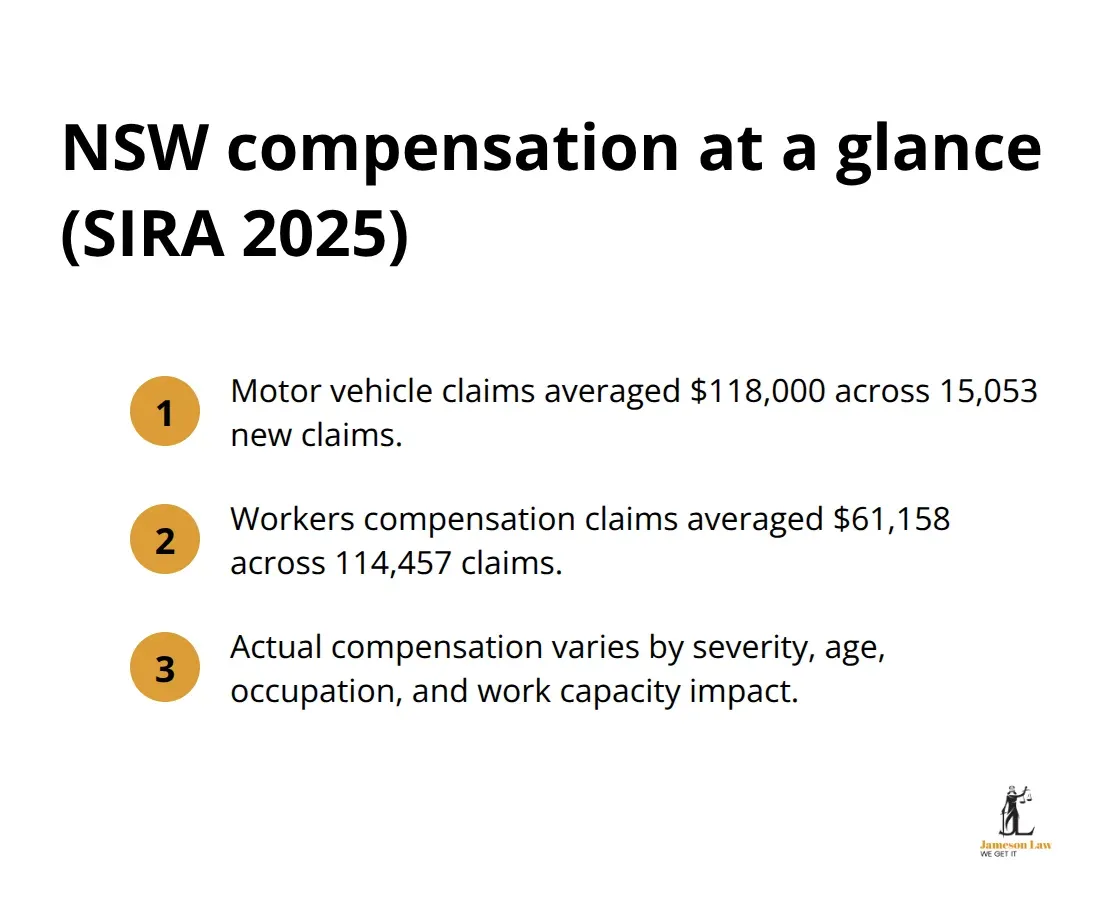
The types of injuries that attract compensation are broad. You can claim for physical injuries like fractures or burns, but also psychological injuries from trauma or shock. According to SIRA data from 2025, NSW motor vehicle accident claims averaged $118,000 per new claim across 15,053 claims, while workers compensation claims averaged $61,158 per claim across 114,457 claims. These figures show that compensation varies significantly based on injury severity, your age, occupation, and how the injury affects your capacity to work.
Workplace injuries, car accidents, slips and falls on someone else’s property, and surgical errors all commonly lead to successful claims. What matters most is proving the defendant failed to take reasonable care that a reasonable person would have taken in similar circumstances.
Time Limits Are Strict and Non-Negotiable
The limitation period in NSW is three years from the date you were injured, under the Limitation Act 1969 (NSW). This deadline applies to motor vehicle claims, public liability claims, and medical negligence claims. If you miss this window, your claim is barred regardless of how strong your case might be. The clock starts when you become aware of your injury and its connection to the incident, not necessarily when the incident occurred. For workers compensation, different timelines apply: you must notify your employer within 30 days, though the claim itself has a three-year window for lump sum payments. If you were under 18 when injured, the three-year period does not begin until your 18th birthday. Courts can extend the limitation period in exceptional circumstances, but extensions are rare and require strong justification. Acting quickly after your injury is essential not only to meet the deadline but to preserve fresh evidence, gather witness details while memories are clear, and obtain medical records that document the injury’s immediate impact. Waiting months or years weakens your position because witnesses become harder to locate, evidence deteriorates, and insurers are more likely to dispute causation.
Duty of Care Defines Who Can Be Held Responsible
Duty of care means the defendant was legally required to take reasonable precautions to avoid harming you. Employers owe duties to their workers to provide safe equipment and working conditions. Drivers owe duties to other road users and passengers. Medical professionals owe duties to their patients to provide treatment meeting accepted professional standards. Property owners owe duties to visitors to keep premises reasonably safe. A breach occurs when the defendant falls short of what a reasonable person would have done. If a workplace failed to provide safety equipment despite known hazards, that is a breach. If a doctor misdiagnosed a serious condition that another competent doctor would have caught, that is a breach. The strength of your claim depends on how clearly you can establish these elements. Evidence of the defendant’s failure-whether through incident reports, photographs, witness accounts, or expert assessments-directly supports your case. Strong proof of breach and causation makes the difference between a successful claim and one that insurers reject or undervalue.
How to Build a Strong Personal Injury Case
Evidence determines whether your claim succeeds or fails. Insurers make decisions based on documentation, not on your account of events alone. The stronger your evidence package, the faster they settle and the higher they offer. Claims often increase substantially in value when claimants gather thorough documentation before instructing a lawyer, compared to those who wait to collect evidence after legal representation begins.
Act Quickly to Preserve Evidence
Start collecting evidence immediately after your injury. Photograph the accident scene from multiple angles, including hazards, weather conditions, and anything relevant to how the injury occurred. If you slipped on a wet floor in a shopping centre, photograph the floor, any warning signs that were or were not present, lighting conditions, and the exact location. Take photos of your injuries as they develop over days and weeks, as healing masks the initial severity.
Obtain the incident report from police, your employer, or the property owner within days while details remain fresh. Write down everything you remember about what happened, including time, date, weather, who was present, and exactly how the injury occurred. Contact witnesses immediately and collect their names, phone numbers, and email addresses. Witnesses often disappear or their memories fade quickly.
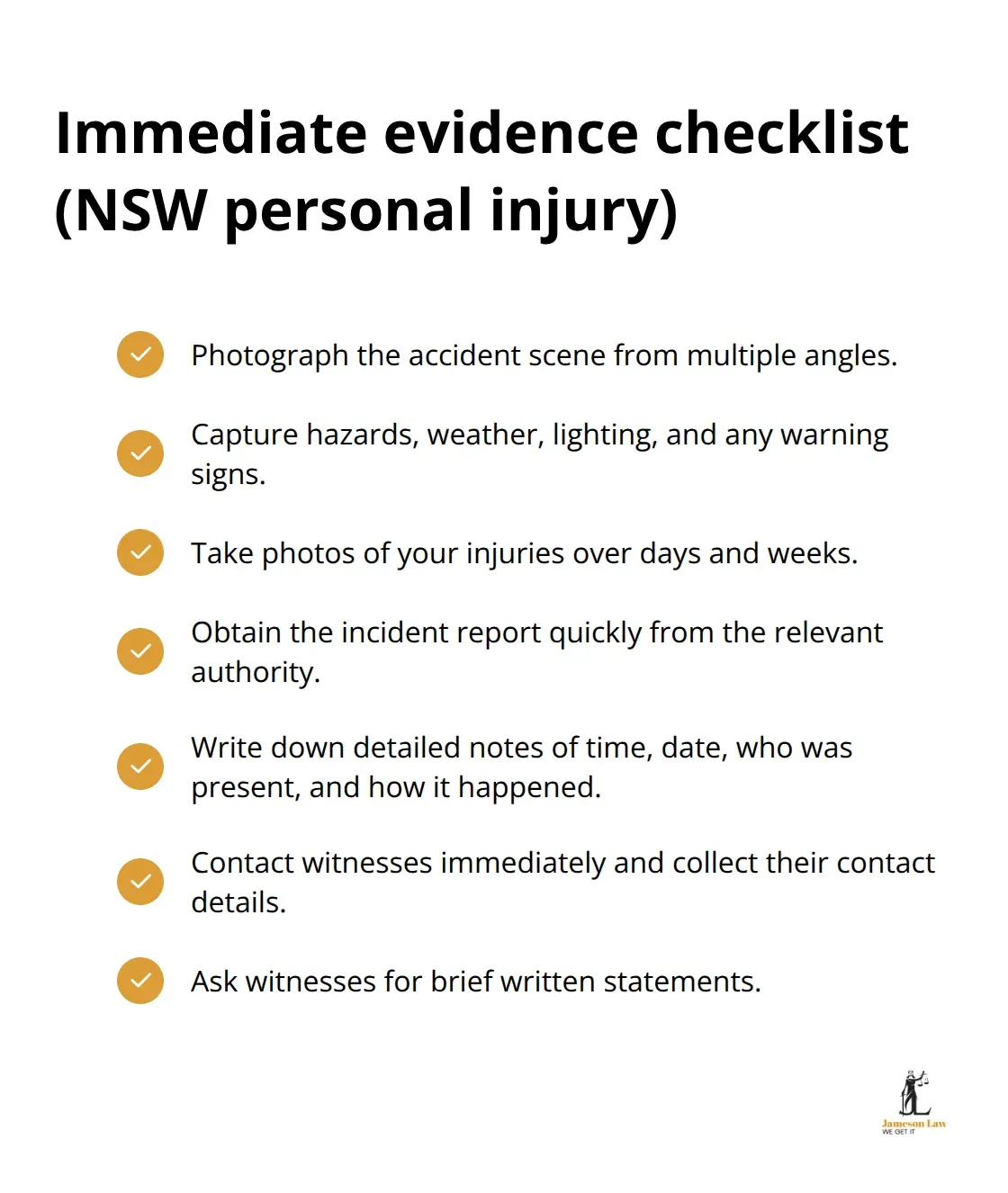
Ask them to write a brief statement about what they observed.
Gather Medical Records and Documentation
Request medical records from every healthcare provider who has treated you, including GPs, physiotherapists, specialists, and hospitals. Medical records form the foundation of your claim because they document the injury’s severity, treatment costs, and recovery timeline. Missing records weaken your position significantly because gaps suggest less serious injuries than you actually sustained.
Collect receipts for all expenses related to your injury, including medical consultations, medications, travel to appointments, home care assistance, and any aids or equipment you purchased. These economic losses are straightforward to prove and should never be overlooked. Keep a diary documenting how your injuries affect your daily activities, work capacity, and quality of life. Insurers often underestimate non-economic losses like pain and suffering, but your diary provides concrete evidence of functional impact.
Obtain Independent Medical Expert Evidence
Expert medical reports carry enormous weight in NSW personal injury claims. Insurers use their own medical experts to assess injury severity, so you need independent expert evidence to counter their conclusions. A medico-legal examination involves an independent doctor reviewing your medical history, conducting a physical assessment, and providing a detailed report about your injuries, prognosis, and capacity for work. This report becomes critical evidence if your claim proceeds to court or faces insurer resistance.
For workplace injuries, workers compensation medical assessments follow specific NSW protocols under the Workers Compensation Act 1987 (NSW), and these assessments determine your permanent impairment rating, which directly affects your lump sum entitlement. For motor vehicle claims, CTP medical reports must address whether your injuries meet the threshold for common law damages. Instruct a lawyer early because they have relationships with trusted medical experts and know which experts carry credibility with insurers and courts in your specific injury category.
Document Life Impact and Functional Limitations
Courts in NSW consider how injuries affect your ability to work, participate in family activities, and enjoy life before injury. The more detailed your documentation of life impact, the stronger your claim for non-economic damages. Your diary should record specific examples: days you missed work, activities you could no longer perform, pain levels at different times, and how your relationships or social life changed. This evidence transforms abstract pain and suffering into measurable functional loss that insurers and courts recognise.
Thorough documentation signals you are serious and prepared to fight for fair compensation. Insurers know that claimants with disorganised evidence are easier to lowball, so a well-organised evidence package strengthens your negotiating position from the outset. Once you have assembled your evidence, the next step involves understanding how the claims process actually works and what happens when you submit your case to an insurer.
The Personal Injury Claims Process in NSW
Your first meeting with a personal injury lawyer sets the trajectory for your entire claim. A thorough initial assessment evaluates whether your case has merit, identifies all potential defendants and insurance policies, and establishes a realistic compensation range based on comparable cases and your specific circumstances. During this consultation, your lawyer reviews the evidence you have gathered, identifies gaps that need filling, and explains the claims process in plain terms. You learn approximately how long your claim will take, what fees you will pay under a no win, no fee arrangement, and what outcomes are realistic given your injury type and severity.
SIRA data shows NSW motor vehicle claims average around $118,000 per new claim, while workers compensation claims average $61,158 per claim, but your claim could fall above or below these figures depending on factors like your age, occupation, earning capacity before injury, and whether your injuries are permanent. A good lawyer asks detailed questions about your life before and after injury because these details drive compensation calculations. They also identify time-sensitive issues such as your three-year limitation period, obligations to notify your employer or report to police, and deadlines imposed by insurers or government schemes.
Many claimants delay seeking legal advice, thinking they can manage claims alone, only to discover later that insurers have undervalued their cases or imposed settlement deadlines they did not understand. Engaging a lawyer early protects you from these mistakes because lawyers know insurer tactics and negotiate from the outset rather than reacting to lowball offers months into the process.
Submitting Your Claim and Initial Assessment
Once your lawyer has prepared your case with complete medical evidence, incident documentation, and witness statements, they submit a detailed claim to the insurer or relevant scheme administrator. The insurer then has 30 days to acknowledge your claim and begin their assessment. This is where negotiation begins in earnest. Insurers employ their own medical experts and lawyers specifically trained to minimise payouts, so your independent medical evidence becomes critical leverage.
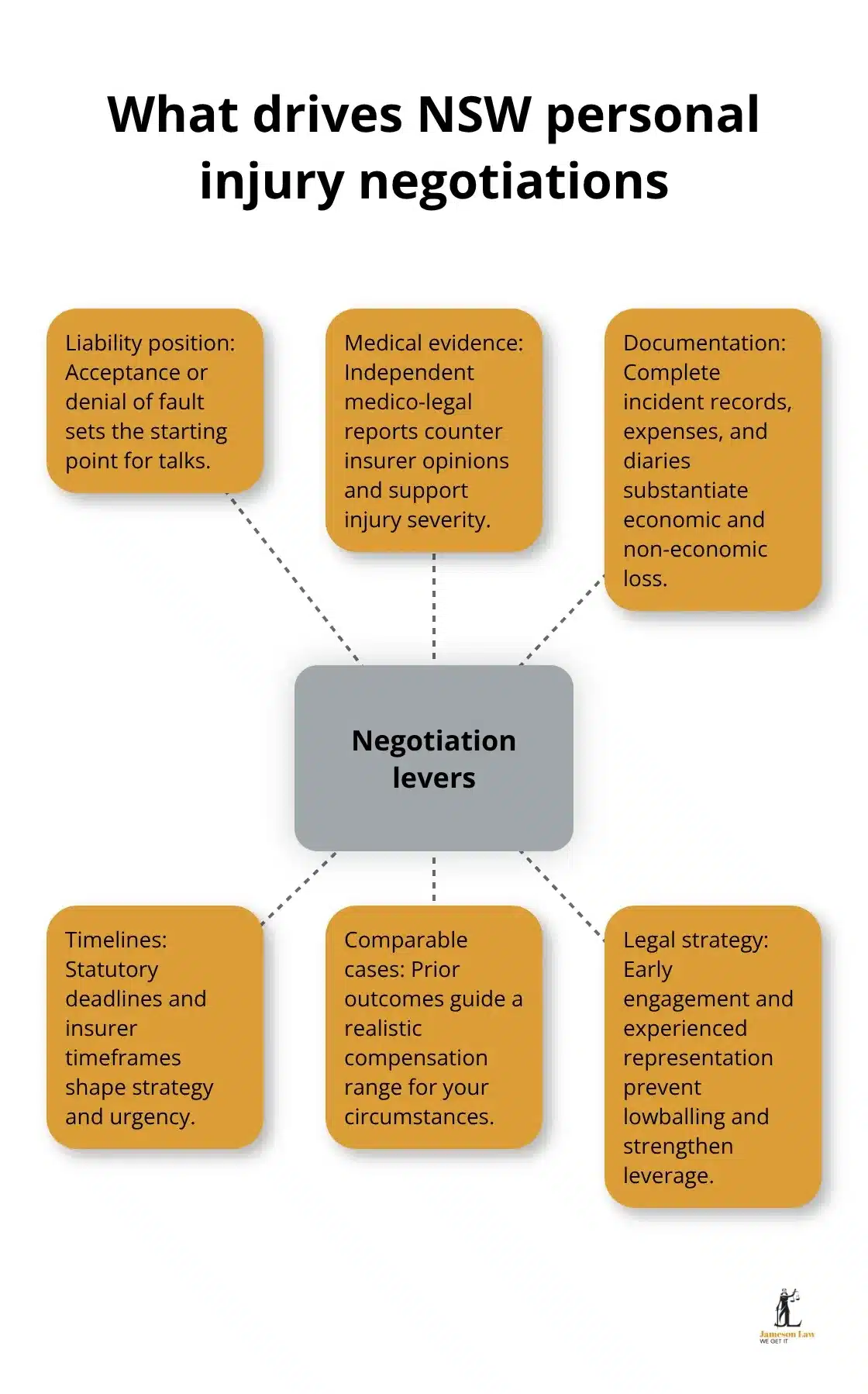
If the insurer accepts liability but disputes injury severity or causation, your medico-legal reports counter their conclusions. Settlement discussions typically occur over weeks or months as both parties exchange evidence and refine their positions. Most NSW personal injury claims settle out of court without litigation, meaning the insurer makes an offer that reflects their assessment of liability, injury severity, and your damages.
Evaluating Settlement Offers
Your lawyer advises whether an offer is fair, whether it adequately covers your past and future losses, and whether accepting it serves your interests or whether pushing for more is justified. This is not a moment for emotion or impatience. Settlement offers should account for all economic losses including medical expenses, rehabilitation costs, lost wages, and travel, plus non-economic losses for pain and suffering.
NSW law caps pain and suffering at $691,000, but this maximum applies only to the most catastrophic injuries. Your lawyer calculates what you should reasonably expect given your injury’s severity and life impact, then advises whether to accept, negotiate further, or reject the offer. A fair settlement reflects the full scope of your losses, not just the obvious ones.
Dispute Resolution and Court Proceedings
If settlement discussions stall or the insurer denies your claim entirely, your lawyer may pursue dispute resolution through mediation or escalate to court proceedings. Court litigation should be a last resort because it extends timelines, increases costs, and introduces uncertainty, but sometimes insurers refuse fair settlement and litigation becomes necessary to protect your rights.
In court, a judge hears evidence from both sides and determines whether negligence occurred and what compensation you deserve. This process is more formal and unpredictable than negotiation, but it ensures your case receives independent judicial assessment rather than being decided by an insurer motivated to minimise payout. Throughout this entire process, your lawyer manages deadlines, correspondence, evidence exchanges, and strategic decisions so you can focus on recovery rather than navigating complex legal procedures.
Final Thoughts
Your personal injury claim succeeds or fails based on the decisions you make in the first weeks after your injury. Acting quickly to collect evidence, document your losses, and seek legal advice protects your rights and strengthens your negotiating position with insurers. The three-year limitation period in NSW is absolute, and missing it bars your claim permanently regardless of merit.
Professional legal advice matters because insurers employ trained negotiators and medical experts specifically tasked with minimising payouts. A Sydney injury lawyer understands insurer tactics, knows which medical experts carry credibility, and negotiates from strength rather than reacting to lowball offers. They also identify compensation sources you might miss, such as multiple insurance policies or superannuation benefits in TPD claims.
We at Jameson Law have helped countless injured Australians recover fair compensation through personal injury claims. Contact Jameson Law for a free claim assessment, and we will evaluate your case, explain your options, and outline realistic compensation based on your injury and circumstances. We work on a no win, no fee basis, meaning you pay legal fees only if your claim succeeds.