

Getting an immigration form NSW right the first time saves you months of delays and frustration. Many applicants miss critical details or submit documents to the wrong department, forcing them to start over.
At Jameson Law, we have helped countless clients navigate these forms successfully. This guide walks you through exactly what you need to do, from gathering documents to tracking your application status.
What NSW and Federal Immigration Forms Do You Actually Need
NSW immigration forms sit alongside federal Department of Home Affairs forms, and the confusion between them stops most applicants dead. The Department of Home Affairs handles all visa decisions, but NSW adds a nomination layer for skilled migration pathways, meaning you complete forms for both.
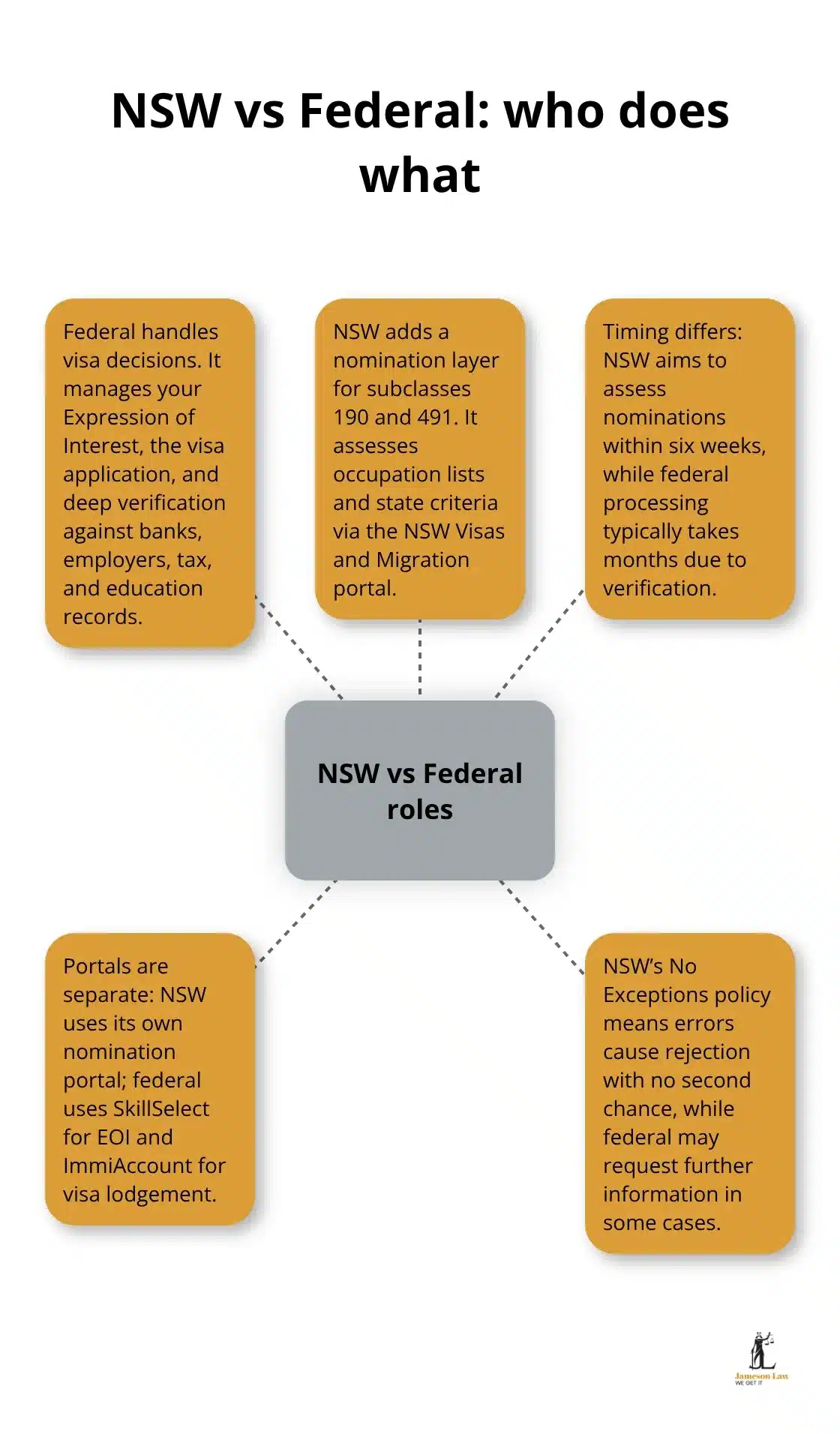
Federal forms like your Expression of Interest through SkillSelect and the subsequent visa application forms come from the Department of Home Affairs. NSW forms apply only if you pursue the Skilled Nominated visa (subclass 190) or the Skilled Work Regional visa (subclass 491) with NSW sponsorship. This distinction matters enormously because submitting the wrong form to the wrong department wastes weeks and forces resubmission.
Federal Forms Handle Your Visa Decision
The Department of Home Affairs website separates online and paper submission options, with a last updated timestamp of 22 May 2026 confirming current guidance. You’ll need federal forms for your Expression of Interest in SkillSelect, your visa application (Form 1414 for most skilled migration), health declarations, and character assessments. Every claim you make on federal forms gets cross-checked against bank records, employment history, tax records, and education credentials.
The Department conducts deep verification, including employment checks and LinkedIn cross-referencing, to confirm your work experience matches your claims. Data mismatches like inconsistent name spellings or employment dates trigger refusals. Your English test results, qualifications assessment from bodies like VETASSESS or Engineers Australia, and work experience evidence all feed into federal processing, which typically takes months.
NSW Nomination Forms Add a State Layer
NSW nomination requires separate completion and payment if you apply within Australia. You lodge the NSW form through the NSW Visas and Migration portal, not through federal SkillSelect. NSW assesses whether your occupation sits on their nomination list and whether you meet their specific criteria, which differ from federal requirements. For subclass 491, you must be currently working in a designated regional area of NSW and have continuously done so for the past six months. NSW processes applications within six weeks and nominates you only once. If NSW nominates you and Home Affairs later invites you to apply for the visa, you become permanently ineligible for future NSW nominations, so timing and accuracy matter.
The No Exceptions Policy Changes Everything
NSW enforces a No Exceptions policy with no discretionary concessions, meaning incomplete or incorrect submissions result in outright rejection rather than requests for further information. This differs sharply from some federal processes where the Department requests additional evidence. One missed document or one data error on your NSW form ends your nomination attempt entirely. You cannot reapply to NSW after rejection, and you lose your nomination opportunity permanently. This strict approach means you must verify every detail before you hit submit—no second chances exist.
Gathering Documents Before You Start
Applicants who start filling out forms before collecting every document they need create delays that could have been prevented. We see this pattern repeatedly: incomplete applications trigger Department requests for missing evidence, processing stalls for months, and NSW’s No Exceptions policy means rejection happens instantly. You must assemble your full document package first, verify each piece matches your claims, then complete the form.
For NSW nomination under subclass 190 or 491, all supporting documents must remain valid at the time of application and for at least five days after submission. Invalid documents render you ineligible immediately.
Identify Your Specific Document Requirements
Start by identifying what your visa stream requires. If you pursue subclass 190 or 491 with NSW nomination, you need standard identity documents, employment evidence, financial statements, and occupation-specific documents. For business migration streams like subclass 188A or 888A, you must provide PAYG summaries, BAS statements, and ASIC historical extracts showing continuous NSW business activity.
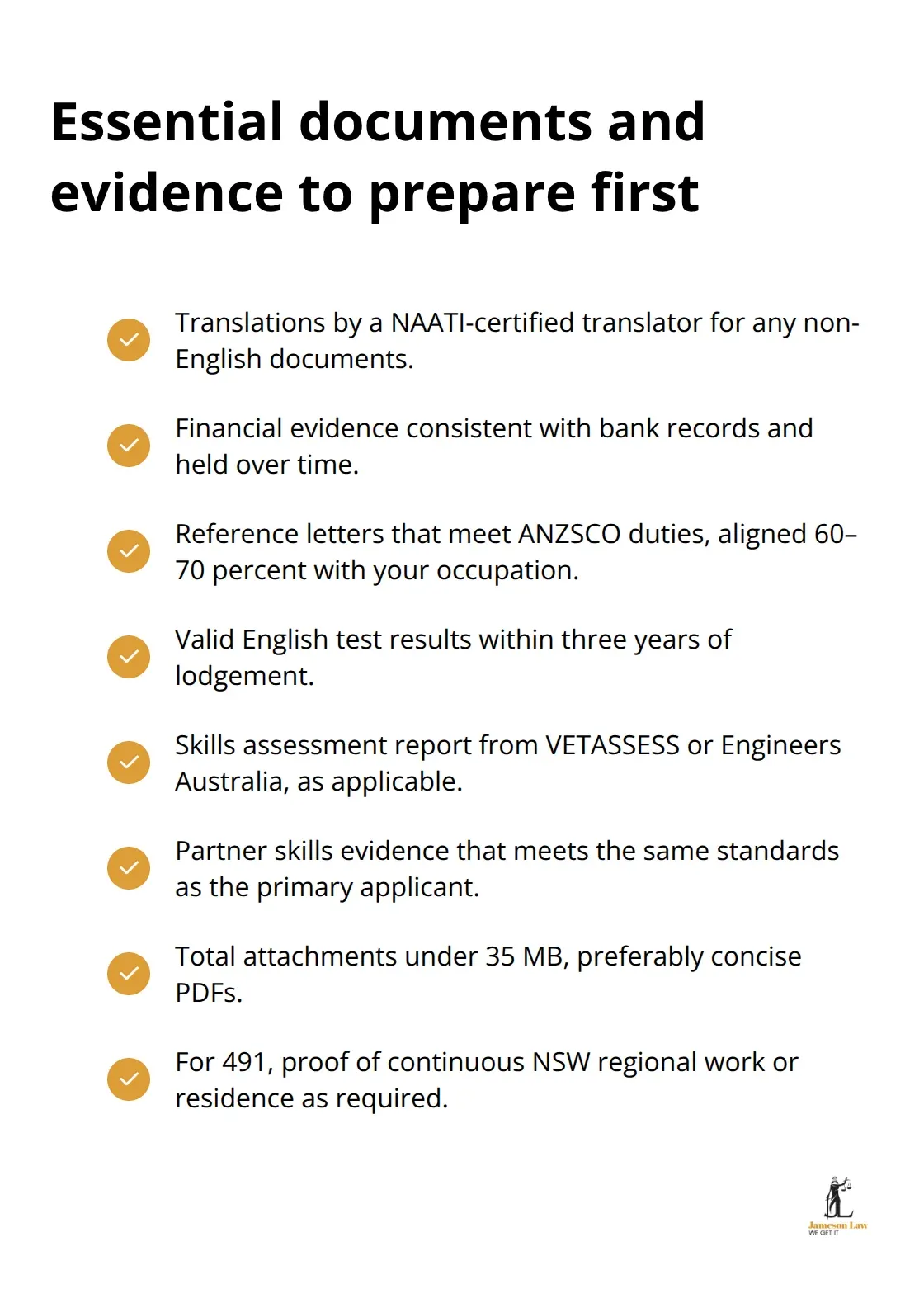
Every document in a language other than English must be translated by a NAATI-certified translator. Outside Australia, your translator must be qualified and provide their full name, qualification details, and contact information.
Present Financial Evidence That Withstands Scrutiny
Your financial evidence gets cross-checked against bank records by the Department. If you claim AUD 29,710 in living costs for a Student visa, your bank statements must show this amount held consistently, not transferred in days before lodgement. Your total attachments cannot exceed 35 MB for NSW nomination or Home Affairs applications. Use PDF format and attach only essential pages.
Ensure Data Accuracy Across All Documents
Data mismatches are silent killers. Your name spelling must match exactly across your passport, birth certificate, and every form field. For employment claims, your dates must align perfectly with tax records and payslips.
Reference letters require specific information: your supervisor’s full name, job title, company letterhead, contact details, start and end dates, job duties, hours worked weekly, and salary. Generic wording triggers refusal because it doesn’t match the ANZSCO code requirements. Your duties in the reference letter must align with the occupation code you’ve selected by at least 60 to 70 percent.
For skilled migration, your English test results must be valid. An expired IELTS test yields zero points and possible refusal. Qualifications can be downgraded by assessing bodies if your degree doesn’t meet Australian standards. Submit your skills assessment report alongside your application to prove your qualification was already verified.
Complete Forms With Precision and Consistency
Complete your NSW form and federal forms separately but simultaneously, ensuring consistency between them. The NSW portal shows whether your occupation sits on their nomination list before you submit. Verify this first. For subclass 491, upload evidence like payslips, employment contracts, or council rates notices showing your NSW address and employment dates.
Lodge your federal visa application through ImmiAccount once NSW nominates you. A complete, decision-ready application with matching documents across all sections gets processed faster.
Submitting Your Application Through the Right Channels
Submitting through the wrong portal costs you weeks of delays. NSW applications go through the NSW Visas and Migration portal. Federal visa applications lodge through ImmiAccount after NSW nominates you.
Payment and Lodgement Timing
When you lodge your NSW nomination, you receive a payment email immediately. The payment window is 30 minutes only. If it expires, contact the NSW team at +61 2 9228 5543 between 10:00 am and 12:00 pm Sydney time for a new link. The application fee is AUD 330 plus 10 percent GST if you apply within Australia.
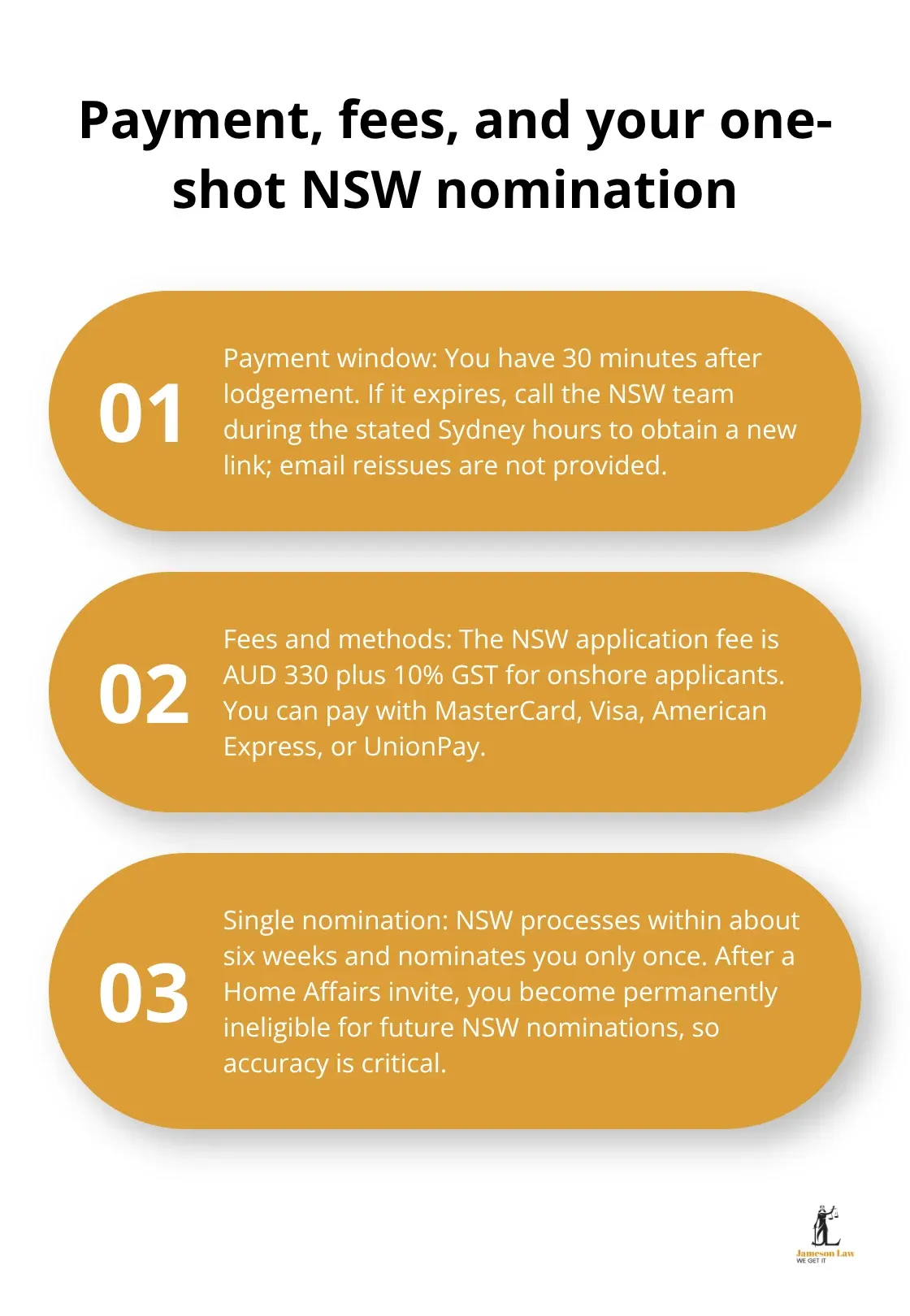
Once NSW processes your nomination within six weeks, they nominate you only once. If Home Affairs then invites you to apply for the visa, you become permanently ineligible for future NSW nominations.
Processing Times and Application Priority
Complete, decision-ready applications with consistent data receive higher priority. NSW allows six weeks for nomination assessment. Do not contact NSW during this period for updates, as inquiries do not accelerate processing. After NSW nominates you, allow several months for federal processing through ImmiAccount. Expedited assessment is available only if your current visa, passport, English test, or skills assessment will expire within ten working days, or you lose points for age. Other reasons will not be considered.
Monitoring and Responding to Department Requests
Monitor ImmiAccount daily after you lodge your federal application. The Department sends requests for additional information through ImmiAccount, not by email. Respond within the timeframe specified (typically 28 days). Delays in responding extend processing from months to potentially years. Track your application status by logging into ImmiAccount with your transaction reference number.
Final Thoughts
Immigration form NSW applications demand precision because NSW enforces a No Exceptions policy that rejects incomplete submissions permanently. You now understand which forms you need, where to lodge them, and what documents must accompany your application.
The steps remain straightforward: gather your complete document package first, verify every detail matches your claims, complete your forms with consistency across all sections, and lodge through the correct portal. A single mistake in your ANZSCO code selection, employment evidence, or qualification assessment can trigger refusal.
Immigration law involves complex requirements that vary significantly depending on your visa stream, occupation, and personal circumstances. At Jameson Law, we are highly experienced in immigration law and have helped countless clients lodge successful applications by identifying risks early. If you are uncertain about any aspect of your NSW application, contact our expert team to receive tailored guidance before you lodge.