

Partner visa eligibility in Australia depends entirely on meeting several strict legislative requirements set by the Department of Home Affairs. Whether you are in a de facto relationship or legally married, understanding these core criteria is the fundamental first step toward a successful application.
At Jameson Law, our expert immigration team has helped countless clients successfully navigate the partner visa process in NSW. This comprehensive 2026 guide breaks down the key eligibility factors, the critical onshore and offshore visa types, and exactly what to expect during the Department’s rigorous assessment.
What You Actually Need to Meet Partner Visa Requirements
Demonstrating a Genuine Relationship
To qualify for an Australian partner visa, you must undeniably satisfy the Department of Home Affairs that your relationship is genuine, continuing, and mutually exclusive. The relationship itself forms the foundation of your entire application.
The Department assesses four primary pillars:
- Financial Aspects: Joint bank accounts, shared leases or mortgages, and combined household bills.
- Nature of the Household: How domestic duties and living arrangements are shared.
- Social Recognition: Statutory declarations from friends and family (Form 888), joint travel records, and social media presence.
- Nature of Commitment: Long-term plans, knowledge of each other’s backgrounds, and terms of your wills.
De Facto Relationships and the 12-Month Requirement
For de facto couples, the Department of Home Affairs typically demands 12 months of continuous cohabitation to establish genuine commitment. However, this requirement can be legally waived if you register your relationship in a state or territory that offers formal relationship registration. In NSW, registering your relationship through Births, Deaths and Marriages effectively removes the 12-month waiting period, although you must still prove you live together.
Health, Character, and 2026 Financial Requirements
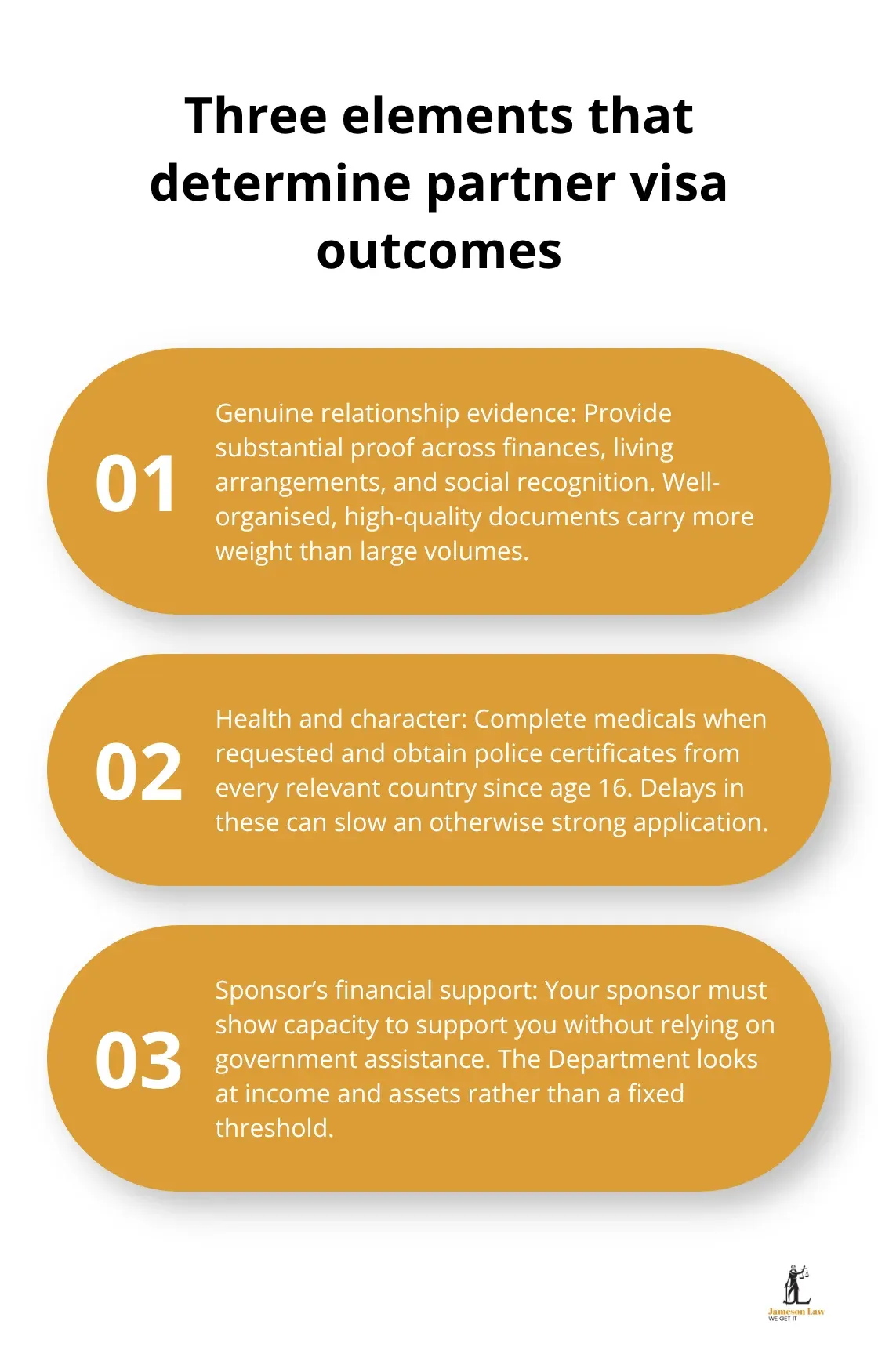
You must undergo medical examinations by a panel physician and obtain formal police certificates from every country where you have lived for 12 months or longer since turning 16. Furthermore, your sponsor (who must be an Australian citizen, permanent resident, or eligible New Zealand citizen) must obtain an Australian Federal Police clearance and demonstrate the financial capacity to support you.
The application itself requires meticulously scanned documents uploaded through ImmiAccount. As of 1 July 2026, the baseline government visa application charge for most partner visas (Subclasses 820/801 and 309/100) increased sharply to AUD $11,710. This fee covers both the temporary and permanent stages but does not include mandatory third-party costs like police checks, medical exams, or certified translations, which often push the total cost well over $12,000.
Your Partner Visa Options in Australia
Onshore and Offshore Pathways
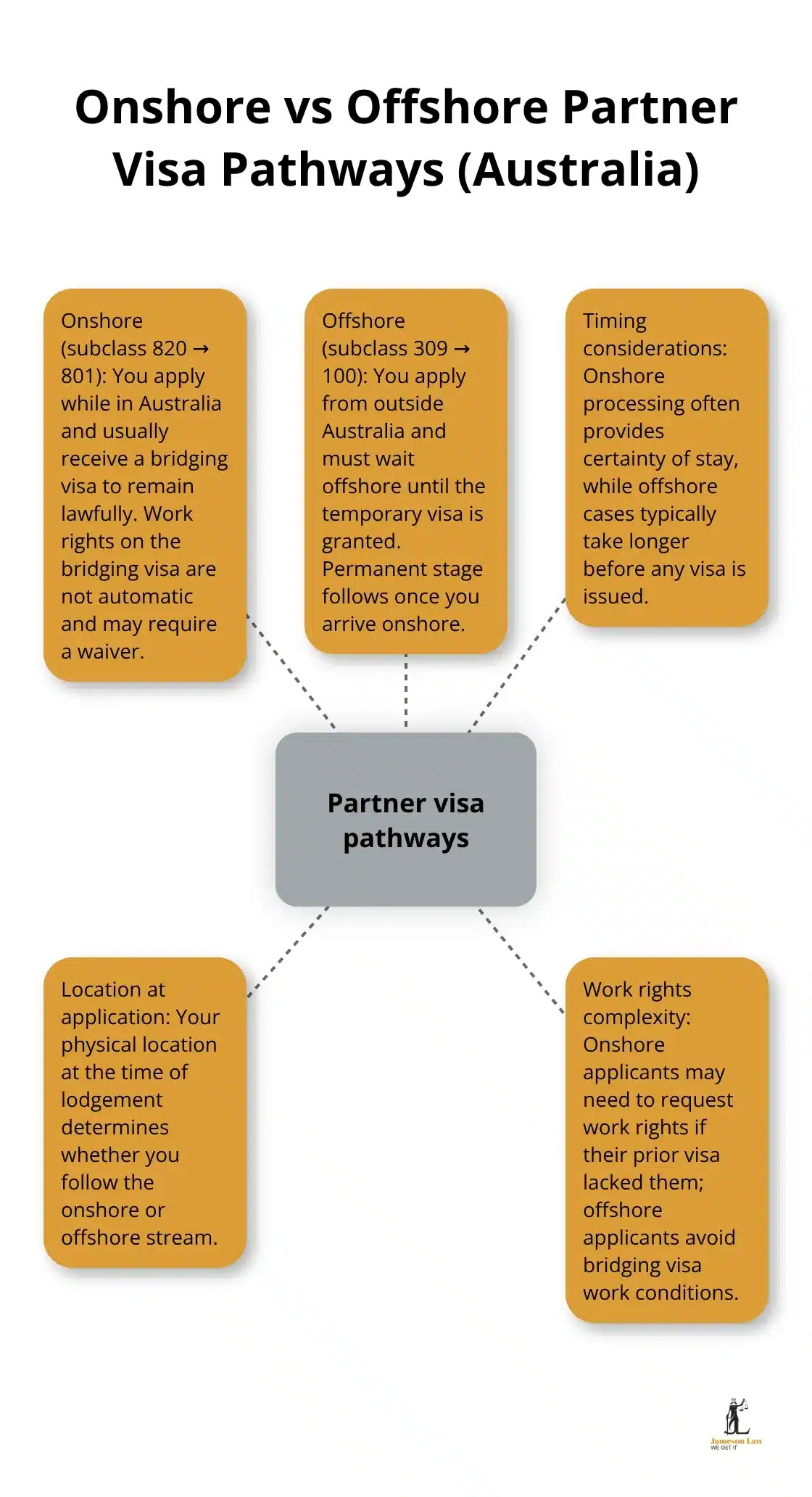
Australia offers two primary pathways for partner visas, each tailored to where you are physically located at the time of lodgement.
| Visa Pathway | Subclasses | Key Advantage / Implication |
|---|---|---|
| Onshore (In Australia) | Subclass 820 (Temporary) & 801 (Permanent) | You are generally granted a Bridging Visa, allowing you to remain lawfully in Australia during processing. |
| Offshore (Outside Australia) | Subclass 309 (Temporary) & 100 (Permanent) | You must wait outside Australia until the temporary visa is granted before you can migrate. |
Warning on Condition 8503: The “No Further Stay” condition presents a significant barrier if your current temporary visa carries it. This condition legally prevents you from applying for an onshore partner visa unless the Department grants an explicit waiver, which is exceptionally difficult to obtain.
What Documentation the Department Actually Reviews
Quality Over Quantity
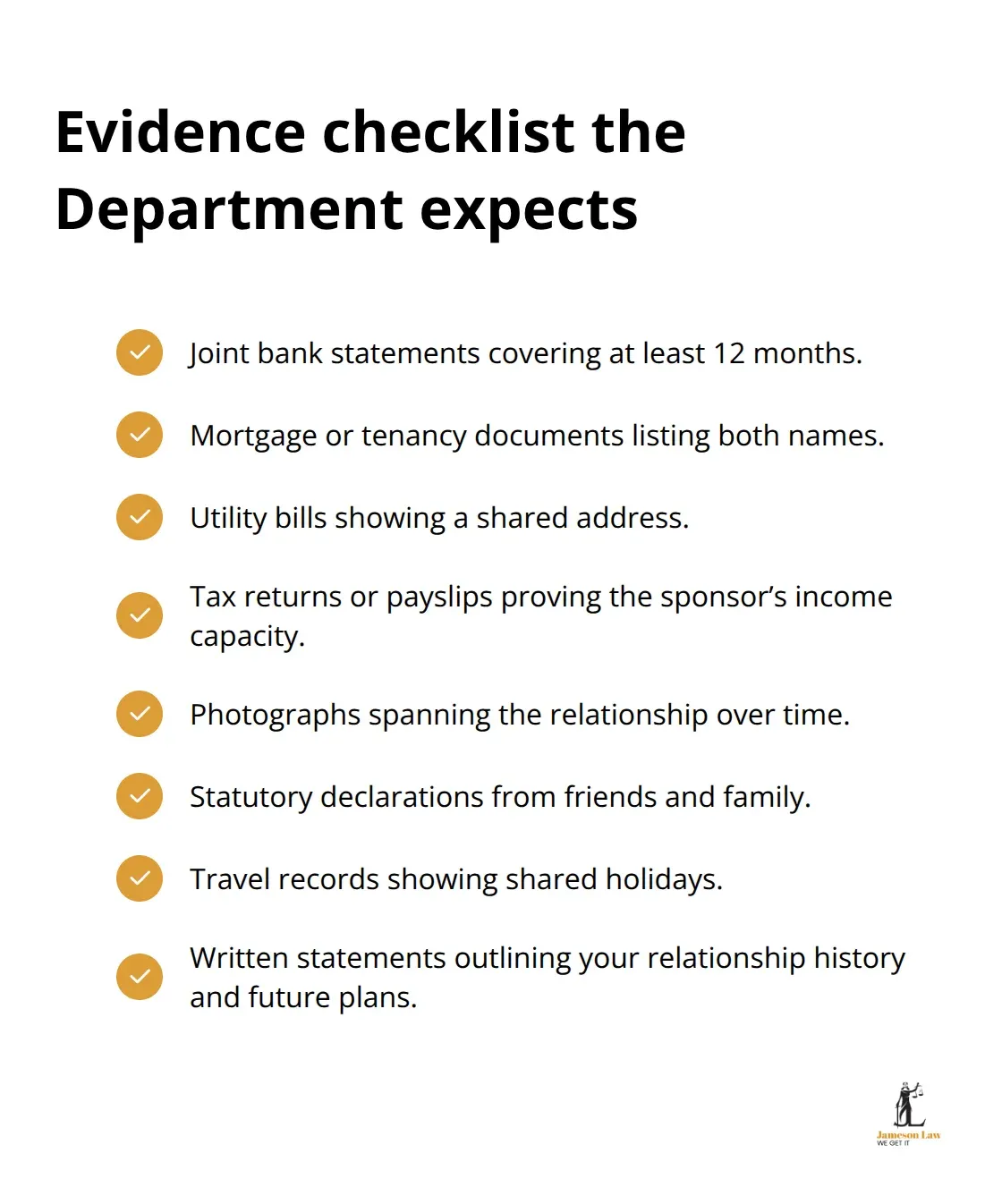
The Department of Home Affairs emphasises that evidence quality matters significantly more than raw quantity. Three well-organised, official documents proving a genuine joint financial commitment heavily outweigh twenty scattered pages of ambiguous text messages.
Processing Timelines and Assessment Focus
Processing timelines vary dramatically. The Department updates its global visa processing times regularly, and currently, a significant portion of subclass 820 applications take between 17 to 24 months to finalize.
Interviews may form part of the assessment if the Department finds your evidence unclear or inconsistent. If invited to an interview, expect rigorous questioning about your relationship history, daily routines, and future plans. Inconsistent answers between you and your sponsor instantly raise “red flags” and can lead to immediate refusal.
Final Thoughts
Partner visa eligibility Australia applications succeed only when you prepare methodically and understand exactly how the Department of Home Affairs scrutinises your private life. The $11,710 government fee is non-refundable if you fail, making precision critical.
Before you lodge your application, ensure you have gathered robust, chronologically sound evidence spanning the four pillars of assessment. Complications such as the 8503 condition, previous visa refusals, or complex financial structures warrant highly experienced legal oversight before submission.
At Jameson Law, our expert Sydney immigration team provides strategic legal assistance tailored to your unique relationship timeline. We ensure your application is airtight and “decision-ready” to prevent costly processing delays. Contact us today to protect your investment and secure your future together in Australia.