


Immigration law information NSW can feel overwhelming when you’re navigating visa applications, character assessments, or appeals. We at Jameson Law have helped countless applicants understand their rights and responsibilities throughout the process.
This guide breaks down the legislation, visa types, and common challenges you’ll face. You’ll find practical steps to move forward with confidence.
The Legal Framework Governing Your Immigration Application
Federal Law Sets the Rules for All Australians
Australian immigration law operates under federal legislation, not state law. This means the same rules apply whether you live in NSW or Western Australia. The Migration Act 1958 and Migration Regulations 1994 form the foundation of every visa decision made in Australia. The Department of Home Affairs applies these laws uniformly across all applications, so you cannot negotiate with state authorities or find NSW-specific loopholes that change the outcome.
Understanding this framework stops you from wasting time on state-level arguments. Instead, you focus on meeting the federal criteria that actually determine whether your application succeeds. The Federal Circuit and Family Court of Australia hears most migration cases, while the Federal Court reviews decisions for jurisdictional errors. This two-tier system exists because courts distinguish between reviewing whether the right process was followed versus deciding whether a decision was correct on the merits. You can challenge a decision only if the case officer made a legal mistake, not simply because you disagree with their judgement.
What You Must Prove and When You Must Prove It
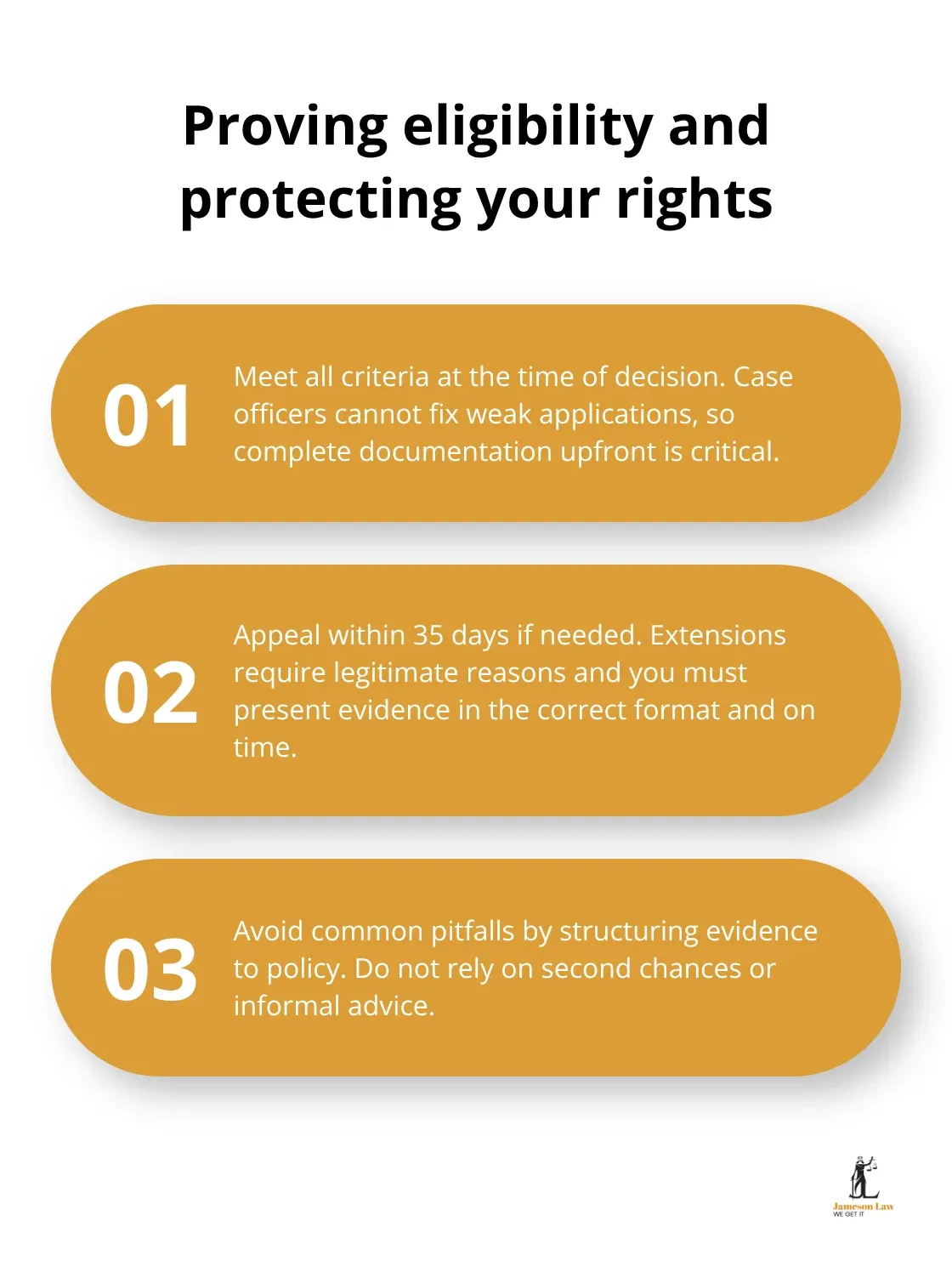
Your rights as an applicant centre on one critical principle: you must meet all criteria at the time the decision is made, not just when you lodge your application. The Department of Home Affairs operates under strict rules-based decision-making. Case officers cannot fix weak applications or give you a second chance to strengthen your evidence. This is why gathering complete documentation upfront matters far more than hoping the case officer will overlook gaps.
You have the right to lodge an appeal within 35 days of a decision, and you can request extensions if you have legitimate reasons for the delay. Your responsibility is to provide evidence in the correct format and within required timeframes. Many applicants lose their cases not because they are ineligible, but because they submitted poorly structured evidence or missed deadlines.
How NSW Location Affects Your Application
NSW residents commonly apply onshore, which gives you access to bridging visas and broader review rights. However, your work rights and visa validity depend on timing and processing speed. This means you must track your application status carefully and understand how bridging visa conditions affect your employment.
If you are uncertain about whether your evidence meets policy requirements or whether you have identified all available visa pathways, seeking professional guidance early prevents costly refusals. The stress of managing appeals after rejection far outweighs the cost of getting advice before you submit. Understanding these legal foundations prepares you to tackle the specific visa types available to NSW applicants and the documentation each one demands.
Which Visa Pathway Matches Your NSW Circumstances
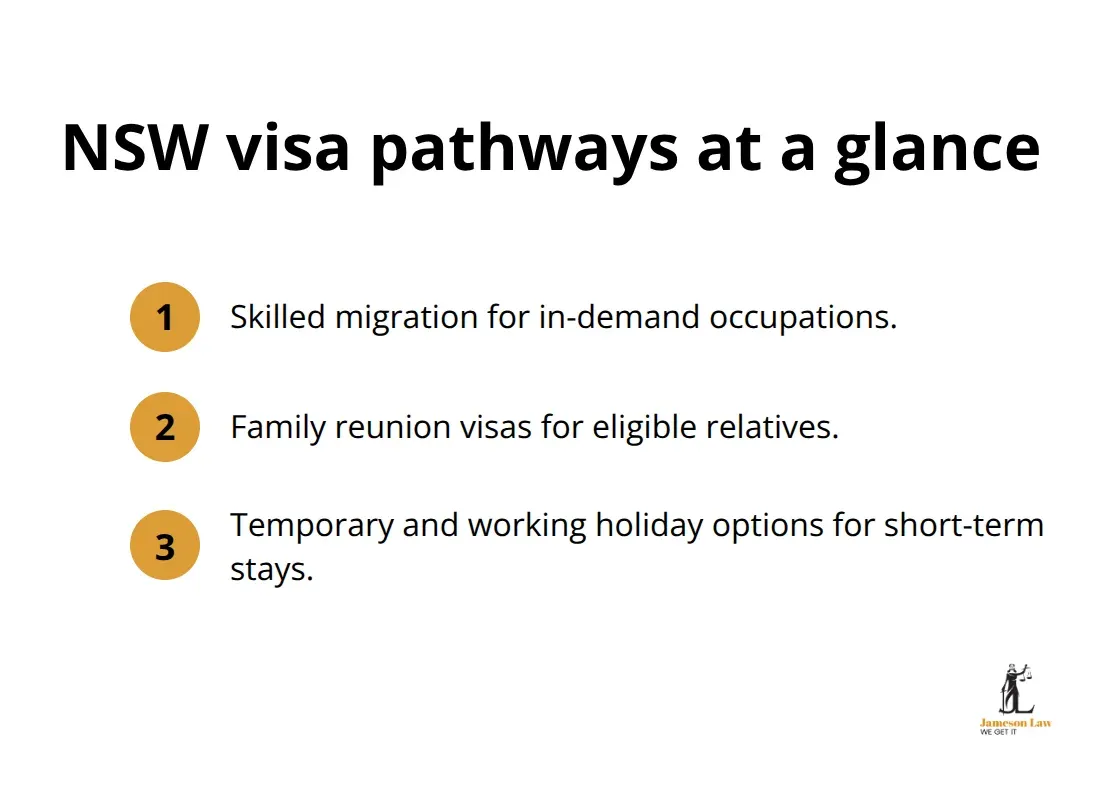
Australia’s immigration system offers distinct pathways, and your eligibility depends on matching your profile to the right visa type. NSW applicants typically pursue three main routes: skilled migration for professionals with in-demand occupations, family reunion visas for sponsoring relatives, and temporary visas for short-term work or travel. Each pathway has different point thresholds, evidence requirements, and processing timelines.
Skilled Migration Visas and the Points Test
Skilled migration visas require a minimum of 65 points on the Online Migration Assessment, calculated from factors like age, English language proficiency, work experience, and qualifications. The Department of Home Affairs publishes the Skilled Occupation List, which identifies occupations in demand across Australia. If your occupation appears on this list, you search it, complete the assessment, and receive an immediate point score along with an Immigration Next-Steps Guide containing direct links to required forms.
The early assessment clarifies whether a self-service application is realistic or whether professional guidance is necessary before lodgement. This step alone can save thousands in legal fees by preventing costly refusals. Processing times for skilled migration are indicative only and not guaranteed, so onshore applicants must carefully manage bridging visa work rights while waiting for a decision that may take months or years depending on occupation and application volume.
Family Reunion Visas and Relationship Evidence
Family reunion visas operate on different criteria entirely. These visas do not use points; instead, you must prove a genuine relationship through documentation such as marriage certificates, birth certificates, or statutory declarations from witnesses who can confirm your connection to the Australian sponsor. The Department of Home Affairs requires evidence of ongoing contact, financial interdependence, or shared living history depending on the visa subclass.
Character assessments apply to all family visa applicants, meaning police certificates from every country where you have lived for more than 12 months are mandatory. Health assessments are also compulsory and must be conducted by Department-approved panel doctors. These requirements add time and cost to family visa applications, so gathering documentation early prevents delays.
Temporary and Working Holiday Visas
Temporary visas and working holiday visas appeal to younger applicants or those seeking short-term work experience in Australia. These visas are available to citizens of specific countries and typically allow stays of 12 months, with the option to extend in some cases. These visas have lower evidence thresholds than permanent migration visas but impose strict conditions on work duration and employer changes.
Temporary skilled migration visas sponsored by employers follow different rules again: the employer must demonstrate they cannot fill the role with Australian workers, and your employment contract must meet minimum salary thresholds set by the Department. Onshore processing for any visa type means you can apply for a bridging visa, which allows you to remain in Australia and work while your application is assessed. This advantage is unique to onshore applicants and makes NSW a strategic location for those who can arrange it.
Choosing Your Path Forward
Understanding which pathway suits your circumstances, qualifications, and timeline is the foundation of a successful application strategy. The evidence you need, the timeframes you face, and the costs involved vary significantly between skilled, family, and temporary visa routes. Once you identify your pathway, the next step involves gathering the specific documentation that case officers require to assess your eligibility against the relevant criteria.
What Stops Most Immigration Applications from Succeeding
Incomplete Evidence and Procedural Mistakes
The gap between lodging an application and receiving approval rarely comes down to ineligibility. Most refusals happen because applicants submit incomplete evidence, miss critical deadlines, or fail to address what case officers actually need to assess against policy. Applicants often gather documents haphazardly, assume the Department of Home Affairs will overlook gaps, or rely on forum advice that contradicts current policy. The Migration Act 1958 and Department instructions are unforgiving on this point.
Case officers have no discretion to fix weak applications or request better-structured evidence after lodgement. You must get it right the first time because the cost of appealing a refusal far exceeds the cost of getting guidance upfront. Early risk assessment by an immigration professional stops you from submitting applications that case officers will reject on procedural grounds alone.
Health Assessments and Character Checks Create Separate Timelines
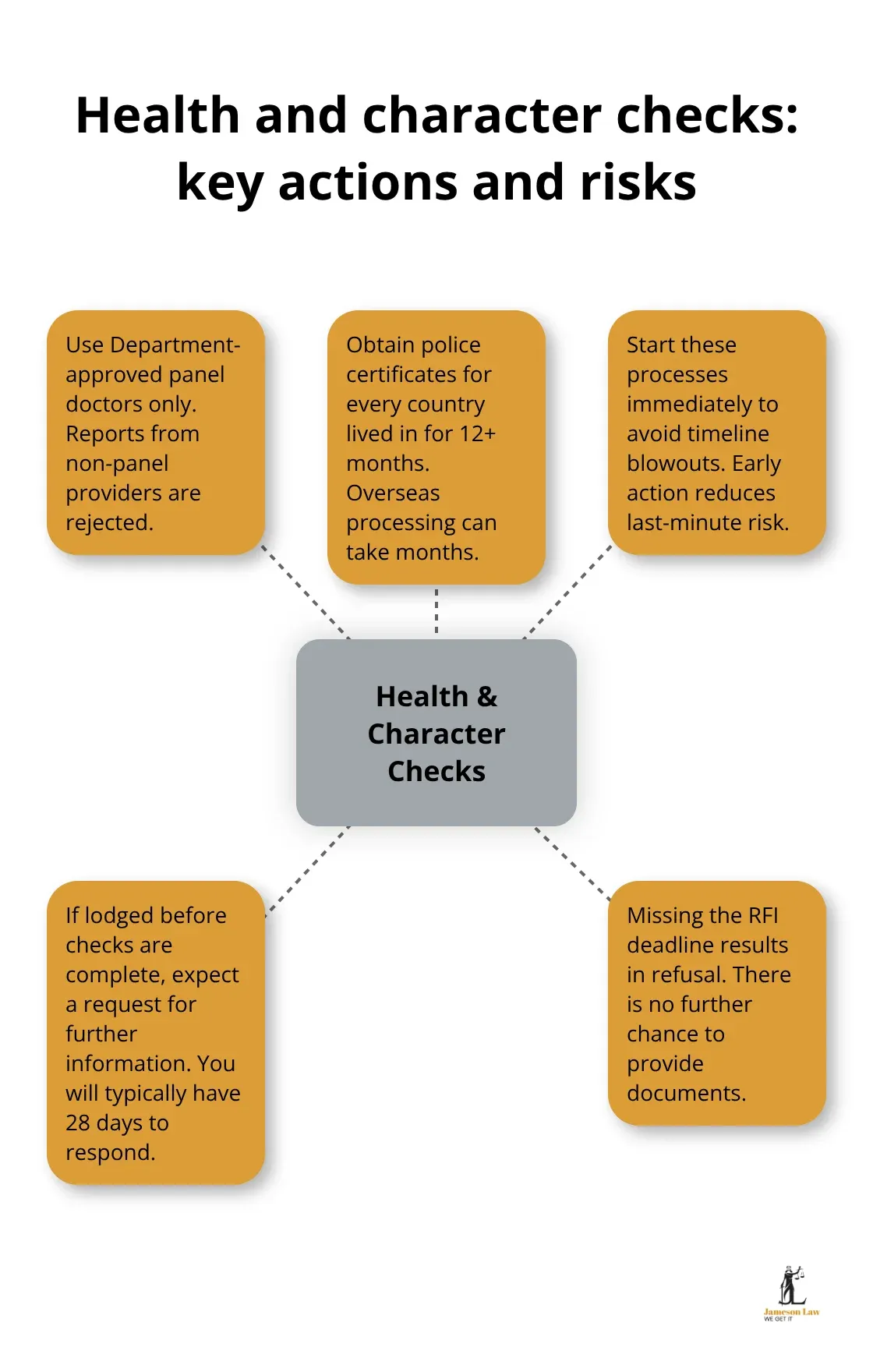
Health and character assessments operate on timelines separate from your visa application, creating pressure points that derail applicants who do not plan ahead. The Department requires health assessments from approved panel doctors listed on the Department website, and reports from private doctors outside this panel will be rejected. Character assessments demand police certificates from every country where you have lived for more than 12 months, and obtaining these from overseas authorities can take months depending on processing delays in that country.
NSW applicants often underestimate how long character clearances take from countries like India, China, or the Philippines, where government processing can stretch beyond six months. Starting these processes immediately after deciding to apply prevents last-minute scrambling that pushes your entire application timeline backward. If you lodge your visa application before health and character requirements are met, your case officer will issue a request for further information, and you then face a clock that typically allows 28 days to respond. Missing this deadline results in refusal without further opportunity to provide the documents.
The Strategic Advantage of Onshore Applications
NSW residents applying onshore have a significant advantage: you can lodge a bridging visa application alongside your substantive visa, which keeps you in Australia and allows work rights while assessments proceed. Offshore applicants have no such option and must complete health and character checks before receiving a decision. This timing difference alone makes onshore applications significantly less risky for applicants who can arrange it.
Appeals after refusals based on missed health or character deadlines are difficult because the court will view the refusal as procedurally correct, even if the delay was beyond your control. An immigration lawyer will conduct a risk assessment, identify which health and character issues require attention, and ensure you use approved panel doctors and legitimate government sources for certificates. This eliminates wasted applications to wrong medical providers and prevents refusals based on procedural non-compliance.
Understanding Appeal Rights and Jurisdictional Grounds
Appeals and review processes exist, but they demand strict adherence to timelines and jurisdictional grounds that most unrepresented applicants do not understand. You have 28 days from a decision to lodge an appeal, and extensions require a draft originating application plus an affidavit explaining the delay. If you miss this window, your right to challenge the decision disappears entirely.
The Federal Court will only review whether the case officer made a legal error, not whether you disagree with their judgement. This means identifying the precise jurisdictional error and proving it affected the decision becomes your entire case. Without professional guidance, applicants often frame arguments around the merits rather than the legal process, which courts reject immediately. A jurisdictional error occurs when the case officer identifies a wrong issue, asks the wrong question, ignores relevant material, relies on irrelevant material, or misapplies the law to the facts.
Final Thoughts
Immigration law information NSW applicants need boils down to three core principles: federal legislation governs every decision, you must meet all criteria at the time of decision, and procedural compliance matters as much as eligibility. Early risk assessment identifies which visa pathway suits your circumstances, reveals documentation gaps before lodgement, and prevents procedural mistakes that case officers will not forgive. Appeals after refusal are expensive, time-consuming, and succeed only when you can prove a legal error occurred, not simply that you disagree with the decision.
NSW residents have access to free or subsidised legal help through Legal Aid NSW Immigration Service, the Immigration Advice and Rights Centre, and Refugee Advice and Casework Service. You can also contact LawAccess NSW on 1300 888 529 to locate Community Legal Centres near you. If you prefer private representation, we at Jameson Law provide immigration law services tailored to your circumstances, with clear explanations of your options and realistic timelines.
Your next step is to assess your eligibility using the Online Migration Assessment if skilled migration applies, gather your documentation systematically, and seek professional advice before lodging. The cost of guidance upfront is far lower than the cost of managing a refusal and appeal. Contact us to discuss your immigration journey and receive a risk assessment that clarifies your pathway forward.