PUBLICATION

Head Injury Compensation NSW: How to Claim

"Claim head injury compensation NSW with our step-by-step guide. Learn eligibility, evidence, and get the support you deserve."
Head Injury Compensation NSW: How to Claim

A head injury can change your life in seconds. Whether it happened at work, in a car accident, or through someone else’s negligence, you deserve compensation for your losses.

We at Jameson Law help NSW residents navigate head injury compensation claims. This guide walks you through the process, from understanding what qualifies for compensation to taking your claim forward.

What Counts as a Compensable Head Injury

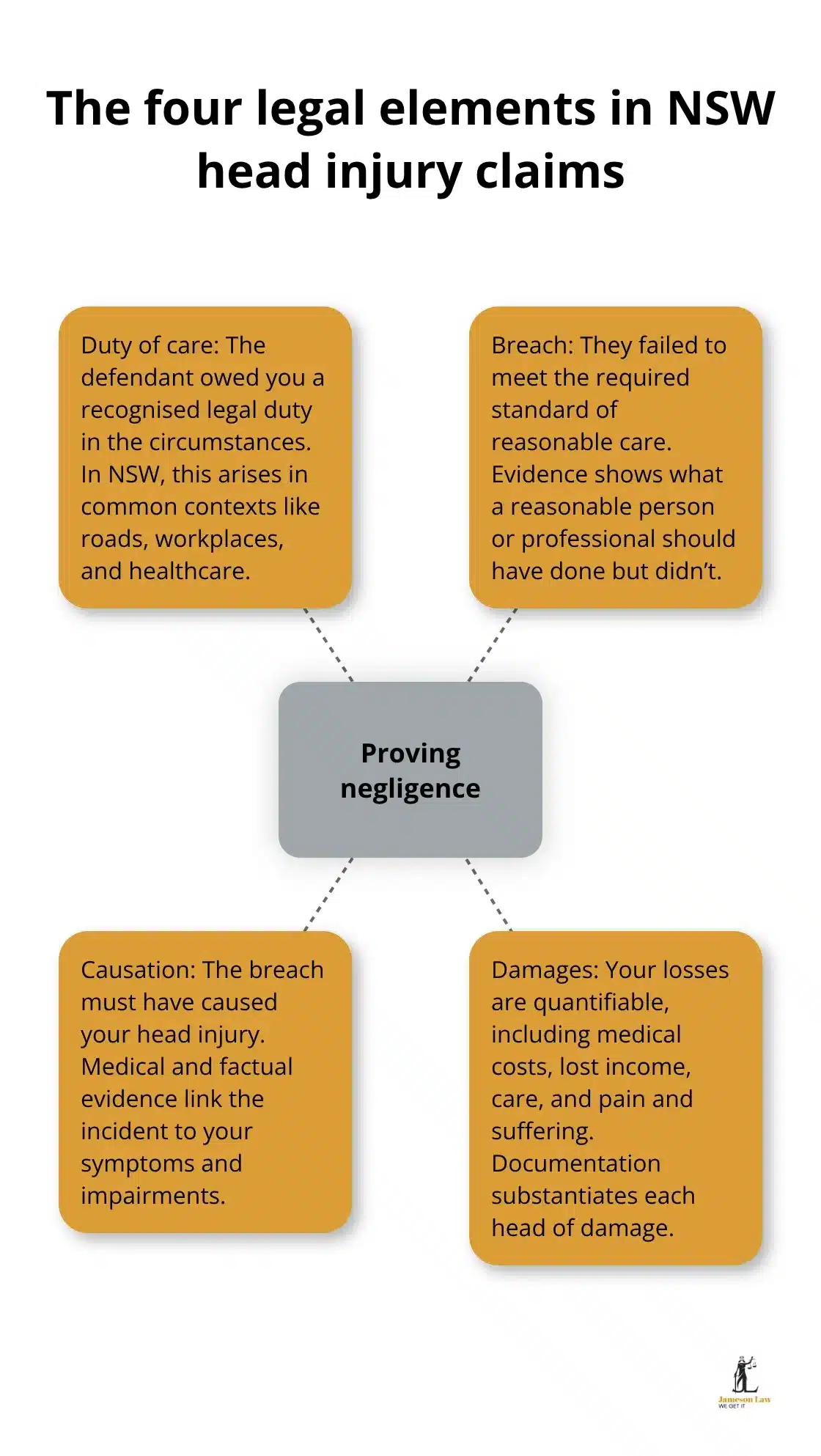
A head injury becomes compensable when someone else’s negligence caused it and you can prove four legal elements: duty of care, breach of that duty, causation, and quantifiable damages. This means the injury must stem from a specific incident-a car crash, workplace accident, slip and fall, or medical negligence-where another party failed to exercise reasonable care. Approximately 1 in 45 Australians live with a brain injury, yet many do not pursue claims because they remain unsure whether their injury qualifies.

Visual overview of the four legal elements needed to prove negligence in a NSW head injury claim - Head injury compensation NSW

Even mild concussions warrant compensation if negligence caused them. Head injuries range from acquired brain injuries (ABI) resulting from non-traumatic events like oxygen deprivation to traumatic brain injuries (TBI) from direct impact. Both types can trigger lifelong cognitive, emotional, or behavioural effects that remain invisible but significantly impact your capacity to work and live independently.

The legal framework for your claim

The Civil Liability Act 2002 (NSW) sets the legal framework for these claims, requiring you to demonstrate that the defendant owed you a duty of care, failed to meet that standard, and caused measurable harm. Your damages cover medical expenses, rehabilitation costs, lost income, home modifications, and non-economic losses such as pain and suffering. Payouts vary widely depending on severity and long-term impact, ranging from tens of thousands to tens of millions of dollars.

Strict deadlines that eliminate your rights

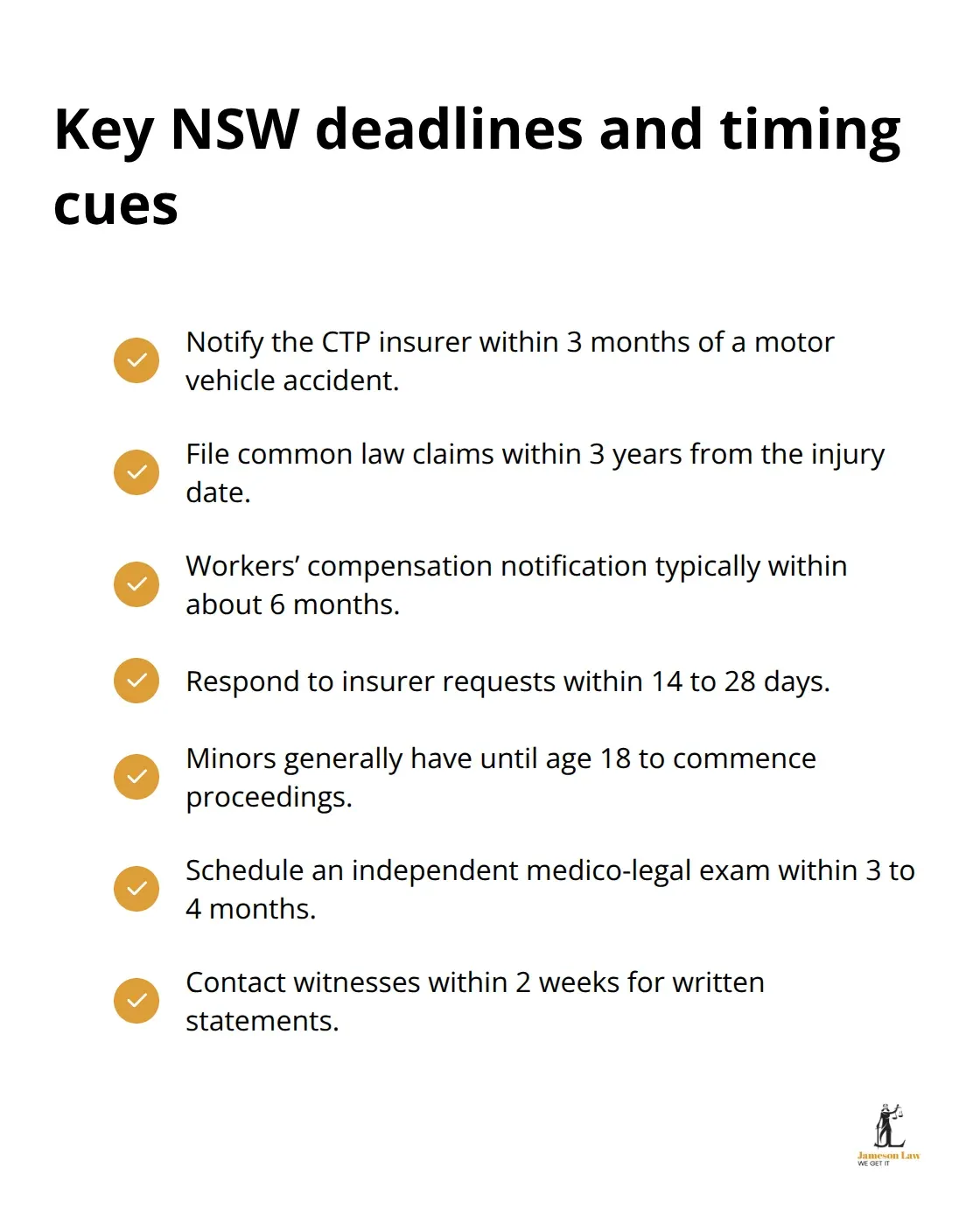
NSW law imposes strict deadlines that can eliminate your right to claim entirely. For motor vehicle accidents, you must notify the insurer within 3 months of the incident, while common law claims must be filed within 3 years from the injury date. Workers’ compensation claims operate differently under a no-fault system, requiring notification within about 6 months of the accident.

The Limitation Act 1969 (NSW) governs these timeframes, though extensions are rarely granted and never guaranteed. Minors have until age 18 to commence proceedings, and delayed-onset injuries may trigger the clock when you become aware of the harm rather than when the accident occurred.

Checklist of critical NSW time limits and timing milestones for head injury claims

Why immediate action protects your claim

Waiting too long destroys your claim’s viability regardless of its strength, so you must act after any head injury. Medical documentation from the outset creates the foundation for your entire claim, making urgent hospital visits and GP records invaluable. Contact a lawyer within weeks of your injury, not months, to preserve evidence and meet statutory deadlines.

Your window to act is narrow. The next step involves gathering the right documentation and working with medical professionals to build a strong evidentiary base for your compensation claim.

Building Your Case: What Happens After Your Injury

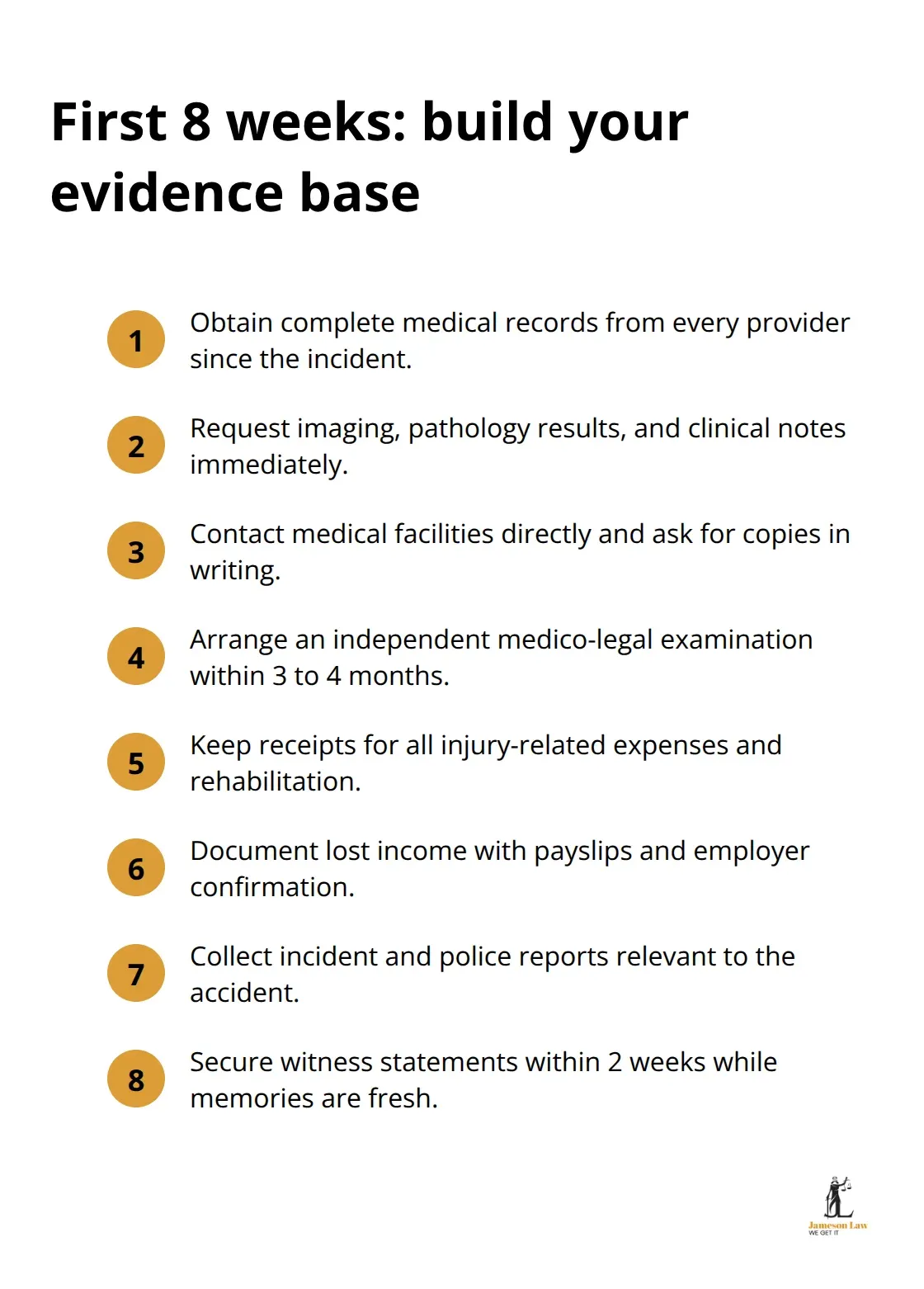
After your head injury, the next 4 to 8 weeks determine whether your claim succeeds or fails. This is when you collect the evidence that insurers and courts will scrutinise. Start by obtaining your medical records from every healthcare provider you’ve seen since the injury.

Compact checklist of priority evidence tasks in the first weeks after a head injury in NSW - Head injury compensation NSW

The Personal Injury Commission in NSW requires detailed medical evidence that links your injury directly to the incident, so request imaging reports, pathology results, and clinical notes immediately. Do not wait for your doctor to send these unprompted; contact the medical facilities directly and request copies in writing. Your medical records form the foundation of everything that follows, and delays in obtaining them can cost you months of lost time.

Getting the right medical assessments

You need two types of medical evidence: treatment records from your doctors and an independent medico-legal examination. The treatment records show your ongoing symptoms and recovery trajectory, while the medico-legal examination quantifies your injury’s impact on your future capacity to work and your long-term care needs. This independent assessment is not treatment; the doctor conducting it will review your history, examine you, and produce a detailed report estimating your prognosis and future medical costs. This report carries enormous weight because courts and insurers trust independent medical opinions more than treating doctors’ statements. You should expect to pay between $1,500 and $4,000 for a comprehensive medico-legal report, depending on the injury’s complexity. Schedule this examination within 3 to 4 months of your injury while your symptoms remain acute and measurable. Waiting longer weakens the report’s credibility because insurers will argue your condition has stabilised or improved. The Guidelines for Evaluation of Permanent Impairment, used by both the Personal Injury Commission and insurers, standardises how doctors rate your injury severity. Ensure your medico-legal doctor references these guidelines in their report because assessments that align with them carry more weight in negotiations and litigation.

Collecting supporting evidence beyond medical records

Collect incident reports, police statements, witness contact details, and any photographs of the accident scene or your injuries. For workplace injuries, obtain your employer’s incident report and safety records. For motor vehicle accidents, request the police report through NSW Police or the other party’s insurer. Witness statements carry significant weight; contact witnesses within 2 weeks of the injury and ask them to provide a written account of what they observed. Insurance companies scrutinise these statements closely, so ensure they include specific details about how the accident occurred and any negligent behaviour by the other party. Photographs of visible injuries taken within the first few days after the accident help establish the injury’s severity at the time. Keep receipts for all expenses related to your injury: medical bills, pharmacy costs, rehabilitation fees, transport to appointments, and any modifications to your home or vehicle. These receipts translate directly into quantifiable damages. Document your lost income by obtaining payslips before the injury and correspondence from your employer confirming time off work. If you’ve had to reduce your hours or change roles due to your injury, request written confirmation from your employer about the income reduction.

Notifying the insurer and responding to requests

Once your medical evidence is complete, your lawyer notifies the liable party’s insurer of your claim, detailing the injury, the circumstances, and the compensation sought. The insurer will request copies of your medical reports, incident details, and financial losses. They will also commission their own medical examination to challenge your assessment. This is standard practice and not a sign that your claim is weak. Respond to the insurer’s requests within the specified timeframe, typically 14 to 28 days. Delays give the impression that your claim is weak or disorganised. The Personal Injury Commission’s Pathway Portal streamlines disputes by automatically assigning cases to the appropriate pathway, whether motor accidents or workers compensation. If you lodge a claim through the Commission, you’ll use this digital platform to exchange documents and track progress. The Commission publishes decision summaries that show how similar head injury cases have been valued, giving both you and the insurer a realistic benchmark for settlement discussions.

Moving toward resolution through mediation or court

Mediation often follows if the insurer’s initial offer falls short of your expectations. A neutral mediator helps both parties negotiate a settlement without court proceedings. Most mediations result in settlement because both sides avoid the cost and uncertainty of litigation. Court proceedings become necessary only if settlement negotiations fail. If your case proceeds to court, the judge will assess negligence based on the four legal elements and award damages accordingly. The outcome of your claim-whether settled or litigated-determines your compensation amount and marks the end of your ability to claim further damages for the same head injury.

Understanding how courts value similar head injury cases helps you prepare for what comes next in your claim journey.

What Makes Head Injury Claims So Difficult to Win

Insurers fight head injury claims harder than almost any other personal injury case because the injuries are often invisible and the long-term costs are enormous. A severe brain injury can cost the insurer millions in lifetime care, so they deploy multiple strategies to reduce or deny your claim.

Proving the accident caused your injury, not a pre-existing condition

The first challenge is proving that the other party’s negligence caused your injury, not some pre-existing condition or genetic predisposition. Medical records showing your health status before the accident become critical evidence here. If you had no prior brain injury diagnosis, your medical history should reflect that clearly.

Insurers will request your full medical history and may obtain your GP records dating back years to identify any previous head complaints, mood disorders, or cognitive issues that they can argue contributed to your current symptoms. This is why you need a medico-legal doctor who specifically addresses this issue in their report, stating whether your current symptoms are consistent with the accident mechanism and inconsistent with your prior health status.

Contributory negligence must be specifically pleaded as a defence to a claim, and since it is raised by way of defence, the onus is on the defendant to prove it. A strong medico-legal report that rules out alternative causes and explains why the injury is consistent with the accident mechanism makes this far harder for the insurer to challenge.

Documenting financial losses with receipts and records

Establishing the financial link between your injury and your damages requires meticulous documentation that many claimants neglect. Lost income claims fail regularly because claimants cannot produce payslips, employment contracts, or employer correspondence confirming the income loss. If you were self-employed, you need tax returns and business records showing your earnings before and after the injury.

Rehabilitation costs must be itemised with invoices and receipts, not rough estimates. Home modifications and accessibility equipment need quotes and invoices, not guesses about future costs. The insurer will scrutinise every expense and reject anything without documentary support. This is where most claimants lose thousands in recoverable damages simply because they failed to keep receipts or request written confirmation from their employer.

The Guidelines for Evaluation of Permanent Impairment, used by the Personal Injury Commission and insurers alike, require specific medical measurements and standardised assessments to quantify your injury’s impact on your earning capacity and future care needs. If your medico-legal report does not reference these guidelines or provide the specific measurements they require, insurers will commission their own examination and use that to argue your compensation is overstated.

Navigating strict procedural deadlines and document limits

Insurance companies exploit procedural weaknesses relentlessly, and this is where most claimants lose without ever reaching court. The Pathway Portal used by the Personal Injury Commission imposes strict document limits and filing deadlines that catch unprepared claimants off guard. Procedural Directions provide information about applying for and the assessment of medical assessment matters in the Commission.

Missing a filing deadline costs you the chance to present evidence, and the Commission will proceed without it. Insurers know these deadlines better than claimants do and will use procedural delays against you if your lawyer lacks experience. They may request extensions, file incomplete responses, or submit voluminous documents designed to overwhelm you into accepting a lower settlement just to end the dispute.

An insurer’s medico-legal doctor who follows these directions precisely will outweigh your treating doctor’s opinion in court, even if your treating doctor has seen you far more frequently.

Why legal representation changes the outcome

Engaging experienced legal representation early is not optional; it is the difference between winning and losing. The Personal Injury Commission publishes Appeal Case Summaries showing how similar head injury claims have been decided, and these decisions reveal that claimants without proper legal representation accept settlements worth significantly less than comparable cases with lawyer representation. The insurer counts on you not knowing this and will anchor their initial offer low, betting you will accept because you lack the knowledge to push back effectively.

Final Thoughts

Head injury compensation NSW claims succeed when you act decisively within strict timeframes and gather evidence before insurers challenge your position. The four legal elements-duty of care, breach, causation, and damages-form the foundation of every successful claim, and your medical evidence must prove each one convincingly. Most claimants lose thousands in recoverable compensation simply because they delay seeking legal advice or fail to document their losses properly.

If your accident occurred within the last three years, you still have time to lodge a claim, but every week that passes weakens your evidence and strengthens the insurer’s position. Insurers anchor their opening offers deliberately low, betting you lack the knowledge to push back effectively. A lawyer will benchmark your claim against comparable decisions, identify weaknesses before the insurer exploits them, and handle all procedural requirements that catch unprepared claimants off guard.

We at Jameson Law offer a no win no fee arrangement for head injury compensation NSW claims, meaning you pay nothing unless we recover compensation for you. Contact Jameson Law today for a free claim assessment and to discuss your options.

Speak to an Expert Lawyer today

Laywers-Jameson-Law-The-best-law-firm-in-Sydney- Sydney Lawyers - Sydney
BOOK NOW

WE'RE IN IT TO WIN IT

Book your consultation

Book Now
Book Now Mobile 06 02 2025

This form submission is encrypted and secured to ensure your information remains confidential.

What our Clients

Related Publications:

What our clients say

.

Jameson Law - Voted the Best Law firm in Sydney Award

Legal Answers ... In Short

We're here to help

Our mission is to ensure our client matters are resolved successfully every time. Success to us does not simply involve winning, but moreover ensuring we take the most feasible, economic and stress-free path to help our clients achieve their goals. We fight hard for our clients, and always go by the motto: we’re in it to win it.

Jameson Law - Best Law Firm in Sydney

WE'RE IN IT TO WIN IT

Book your consultation

Call us now on (02) 8806 0866 or fill out the form below

Book Now Mobile

This form submission is encrypted and secured to ensure your information remains confidential.

WE'RE IN IT TO WIN IT

Book your consultation

Book Now Mobile 06 02 2025
lock

This form submission is encrypted and secured to ensure your information remains confidential.

Our Sydney Offices

Offices Parramatta and Sydney Jameson Law
Parramatta CBD - Head Office
jameson Law - Blacktown
jameson Law - Liverpool Office
Jameson Law - Bankstown
Court Houses We Frequent Jameson Law

Court Houses We Frequent

Balmain Local Court

Registry: Monday to Friday, 9:00am to 4:30pm

Bankstown Local Court

Court Operating Hours: 9:30am-4:30pm

Blacktown Local Court

Registry Hours: 9:00 – 4:30
Telephone Hours: 8:30 -4:30
Days open: Mon-Fri

Burwood Local Court

Registry Hours: 9:00 – 4:30
Telephone Hours: 8:30 – 4:30
Days open: Mon – Fri

Campbell Local Court

Registry Hours: 9:00 – 4:30
Telephone Hours: 8:30 – 4:30
Days open: Mon – Fri

Central Local Court

Registry Hours: 9:00 – 1:00 and 2:00 – 4:30
Telephone Hours: 8:30 – 4:30

Downing Local Court

Registry Hours: 9:00 – 1:00 and 2:00 – 4:30
Telephone Hours: 8:30 – 4:30

Wollongong Local Court

Registry Hours: 9:00 – 1:00 and 2:00 – 4:30
Telephone Hours: 8:30 – 4:30

Fairfield Local Court

Registry Hours: 9:00 – 1:00 and 2:00 – 4:30
Telephone Hours: 8:30 – 4:30

Hornsby Local Court

Registry Hours: 9:00 – 1:00 and 2:00 – 4:30
Telephone Hours: 8:30 – 4:30

Liverpool Local Court

Registry Hours: 9:00 – 1:00 and 2:00 – 4:30
Telephone Hours: 8:30 – 4:30

Manly Local Court

Registry Hours: 9:00 – 1:00 and 2:00 – 4:30
Telephone Hours: 8:30 – 4:30

Newtown Local Court

Registry Hours: 9:00 – 1:00 and 2:00 – 4:30
Telephone Hours: 8:30 – 4:30

Parramatta Local Court

Registry Hours: 9:00 – 1:00 and 2:00 – 4:30
Telephone Hours: 8:30 – 4:30

Penrith Local Court

Registry Hours: 9:00 – 1:00 and 2:00 – 4:30
Telephone Hours: 8:30 – 4:30

Sutherland Local Court

Registry Hours: 9:00 – 1:00 and 2:00 – 4:30
Telephone Hours: 8:30 – 4:30

Waverley Local Court

Registry Hours: 9:00 – 1:00 and 2:00 – 4:30
Telephone Hours: 8:30 – 4:30

Windsor Local Court

Registry Hours: 9:00 – 1:00 and 2:00 – 4:30
Telephone Hours: 8:30 – 4:30

Wollongong Local Court

Registry Hours: 9:00 – 1:00 and 2:00 – 4:30
Telephone Hours: 8:30 – 4:30

Downing Centre District Court

Registry Hours: 9:00 – 4:30
Telephone Hours: 8:30 – 4:30
Days open: Mon – Fri

Parramatta District Court

Registry Hours: 9:00 – 4:30
Days open: Mon-Fri

Penrith District Court

Registry Hours: 9:00 – 4:30
Days open: Mon-Fri

Campbelltown District Court

Registry Hours: 9:00 – 4:30
Days open: Mon – Fri

Liverpool District Court

Registry Hours: 9:00 – 4:30
Days open: Mon – Fri

Wollongong District Court

Registry Hours: 9:00 – 1:00 and 2:00 – 4:30
Telephone Hours: 8:30 – 4:30

Supreme Court New South Wales

Registry Hours: 9:00 AM – 4:30 PM
Telephone Hours: 8:30 AM – 4:30 PM
Days Open: Monday to Friday

Federal Circuit and Family Court of Australia

Registry Hours: 9:00 AM – 4:30 PM
Telephone Hours: 8:30 AM – 5:00 PM
Days Open: Monday to Friday

Federal Court

Monday to Friday, 8:30 AM – 4:30 PM

High Court

Monday to Friday, 8:30 AM – 5:00 PM

Children’s Court of New South Wales

Registry Hours: 9:00 AM – 4:30 PM
Telephone Hours: 8:30 AM – 4:30 PM
Days Open: Monday to Friday

Coroner’s Court New South Wales

Registry Hours: 9:00 AM – 4:30 PM
Telephone Hours: 8:30 AM – 4:30 PM
Days Open: Monday to Friday

Industrial Relations Commission of New South Wales

Registry Hours: 9:00 AM – 4:30 PM
Telephone Hours: 8:30 AM – 4:30 PM
Days Open: Monday to Friday

Land and Environment Court of New South Wales

Registry Hours: 9:00 AM – 4:30 PM
Telephone Hours: 8:30 AM – 4:30 PM
Days Open: Monday to Friday

WE'RE IN IT TO WIN IT

Book your consultation

Book Now
Book Now Mobile 06 02 2025
lock

This form submission is encrypted and secured to ensure your information remains confidential.