
PUBLICATION

Criminal Defence Sydney: What to Expect in Court

"Prepare for your day in court with our complete criminal defence Sydney guide. Learn what to expect and how to protect your rights."
Criminal Defence Sydney: What to Expect in Court

Facing criminal charges in Sydney can feel overwhelming, especially if you’ve never been through the court system before. We at Jameson Law know that understanding what happens in the courtroom helps you prepare properly and reduces anxiety.

This guide walks you through each stage of the criminal defence process in NSW, from your first appearance to sentencing. You’ll learn what to expect, how to work with your lawyer, and what rights you have at every step.

Understanding the Criminal Court System in NSW

Where Your Case Will Be Heard

NSW operates two main criminal courts that handle the vast majority of cases, and understanding which one deals with your matter is essential from day one. The Local Court handles the majority of criminal matters in the state, including summary offences and indictable offences, and serves as the entry point for all criminal charges, while the District Court deals with more serious indictable offences. The Supreme Court sits above both but only hears murder, treason, and appeals. Most people facing criminal charges in Sydney start in the Local Court, regardless of how serious their case is.
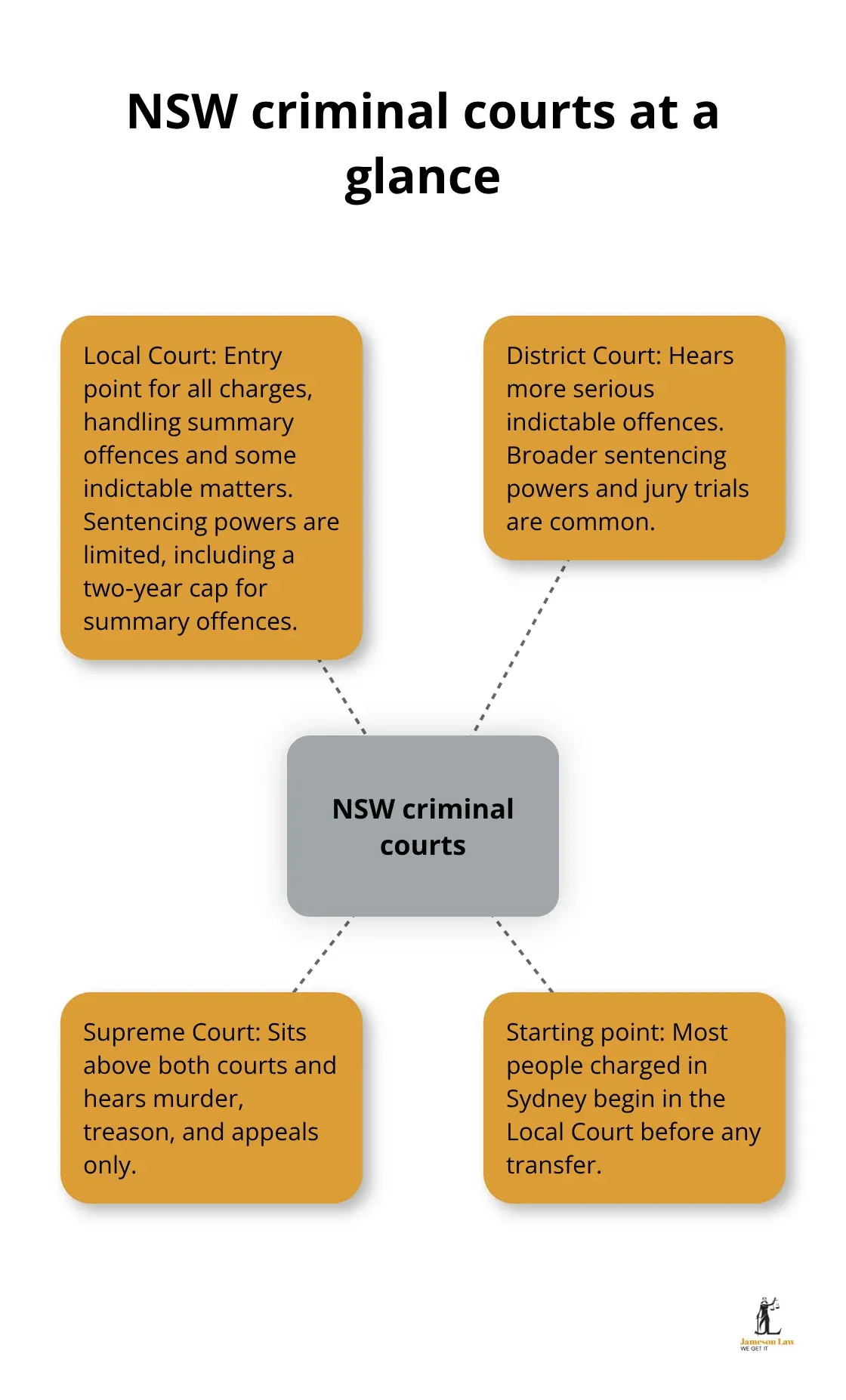
Diagram showing Local Court, District Court, and Supreme Court roles in NSW and where most cases begin. - criminal defence Sydney

This initial appearance, often called a mention, typically happens within weeks of arrest and sets the trajectory for everything that follows. The Local Court magistrate has limited sentencing powers, capped at two years imprisonment for summary offences, which is why serious matters move to the District Court. The District Court, by contrast, operates without the restrictions that bind magistrates and handles more serious indictable offences.

Preparing for Your First Court Date

Your first court date is not the time to make rushed decisions about pleading guilty or not guilty. Arrive at least 30 minutes early to find your courtroom and locate court staff-this prevents the stress of scrambling at the last moment. Many people underestimate how long proceedings take, so clear your schedule entirely rather than planning to slip back to work.

If you are on bail, failing to show up results in a warrant being issued and your bail being forfeited, which then creates a separate offence on top of your original charge. Court breaks occur around 11:30am (morning tea) and 1:00pm–2:00pm (lunch), so plan accordingly.

Key Stages from Arrest to Trial

The journey from arrest to trial follows distinct stages, each with different rules and timelines that affect your defence strategy. After arrest, you have the right to silence and should not answer questions beyond providing your name and address without a lawyer present. Police must disclose their brief within statutory timeframes, and requesting this disclosure early allows your lawyer to spot weaknesses and inconsistencies in the prosecution case.

Within the Local Court, you enter a plea at your first appearance, and this decision determines whether the case proceeds to trial or sentencing. If you plead not guilty, the magistrate may refer serious matters to the District Court for trial, or your matter may remain in the Local Court depending on the charge and your election. Pre-trial orders made before jury empanelment in the District Court bind the trial judge unless justice requires otherwise, so early rulings on admissibility of evidence or venue changes matter significantly.

The Role of the Magistrate and Judge

The magistrate and judge play fundamentally different roles in the criminal system. The magistrate decides guilt or innocence in the Local Court and imposes sentences within their power, while the District Court judge manages pre-trial procedure, oversees jury empanelment, and delivers sentencing after a jury conviction. In judge-alone trials in the District Court, the judge performs both roles, deciding the law and the facts.

Representation influences outcomes substantially according to NSW Bureau of Crime Statistics and Research data. Defendants who have experienced lawyers achieve better results through procedural knowledge and evidence challenges under the Evidence Act 1995 (NSW). Your lawyer’s familiarity with court procedures, local magistrates, and prosecution practices can shift the entire trajectory of your case-which is why the next step involves understanding how to work effectively with your defence team.

Preparing for Your Court Appearance

Act Immediately After Receiving Your Court Attendance Notice

Preparation separates defendants who achieve better outcomes from those who struggle through the process unprepared. The moment you receive a Court Attendance Notice, your first action should be to obtain a copy of the police brief and review it thoroughly with a lawyer. This brief contains the prosecution’s evidence, witness statements, and the facts they intend to prove, and spotting weaknesses early allows your lawyer to build a defence strategy before your first appearance. Request disclosure within statutory timeframes, as delays compress your preparation window and limit your options.

Gather supporting materials immediately: character references from employers, community members, or family; medical reports if mental health or injury is relevant; financial documents if you face sentencing; and any evidence that contradicts the prosecution case. Courts are more likely to accept non-conviction orders or reduced sentences when defendants present comprehensive supporting material, and waiting until the last moment means you’ll miss opportunities to obtain these documents. If you’re facing traffic offences, gather dashcam footage, witness details, or maintenance records for your vehicle immediately, as these often determine the difference between conviction and acquittal.

Identify Procedural Breaches and Unlawful Evidence

Your lawyer needs time to analyse the police brief, identify procedural breaches in how police conducted interviews or searches, and determine whether evidence was obtained unlawfully under the Evidence Act 1995 (NSW). Police must follow strict protocols during arrest, detention, and interviewing, and unlawfully obtained evidence can be excluded from trial entirely, which sometimes means the entire case collapses before it reaches court.

Work Honestly with Your Defence Lawyer

Working effectively with your defence lawyer means being honest about the facts, even the unfavourable ones, and understanding that your lawyer’s job is to challenge the prosecution case and protect your rights, not to judge you. Your first consultation should produce a clear action plan that outlines the defence strategy, assesses the strength of the prosecution brief, discusses realistic outcomes for your charge, and establishes a timeline for gathering material and preparing for court.

Tell your lawyer everything: prior criminal history, any admissions you’ve made to police, conversations with witnesses, and any mental health or substance use issues that might be relevant to sentencing or your defence. Silence is your protection during police questioning, and giving information without legal advice present can harm your case irreparably, so never answer questions beyond providing your name and address without your lawyer present.

Know Your Rights at Every Court Stage

Understanding your rights at each court stage is non-negotiable. You have the right to legal representation, the right to silence, the right to cross-examine prosecution witnesses, and the right to present your own evidence or witnesses. If you cannot afford a lawyer, contact Legal Aid NSW on 1300 888 529 before your court date, as a duty lawyer may assist on the day, though they typically cannot prepare your case in advance.

At your first appearance, you are not obligated to plead guilty or not guilty immediately if you need more time; request an adjournment and explain that you need time to obtain legal advice or wait for representations to be prepared. Courts routinely grant adjournments for these reasons, and rushing into a guilty plea without understanding the consequences or exploring your options is a mistake that cannot be undone. Once you understand your rights and have prepared your materials, the actual court hearing follows a structured format that you need to anticipate.

What Happens Inside the Courtroom

The Prosecution Opens and Presents Evidence

The prosecution opens first and outlines the case against you in succinct, factual terms. This opening address sets out what the Crown intends to prove without argument, so the jury or judge understands the allegations clearly. The prosecutor then calls witnesses in a sequence they control, and each witness answers questions about what they saw, heard, or discovered. The Crown must prove guilt beyond reasonable doubt, which means the evidence must be strong enough to eliminate any reasonable doubt about your guilt.

Cross-Examination Tests Witness Credibility

Your defence lawyer cross-examines each prosecution witness immediately after their evidence. This is where your lawyer challenges the witness’s reliability, accuracy, or truthfulness by asking pointed questions about inconsistencies, gaps, or weaknesses in their account. A weak witness statement often collapses under rigorous cross-examination, and many cases turn on whether prosecution witnesses can withstand pressure when questioned about what they actually observed versus what they assumed.

The Judge May Direct an Acquittal

If the Crown’s evidence at its highest cannot prove the charge beyond reasonable doubt, the judge must direct an acquittal rather than allowing the case to proceed to the jury or to a defence response. This is not a discretionary step-it is mandatory, and it prevents weak cases from reaching a verdict stage. Your lawyer watches for this moment and can request it if the prosecution evidence fails to meet the threshold.

Your Defence Presents Its Case

After the prosecution closes its case, your defence presents its own evidence and witnesses. You have the right to give evidence or remain silent. Many defendants choose to give evidence because it allows them to respond directly to the Crown’s allegations, but silence is also a powerful protection and cannot be held against you by the judge or jury. The prosecution will cross-examine you if you give evidence, and the Crown will probe your account to test consistency and credibility.

Closing Submissions, Jury Directions, and Verdict

Once the defence case concludes, both sides present closing submissions where they argue what the evidence proves and why the jury or judge should reach their conclusion. The judge then sums up the law and the evidence for the jury, directing them on what they must find to return guilty or not guilty. A jury verdict must be unanimous in most cases, and if jurors cannot agree after deliberating, a hung jury results and the case is relisted for retrial. Sentencing happens only after conviction, and the judge considers your criminal history, personal circumstances, character references, medical reports, and victim impact statements when determining the appropriate penalty. Courts have powers ranging from conditional release orders to imprisonment, and the sentence reflects the seriousness of the offence and your individual circumstances.

Final Thoughts

Understanding the criminal court process in NSW removes much of the uncertainty that makes facing charges so stressful. From your first appearance in the Local Court through to sentencing, each stage follows a predictable structure, and knowing what to expect allows you to prepare strategically rather than react in panic. The moment you receive a Court Attendance Notice, contact a lawyer immediately, as early intervention with an experienced criminal defence lawyer can lead to charge reductions, alternative sentencing, or dismissal through evidence challenges.

Representation influences outcomes substantially because defendants who work with experienced lawyers achieve better results through procedural knowledge, negotiation, and the ability to challenge evidence under the Evidence Act 1995 (NSW). This is not about having a lawyer present in court; it is about having someone who understands local court practices, knows how magistrates and judges approach sentencing, and can spot weaknesses in the prosecution case that you would miss alone. Waiting until your court date compresses your preparation window and limits your options for gathering supporting material, identifying procedural breaches, or negotiating with the prosecution.

If you face criminal charges in Sydney and need practical legal advice tailored to your situation, contact Jameson Law to discuss your case with an experienced criminal defence lawyer. The sooner you act, the more options remain available to you. We at Jameson Law stand ready to help you navigate this process with confidence.

Speak to an Expert Lawyer today

Laywers-Jameson-Law-The-best-law-firm-in-Sydney- Sydney Lawyers - Sydney
BOOK NOW

WE'RE IN IT TO WIN IT

Book your consultation

Book Now
Book Now Mobile 06 02 2025

This form submission is encrypted and secured to ensure your information remains confidential.

What our Clients

Related Publications:

What our clients say

.

Jameson Law - Voted the Best Law firm in Sydney Award

Legal Answers ... In Short

We're here to help

Our mission is to ensure our client matters are resolved successfully every time. Success to us does not simply involve winning, but moreover ensuring we take the most feasible, economic and stress-free path to help our clients achieve their goals. We fight hard for our clients, and always go by the motto: we’re in it to win it.

Jameson Law - Best Law Firm in Sydney

WE'RE IN IT TO WIN IT

Book your consultation

Call us now on (02) 8806 0866 or fill out the form below

Book Now Mobile

This form submission is encrypted and secured to ensure your information remains confidential.

WE'RE IN IT TO WIN IT

Book your consultation

Book Now Mobile 06 02 2025
lock

This form submission is encrypted and secured to ensure your information remains confidential.

Our Sydney Offices

Offices Parramatta and Sydney Jameson Law
Parramatta CBD - Head Office
jameson Law - Blacktown
jameson Law - Liverpool Office
Jameson Law - Bankstown
Court Houses We Frequent Jameson Law

Court Houses We Frequent

Balmain Local Court

Registry: Monday to Friday, 9:00am to 4:30pm

Bankstown Local Court

Court Operating Hours: 9:30am-4:30pm

Blacktown Local Court

Registry Hours: 9:00 – 4:30
Telephone Hours: 8:30 -4:30
Days open: Mon-Fri

Burwood Local Court

Registry Hours: 9:00 – 4:30
Telephone Hours: 8:30 – 4:30
Days open: Mon – Fri

Campbell Local Court

Registry Hours: 9:00 – 4:30
Telephone Hours: 8:30 – 4:30
Days open: Mon – Fri

Central Local Court

Registry Hours: 9:00 – 1:00 and 2:00 – 4:30
Telephone Hours: 8:30 – 4:30

Downing Local Court

Registry Hours: 9:00 – 1:00 and 2:00 – 4:30
Telephone Hours: 8:30 – 4:30

Wollongong Local Court

Registry Hours: 9:00 – 1:00 and 2:00 – 4:30
Telephone Hours: 8:30 – 4:30

Fairfield Local Court

Registry Hours: 9:00 – 1:00 and 2:00 – 4:30
Telephone Hours: 8:30 – 4:30

Hornsby Local Court

Registry Hours: 9:00 – 1:00 and 2:00 – 4:30
Telephone Hours: 8:30 – 4:30

Liverpool Local Court

Registry Hours: 9:00 – 1:00 and 2:00 – 4:30
Telephone Hours: 8:30 – 4:30

Manly Local Court

Registry Hours: 9:00 – 1:00 and 2:00 – 4:30
Telephone Hours: 8:30 – 4:30

Newtown Local Court

Registry Hours: 9:00 – 1:00 and 2:00 – 4:30
Telephone Hours: 8:30 – 4:30

Parramatta Local Court

Registry Hours: 9:00 – 1:00 and 2:00 – 4:30
Telephone Hours: 8:30 – 4:30

Penrith Local Court

Registry Hours: 9:00 – 1:00 and 2:00 – 4:30
Telephone Hours: 8:30 – 4:30

Sutherland Local Court

Registry Hours: 9:00 – 1:00 and 2:00 – 4:30
Telephone Hours: 8:30 – 4:30

Waverley Local Court

Registry Hours: 9:00 – 1:00 and 2:00 – 4:30
Telephone Hours: 8:30 – 4:30

Windsor Local Court

Registry Hours: 9:00 – 1:00 and 2:00 – 4:30
Telephone Hours: 8:30 – 4:30

Wollongong Local Court

Registry Hours: 9:00 – 1:00 and 2:00 – 4:30
Telephone Hours: 8:30 – 4:30

Downing Centre District Court

Registry Hours: 9:00 – 4:30
Telephone Hours: 8:30 – 4:30
Days open: Mon – Fri

Parramatta District Court

Registry Hours: 9:00 – 4:30
Days open: Mon-Fri

Penrith District Court

Registry Hours: 9:00 – 4:30
Days open: Mon-Fri

Campbelltown District Court

Registry Hours: 9:00 – 4:30
Days open: Mon – Fri

Liverpool District Court

Registry Hours: 9:00 – 4:30
Days open: Mon – Fri

Wollongong District Court

Registry Hours: 9:00 – 1:00 and 2:00 – 4:30
Telephone Hours: 8:30 – 4:30

Supreme Court New South Wales

Registry Hours: 9:00 AM – 4:30 PM
Telephone Hours: 8:30 AM – 4:30 PM
Days Open: Monday to Friday

Federal Circuit and Family Court of Australia

Registry Hours: 9:00 AM – 4:30 PM
Telephone Hours: 8:30 AM – 5:00 PM
Days Open: Monday to Friday

Federal Court

Monday to Friday, 8:30 AM – 4:30 PM

High Court

Monday to Friday, 8:30 AM – 5:00 PM

Children’s Court of New South Wales

Registry Hours: 9:00 AM – 4:30 PM
Telephone Hours: 8:30 AM – 4:30 PM
Days Open: Monday to Friday

Coroner’s Court New South Wales

Registry Hours: 9:00 AM – 4:30 PM
Telephone Hours: 8:30 AM – 4:30 PM
Days Open: Monday to Friday

Industrial Relations Commission of New South Wales

Registry Hours: 9:00 AM – 4:30 PM
Telephone Hours: 8:30 AM – 4:30 PM
Days Open: Monday to Friday

Land and Environment Court of New South Wales

Registry Hours: 9:00 AM – 4:30 PM
Telephone Hours: 8:30 AM – 4:30 PM
Days Open: Monday to Friday

WE'RE IN IT TO WIN IT

Book your consultation

Book Now
Book Now Mobile 06 02 2025
lock

This form submission is encrypted and secured to ensure your information remains confidential.