PUBLICATION

Personal Injury Time Limits: What NSW Claimants Should Know

"Understand personal injury time limits in NSW and how they affect your claim eligibility. Learn deadlines and exceptions for compensation cases."
Personal Injury Time Limits: What NSW Claimants Should Know

If you’ve been injured in NSW, you’re racing against the clock. Personal injury time limits are strict, and missing them can cost you your right to claim compensation entirely.

At Jameson Law, we’ve seen too many people lose valid claims because they waited too long. This guide breaks down exactly how much time you have, what exceptions exist, and what happens if you miss the deadline.

How Much Time Do You Have to Claim

The Three-Year Standard Rule

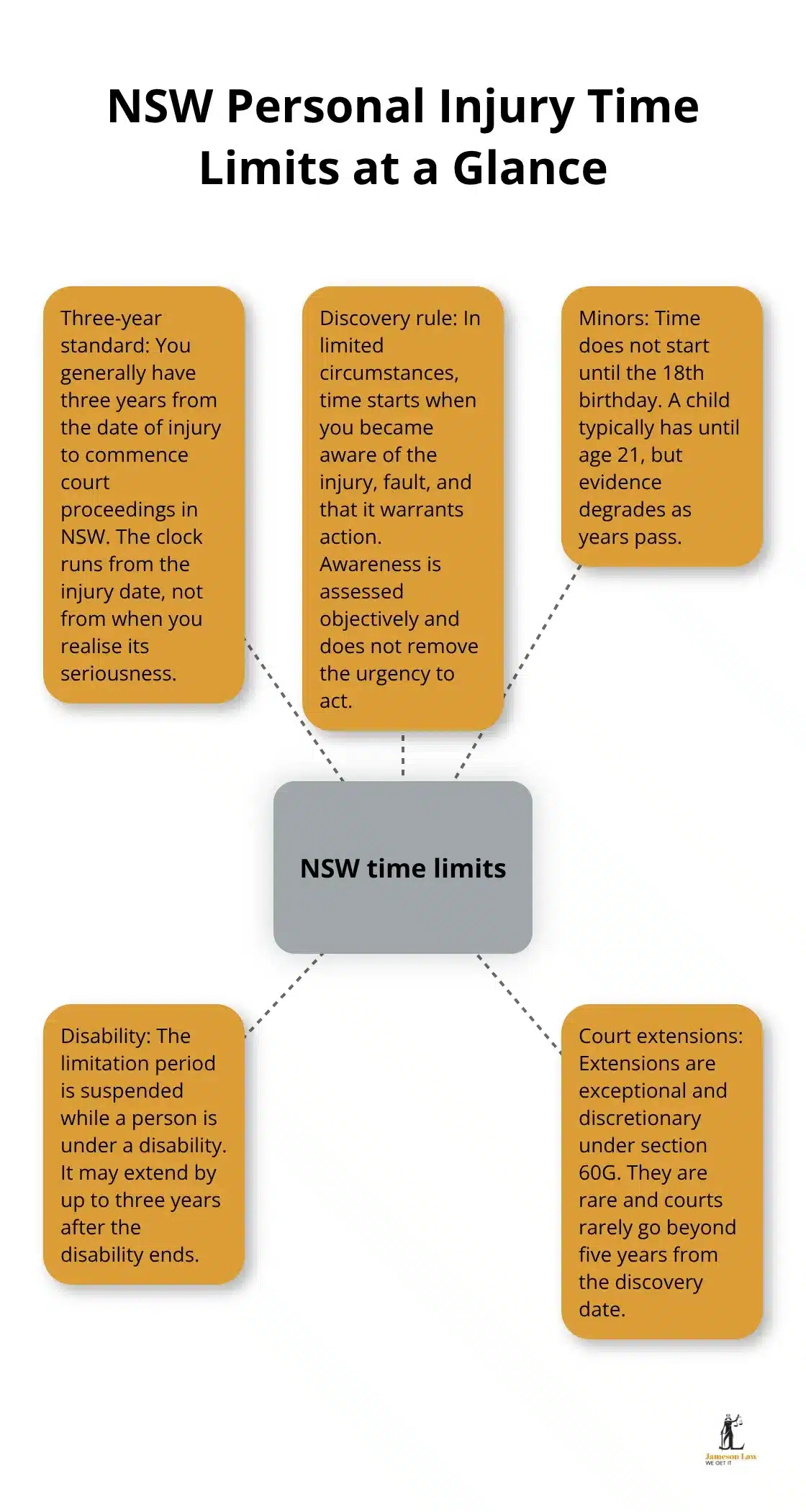
Under NSW law, the Limitation Act 1969 sets strict deadlines for personal injury claims. The standard rule is unforgiving: you have three years from the date of your injury to start court proceedings. This three-year window applies to most personal injury cases in NSW, whether your injury stems from a car accident, workplace incident, or public liability event. The clock starts ticking from the date the injury occurred, not from when you discovered the injury or realised how serious it was.

This distinction matters enormously. Many people assume they have more time once they understand the full extent of their harm, but NSW law disagrees. If you suffer an injury on 15 June 2023, your deadline is 15 June 2026, regardless of whether you sought medical treatment in 2024 or didn’t realise the injury was serious until 2025.

Visual summary of NSW personal injury time limits, discovery rule, minors/disability provisions, and court extensions in New South Wales

When the Discovery Rule Changes Everything

The Limitation Act recognises that some injuries don’t show up immediately. The discovery rule allows the three-year clock to start from when you became aware of the injury, not from when it actually occurred. However, this rule has strict conditions. You must know (or should have known) three things: that the injury happened, that someone else’s fault caused it, and that the injury is serious enough to justify legal action.

Courts interpret “should have known” objectively, meaning they assess what a reasonable person would have discovered, not what you personally noticed. This creates a trap for claimants who ignore warning signs or delay seeking medical advice. The discovery rule extends your window, but it doesn’t eliminate the pressure to act quickly once you understand the facts.

Special Rules for Minors and Disabled Persons

For minors, the clock doesn’t start until their 18th birthday. A child injured at age 12 has until age 21 to lodge a claim, providing extra time but also creating a false sense of security for parents who assume they can act whenever they’re ready. If the injured person is under a disability, the limitation period is suspended and may extend by up to three years after the disability ends.

These protections exist for good reason, but they can mask the urgency of gathering evidence and medical records while memories remain fresh and witnesses are still available.

When Courts Extend the Deadline

The three-year timeframe is absolute for most cases, and courts can extend it only in exceptional circumstances. An extension is never guaranteed, which is why waiting is genuinely dangerous. The court has discretion to extend the limitation period under section 60G of the Limitation Act, but the threshold is high: you must show it is just and reasonable to do so.

Courts consider several factors when deciding whether to grant an extension: the length of the delay, prejudice to the defendant, and whether evidence is still available. Courts rarely grant extensions beyond five years from the discovery date, and some extensions are refused outright because the defendant’s ability to defend themselves has been compromised by the passage of time. In practice, this means if you miss the three-year deadline and the defendant hasn’t received notice of your claim, your chances of recovering anything drop dramatically.
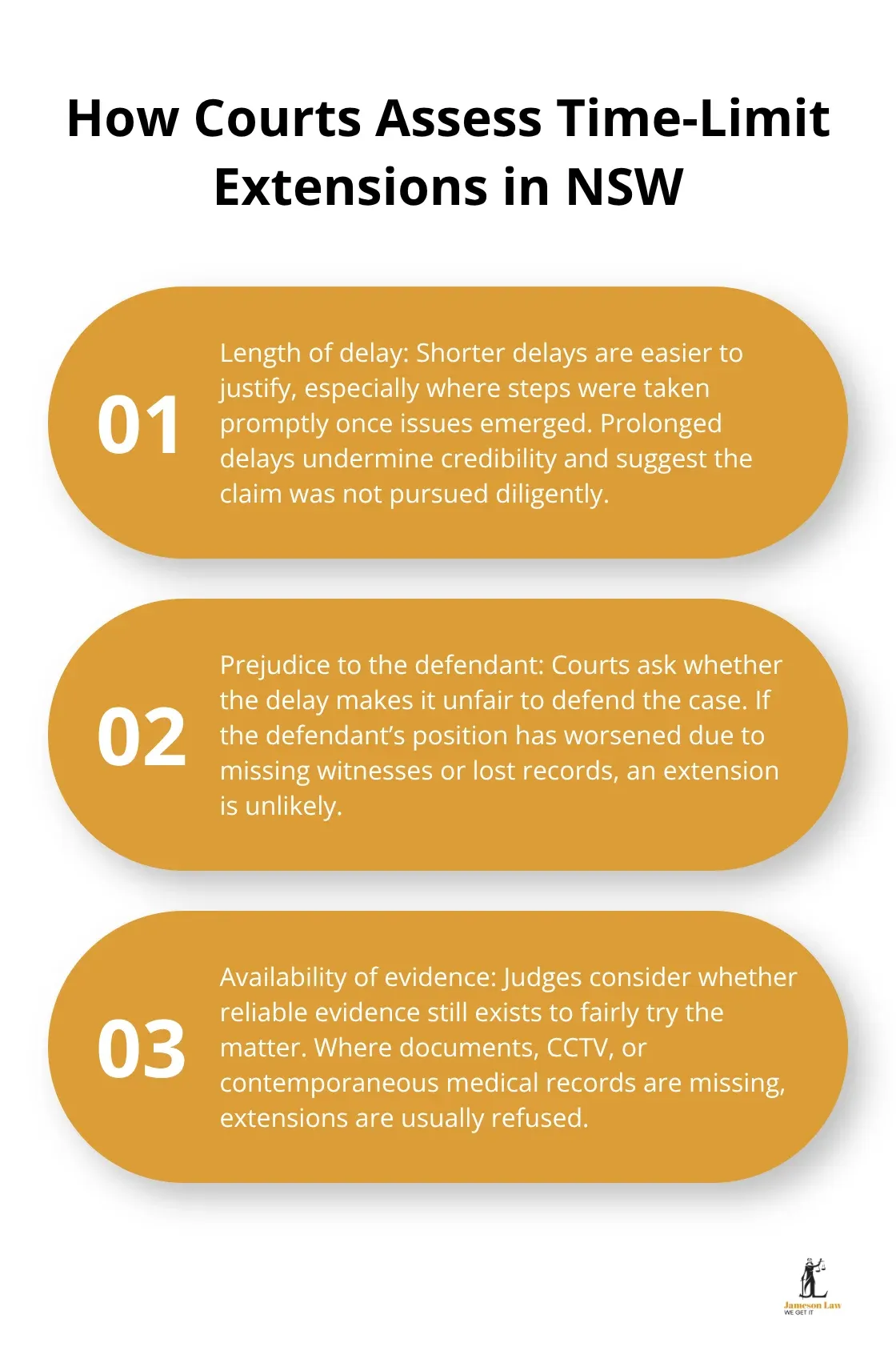
Three key factors courts weigh when deciding whether to extend limitation periods in NSW personal injury cases - personal injury time limits

Why Acting Early Protects Your Claim

The harsh reality is that limitation periods are not flexible guidelines; they are absolute barriers unless you meet the narrow criteria for a court extension, and those criteria are difficult to satisfy. Claims worth tens of thousands of dollars disappear because claimants waited just months too long, assuming they could lodge later. The consequences of missing the deadline extend beyond losing your right to compensation-you also lose the opportunity to gather fresh evidence, secure witness statements, and obtain medical records that support your case. The sooner you lodge a claim, the stronger your position becomes, and the more options remain available to you.

When Time Limits Bend

Minors and the Extended Clock

The three-year rule sounds absolute until you examine NSW case law and the Limitation Act more closely. Courts have carved out exceptions that matter in real claims, but these exceptions require you to meet precise conditions. For minors, the clock does not start ticking until their 18th birthday under section 50E of the Limitation Act 1969. A child injured at age 10 has until age 21 to lodge a claim, which seems generous until you realise that evidence degrades, witnesses move away, and medical records become harder to obtain as years pass. Parents often treat this extension as permission to delay indefinitely, then discover at age 20 that key witnesses can no longer be found or that the defendant has disposed of critical evidence.

The Discovery Rule: When You Became Aware

The discovery rule presents another pathway, allowing the three-year clock to start when you became aware of the injury, not when it occurred. Under discovery rule sections 50C and 50D, you must know three specific facts: that the injury happened, that someone else’s fault caused it, and that the injury warrants legal action. Courts assess this objectively, meaning they ask what a reasonable person would have discovered, not what you personally noticed. A person who experienced back pain for months before seeking medical assessment cannot claim they only discovered their injury once a doctor diagnosed it. The discovery rule extends your window, but it narrows significantly once you consult a medical professional or receive a diagnosis.

Court Extensions: The Narrow Path

Courts extend deadlines only in exceptional circumstances, and section 60G permits extensions up to five years beyond the discovery date if the court finds it just and reasonable. The threshold is genuinely high. Courts weigh the length of delay, prejudice to the defendant, and whether evidence remains available. A two-year delay might be acceptable; a five-year delay almost certainly is not. In practice, extensions are rare and unpredictable, so you cannot rely on them as a planning strategy.

Why Acting Fast Strengthens Your Position

The consequence is that limitation periods operate as genuine barriers, not flexible guidelines. Missing the three-year deadline or the discovery-based equivalent means your claim dies, and courts will reject it outright unless you meet the narrow criteria for extension. Acting within months of injury rather than years later dramatically improves your position. You secure witness statements while memories are fresh, obtain medical records that document your condition contemporaneously, and preserve evidence before it deteriorates. Defendants also respond differently to claims lodged promptly; they view them as serious and are more inclined to settle. Claims lodged years later invite scepticism about whether the injury was genuinely caused by the incident or whether the claimant is exaggerating its severity. Early action protects not only your legal deadline but also the strength of your underlying case, which is why understanding what happens immediately after an injury matters just as much as knowing the time limits themselves.

What Happens When You Miss the Deadline

The Finality of Expired Time Limits

Your claim does not pause, extend, or wait for you to be ready. Once the three-year window closes, your right to sue vanishes almost entirely. NSW courts will reject your claim at the outset if you lodge it after the deadline has passed, and the defendant’s lawyers will file a motion to strike it out before any evidence is even heard. This is not a technicality courts overlook or a procedural bump you can negotiate around. The Limitation Act 1969 operates as an absolute barrier, and judges apply it mechanically. A claim worth $150,000 disappears because you filed on day 1,096 instead of day 1,095. The defendant keeps their money, your medical bills remain unpaid, and your lost wages stay lost. Courts will not hear arguments about fairness or hardship once the deadline has passed.

The Narrow Path to Extension

The only pathway back into court after missing the deadline is to convince a judge that extending the limitation period is just and reasonable under section 60G of the Limitation Act. This is genuinely difficult. Courts extend deadlines in perhaps five to ten percent of cases where the claimant has missed the three-year window, and those extensions typically occur only when the claimant has a compelling reason for the delay. A person who was hospitalised and unconscious for months following their injury might succeed. A person who simply forgot about their claim will not.

Courts scrutinise the length of delay, the prejudice to the defendant, and whether evidence remains available to fairly determine the case. A delay of one or two years is problematic. A delay of three or four years is almost certainly fatal. The defendant’s ability to gather evidence deteriorates as time passes, witnesses disappear, and documents are destroyed in the ordinary course of business. A defendant sued in 2024 for an injury that occurred in 2020 will argue, often successfully, that they cannot fairly defend themselves because critical witnesses have moved overseas, CCTV footage has been automatically deleted, and the injured person’s original medical records have been mislaid. Courts take this seriously and refuse extensions when the defendant’s position has been substantially prejudiced. Missing the deadline is not a problem you can fix later. It is permanent.

Immediate Actions That Protect Your Claim

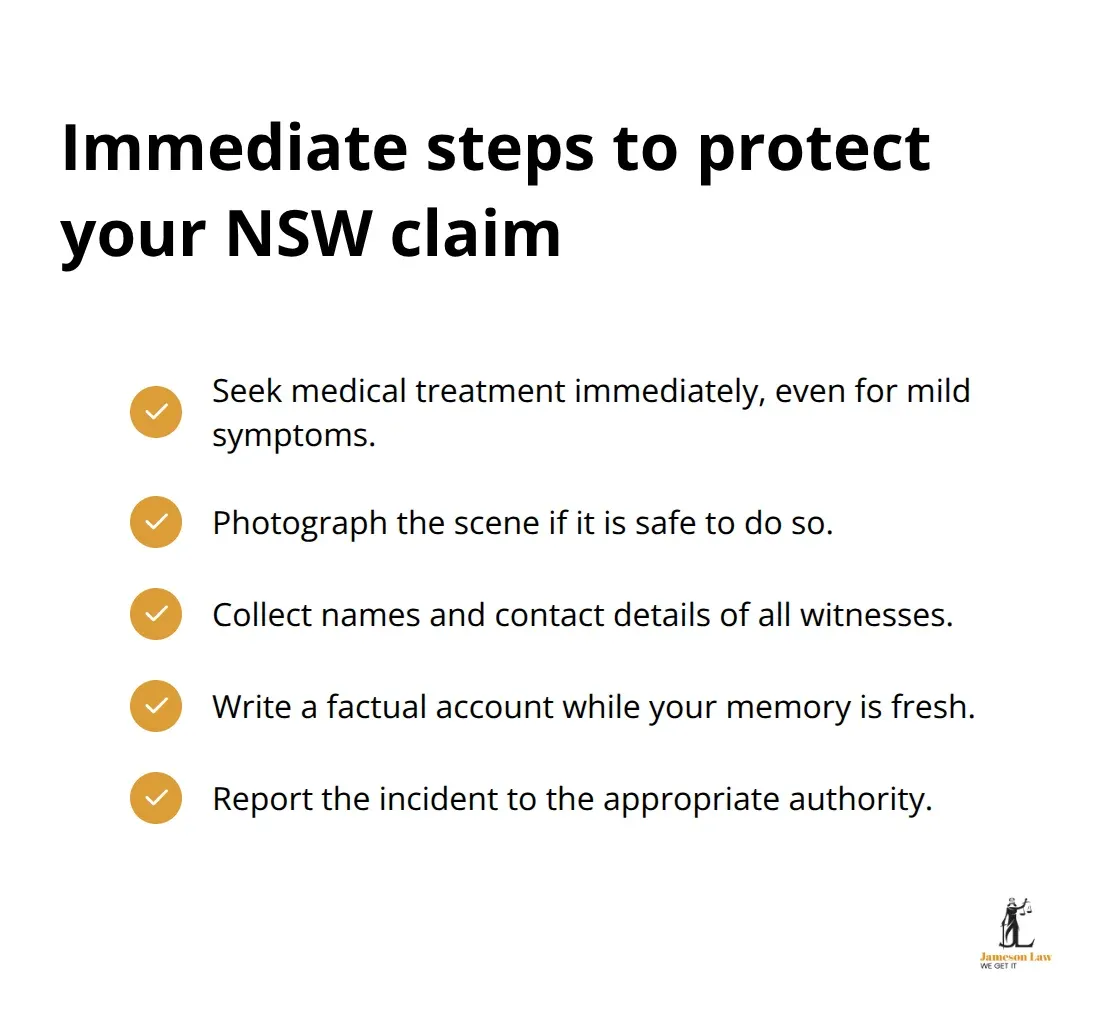
The steps you take in the first weeks after injury determine whether your claim survives at all. Seek medical treatment immediately, even if the pain is mild or you think you might recover without help. Medical records created near the date of injury are treated as objective evidence of your condition, and they establish the discovery date clearly. A person who waits six months before seeing a doctor has handed the defendant an argument that they did not take the injury seriously and may be exaggerating its effects now.

Photograph the scene of the incident if it is safe to do so. Collect the names and contact details of every witness, including their phone numbers and addresses. Write down what happened while your memory is fresh, focusing on facts rather than opinions. Report the incident to the appropriate authority: police for car accidents, your employer for workplace injuries, and the property owner or manager for public liability incidents.

Checklist of immediate actions to safeguard a New South Wales personal injury claim

These reports create a contemporaneous record and often trigger the defendant’s insurance notification, which locks them into their version of events.

Protecting Evidence and Your Legal Position

Do not provide a recorded statement to an insurer before speaking with a lawyer. A brief, factual written account is safer and avoids the trap of saying something that undermines your claim later. Preserve all receipts, invoices, and records related to your injury and treatment. Lost earnings documents, travel expenses, and medication receipts all form part of your damages claim, and you cannot reconstruct them years later.

Contact a personal injury lawyer within weeks, not months. A lawyer will identify which time limit applies to your specific injury, lodge your claim or notify the defendant before the deadline passes, and manage the procedural steps that protect your rights. If you are a minor or under a disability, your parents or guardians should still act promptly to gather evidence and secure legal advice, because the extended time limit does not extend the deadline for gathering fresh evidence. The evidence you collect in the first month after injury is worth far more than evidence you attempt to gather a year later, because memories fade, documents disappear, and witnesses become unavailable.

Final Thoughts

NSW personal injury time limits operate as absolute legal barriers that will destroy your claim if you miss them. The three-year window from injury date is the standard rule, and courts extend it only in exceptional circumstances that are difficult to prove. Acting immediately after an injury-seeking medical treatment, gathering evidence, collecting witness details, and contacting a lawyer within weeks-protects your position far more effectively than any legal argument you might make later.

The discovery rule and extensions for minors provide some flexibility, but they are not safety nets you can rely on. A minor has until age 21 to lodge a claim, yet waiting until age 20 to gather evidence means witnesses have moved away and medical records have degraded. The discovery rule starts the clock when you became aware of the injury, but courts interpret awareness objectively, assessing what a reasonable person would have noticed rather than what you personally chose to ignore. Missing the deadline has permanent consequences-your claim will be struck out before trial, the defendant keeps their money, and your medical bills and lost wages remain unpaid.

Contact a personal injury lawyer early to identify which personal injury time limits apply to your injury and lodge your claim before the deadline passes. We at Jameson Law provide personal injury assistance on a No Win No Fee basis for plaintiff claims, meaning you pay nothing unless your claim succeeds. Do not let your claim expire-act now.

Speak to an Expert Lawyer today

Laywers-Jameson-Law-The-best-law-firm-in-Sydney- Sydney Lawyers - Sydney
BOOK NOW

WE'RE IN IT TO WIN IT

Book your consultation

Book Now
Book Now Mobile 06 02 2025

This form submission is encrypted and secured to ensure your information remains confidential.

What our Clients

Related Publications:

What our clients say

.

Jameson Law - Voted the Best Law firm in Sydney Award

Legal Answers ... In Short

We're here to help

Our mission is to ensure our client matters are resolved successfully every time. Success to us does not simply involve winning, but moreover ensuring we take the most feasible, economic and stress-free path to help our clients achieve their goals. We fight hard for our clients, and always go by the motto: we’re in it to win it.

Jameson Law - Best Law Firm in Sydney

WE'RE IN IT TO WIN IT

Book your consultation

Call us now on (02) 8806 0866 or fill out the form below

Book Now Mobile

This form submission is encrypted and secured to ensure your information remains confidential.

WE'RE IN IT TO WIN IT

Book your consultation

Book Now Mobile 06 02 2025
lock

This form submission is encrypted and secured to ensure your information remains confidential.

Our Sydney Offices

Offices Parramatta and Sydney Jameson Law
Parramatta CBD - Head Office
jameson Law - Blacktown
jameson Law - Liverpool Office
Jameson Law - Bankstown
Court Houses We Frequent Jameson Law

Court Houses We Frequent

Balmain Local Court

Registry: Monday to Friday, 9:00am to 4:30pm

Bankstown Local Court

Court Operating Hours: 9:30am-4:30pm

Blacktown Local Court

Registry Hours: 9:00 – 4:30
Telephone Hours: 8:30 -4:30
Days open: Mon-Fri

Burwood Local Court

Registry Hours: 9:00 – 4:30
Telephone Hours: 8:30 – 4:30
Days open: Mon – Fri

Campbell Local Court

Registry Hours: 9:00 – 4:30
Telephone Hours: 8:30 – 4:30
Days open: Mon – Fri

Central Local Court

Registry Hours: 9:00 – 1:00 and 2:00 – 4:30
Telephone Hours: 8:30 – 4:30

Downing Local Court

Registry Hours: 9:00 – 1:00 and 2:00 – 4:30
Telephone Hours: 8:30 – 4:30

Wollongong Local Court

Registry Hours: 9:00 – 1:00 and 2:00 – 4:30
Telephone Hours: 8:30 – 4:30

Fairfield Local Court

Registry Hours: 9:00 – 1:00 and 2:00 – 4:30
Telephone Hours: 8:30 – 4:30

Hornsby Local Court

Registry Hours: 9:00 – 1:00 and 2:00 – 4:30
Telephone Hours: 8:30 – 4:30

Liverpool Local Court

Registry Hours: 9:00 – 1:00 and 2:00 – 4:30
Telephone Hours: 8:30 – 4:30

Manly Local Court

Registry Hours: 9:00 – 1:00 and 2:00 – 4:30
Telephone Hours: 8:30 – 4:30

Newtown Local Court

Registry Hours: 9:00 – 1:00 and 2:00 – 4:30
Telephone Hours: 8:30 – 4:30

Parramatta Local Court

Registry Hours: 9:00 – 1:00 and 2:00 – 4:30
Telephone Hours: 8:30 – 4:30

Penrith Local Court

Registry Hours: 9:00 – 1:00 and 2:00 – 4:30
Telephone Hours: 8:30 – 4:30

Sutherland Local Court

Registry Hours: 9:00 – 1:00 and 2:00 – 4:30
Telephone Hours: 8:30 – 4:30

Waverley Local Court

Registry Hours: 9:00 – 1:00 and 2:00 – 4:30
Telephone Hours: 8:30 – 4:30

Windsor Local Court

Registry Hours: 9:00 – 1:00 and 2:00 – 4:30
Telephone Hours: 8:30 – 4:30

Wollongong Local Court

Registry Hours: 9:00 – 1:00 and 2:00 – 4:30
Telephone Hours: 8:30 – 4:30

Downing Centre District Court

Registry Hours: 9:00 – 4:30
Telephone Hours: 8:30 – 4:30
Days open: Mon – Fri

Parramatta District Court

Registry Hours: 9:00 – 4:30
Days open: Mon-Fri

Penrith District Court

Registry Hours: 9:00 – 4:30
Days open: Mon-Fri

Campbelltown District Court

Registry Hours: 9:00 – 4:30
Days open: Mon – Fri

Liverpool District Court

Registry Hours: 9:00 – 4:30
Days open: Mon – Fri

Wollongong District Court

Registry Hours: 9:00 – 1:00 and 2:00 – 4:30
Telephone Hours: 8:30 – 4:30

Supreme Court New South Wales

Registry Hours: 9:00 AM – 4:30 PM
Telephone Hours: 8:30 AM – 4:30 PM
Days Open: Monday to Friday

Federal Circuit and Family Court of Australia

Registry Hours: 9:00 AM – 4:30 PM
Telephone Hours: 8:30 AM – 5:00 PM
Days Open: Monday to Friday

Federal Court

Monday to Friday, 8:30 AM – 4:30 PM

High Court

Monday to Friday, 8:30 AM – 5:00 PM

Children’s Court of New South Wales

Registry Hours: 9:00 AM – 4:30 PM
Telephone Hours: 8:30 AM – 4:30 PM
Days Open: Monday to Friday

Coroner’s Court New South Wales

Registry Hours: 9:00 AM – 4:30 PM
Telephone Hours: 8:30 AM – 4:30 PM
Days Open: Monday to Friday

Industrial Relations Commission of New South Wales

Registry Hours: 9:00 AM – 4:30 PM
Telephone Hours: 8:30 AM – 4:30 PM
Days Open: Monday to Friday

Land and Environment Court of New South Wales

Registry Hours: 9:00 AM – 4:30 PM
Telephone Hours: 8:30 AM – 4:30 PM
Days Open: Monday to Friday

WE'RE IN IT TO WIN IT

Book your consultation

Book Now
Book Now Mobile 06 02 2025
lock

This form submission is encrypted and secured to ensure your information remains confidential.