Citizenship Pathway
Australian Citizenship Pathway NSW: Your Complete 2026 Guide
Becoming an Australian citizen is a significant milestone, and the pathway in NSW involves clear steps and highly specific requirements. At Jameson Law, our expert immigration team understands that navigating the Australian citizenship pathway NSW can feel overwhelming without proper, authoritative guidance.
This comprehensive guide walks you through each stage—from initial eligibility checks to your final assessment and citizenship test—so you know exactly what to expect and how to prepare effectively.
What You Must Have Before Applying for Australian Citizenship
Permanent Residency Status: The Foundation Requirement
To become an Australian citizen by conferral, you must hold a permanent visa at the time you apply and at the time the Department of Home Affairs makes its decision. This requirement is completely non-negotiable.
The Department will not bend this rule, so confirming your status now prevents months of frustration later. Note that Special Category Visa (SCV) holders generally qualify as permanent residents for citizenship purposes, but standard temporary visa holders cannot apply, regardless of how long they have lived in Australia.
The Four-Year Residency Test
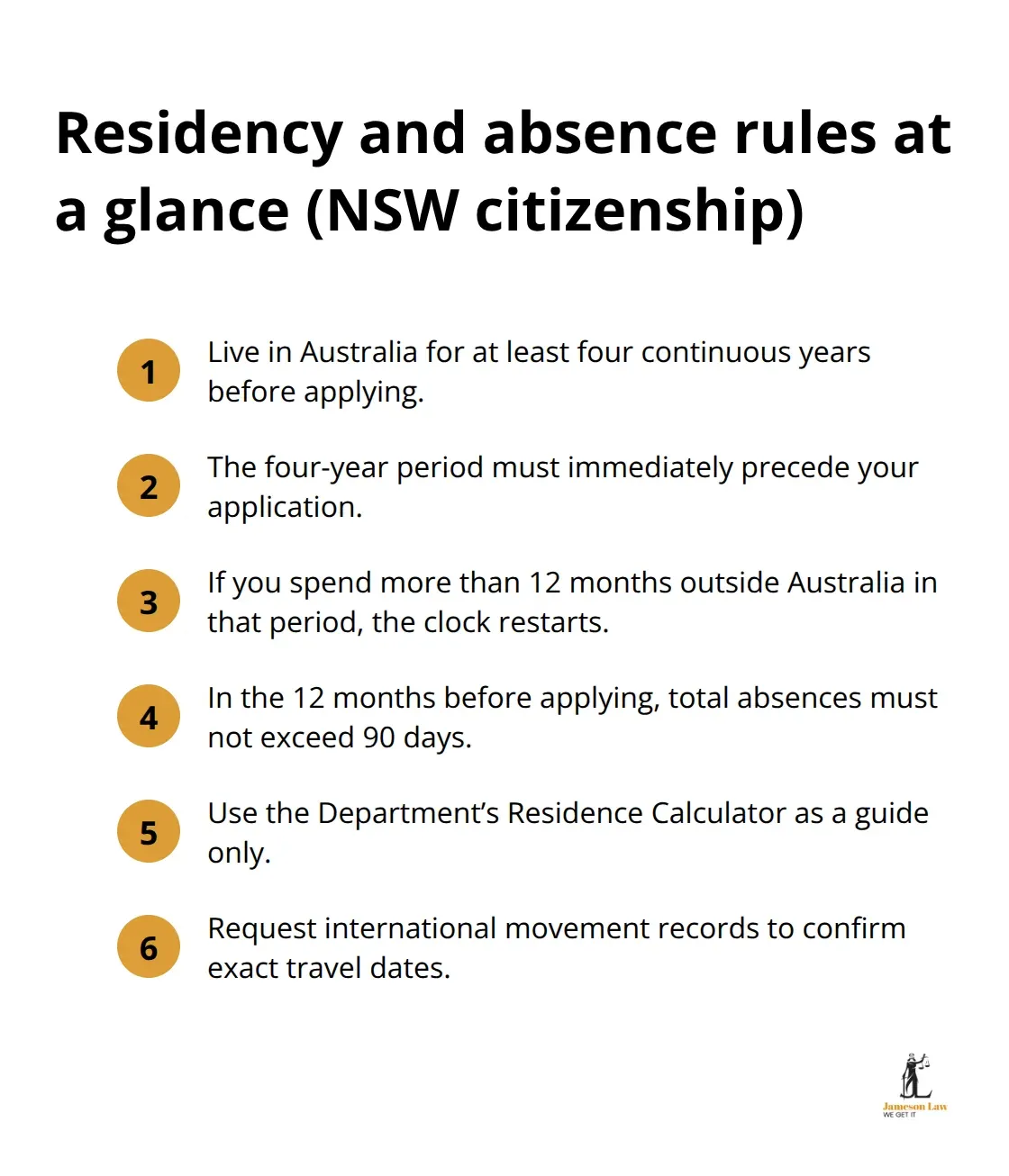
You must have lived in Australia for at least four years immediately before applying on a valid visa. The Department of Home Affairs measures this four-year period from your lawful residence date—the day you first arrived in Australia on any valid visa.
| Requirement | Residency Rule Details |
|---|---|
| Total Lawful Residence | Lived in Australia on a valid visa for 4 years immediately before applying. |
| Permanent Residence | Held permanent resident status for at least the last 12 months. |
| Absence Limit (4 Years) | Away from Australia for no more than 12 months in total over the 4 years. |
| Absence Limit (Last 12 Months) | Away from Australia for no more than 90 days total in the 12 months prior to applying. |
These absence limits are incredibly rigid. If you took a three-month holiday overseas and then a two-week trip back home, that counts as roughly 104 days—meaning you no longer meet the requirement. You can request international movement records free of charge from the Department of Home Affairs to confirm the exact dates they hold on file before lodging your application.
Character Assessment: What the Department Examines
You must pass strict character and health assessments. A character assessment means you must not pose a risk to Australian society. The Department considers convictions in Australia and overseas. A conviction for violence, sexual offences, drug trafficking, or terrorism-related offences will almost certainly result in an automatic refusal.
Even if minor traffic offences or spent convictions do not automatically block your application, dishonesty matters significantly. If you have been convicted of fraud, theft, or deception, the Department views this seriously because it suggests you cannot be trusted to uphold Australian civic values.
Health Assessment Requirements
The health assessment checks for communicable diseases to ensure you do not pose a public health risk. Most applicants pass this requirement without issue. However, you will need to undergo a health examination by an approved panel doctor if the Department specifically requests one (which typically costs between $300 to $600 at the applicant’s expense).
Getting Your Documents in Order
Prepare and Certify Your Evidence
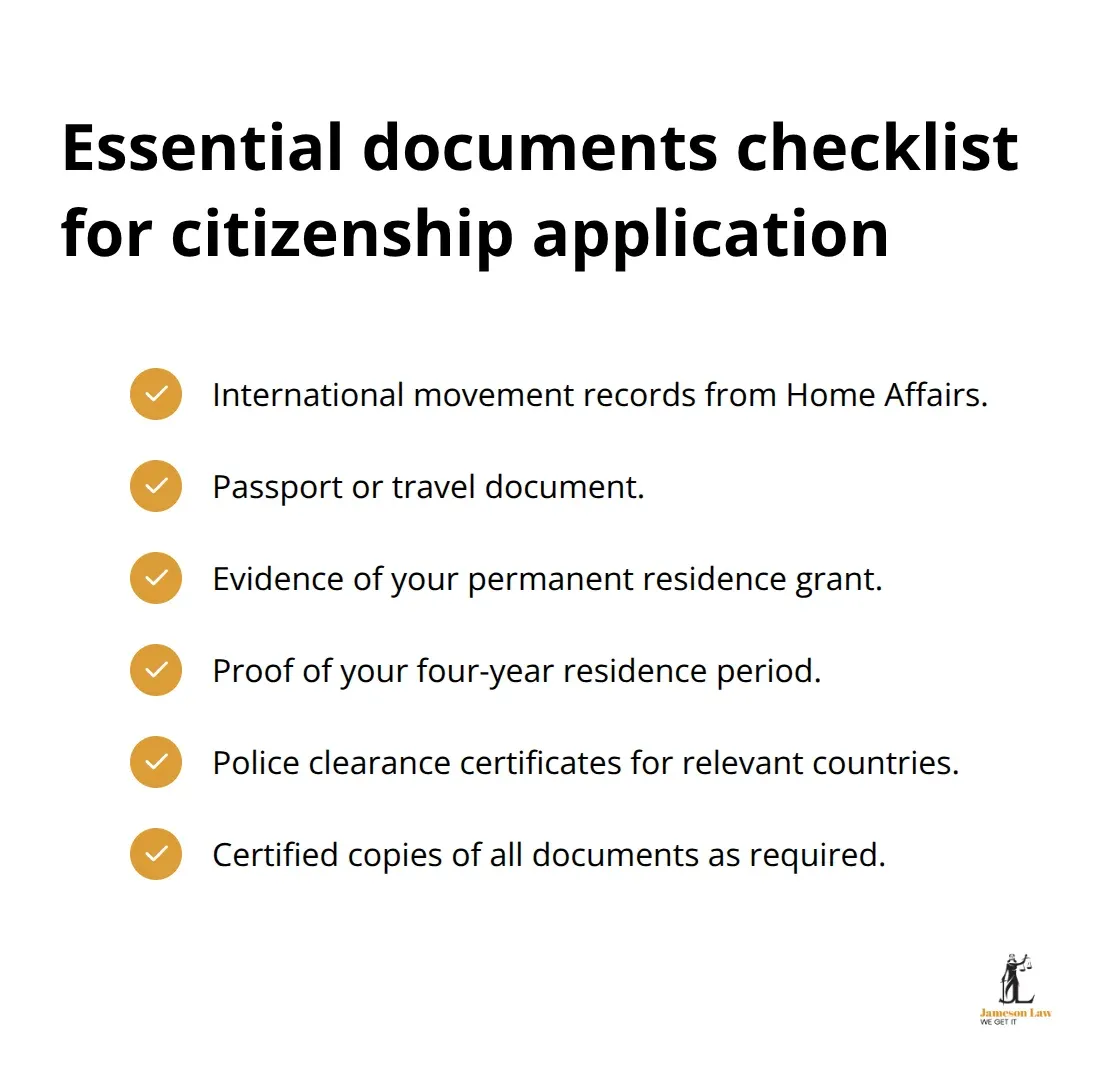
Start by requesting your international movement records to eliminate any guesswork about your travel dates. The Department will require you to present certified copies of all documents (not originals) when you lodge. Your document checklist should include:
- Identity Documents: Your passport and birth certificate.
- Residency Evidence: Your official visa grant letter confirming permanent residence status.
- Police Clearance Certificates: Required from Australia (Australian Federal Police) and from every country where you have lived for more than six months in the past ten years.
Failure to disclose a conviction—even a minor one—can result in refusal on character grounds based on dishonesty rather than the conviction itself. Obtain your overseas certificates early, as they often take several weeks to process.
Complete the Application Form Accurately
The Department uses Form 1300t for citizenship by conferral. You must answer every question accurately. Declare your full name exactly as it appears in your passport and list every address where you have lived in Australia for the past four years with precise dates.
Lodge Your Application and Track Progress
If you are uncertain about any answer, seek expert legal advice before submitting, as corrections after lodgement are difficult. You can lodge your application online through ImmiAccount.
You must pay the citizenship application fee at the time of lodgement. Following the recent indexing adjustments effective from 1 July 2026, the standard application fee for general eligibility is AUD $595 for adults. Once lodged, the Department will send you an acknowledgement letter containing your reference number.
What Happens at Your Citizenship Interview
Interview Scheduling and Attendance Requirements
The Department typically schedules interviews four to eight weeks after receiving your application. You will receive a written notice specifying the date, time, and location. This interview is not optional; failing to attend without a highly valid reason results in refusal. Bring your notice of interview, your original passport, and any specific documents the Department requested.
What the Interview Covers
The interview typically lasts 20 to 40 minutes and focuses on three core areas:
- Verifying the factual accuracy of your application form.
- Assessing your functional English language abilities.
- Administering the official test on Australian values, history, and government structure.
The interviewer will ask questions about your residence history, employment, character matters, and family circumstances. Discrepancies between your written application and your verbal answers will be formally noted.
The Citizenship Test: Content and Preparation
The citizenship test examines your knowledge of Australian democratic values, the Constitution, Parliament, the national flag, and significant historical events. The Department publishes the official citizenship test study materials free of charge on their website. Do not rely on assumptions; study the official resources.
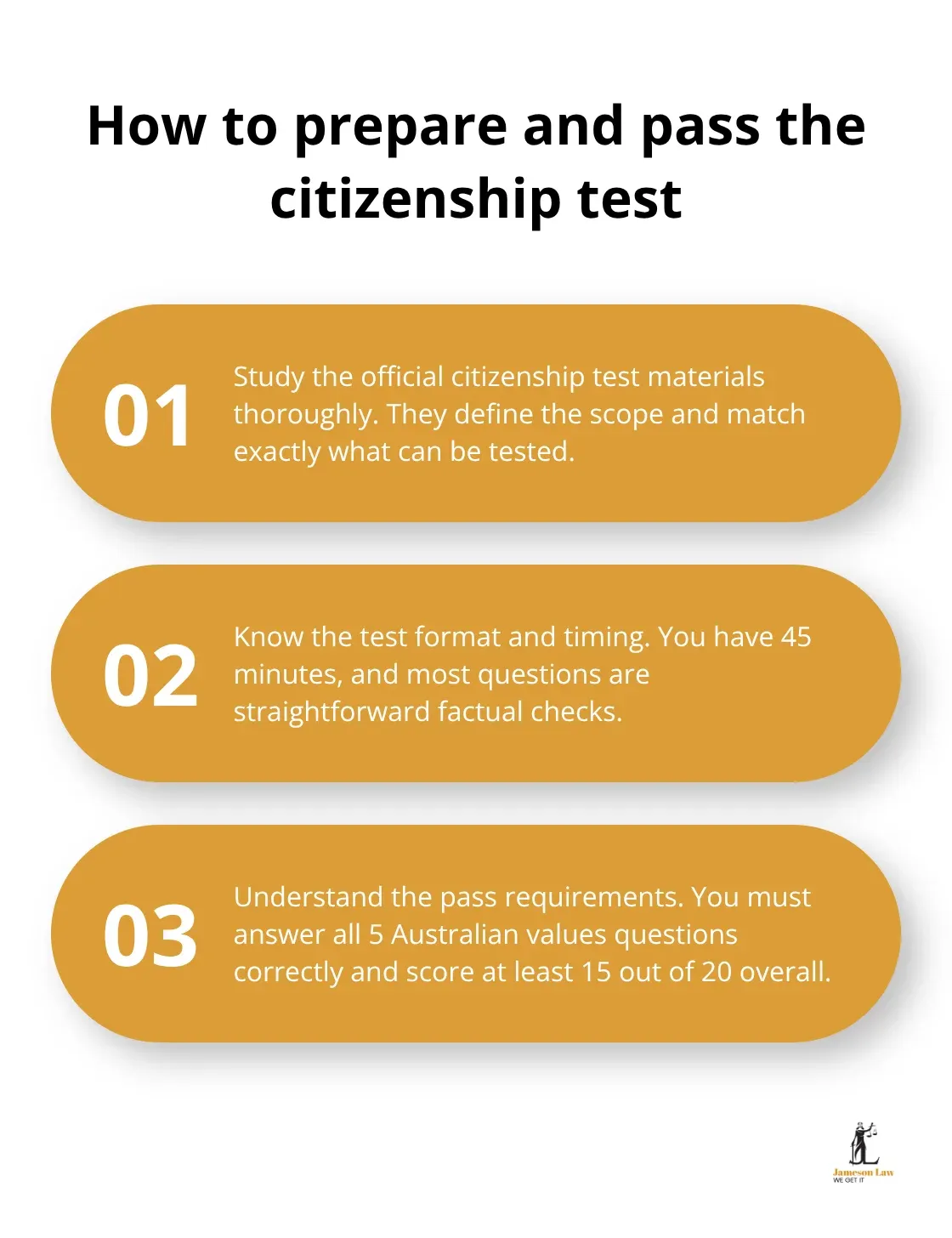
To pass The Citizenship Test, you must correctly answer all 5 questions dedicated to Australian values, and achieve an overall mark of at least 15 out of 20 (75%). You have 45 minutes to complete the computer-based test.
Exemptions from the citizenship test apply if you are under 18 years old, over 60 years old, or possess a substantial physical, sensory, or cognitive impairment. You must notify the Department and provide supporting medical evidence when lodging your application to claim an exemption.
Final Thoughts
The Australian citizenship pathway NSW requires you to move methodically through distinct stages, each with strict legal requirements and deadlines. Most applicants successfully complete the process within six to twelve months from formal lodgement, depending heavily on departmental workloads and application accuracy.
After your interview and test, the Department of Home Affairs will notify you of their final decision. If approved, you will receive an invitation to attend a local citizenship ceremony, where you take the pledge of commitment to Australia.
The complexity of the citizenship framework means that minor mistakes in your application or interview responses can have profound consequences. If you have any criminal history, complex health concerns, or uncertainty regarding your overseas absences, it is vital to seek highly experienced legal counsel before applying.
At Jameson Law, our Sydney team provides comprehensive immigration law services to ensure your pathway to Australian citizenship is smooth, compliant, and legally secure. Contact us today to discuss your application.