De facto partner visa requirements in Australia usually include evidence that the relationship is genuine and continuing, that the couple has a mutual commitment to a shared life, and that they live together or are not permanently separated. For most de facto partner visa applications, the relationship must also have existed for at least 12 months immediately before applying, unless an exception applies.
Living in NSW does not create a separate “NSW de facto visa”. Partner visas are administered under Commonwealth migration law. NSW may still be relevant if the couple registers their relationship or needs NSW-issued records as supporting evidence.
What counts as a de facto relationship for a partner visa?
For migration purposes, a de facto partner is not simply a boyfriend, girlfriend or person you are dating. The relationship must meet the statutory definition and be genuine and continuing. The partners must have a mutual commitment to a shared life to the exclusion of others, and they must live together or not live separately and apart on a permanent basis.
The Department of Home Affairs assesses the whole relationship. It considers four broad areas:
- Financial aspects: joint assets or liabilities, shared expenses and the way finances are managed.
- Nature of the household: living arrangements, household responsibilities and care of children.
- Social aspects: how the couple presents the relationship to family, friends and organisations, and shared social activities.
- Commitment: the relationship’s duration, companionship, emotional support, future plans and contact when apart.
No single document proves a relationship. A consistent body of evidence across these areas is usually more useful than a large quantity of repetitive material.
Is 12 months of cohabitation always required?
Usually, a de facto relationship must have existed for at least 12 months immediately before the partner visa application. This is a relationship-duration rule, not a requirement to provide exactly 12 months of every document or to have spent every day under one roof.
Exceptions may apply. Home Affairs states that the 12-month requirement may not apply where the relationship is registered under an Australian state or territory law, where compelling and compassionate circumstances exist, or in certain humanitarian circumstances. Registration does not guarantee a visa and does not remove the need to prove a genuine and continuing relationship.
Periods living apart can require explanation. Work, study, caring duties or travel may account for temporary separation, but the evidence should show that the relationship continued and that the couple was not permanently separated.
Which partner visa pathway applies?
The correct pathway usually depends on where the applicant is when applying:
- In Australia: the combined Partner (Temporary) subclass 820 and Partner (Permanent) subclass 801 application is generally the relevant pathway.
- Outside Australia: the combined Partner (Provisional) subclass 309 and Partner (Migrant) subclass 100 application is generally the relevant pathway.
The temporary or provisional stage normally comes first. The permanent-stage assessment is generally available two years after the combined application was lodged, subject to the applicable requirements and any exceptions.
The subclass 300 Prospective Marriage visa is a separate pathway for a person outside Australia who intends to marry. It is not the ordinary pathway for an applicant who already qualifies as a spouse or de facto partner.
Evidence checklist for a de facto partner visa
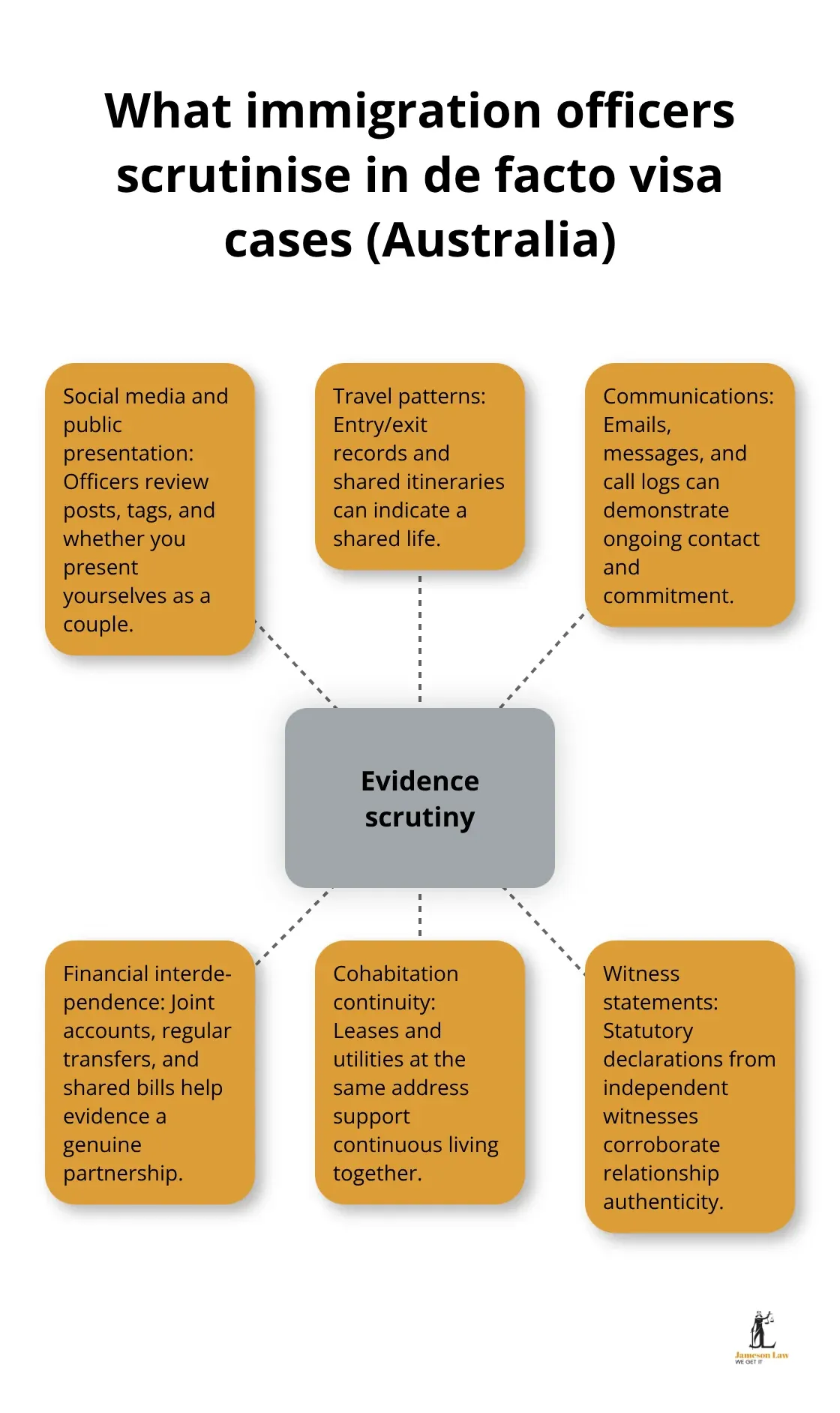
Evidence should be accurate, dated and consistent with the application forms and personal statements. Depending on the relationship, useful material may include:
- joint bank, loan, lease, mortgage, insurance or utility records;
- documents showing a shared address and household responsibilities;
- evidence of joint responsibility for children;
- travel records, invitations and evidence of shared activities;
- statements from the applicant and sponsor explaining the relationship history;
- supporting statements from eligible people who know the couple; and
- messages, call records or other evidence of ongoing contact during periods apart.
Home Affairs may ask for further information. Applicants should never create or alter evidence. Inconsistencies about dates, addresses or previous relationships should be explained honestly.
Costs, timing and common mistakes
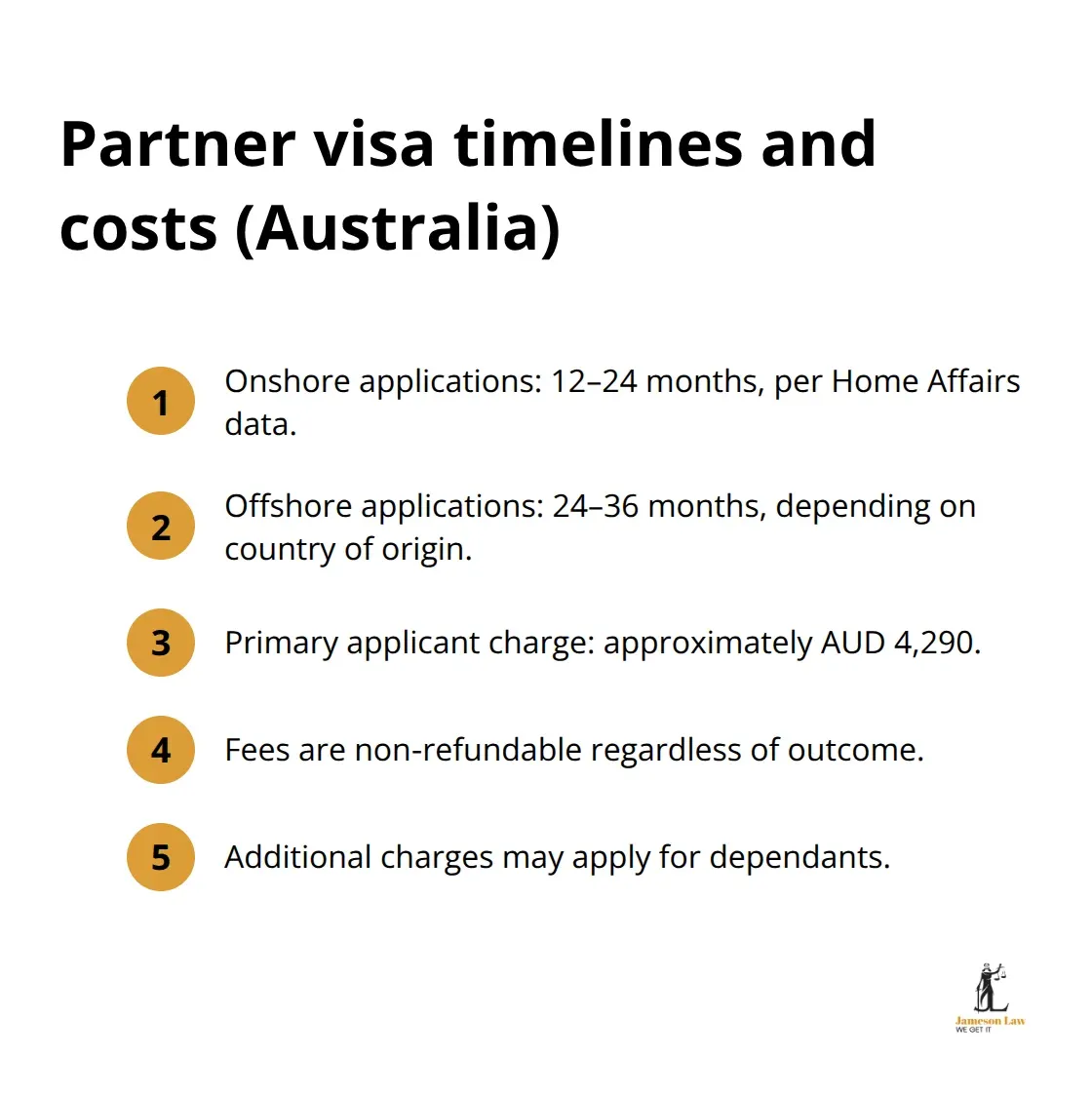
Visa application charges and processing times change. Home Affairs currently directs applicants to its Visa Pricing Estimator and processing-times guide, which should be checked immediately before lodgement. Avoid relying on a fixed price or a promised decision date in an article, quote or social media post.
Common problems include choosing the wrong onshore or offshore pathway, assuming relationship registration is enough by itself, relying on only one type of evidence, omitting previous relationship information, and failing to explain periods living apart.
Frequently Asked Questions
How long must a de facto relationship exist for an Australian partner visa?
Usually, it must have existed for at least 12 months immediately before the application. Exceptions can apply, including relationship registration and compelling and compassionate circumstances.
Which partner visa applies if we are living in NSW?
Applicants in Australia generally use the combined subclass 820 and 801 pathway. Applicants outside Australia generally use the combined subclass 309 and 100 pathway. Individual eligibility must still be checked.
What evidence can support a de facto partner visa application?
Home Affairs considers financial arrangements, household arrangements, social recognition and commitment. The best evidence depends on how the couple actually lives.
Does registering a relationship in NSW automatically grant a partner visa?
No. Registration may remove the usual 12-month duration requirement in some cases, but all other visa criteria still apply.
Are partner visa processing times and charges fixed?
No. Check the official Home Affairs pricing estimator and processing-times guide before applying.
Get advice about your circumstances
Partner visa applications are evidence-heavy and small factual inconsistencies can cause delay. Jameson Law can help identify the appropriate pathway, review relationship evidence and explain the requirements that apply to your circumstances. Outcomes cannot be guaranteed.