

A partner visa lets you live permanently in Australia with your spouse or de facto partner. Whether you’re married, in a same-sex relationship, or living together, understanding partner visa eligibility in Australia is the first step toward building your future here.
At Jameson Law, we help people navigate these requirements every day. This guide walks you through who qualifies, what financial and health checks you’ll face, and how to prepare your application.
Who Qualifies for a Partner Visa
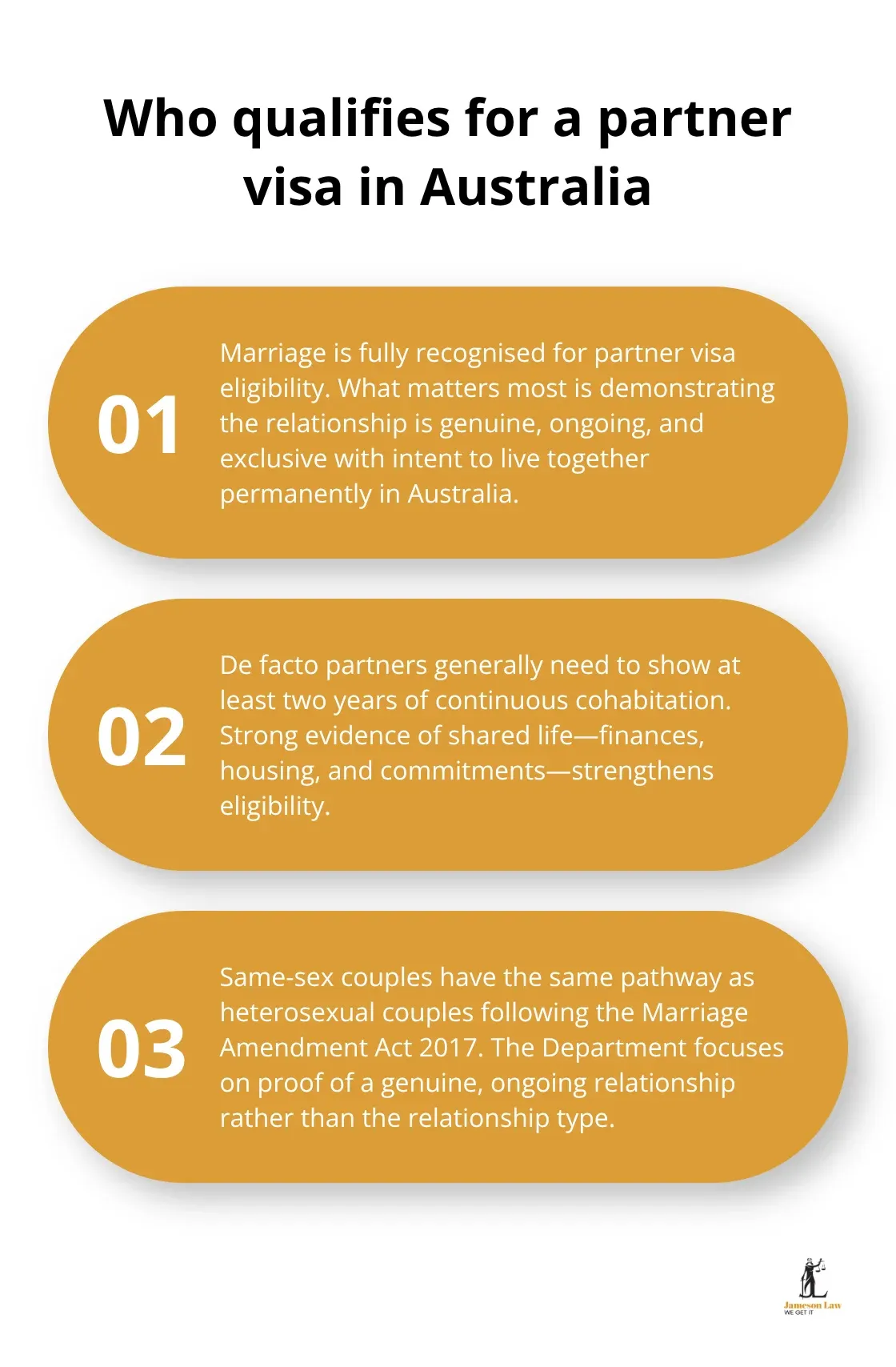
A partner visa in Australia recognises three main relationship types: married couples, de facto partners living together for at least two years, and same-sex couples in any of these arrangements. The Department of Home Affairs does not distinguish between these categories when assessing eligibility, which means your relationship structure matters far less than proving the relationship is genuine and ongoing. What matters most is demonstrating to the Department that you and your partner have a real commitment to each other and intend to live together permanently in Australia.
Proving Your Relationship is Genuine
Most applications either succeed or face delays at this stage, because officials scrutinise the evidence carefully. You must show how you met, how long you’ve been together, whether you live together, and your financial interdependence. Statutory declarations from friends and family help, but they rank second to concrete evidence like joint bank accounts, shared lease agreements, utility bills in both names, and travel records showing you’ve spent time together. Same-sex couples have exactly the same eligibility pathway as heterosexual couples since the Marriage Amendment Act 2017 came into effect, and de facto couples are treated identically to married couples provided they can prove two years of continuous cohabitation.
Sponsor Requirements
Your sponsor must be an Australian citizen, permanent resident, or eligible New Zealand citizen, and they must be at least 18 years old with no criminal record that would disqualify them. The sponsor is legally responsible for your financial support, so the Department assesses their income and capacity to maintain you without reliance on government welfare payments. The sponsorship obligation typically lasts two years from the visa grant date, meaning your sponsor commits to supporting you financially during this period. This is a serious undertaking, which is why some applicants struggle to find willing sponsors.
Applicant Requirements and Exclusions
As the applicant, you cannot be sponsoring another partner visa at the same time, and you must meet health and character requirements which we cover in the next section. The relationship must be exclusive and genuine, so if either partner has another spouse or de facto partner anywhere in the world, the application will be rejected immediately. If you are married or in a de facto relationship, your partner is the natural sponsor, but in rare cases (such as where your partner cannot meet financial requirements), another eligible person can sponsor you if they have a genuine reason to do so.
Understanding these eligibility requirements forms the foundation of your application, but meeting them is only part of the process. The Department also requires you to satisfy financial thresholds and pass health and character assessments, both of which carry their own documentation demands and timelines.
Financial Requirements for Partner Visas
Understanding the Maintenance Income Limit
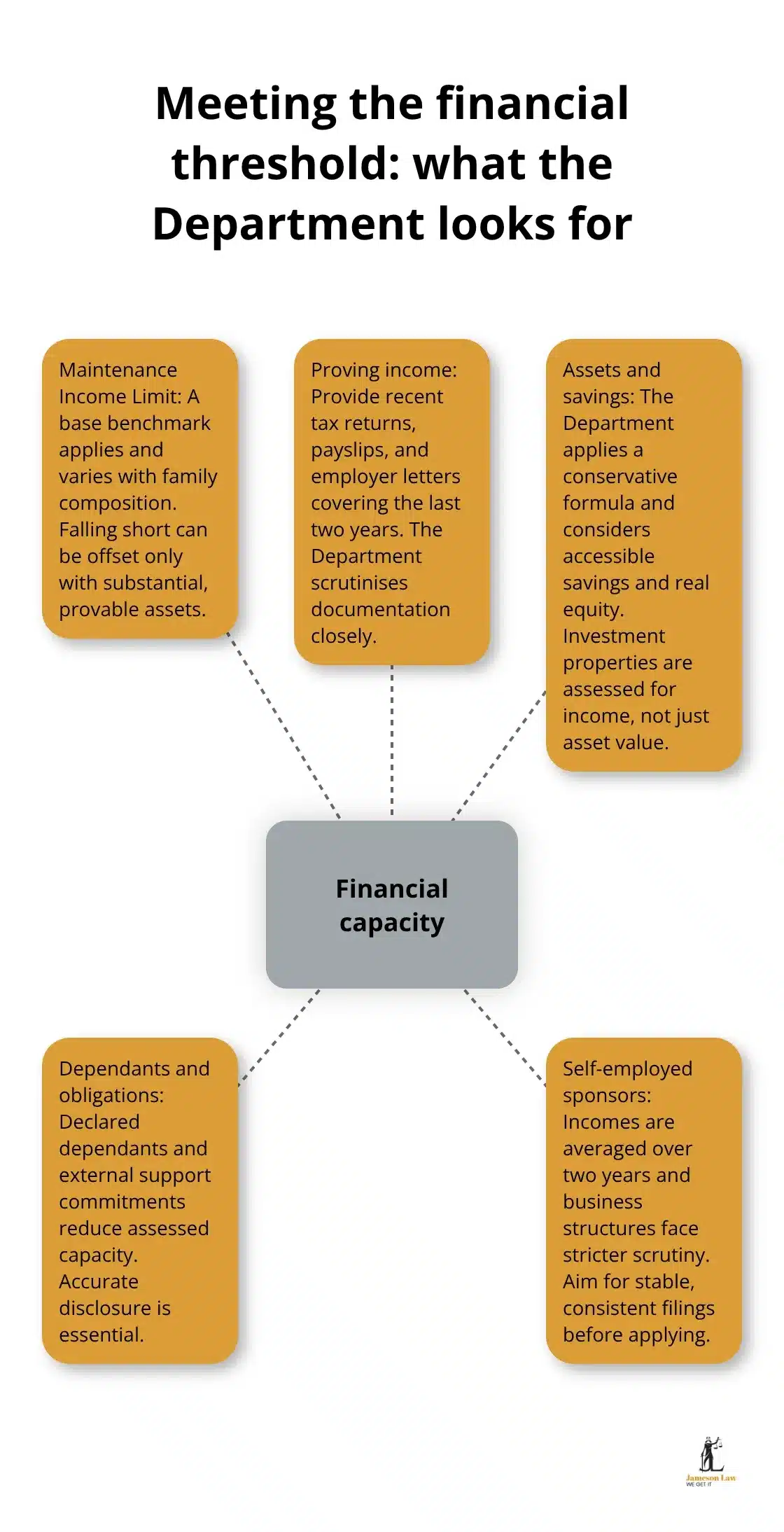
The Department of Home Affairs assesses your sponsor’s financial capacity against the Maintenance Income Limit, which varies depending on family composition. As of 2026, the base rate for a single applicant sits at approximately $75,000 per annum, but this increases significantly if your sponsor has dependent children or other dependants. If your sponsor earns below this threshold, the application faces serious obstacles unless they can demonstrate substantial assets or savings to offset the income shortfall.
Proving Current Income
The Department does not accept theoretical future income, so your sponsor must show current, verifiable earnings through recent tax returns, payslips, and employer letters covering the last two years. This is where many applications stall, because sponsors underestimate how strictly the Department scrutinises income documentation. Your sponsor cannot simply claim they earn enough; they must prove it with concrete evidence that withstands departmental scrutiny.
Using Assets and Savings to Meet the Threshold
Assets and savings can compensate for lower income, but the Department applies a conservative formula. Approximately $20,000 in accessible savings offsets a $1,000 annual income shortfall, meaning if your sponsor earns $70,000 but holds $100,000 in savings, they may still meet the threshold depending on your family circumstances. Property ownership counts toward assets, but only the equity your sponsor actually owns, not the full property value, and investment properties generate income assessments rather than being treated as pure assets.
Declaring Financial Dependants and Obligations
Your sponsor must also declare any financial dependants outside Australia, because the Department factors these into the maintenance calculation. If your sponsor supports elderly parents overseas or has children from previous relationships, these obligations reduce their assessed capacity to sponsor you. Self-employed sponsors face particular difficulty because the Department averages income across the last two years and applies stricter scrutiny to business structures, depreciation claims, and profit calculations. Many accountants advise self-employed sponsors to lodge tax returns showing stable or growing income well before applying, because the Department will not accept inflated or inconsistent figures.
What Comes Next in Your Application
Once your sponsor satisfies the financial requirements, the Department turns its attention to your health and character assessments. These checks run parallel to the financial review and often determine whether your application succeeds or faces rejection, so understanding what the Department expects from you at this stage matters just as much as proving your sponsor’s income.
Health and Character Assessments
The Department of Home Affairs runs health and character checks parallel to your financial assessment, and these determinations move independently. You cannot proceed to visa grant without clearing both, which means a delay in one area holds up your entire application.
Health Examination Requirements
Health examinations must take place with a Department-approved panel doctor, and your GP’s assessment will not count toward your visa application. The panel doctor performs a comprehensive medical examination and sends results directly to the Department through a secure system, so you have limited visibility into what they report. Health assessment delays account for a significant portion of cases exceeding the standard processing timeframe.
You must complete your health examination within 12 months of the Department requesting it, or your application lapses and you must reapply. Chest X-rays are mandatory for all applicants regardless of age, and if you have tuberculosis or other notifiable diseases, your application will face refusal. The Department also screens for health conditions that would impose significant costs on the Australian health system, though most common conditions do not trigger refusal if you can demonstrate you have private health insurance.
Declaring Medical History and Health Conditions
If you have any chronic conditions, previous surgeries, or mental health treatment in your medical history, declare these upfront to your panel doctor. The Department has access to your medical records anyway and will view omissions as dishonesty. Applicants with minor historical health concerns have succeeded by providing complete medical documentation and honest disclosure rather than minimisation.
Character Checks and Criminal History
Character assessment involves police checks across every country where you have lived for more than six months, and the Department cross-references these against its own records and international databases. Criminal convictions, even minor ones from decades ago, must be disclosed, and the Department has discretion to refuse your application if your character is deemed not satisfactory.
A single drink-driving conviction will not automatically refuse you, but multiple traffic or criminal offences suggest a pattern that raises serious character concerns. Sexual offences, violence-related crimes, and drug trafficking convictions carry a much higher risk of refusal, and the Department rarely exercises discretion in your favour for these offences. If you have a criminal record, your sponsor’s character also faces heightened scrutiny, and the Department may question whether they are a fit and proper person to sponsor you.
Obtaining Police Certificates and Preparing Documentation
You need to obtain police certificates from every country where you have lived, and processing these can take weeks or months depending on the jurisdiction. Start requesting police certificates immediately once you decide to apply, because delays here cascade through your entire application timeline. Some applicants with minor historical offences have succeeded by providing statutory declarations explaining the circumstances, evidence of rehabilitation, and character references from employers or community leaders, but this approach requires strong documentation and honest explanation.
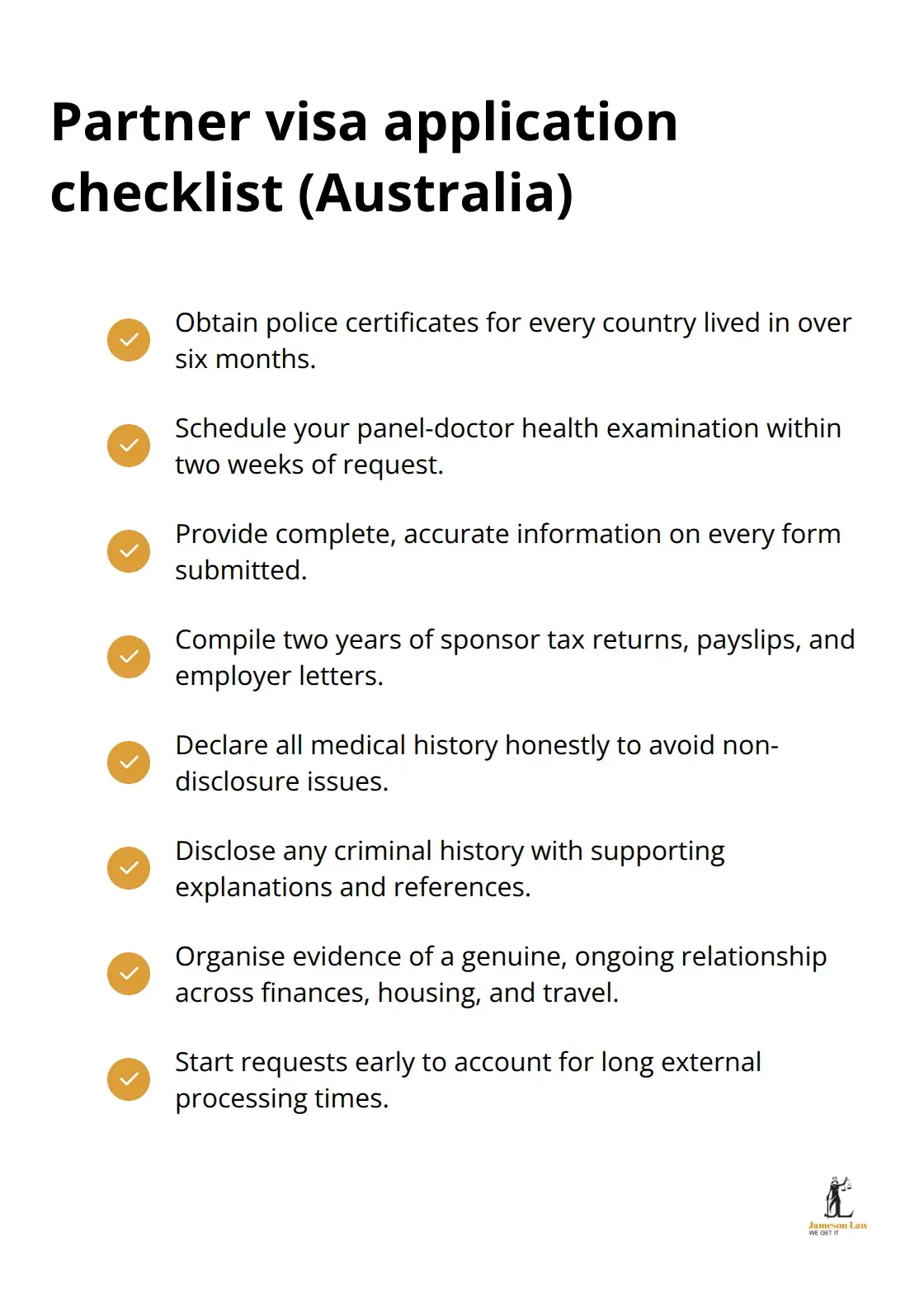
The practical reality is that health and character assessments succeed for the vast majority of applicants, but they fail dramatically when you fail to disclose information or provide incomplete documentation. The Department views non-disclosure as dishonesty, which can lead to refusal not just of this application but of future Australian visas for several years. Obtain your police certificates before submitting your application, have your health examination scheduled within two weeks of the Department requesting it, and provide complete and accurate information on every form.
If you have any criminal history or health concerns, legal advice at this stage prevents costly mistakes and ensures you understand your actual prospects before investing time and money into an application that faces genuine obstacles.
Final Thoughts
Partner visa eligibility Australia depends on three core pillars: proving your relationship is genuine and exclusive, demonstrating your sponsor meets financial thresholds, and clearing health and character assessments. The Department of Home Affairs applies these requirements consistently across all relationship types, whether you are married, in a de facto partnership, or in a same-sex relationship. Your application succeeds when you provide complete, accurate documentation that satisfies each requirement without gaps or omissions.
Start gathering evidence now, before you formally apply. Obtain police certificates from every country where you have lived for more than six months, because processing these takes weeks or months depending on jurisdiction. Have your sponsor compile two years of tax returns, recent payslips, and employer letters to demonstrate income or assets that meet the maintenance threshold, and schedule your health examination with a Department-approved panel doctor within two weeks of the Department requesting it.
Non-disclosure or incomplete documentation remains the primary reason applications face refusal or unnecessary delays. The Department views omissions as dishonesty, which can affect not just this application but your eligibility for future Australian visas. If your circumstances involve criminal history, financial complications, or any factor that raises genuine concerns about your prospects, contact Jameson Law to discuss your situation with someone who understands Australian immigration law and can advise you on the best path forward.