


Facing criminal charges in Sydney can feel overwhelming, especially if you have never been through the state court system before. At Jameson Law, we know that understanding exactly what happens in the courtroom is your strongest weapon in reducing anxiety and preparing a formidable defence.
This authoritative guide walks you through each stage of the criminal defence Sydney process in 2026—from your very first appearance in the Local Court through to cross-examination and updated sentencing regulations. You will learn what to expect, how to work strategically with your lawyer, and what rights you possess at every single step.
Understanding the Criminal Court System in NSW
Where Your Case Will Be Heard
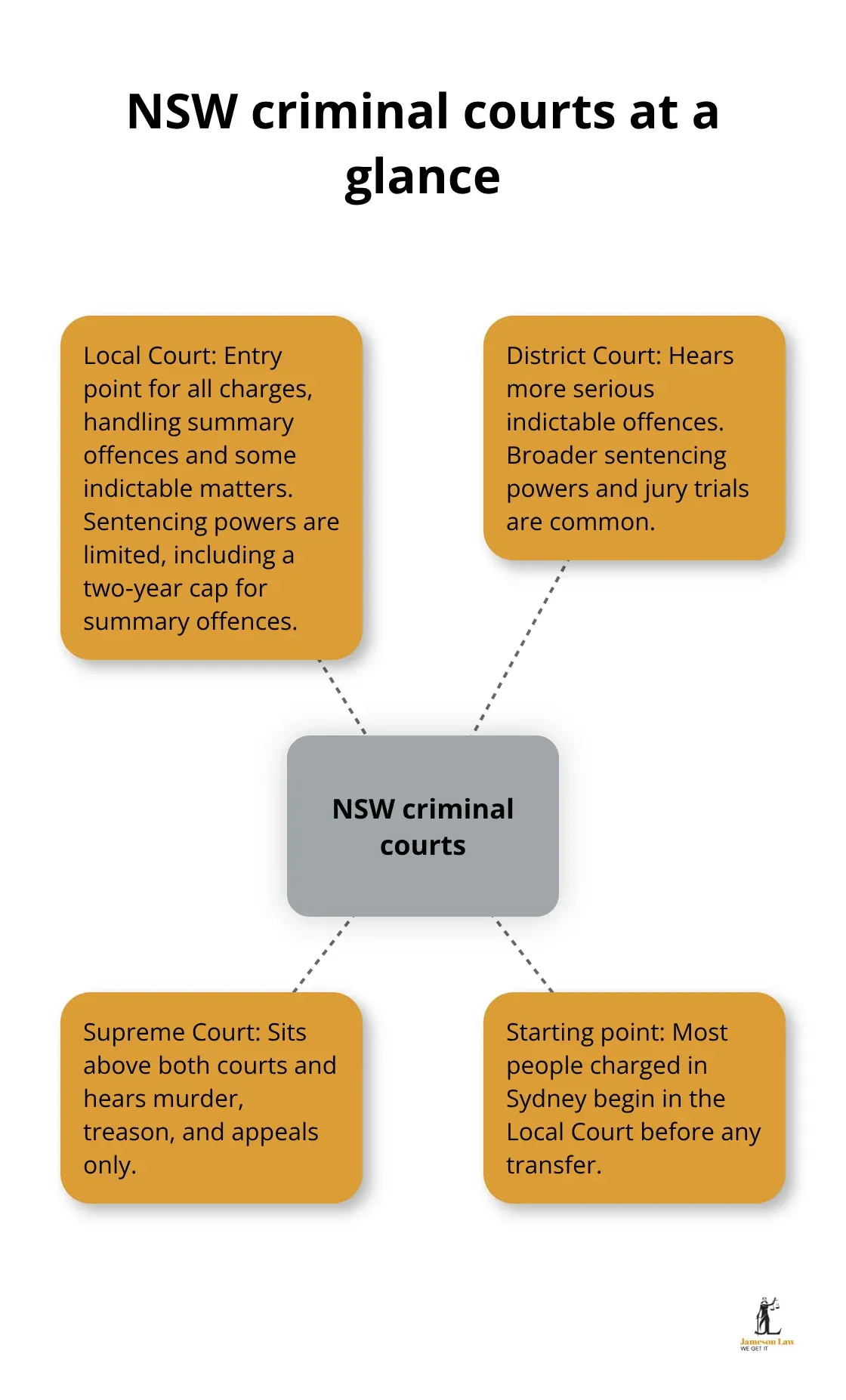
NSW operates a tiered court framework. Understanding which jurisdiction deals with your matter is essential from day one, as it dictates your trial format and potential maximum penalties:
| Court Jurisdiction | Types of Matters Handled | Sentencing Authority |
|---|---|---|
| Local Court | Summary offences and some indictable offences triable summarily. Serves as the entry point for all criminal charges. | Magistrate only (No jury). Maximum 2 years per offence (or 5 years total). |
| District Court | Serious indictable offences (e.g., aggravated assault, major drug supply, sexual offences) and appeals from the Local Court. | Judge and Jury. Broad sentencing powers, including lengthy imprisonment. |
| Supreme Court | The most severe indictable matters (e.g., murder, treason) and complex appeals. | Judge and Jury. Unlimited sentencing jurisdiction. |
Most people facing criminal charges in Sydney start in the Local Court for an initial appearance, often called a “mention,” regardless of how serious their case is.
Preparing for Your First Court Date
Your first court date is not the time to make rushed decisions about pleading guilty or not guilty. Arrive at least 30 minutes early to find your courtroom and locate court staff. If you are on bail, failing to show up results in an immediate warrant being issued for your arrest and your bail being forfeited—creating a separate criminal offence on top of your original charge.
Preparing for Your Court Appearance
Act Immediately After Receiving Your Court Attendance Notice (CAN)
Preparation separates defendants who achieve favourable outcomes from those who struggle. The moment you receive a CAN, your first action must be to obtain a copy of the police brief of evidence and review it thoroughly with an expert lawyer.
This brief contains the prosecution’s evidence, witness statements, and the facts they intend to prove. Spotting weaknesses early allows your legal team to build a defence strategy before your first appearance.
Identify Procedural Breaches and Unlawful Evidence
Your legal representative needs time to analyse the police brief to identify procedural breaches in how officers conducted interviews or searches. Under the Evidence Act 1995 (NSW), unlawfully obtained evidence can be excluded from trial entirely, which frequently results in the prosecution’s case collapsing before it even reaches a hearing.
Know Your Rights at Every Court Stage
Understanding your fundamental rights is non-negotiable:
- The Right to Silence: Silence is your primary protection. Never answer questions beyond providing your name and address without a lawyer present.
- The Right to Legal Representation: You are entitled to be defended by a highly experienced lawyer.
- The Right to Adjourn: At your first appearance, you are not obligated to enter a plea immediately. You can request an adjournment to seek proper legal advice.
What Happens Inside the Courtroom
The Prosecution Opens and Presents Evidence
The prosecution opens first, outlining the case against you in succinct, factual terms. They must prove your guilt beyond a reasonable doubt. The prosecutor will call witnesses in a sequence they control, and each witness answers questions about what they allegedly saw, heard, or discovered.
Cross-Examination Tests Witness Credibility
Your defence lawyer will cross-examine each prosecution witness immediately after their evidence is given. This is where your lawyer aggressively challenges the witness’s reliability and accuracy by asking pointed questions about inconsistencies or gaps in their account. A weak witness statement often shatters under rigorous cross-examination.
Closing Submissions and the 2026 Sentencing Reforms
Once both sides present closing submissions, the judge or magistrate decides the verdict. If convicted, the matter proceeds to sentencing.
Critical 2026 Law Update: In February 2026, the NSW Government passed landmark legislation that completely abolished “good character” as a mitigating factor in sentencing. You can no longer submit a generic reference letter simply stating you are a “good person.” Character references must now focus strictly on concrete facts, such as proven rehabilitation steps or the impact of the sentence on your dependants.
Final Thoughts
Understanding the criminal court process in NSW removes the uncertainty that makes facing charges so deeply stressful. From your first appearance in the Local Court through to complex evidence challenges and sentencing, each stage follows a predictable structure. Knowing what to expect allows you to prepare strategically rather than reacting in panic.
Representation profoundly influences outcomes. Defendants who work with highly experienced lawyers achieve far superior results through deep procedural knowledge, effective plea negotiations, and the ability to systematically dismantle weak prosecution evidence. Waiting until your court date severely compresses your preparation window and limits your options.
If you are facing criminal charges and need practical, authoritative legal advice tailored to your situation, contact Jameson Law immediately. The sooner you act, the more robust your defence will be. Our expert criminal defence Sydney team stands ready to protect your rights, your reputation, and your future.