


An assault charge in NSW can derail your life, affecting your job, your reputation, and your future. We at Jameson Law understand the stakes, which is why we’ve written this comprehensive guide to Sydney assault defence.
Whether you’re facing common assault charges or more serious aggravated offences, knowing your legal options makes all the difference. This article walks you through the defences available to you, how sentencing works, and what steps to take next in 2026.
What Counts as Assault Under NSW Law
How NSW Law Defines Common Assault
Common assault under the Crimes Act 1900 (NSW) is an act that causes a person to apprehend immediate and unlawful violence. This definition matters because the prosecution does not need to prove you made physical contact—only that the victim feared immediate violence.
Section 61 of the Crimes Act sets the maximum penalty at 2 years imprisonment. The law treats even minor actions seriously: punching, hitting, slapping, pushing, kicking, spitting, threatening to hurt someone, throwing objects, or restraining someone against their will all qualify.
The critical element is intent or recklessness. The prosecution must prove beyond reasonable doubt that your act was intentional or reckless, that the victim did not consent, and that you had no lawful excuse. This last point matters—lawful correction, self-defence, and consent can all negate a charge. Many defendants assume they need visible injuries to face conviction, but that assumption is wrong. Courts have treated multiple deliberate assaults as serious even when no actual bodily harm occurred, meaning the severity depends on the circumstances, not just physical damage.
Aggravated Assault and Increased Penalties
Aggravated assault carries significantly harsher penalties because it involves additional elements that increase culpability. If the assault involves actual bodily harm, you face assault occasioning actual bodily harm (AOABH) under section 59, which can include injuries that are not permanent or even psychological harm. The maximum penalty jumps to 5 years imprisonment.
More serious still is assault causing grievous bodily harm (GBH) or wounding under section 33, carrying up to 25 years imprisonment. Aggravating factors that courts consistently emphasise include use of a weapon, premeditation, unprovoked conduct, offending in company, targeting vulnerable victims, committing the offence in the victim’s home, gratuitous cruelty, and substantial harm. Weapons significantly affect seriousness—knives notably increase culpability, as do syringes and broken glass.
Courts apply what is called the De Simoni principle, which prevents treating a circumstance that would justify a more serious offence as an aggravating factor when sentencing for a lesser offence. Understanding this matters for your defence because it shapes how injuries and your mental state are assessed.
Assault Versus Battery: Understanding the Distinction
The distinction between assault and battery is worth noting: assault refers to the threat or apprehension of violence, while battery is actual physical contact. In NSW, both fall under assault offences in the Crimes Act, but knowing this distinction helps clarify what the prosecution needs to prove against you.
This understanding becomes particularly important when you examine the evidence against you and identify weaknesses in the prosecution’s case. The specific charge you face determines which elements the prosecution must establish beyond reasonable doubt, as highlighted in the legislative matrix below:
| Offence Category | Crimes Act Section | Maximum Penalty | Core Legal Threshold |
|---|---|---|---|
| Common Assault | Section 61 | 2 Years Imprisonment | Apprehension of immediate unlawful force. |
| Assault Occasioning ABH | Section 59 | 5 Years Imprisonment | Assault resulting in actual physical/mental bodily harm. |
| Wounding or GBH with Intent | Section 33 | 25 Years Imprisonment | Grievous bodily harm or breaking of skin layers. |
Building Your Defence Strategy
Self-Defence: Proving Reasonable and Proportionate Force
An effective defense strategy relies on proving your actions were legally justified. Under the law, self-defence force must be reasonable and proportionate to the threat encountered. The law does not require you to retreat or wait until you are hit before defending yourself, but it does demand that your response match the threat you faced. If the prosecution alleges you threw a punch, you need evidence showing the other person posed an immediate threat that justified that action.
CCTV footage, witness statements from people who saw the initial aggression, or even injuries on your own body support your claim. Courts assess reasonableness objectively, meaning they ask whether a reasonable person in your position would have used similar force. Excessive force undermines your defence entirely. If you punched someone who was unarmed and smaller than you, or if you continued striking after they retreated, a court will likely reject your self-defence argument.
The prosecution often argues that your actions went beyond what was necessary, so gathering evidence immediately after the incident is critical. Photographs of any injuries you sustained, statements from witnesses who saw the other person act aggressively first, and any video evidence should be collected and provided to your lawyer without delay.
Lack of Intent or Recklessness as a Defence
Prosecution cases collapse when the evidence shows you lacked the required intent or recklessness. Establishing intent or recklessness as an essential element of assault means the prosecution cannot procure a conviction unless this element is proved beyond reasonable doubt. This element forms the foundation of assault liability, and weaknesses in the prosecution’s proof here can dismantle their entire case.
Mistaken Identity and Witness Reliability
Mistaken identity cases are surprisingly common in assault charges, particularly in crowded venues or incidents involving multiple people. Analysis of eyewitness identification reliability in assault cases shows that witnesses frequently misidentify offenders, yet courts still rely heavily on identification evidence.
Requesting early disclosure of all police evidence, including CCTV footage, frequently contradicts witness accounts. If the video shows someone else committed the assault or shows the incident from an angle that contradicts the witness narrative, this becomes your strongest defence. Video evidence often exposes the weaknesses in eyewitness testimony and shifts the case in your favour.
Consent and Lawful Correction
Consent and lawful correction are less common but still viable in specific contexts. If the alleged victim consented to the contact, no assault occurred. Lawful correction applies in limited circumstances involving parents disciplining children, though courts increasingly scrutinise what qualifies as lawful.
The earlier you obtain expert legal advice, the better your prospects of identifying which defence applies to your circumstances and gathering supporting evidence before it disappears. Your lawyer can assess the strength of each potential defence against the evidence the prosecution holds and advise you on the most effective strategy.
What Happens After an Assault Conviction
A conviction for assault in NSW carries consequences that extend far beyond a prison sentence or fine. The moment a court finds you guilty, your employment prospects narrow, your professional standing shifts, and your record follows you indefinitely. An assault conviction can derail careers in regulated industries, damage professional licences, and complicate future applications. Understanding what sentencing actually looks like and how courts weigh factors for and against you is essential before you enter a courtroom.
Sentencing Ranges and How Courts Assess Seriousness
Sentencing for common assault under section 61 of the Crimes Act ranges from a conditional discharge to 2 years imprisonment, but the Local Court typically imposes lighter penalties than higher courts. In practice, first-time offenders with no aggravating factors often receive a community correction order or a small fine, while repeat offenders face custodial time.
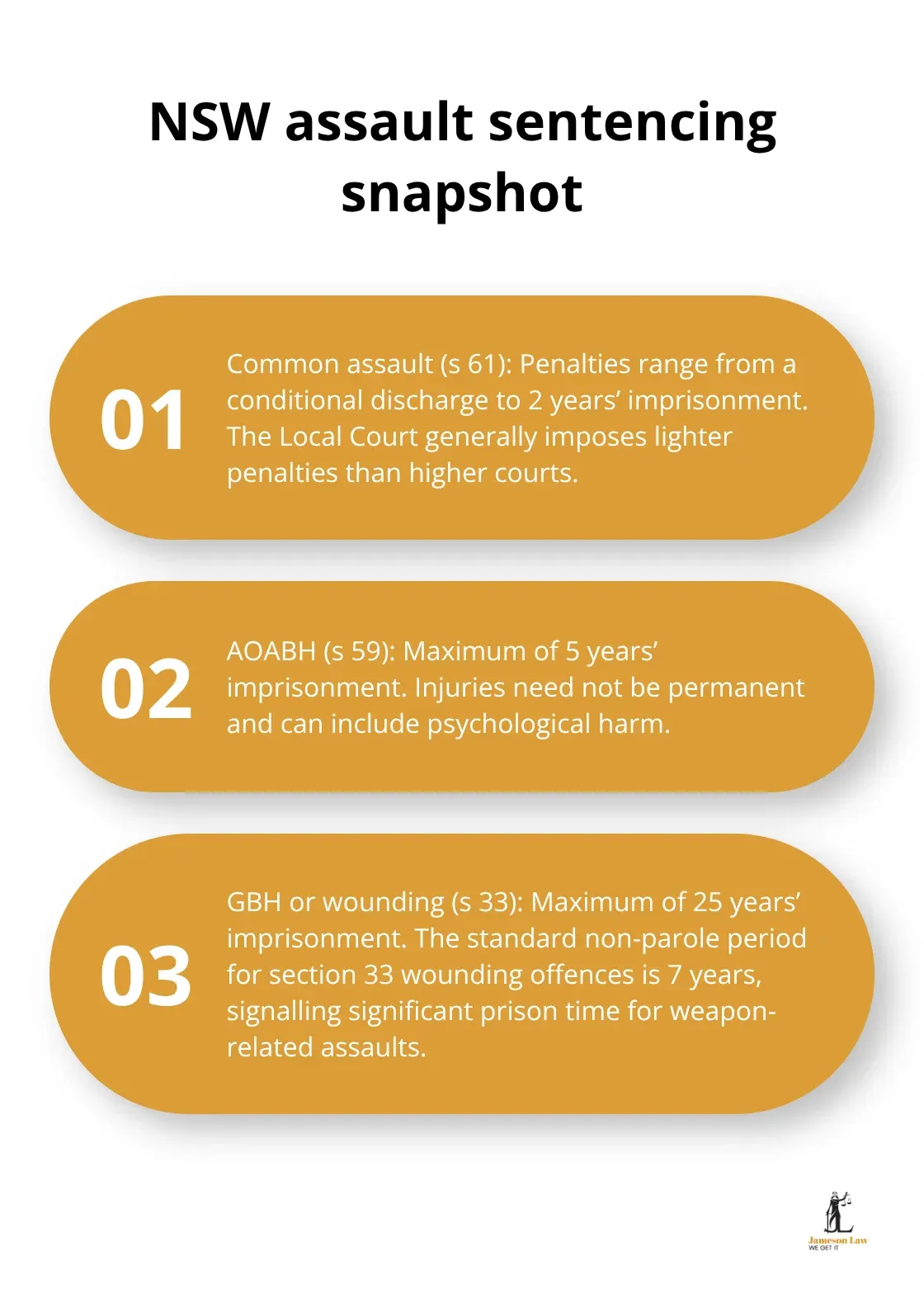
The NSW Judicial Commission provides data showing that the standard non-parole period for section 33 wounding offences is 7 years, meaning courts expect significant prison time for weapon-related assaults. Courts assess seriousness by examining the extent and nature of injuries, the degree of violence used, and your mental state at the time. Domestic violence assaults receive heightened scrutiny, with courts emphasising deterrence and denunciation to protect victims.
Aggravating Factors That Push Sentences Higher
Aggravating factors substantially increase your sentence. The prosecution will highlight whether your conduct was unprovoked, whether you showed gratuitous cruelty, or whether the harm was substantial.
Crucially, self-induced intoxication at the time of the offence does not reduce your sentence; under section 21A(5AA) of the Crimes (Sentencing Procedure) Act 1999 (NSW), courts cannot take intoxication into account as a mitigating factor. Your lawyer can argue mitigating factors including your age, lack of prior convictions, genuine remorse, mental health conditions affecting your conduct, and the impact of custody on your dependants.
Employment and Professional Licence Consequences
An assault conviction triggers automatic disclosure requirements for most applications, particularly in regulated industries. Teachers, healthcare workers, security personnel, and anyone working with vulnerable people face licence cancellation or suspension following an assault conviction. Professional bodies like the Medical Council of NSW and the Law Society of NSW treat assault convictions seriously and may initiate separate disciplinary proceedings.
Your criminal record remains on the National Police Database indefinitely unless you obtain a spent conviction or historical annulment, which is subject to specific statutory crime-free periods. This means future employers, overseas authorities, and professional bodies will see your conviction during background checks.
Immigration, Visas, and Other Long-Term Impacts
Migration applications and visa sponsorship become significantly more difficult because assault convictions are treated as serious criminal conduct under the character test. The consequences of an assault conviction extend into every aspect of your life, making a robust Sydney assault defence strategy essential from the outset.
Final Thoughts
An assault charge demands immediate action because witnesses disappear, memories fade, and CCTV footage gets deleted within weeks. The defences available to you—self-defence, lack of intent, mistaken identity, and consent—only work if you collect evidence quickly and present it strategically. The window to build a strong Sydney assault defence closes fast, and delays cost you opportunities to challenge the prosecution’s case.
Early legal advice separates outcomes because a lawyer can assess which defences apply to your specific circumstances, identify weaknesses in the police evidence, and advise whether fighting the charge or negotiating a better outcome serves your interests. Your employment, your professional standing, and your future depend on getting this right from the start.
Contact Jameson Law to discuss your case with our highly experienced legal professionals who understand NSW assault law and the practical realities of defending these charges. We focus on providing practical, authoritative advice tailored to your situation. The stakes are too high to delay.