


An Apprehended Violence Order (AVO) can significantly impact your life, whether you’re seeking protection or facing an application against you. At Jameson Law, we help NSW residents navigate these complex legal matters with clarity and confidence.
If you need an avo lawyer NSW or simply want to understand how protective orders work, this guide covers everything from the application process to court-tested defence strategies.
What an AVO Actually Protects You From
An Apprehended Violence Order under NSW law is a court-issued protective order that stops someone from committing or threatening violence, harassment, stalking, or property damage against you. The Crimes (Domestic and Personal Violence) Act 2007 establishes the legal framework, and NSW Police issue thousands of AVOs annually to protect people across the state.
The order itself is not a criminal conviction, but breaching it is a serious criminal offence that can result in up to two years’ imprisonment. Every AVO contains three mandatory conditions that apply regardless of the circumstances:
- A strict prohibition on committing assault or making threats against the protected person.
- A comprehensive ban on stalking, harassing, or intimidating behavior.
- A restriction on intentionally damaging property or harming animals belonging to the protected person.
The court can add extra conditions tailored to your specific situation, such as contact restrictions, exclusion from your home, location-based orders keeping someone away from your workplace or children’s school, or weapons prohibitions.
Domestic and Non-Domestic Orders Work Differently
NSW recognises two distinct types of AVOs based on your relationship to the person causing fear. An Apprehended Domestic Violence Order (ADVO) applies when the person is a current or former intimate partner, family member, or someone with whom you share a domestic relationship, including extended kinship relationships for Aboriginal and Torres Strait Islander people.
Under default rules, an Apprehended Domestic Violence Order carries a default duration of two years under NSW law if no specific timeframe is explicitly stated by the magistrate, whereas APVOs generally last for 12 months unless the court specifies otherwise. You can also seek an indefinite ADVO if a significant ongoing risk exists, though this cannot be ordered if the defendant was under 18 when the initial application was made.
| Order Type | Relationship Threshold | Default Duration |
|---|---|---|
| ADVO (Domestic) | Current/former partners, family members, or cohabitants. | 2 Years |
| APVO (Personal) | Neighbours, work colleagues, acquaintances, or strangers. | 12 Months |
Who Can Apply and How the Process Starts
Police handle most ADVO applications, but you can apply privately for either type if you have experienced or fear physical assault, sexual assault, threats, stalking, harassment, or property damage.
If you are protecting a child under 16, police must usually apply unless you are a parent seeking protection for yourself and your child simultaneously. Private applications require you to prepare and present your own evidence to the standard required by the court.
Provisional Orders Provide Faster Initial Protection
Provisional AVOs provide immediate temporary protection without a full court hearing, operating as temporary shields while your case progresses toward a final determination. Police can obtain a Provisional AVO quickly—sometimes by phone, fax, or online—without requiring a full court hearing, and this order automatically converts to an Interim AVO at your first court appearance unless contested.
Interim AVOs remain in force until the case is finalised, and the court may impose custom conditions depending on what emerges during the court process. A Final AVO is made only after a formal hearing where evidence is presented and tested, or by consent if the defendant agrees to the order without admitting wrongdoing.
Urgent Protection Notice: If you are in immediate danger, contacting NSW Police on 000 or the non-emergency line 131 444 will trigger the fastest protective response. Police applications move through the registry quicker than private filings.
How AVOs Progress Through the Court System
Building Your Case: Evidence and Preparation
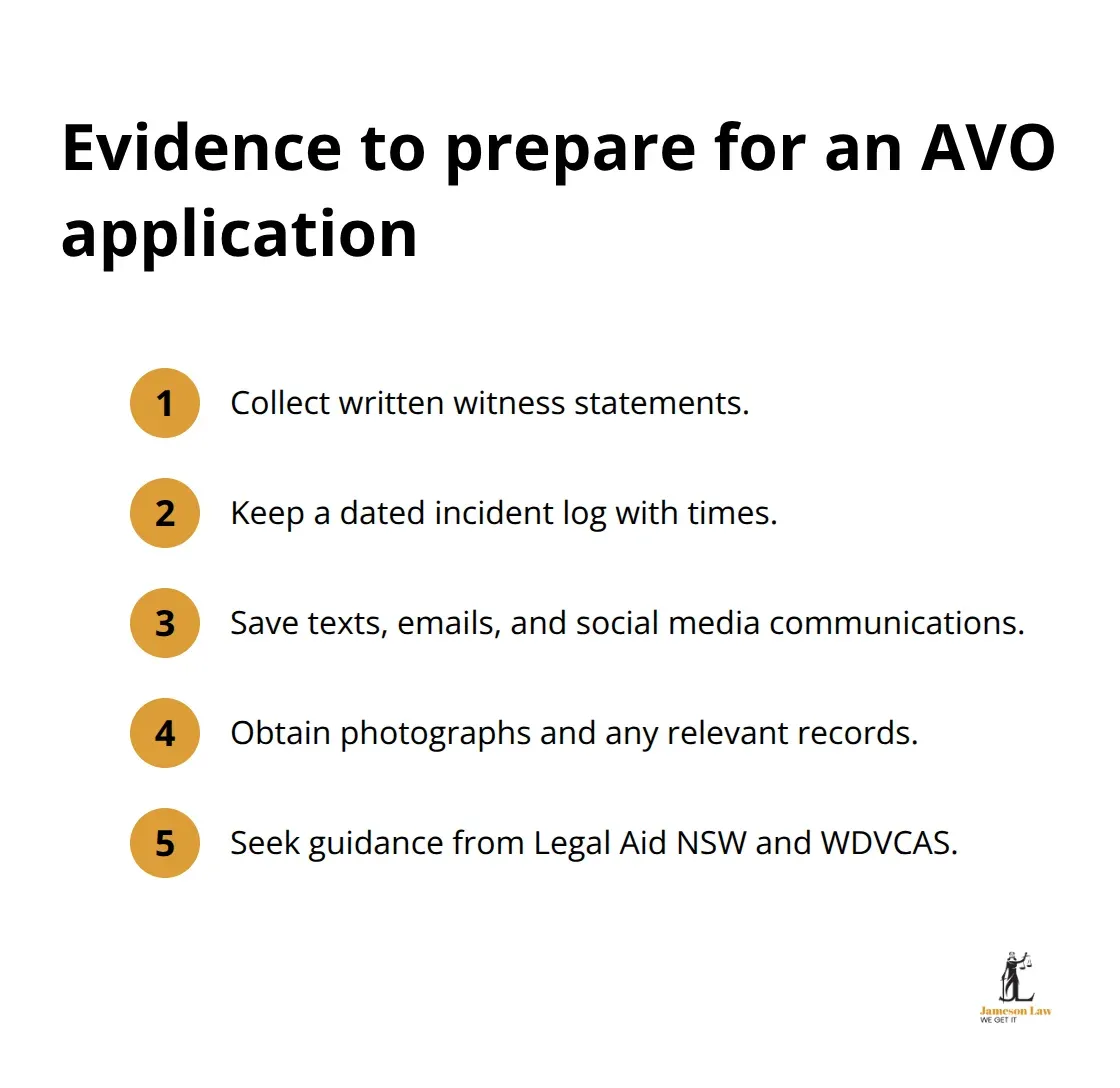
Applying for an AVO in NSW involves distinct stages, and understanding where your case sits in this process directly affects your timeline. If police handle your application, they will gather statements, photographs, and witness evidence to support your case at no cost to you. Private applicants must manage evidence collection independently, documenting incidents with precise dates and times.
The Domestic Violence Unit within Legal Aid NSW can provide initial advice, and Women’s Domestic Violence Court Advocacy Services (WDVCAS) operate across 136 NSW local court locations to offer information and support.
The Court Hearing Process
Your first court appearance is a mention hearing, not a final determination, and this is where the court assesses whether the AVO remains necessary and how the defendant intends to respond. If the defendant contests the order, the matter is adjourned for a full hearing where both sides present evidence and witnesses can be cross-examined. Consent orders offer a faster alternative: if the defendant agrees to the AVO without admitting wrongdoing, the court can make the final order on the same day.
Conditions the Court Imposes
Beyond the three mandatory conditions, courts frequently add contact restrictions that require all communication to pass through a lawyer, preventing direct contact by phone, text, or email. Exclusion orders bar the defendant from your residence, and location orders can restrict them from entering specified postcodes.
Furthermore, weapons prohibitions automatically revoke any firearms licence while the order is active. Property recovery orders can be made simultaneously with provisional, interim, or final orders to return belongings left with the other party with police assistance.
Defending Against an AVO Application
If you face an AVO application, your response strategy depends on whether you contest the order entirely or negotiate the conditions. The most critical decision involves whether you admit or deny the allegations.
Consent Orders vs. Contesting the Application
Many defendants accept an AVO without admitting wrongdoing through a consent order. This approach avoids the cost of a full hearing, though the order remains active on your record. If you dispute the application, you must present evidence demonstrating the applicant has not proven their case on the balance of probabilities—meaning it is more likely than not that their fears are unreasonable or exaggerated.
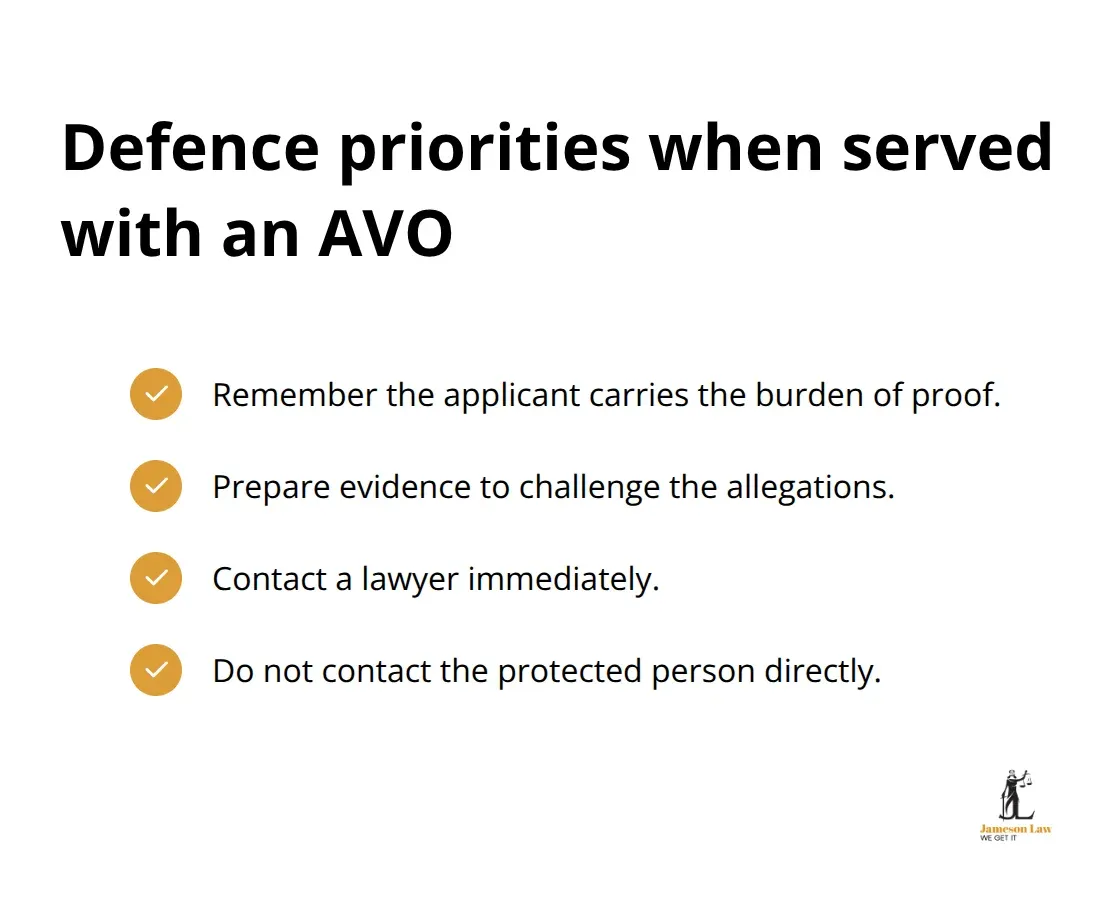
Contact a lawyer immediately after being served. Do not communicate directly with the protected person or attempt to contact them to resolve matters, as any such contact will be used as evidence against you and may constitute a criminal breach if a provisional order is already active.
Collecting Evidence and Character Witness Statements
A credible defence requires evidence that contradicts the applicant’s allegations. Gather text messages, emails, or social media exchanges that show you did not behave as alleged or that the applicant initiated contact despite claiming fear.
Witness statements from people who can speak to your character or who were present during disputed incidents carry significant weight in court. These witnesses should provide signed written statements detailing what they saw or heard, as they may be cross-examined by the prosecution or police prosecutor during the final hearing.
Preparing for the Final Hearing
At the hearing, you will have the opportunity to give your own evidence and to test the applicant’s account. Prepare your testimony carefully by reviewing your timeline multiple times before entering the Local Court registry. During cross-examination, answer only what is asked, remain calm, and do not volunteer additional information or become defensive.
Many AVOs are made because courts assess risk conservatively, prioritizing safety even when evidence is unclear. Understanding this reality helps you decide whether to fight the application or negotiate terms you can realistically comply with.
Final Thoughts
An Apprehended Violence Order in NSW demands immediate action and clear understanding, whether you seek protection or face an application. Contact NSW Police to start the process without delay if you are facing immediate safety threats. If you face an AVO application, your response strategy matters significantly—accepting a consent order offers faster resolution, while contesting allows you to challenge allegations with credible evidence.
Breaching an AVO carries severe penalties of up to two years’ imprisonment, so absolute compliance is non-negotiable for defendants. Support services throughout Sydney and wider NSW, including Women’s Domestic Violence Court Advocacy Services at all local court locations and Legal Aid NSW, provide valuable guidance for those navigating the system.
An expert avo lawyer NSW can guide you through this complex process and help you protect your rights. Contact Jameson Law today to discuss your specific situation with our highly experienced legal team and discover the next steps you need to take.