Parenting arrangements after separation or divorce affect every aspect of your child’s life. The decisions you make now shape their stability, relationships, and wellbeing for years to come.
At Jameson Law, we’ve helped countless families in NSW navigate family law parenting arrangements. This guide walks you through the options available, what courts consider, and how to reach agreements that work for your child.
Your Parenting Arrangement Options in NSW
After separation, three distinct paths exist for formalising how your child spends time with each parent. The Family Law Act 1975 recognises sole parental responsibility arrangements, where one parent makes major long-term decisions about the child’s education, medical care, and cultural upbringing, while the other parent may have regular contact. This structure works when one parent has demonstrated greater capacity to manage these responsibilities or when safety concerns exist. Shared parental responsibility is the default position under the Family Law Act unless the court finds evidence of child abuse or family violence. In shared arrangements, both parents contribute to major decisions affecting the child, though the child may spend more time with one parent than the other. Research from the Australian Institute of Family Studies shows that children with regular contact with both parents tend to have better emotional outcomes when the arrangement is stable and conflict-free. The third option involves flexible arrangements that adapt as your child grows, including graduated transitions where contact increases incrementally.
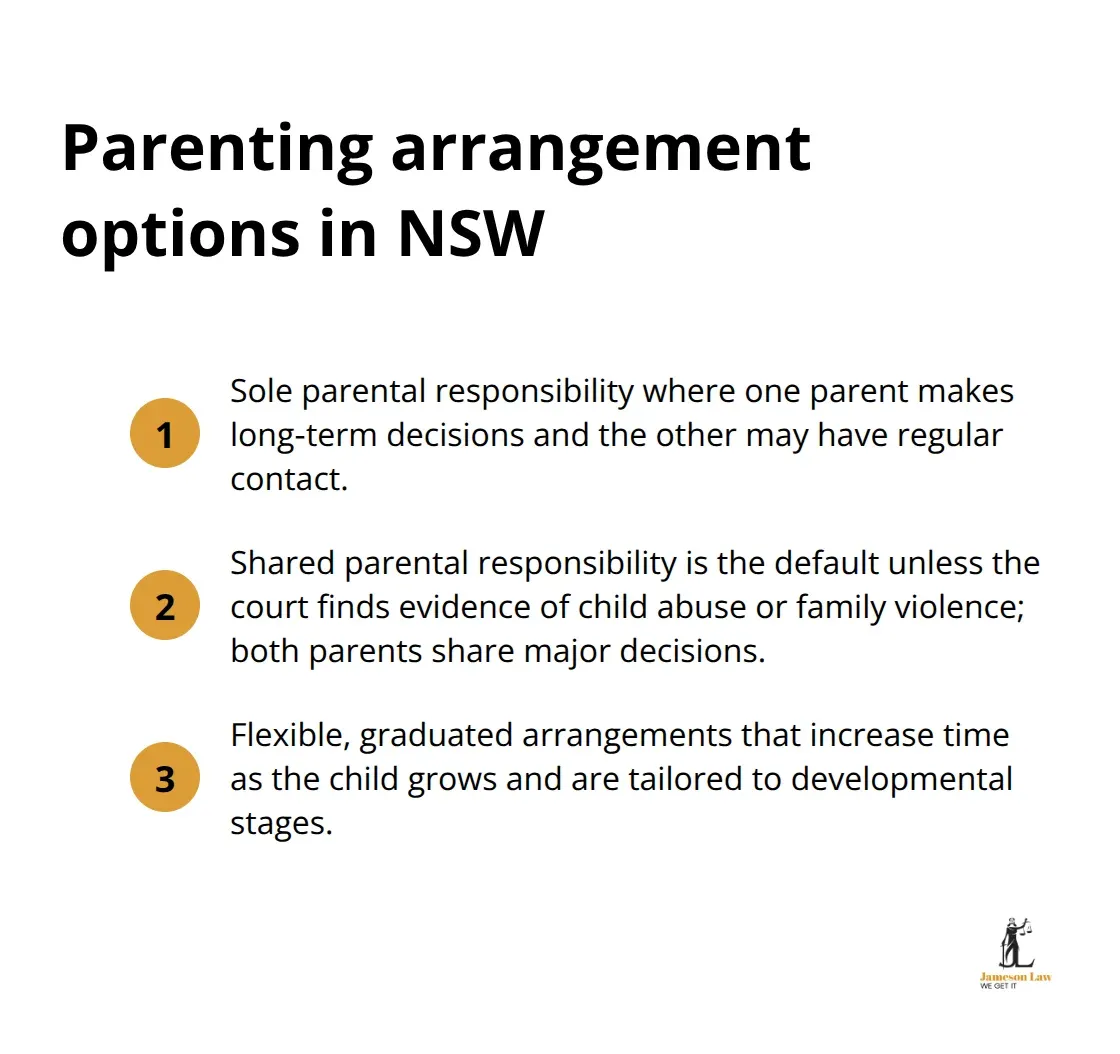
A child aged five might start with two afternoons weekly with one parent, then progress to overnight visits, and eventually to equal time by age ten. This approach recognises that developmental stages matter; a toddler has different needs than a teenager.
What NSW Courts Actually Prioritise
NSW courts do not view all arrangements equally. They examine each parent’s actual capacity to meet the child’s emotional, intellectual, and physical needs, not just stated intentions. A parent working irregular shift work faces practical barriers to consistent contact that a court will weigh carefully.
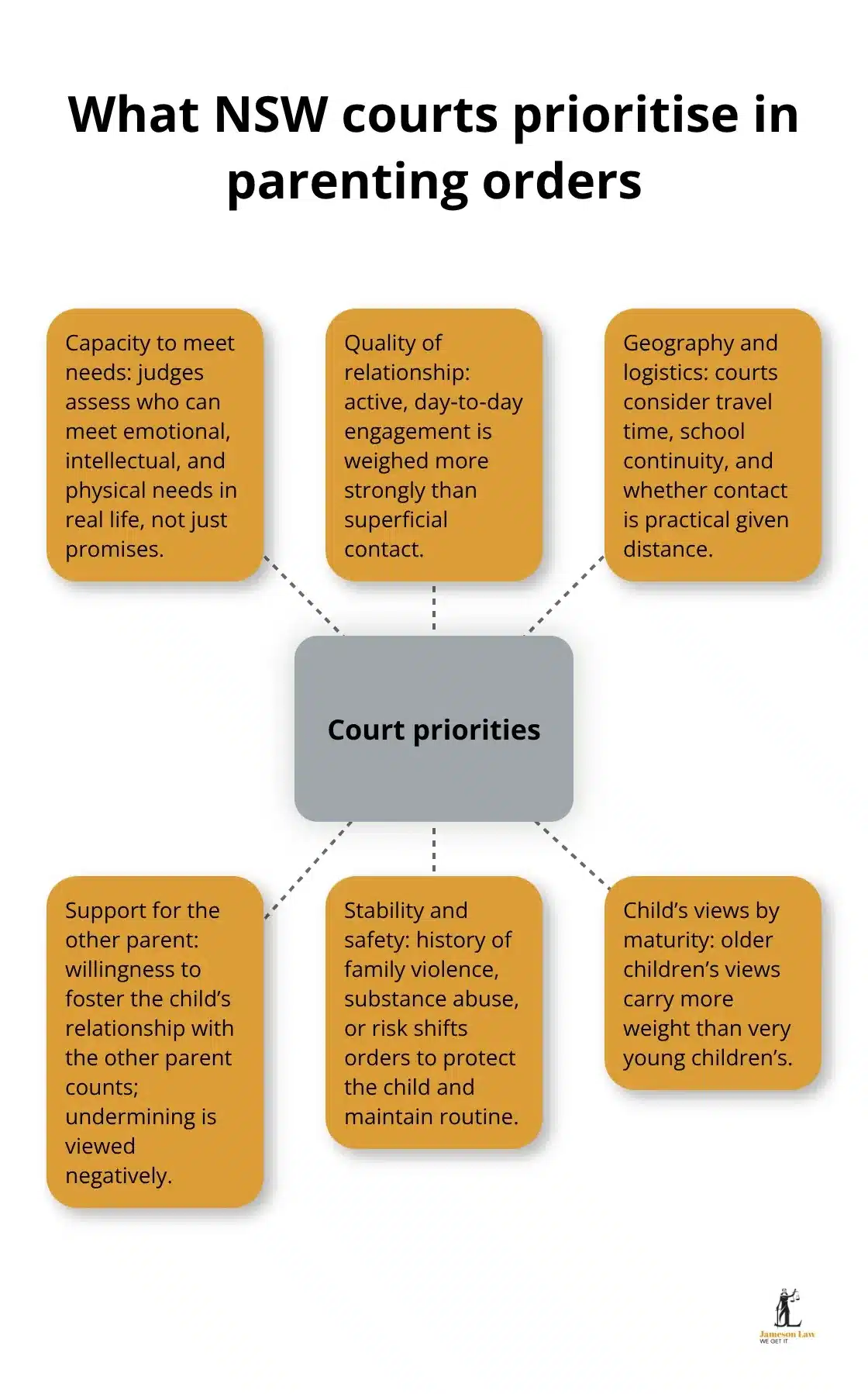
The quality of the relationship between your child and each parent carries substantial weight; courts assess whether a parent actively engages in the child’s daily life or maintains only superficial contact. Location matters significantly in NSW. If you live in Western Sydney and the other parent in Newcastle, the location and practicality of maintaining regular contact influences what the court will order. Courts also consider whether a parent has demonstrated willingness to support the child’s relationship with the other parent or has actively undermined it. A parent who schedules the child’s activities exclusively on the other parent’s contact time sends a clear message that courts interpret negatively.
How to Structure Your Arrangement for Success
The most effective parenting arrangements include specific, predictable schedules rather than vague agreements to visit when convenient. Instead of saying the child visits dad on weekends, specify that the child stays Thursday 3:30 pm to Sunday 5:00 pm, collected from school. This clarity prevents disputes and gives your child certainty about their routine. Include provisions for how parents will communicate about school events, medical appointments, and emergencies. The Family Law Act acknowledges that parenting arrangements must be reviewed periodically as children’s needs change. What works at age six rarely works at age fourteen. Try building in a review point-perhaps annually or when significant life changes occur-to prevent arrangements from becoming obsolete. If you’re considering flexible arrangements with graduated transitions, document the specific triggers for moving to the next stage. Rather than leaving it to interpretation, write that overnight visits increase to two nights weekly once the child demonstrates comfort with the transition and completes a full week of regular contact without distress.
Moving Forward With Your Arrangement
The decisions you make now about parenting arrangements set the foundation for your child’s stability and wellbeing. Whether you choose sole responsibility, shared responsibility, or flexible arrangements, the key lies in creating clear, specific terms that both parents understand and can follow. Your next step involves determining how to formalise these arrangements-whether through direct negotiation, family dispute resolution, or court orders.
What Courts Actually Examine When Deciding Parenting Orders
NSW courts apply a structured assessment when evaluating parenting arrangements, and understanding what they scrutinise shifts how you approach your own agreement. The Family Law Act 1975 requires courts to treat the child’s best interests as the paramount consideration, but this phrase means something concrete and measurable in practice.
How Courts Weigh Your Child’s Views
Courts examine the child’s own views and their capacity to express them, weighted by age and maturity. A fourteen-year-old’s stated preference to live with one parent carries significant influence; a four-year-old’s preference carries minimal weight because young children often cannot distinguish between preference and fear. The court listens to what your child actually says, not what you think they should say.
The Quality of Each Parent’s Relationship With the Child
Courts look at the quality of each parent’s relationship with the child, not just the quantity of time spent together. A parent who attends school assemblies, knows the child’s friends, and discusses their day demonstrates active engagement. A parent who collects the child at scheduled times but remains uninvolved in their life presents differently to the court. Children benefit most from regular, meaningful contact with both parents when the arrangement is stable and free from conflict. This means courts favour arrangements where both parents remain consistently involved rather than one parent dominating decision-making while the other fades into the background.
Courts also assess each parent’s capacity to meet the child’s specific needs. If your child has autism and requires speech therapy twice weekly, a court examines which parent can reliably facilitate these appointments and afford the cost. A parent’s work schedule, health status, financial capacity, and willingness to support the child’s relationship with the other parent all factor into this assessment. Courts view a parent who actively undermines the other parent’s relationship with the child as failing to meet the child’s emotional needs, regardless of their capacity to provide food and shelter.
Stability, Safety, and Practical Considerations
Courts weight stability heavily, particularly for younger children. Moving between homes constantly destabilises children’s routines, school attendance, and friendships. A court will favour an arrangement that keeps the child in the same school and neighbourhood over one that provides equal time but requires constant relocation. Courts also consider whether either parent has a history of family violence, substance abuse, or criminal behaviour affecting the child’s safety. The Family Law Act explicitly requires courts to consider the risk of family violence and tailor orders to protect the child. If one parent has a domestic violence order against them, courts will structure arrangements to minimise unsupervised contact.
Courts examine the child’s cultural, religious, and Indigenous connections and whether each parent will support these. If your child is Aboriginal, courts consider whether arrangements maintain connection to country, community, and cultural practices. A parent who actively supports these connections demonstrates greater capacity to meet the child’s overall needs.
Geography, Age, and What Actually Works
Courts assess the practicality of the proposed arrangement. If you live in Parramatta and the other parent in Byron Bay, a weekly equal-time arrangement is neither practical nor in the child’s best interests because the child would spend hours travelling and miss school. Courts will adjust expectations to reflect geographical reality. The age of the child significantly influences what courts order. Infants require different arrangements than teenagers. A six-month-old needs frequent contact with both parents but cannot manage overnight stays away from the primary caregiver. A sixteen-year-old may need flexible arrangements that accommodate their school commitments and social life.
Understanding these factors means you can structure your own parenting agreement to address what courts actually prioritise, rather than proposing arrangements that sound fair in theory but fail in practice. The next step involves deciding how to formalise these arrangements-whether through direct negotiation with the other parent, family dispute resolution, or court orders.
How to Reach a Parenting Agreement
Direct Negotiation With the Other Parent
Direct negotiation with the other parent works when both parties can separate their personal feelings from the child’s needs. This means setting aside anger about the separation and focusing strictly on what arrangements serve your child. Many parents attempt this alone and fail because the emotional weight of the conversation derails practical discussion.
If you and the other parent can communicate without conflict, start by listing the specific topics you need to agree on: where the child lives, weekly contact schedule, school and medical decisions, communication protocols, and how you’ll handle changes. Write down each parent’s preferred arrangement and the reasons behind it. A parent wanting sole parental responsibility might cite work flexibility or the child’s special needs requiring consistent management. The other parent might prioritise equal time because they want meaningful involvement in daily parenting.
Written proposals prevent misremembering what was discussed and create a record you can formalise later. However, direct negotiation fails when one parent uses it as a delay tactic, makes unreasonable demands, or refuses to engage genuinely. If conversations become heated, circular, or unproductive after three or four attempts, stop and move to structured processes.
Family Dispute Resolution and Mediation
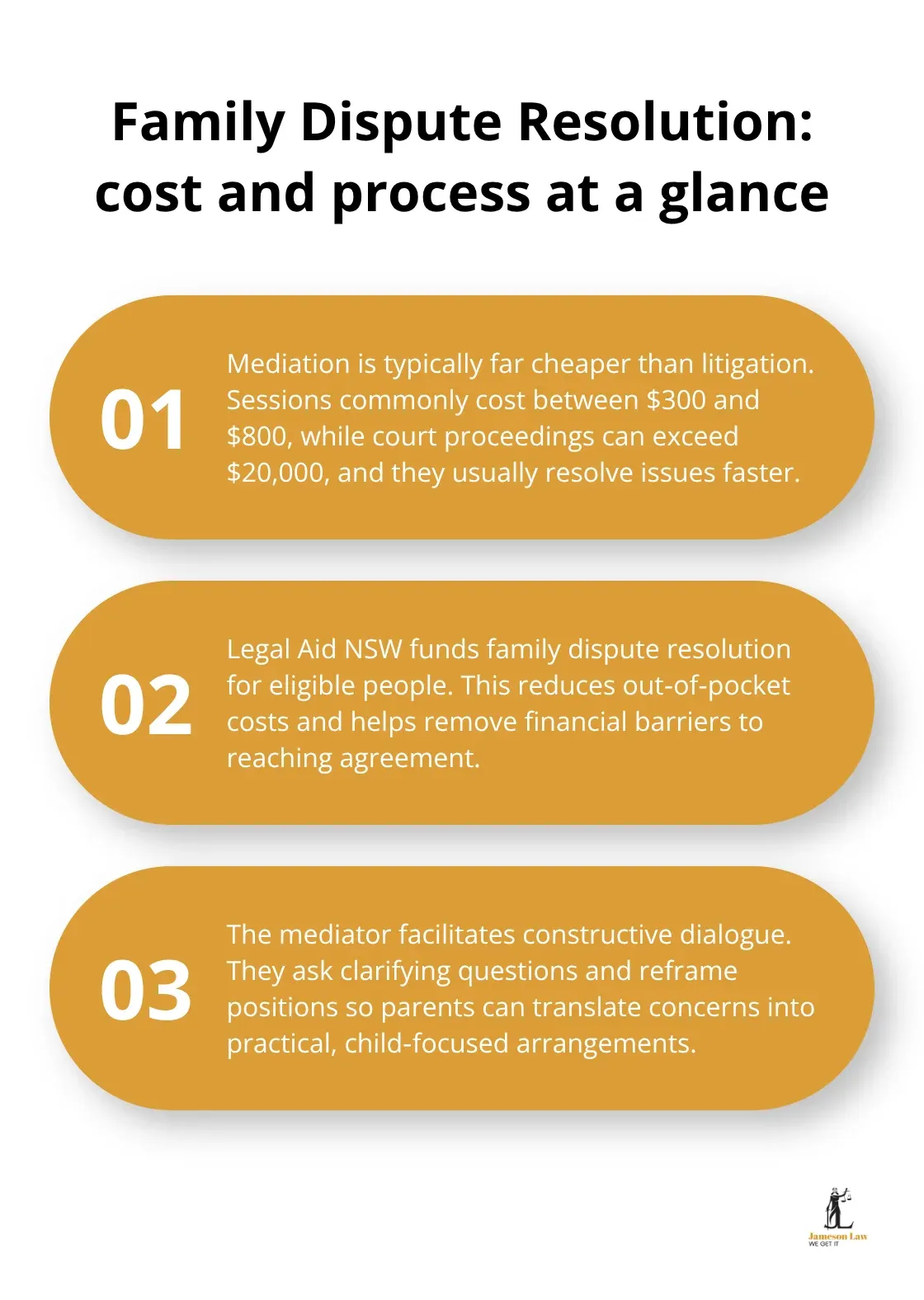
Family dispute resolution offers a middle ground between negotiation and court. An accredited mediator facilitates discussion without making decisions for you, helping both parents communicate more effectively and identify common ground. Except in limited circumstances, you must attempt family dispute resolution before you can file an application for parenting orders, though exemptions exist for family violence, child abuse, or urgent safety concerns.
Mediation typically costs between $300 and $800 per session depending on the mediator’s experience and location, substantially less than court proceedings which can exceed $20,000. Legal Aid NSW funds family dispute resolution for eligible people, removing cost barriers. The mediator helps you translate positions into workable arrangements by asking clarifying questions and reframing demands in terms of the child’s actual needs.
If you reach agreement through mediation, you can formalise it as a parenting plan, which both parents sign and date, or as consent orders filed with the court. A parenting plan is not legally enforceable, however it is still carefully regarded in family law matters, while consent orders are legally enforceable immediately once the court approves them. Both documents prevent future disputes about what was agreed. If mediation fails, you have clear documentation of what you tried to resolve and what remains contested, which the court considers when assessing whether you’ve genuinely attempted resolution.
Court Orders When Agreement Fails
Court orders become necessary when parents cannot agree despite negotiation and mediation. You apply through the Commonwealth Courts Portal with your family dispute resolution certificate, proposed orders, and supporting evidence about the child’s best interests. Court proceedings are adversarial and expensive, but they produce binding orders with serious consequences for breach.
A parent who repeatedly violates a parenting order can face enforcement action, including potential imprisonment in extreme cases. Courts will examine everything: your communications with the other parent, your involvement in the child’s life, any incidents of family violence, and expert reports about the child’s needs. The process takes months and forces both parents to relive their relationship’s failure in front of a judge.
Most families settle partway through once they see the costs and stress involved. The financial burden and emotional toll of contested proceedings motivate many parents to reach agreement at the mediation stage rather than proceed to full court hearings.
Final Thoughts
Parenting arrangements after separation require you to set aside what feels fair to you and focus on what actually serves your child. The three paths available-sole responsibility, shared responsibility, and flexible arrangements-each work in different circumstances, and matching the arrangement to your child’s age, your family’s geography, and both parents’ genuine capacity to remain involved determines whether the arrangement succeeds. Courts in NSW examine concrete factors: your child’s actual relationship with each parent, the stability of the proposed arrangement, and whether both parents will support the child’s connection to the other parent.
Reaching agreement without court involvement saves money, time, and emotional damage to your child. Direct negotiation works when both parents can separate personal hurt from practical discussion, while family dispute resolution provides structure when negotiation stalls. Court orders become necessary only when genuine agreement is impossible, and they carry serious consequences for breach.
If you are uncertain about what arrangement serves your child’s best interests, if the other parent refuses to engage constructively, or if safety concerns exist, seek legal advice from a family law lawyer. We at Jameson Law help NSW families navigate family law parenting arrangements and reach agreements that protect their child’s wellbeing. Contact us to discuss your situation with an experienced family law lawyer.