Applying for an Australian visa involves multiple steps, and missing even one document can delay your application or lead to rejection. We at Jameson Law have helped countless people navigate this process, and we’ve seen how a solid visa application checklist Australia can make the difference between approval and frustration.
Getting it right from the start saves time and money. This guide walks you through exactly what you need to prepare.
What Documents You Actually Need to Gather
Your visa application succeeds or fails based on its documentation. The Department of Home Affairs processes over 7.5 million visas annually, and the difference between approval and rejection often hinges on whether you’ve included every required document from the start. Applications face delays of months when applicants miss a single certified copy or provide incorrect financial evidence. Start by creating an ImmiAccount on the Department of Home Affairs website-this tool generates a tailored document checklist specific to your visa subclass, which outperforms generic online guides.
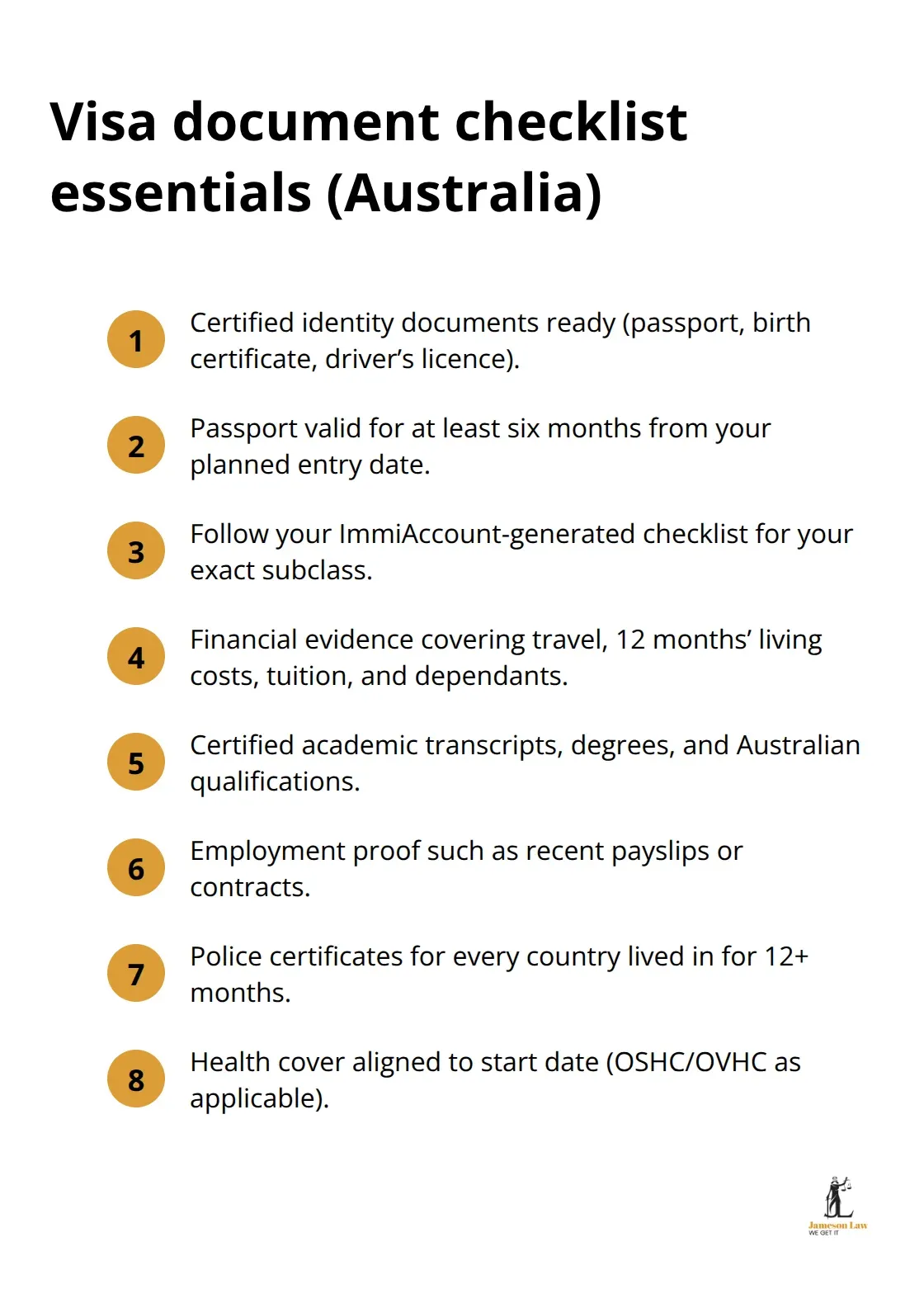
Your passport requires at least six months’ validity from your planned entry date; the Department automatically rejects applications that fall short of this requirement.
Identity and Personal Documents
Gather certified copies of your birth certificate, national identity card, or driver’s licence alongside your passport. If you’ve changed your name, obtain certified copies of your marriage certificate, deed poll, or equivalent evidence immediately. For partner visa applications, provide your marriage certificate, Family Book, Household Booklet, or other proof of family composition. The Department requires certified copies for identity documents-ordinary photocopies won’t suffice. Take originals to a notary public, lawyer, or accountant who can certify them.
Financial Documentation
Financial documentation demands specificity. You must show sufficient funds to cover travel costs, 12 months of living expenses, tuition fees, and any dependant school costs. The exact amounts vary by visa category and appear in your ImmiAccount’s Step by Step guidance. Provide recent bank statements, investment statements, or a sponsorship letter showing your sponsor’s annual income meets the minimum threshold. Employment history matters significantly under the Genuine Student rule introduced on 23 March 2024. Attach certified copies of your academic transcripts, degrees, Australian qualifications, and a CV detailing your employment and education history for the past five years. If you’re currently employed, include recent payslips or employment contracts.
Character and Health Requirements
Character documentation includes police certificates from every country where you’ve lived for 12 months or longer-this requirement is non-negotiable, and processing these certificates alone can take weeks. Health insurance is mandatory. Obtain Overseas Student Health Cover (OSHC) for yourself and any dependants covering your entire stay, starting at least one week before your course begins. Include the provider name, policy start and end dates, and policy number in your application. Residents of Norway, Sweden, or Belgium may qualify for exemptions per PrivateHealth.gov.au, but verify this applies to you before skipping this requirement. Complete your health examination before lodging your application if the Department advises it-delays waiting for medical results after submission are common and frustrating.
Dependants and Additional Documentation
For dependent children aged 5–18 attending Australian schools, provide school enrolment documentation. Under 18 applicants require both parents to sign Form 1229, or if you have sole custody, supply a court order. The Department takes document completeness seriously because incomplete applications cost them time and resources, which translates directly into processing delays for you. Once you’ve assembled these documents, you need to understand which visa category actually fits your circumstances and what processing timeframes you should expect.
Matching Your Circumstances to the Right Visa
Australia’s visa system contains 134 visa classes and 233 subclasses as of mid-2015, according to the Australian National Audit Office. This complexity means selecting the wrong visa category wastes money and months of processing time. Your ImmiAccount generates a tailored checklist for your specific subclass, but you need to confirm you’re applying for the correct one first.
Identifying Your Visa Category
Start by identifying whether you’re migrating for work, study, family reunion, or temporary purposes. Work visas span employer-sponsored pathways like the Subclass 482 Skills in Demand visa, which the Department of Home Affairs processes at 50% within approximately five days and 90% within five months. Student visas take longer-50% process in 28 days and 90% in three months according to current Department benchmarks. Partner visas demand significantly more patience: offshore applications sit at 50% within 15 months and 90% within 25 months.
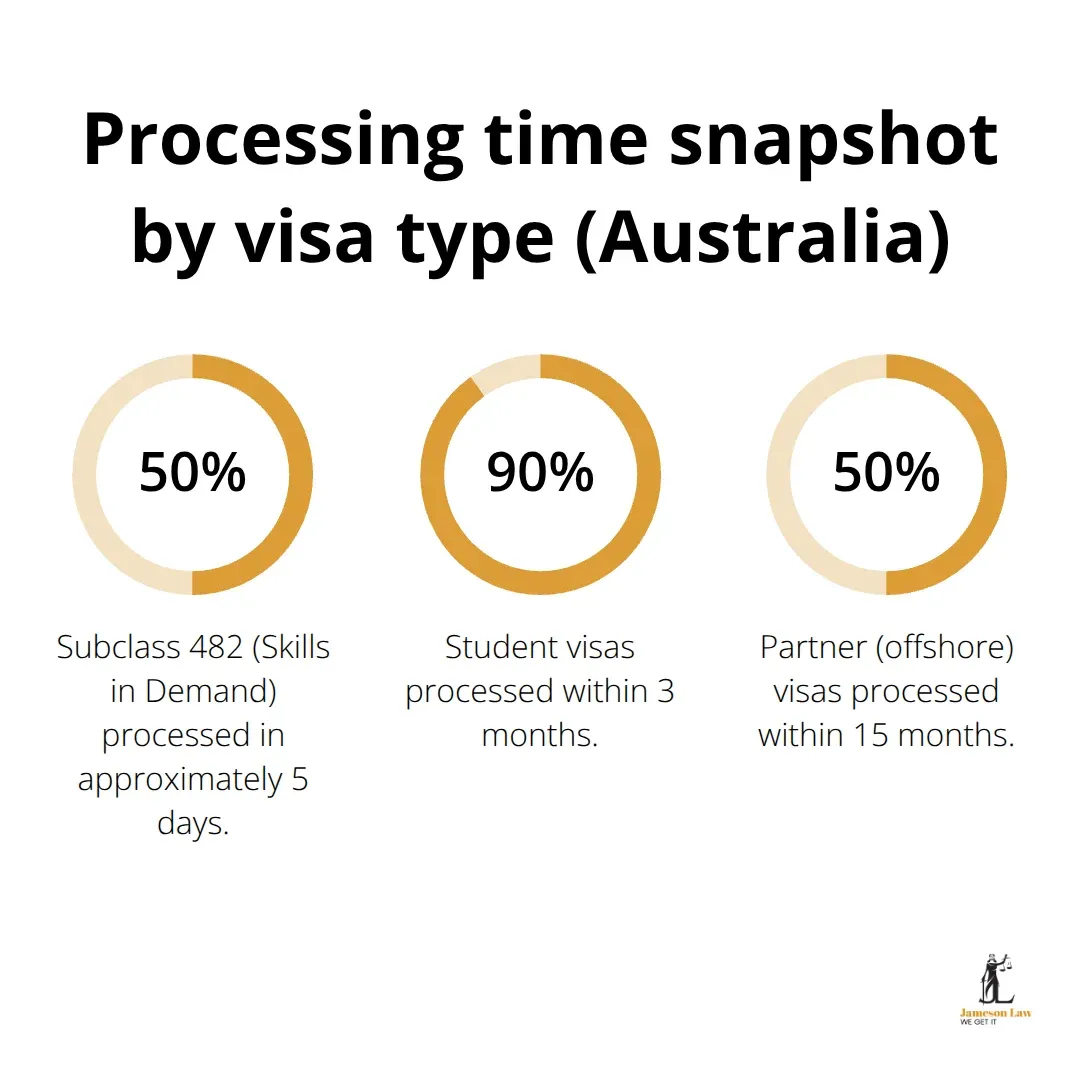
Visitor visas move fastest, with 50% processed in 11 days.
These timeframes matter because they affect your financial planning, employment start dates, and whether you can arrange accommodation before arrival. Each visa subclass carries different eligibility requirements, and the Department rejects applications that don’t meet these thresholds.
Meeting Eligibility and Assessment Requirements
If you’re applying for skilled migration, you’ll need a skills assessment from the relevant authority proving your qualifications match Australian standards. The Genuine Student rule requires you to answer three English-written questions up to 150 words each about your circumstances, course choice, and how the qualification benefits you. This assessment determines whether the Department views you as genuinely intending to study rather than using the visa for work or other purposes. Student visa approval rates hover around 85%, making this one of the highest-approval categories, but only if you meet the genuine intent requirement.
Understanding Costs and Budget Requirements
Processing costs escalate with visa complexity. The Department charges application fees ranging from modest amounts for visitor visas to thousands for skilled migration and partner visas. You should track your budget because these fees rarely represent your total cost-you’ll also pay for certified document copies, health examinations, police certificates from multiple countries, English language tests if required, and potentially migration agent fees if you seek professional guidance.
The 2026–27 Migration Programme introduces a four-year planning horizon, which the government uses to manage visa volumes and reduce delays, but this also means your application sits within a larger strategic framework beyond individual processing speed. Checking the Department of Home Affairs website reveals exact processing targets for your visa subclass, and your ImmiAccount tracks your application status in real time once you lodge it.
Language, Health, and Visa Conditions
English language requirements vary significantly: some applicants qualify for exemptions if they hold certain passports, were sponsored by Defence or DFAT, or studied substantial English previously. The Migration English Language Tests and Exemptions Instrument 2025 details these exemptions, and consulting this document prevents unnecessary test expenses.
Visa conditions attached to your grant determine what you can legally do in Australia-work restrictions, study limitations, and duration of stay all depend on your specific subclass. You should understand these conditions before you arrive to prevent breaches that trigger cancellation. Health insurance requirements differ too: Overseas Student Health Cover applies to students, while Overseas Visitors Health Cover suits temporary residents, and some nationalities qualify for exemptions.
Strategic Timing and Regional Priorities
The Department’s decision-making trends show strong emphasis on regional migration pathways and skilled occupations experiencing shortages, meaning applications aligned with these priorities may process faster. Once you’ve confirmed your visa category and understood the eligibility requirements specific to your circumstances, the next critical step involves assembling your application and avoiding the mistakes that commonly derail otherwise strong cases.
Common Mistakes That Derail Strong Visa Applications
The Department of Home Affairs rejects applications for two primary reasons: incomplete documentation and information inconsistencies that raise fraud concerns. The overwhelming majority of rejections stem from preventable errors rather than genuine ineligibility. When you submit incomplete information or missing documents, the Department does not automatically approve your application after you provide the missing items-they reassess your entire case, which resets processing timelines and introduces risk.
Incomplete Documentation and Missing Certified Copies
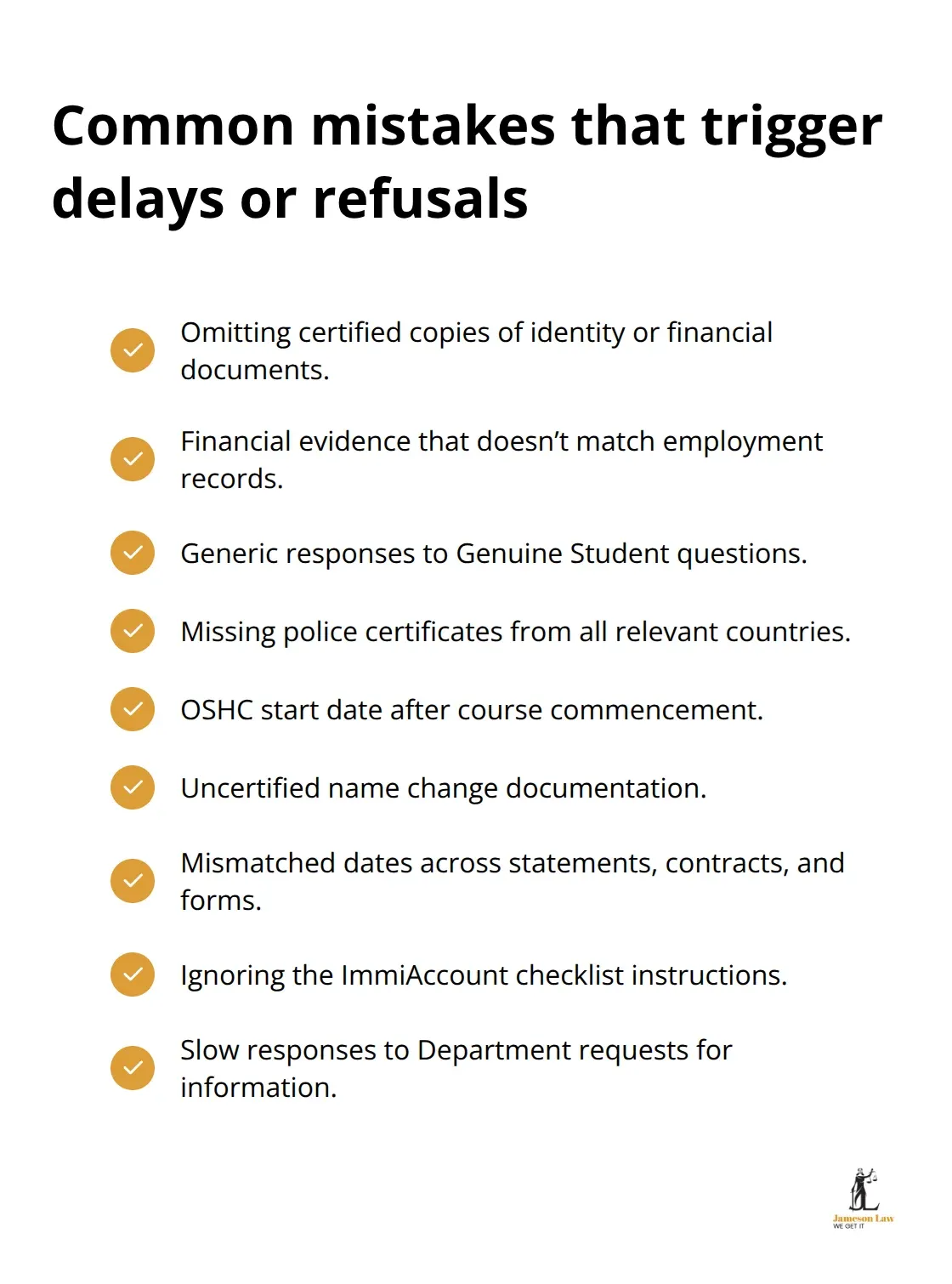
Incomplete or contradictory information triggers additional scrutiny that extends processing times by months. Your ImmiAccount generates a tailored checklist specific to your visa subclass, and deviating from this checklist-even by omitting one certified copy-signals to the Department that you have not read the requirements carefully, which raises questions about your application’s authenticity. Certified copies carry specific legal weight that ordinary photocopies cannot match. You must take originals to a notary public, lawyer, or accountant who can certify them properly. The Department rejects applications that contain uncertified identity documents, financial records, or employment history without exception.
Financial Documentation Problems
Financial documentation represents the most common problem area. Applicants provide recent bank statements showing sufficient funds but omit employment contracts or payslips proving legitimate income sources, which makes the Department question whether the funds are temporary gifts or borrowed money. You must show sufficient funds to cover travel costs, 12 months of living expenses, tuition fees, and any dependant school costs. The exact amounts vary by visa category and appear in your ImmiAccount’s Step by Step guidance. Employment history matters significantly under the Genuine Student rule introduced 23 March 2024. You must attach certified copies of your academic transcripts, degrees, Australian qualifications, and a CV detailing your employment and education history for the past five years. If you are currently employed, include recent payslips or employment contracts that match the dates and income figures in your financial statements.
Genuine Student Assessment and Character Gaps
Under the Genuine Student rule, you must answer three English-written questions explaining your circumstances, course choice, and how the qualification benefits your career. Generic or poorly thought-out responses trigger requests for additional information, and if you cannot articulate genuine intent, the Department refuses your application outright. Character documentation gaps create similar problems. If you have lived in multiple countries, you must obtain police certificates from every jurisdiction where you resided for 12 months or longer. Applicants frequently underestimate this requirement, submit incomplete character evidence, and watch their applications stall while they chase certificates from overseas authorities-a process that routinely takes 8–12 weeks per country. This delay compounds when you apply late and discover you need certificates from three or four different nations.
Health Insurance and Name Change Documentation
Health insurance gaps are equally problematic. Overseas Student Health Cover must commence at least one week before your course begins, and if your policy start date falls after your course commencement, the Department views this as non-compliance with visa conditions and may refuse your application. Name changes require certified documentation proving the legal change occurred. You must provide certified copies of your marriage certificate, deed poll, or equivalent evidence immediately. Applicants who skip this step create identity verification problems that can lead to refusal because the Department cannot match your current name to your historical records.
Verification and Submission Strategy
Cross-reference every document against your ImmiAccount checklist to eliminate the most common errors. Confirm every certified copy carries proper certification marks from an authorised certifier. Verify financial evidence matches your employment history and that dates align across all documents. Ensure health insurance and character documentation align with your course or work start dates. Processing delays increase exponentially when the Department requests additional information, so submitting a complete, accurate application from the start eliminates the most common reasons applications face rejection or extended assessment periods.
Final Thoughts
Your visa application checklist Australia succeeds when you treat accuracy and completeness as non-negotiable standards. The Department of Home Affairs processes millions of applications annually, and the ones that move through fastest contain every required document certified, every financial figure verified, and every answer to the Genuine Student questions thoughtfully completed. Rushing this process costs you months of waiting and introduces unnecessary rejection risk.
You need certified identity documents with at least six months passport validity, complete financial evidence that matches your employment history, character certificates from every country where you lived for 12 months or longer, and health insurance that commences before your course or work start date. Your ImmiAccount generates a tailored checklist specific to your visa subclass, and this tool outperforms generic guides because it reflects your exact circumstances. Cross-reference every document against this checklist before you submit your application.
After you lodge your application, track your status through ImmiAccount and respond immediately to any Department requests for additional information. Processing delays multiply when you delay responding, so treat Department correspondence as urgent. If your application involves complexity, dependants, or circumstances you feel uncertain about, professional immigration law assistance helps you navigate visa applications and understand your options.