

When you suffer an injury due to someone else’s negligence in New South Wales, securing the right Sydney injury lawyer is critical to protecting your legal rights. Navigating statutory frameworks, assessing evidence, and ensuring compliant costs disclosure are complex steps that require specialised legal representation.
At Jameson Law, we guide injured individuals through the complexities of NSW compensation schemes. This guide focuses on what you must consider when choosing a legal representative, how legal costs and funding operate in NSW, and the strategic value an experienced lawyer brings to your case.
Navigating NSW Personal Injury Claim Regimes
Before selecting legal representation, it is essential to understand that not all personal injury claims are identical. A proficient Sydney injury lawyer must have specific experience within the statutory regime governing your accident. The primary frameworks include:
- Workers Compensation: A mostly no-fault statutory scheme for workplace injuries, with potential access to common law Work Injury Damages for severe negligence.
- Motor Vehicle Accidents (CTP): Governed by the Motor Accident Injuries Act 2017, providing statutory benefits and potential common law damages.
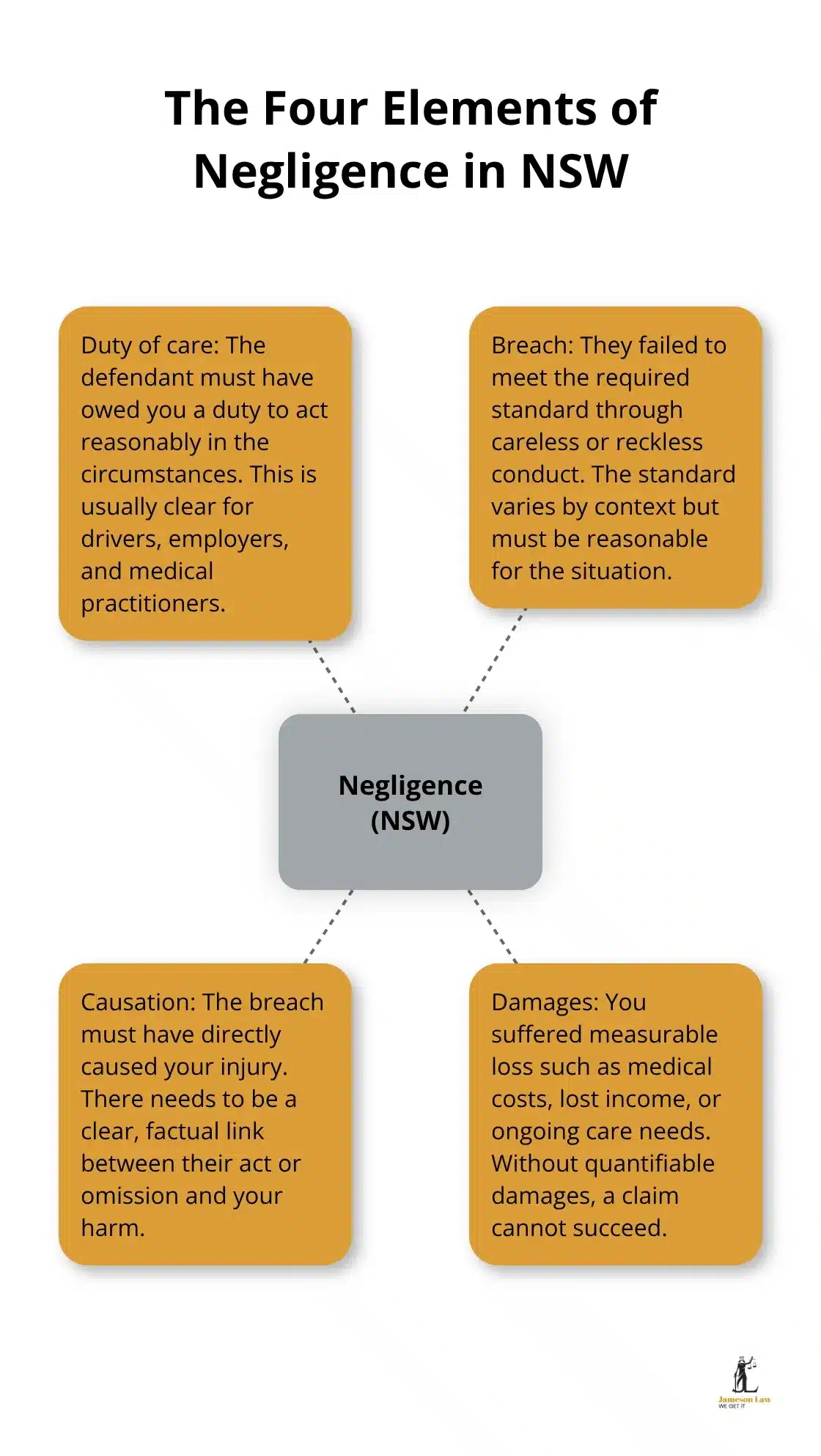
- Public Liability & Medical Negligence: Governed by the Civil Liability Act 2002 (NSW), requiring strict proof of duty of care, breach, causation, and damage.
For a detailed breakdown of how each regime operates, including the steps from the initial accident to resolution, read our comprehensive guide on personal injury NSW claims from first consultation to settlement.
How a Sydney Injury Lawyer Formulates an Evidence Strategy
The difference between a poorly structured claim and a robust one lies in how quickly and thoroughly your lawyer secures objective evidence.
Preserving Contemporaneous Evidence
Insurers heavily scrutinise the timing and consistency of your incident reports. A specialised lawyer will immediately act to subpoena CCTV footage, secure unedited incident reports from employers or venues, and obtain witness statements before memories fade.
Securing Independent Medico-Legal Reports
Your treating doctor’s clinical notes are necessary, but they are rarely sufficient for assessing long-term damages. An experienced lawyer will identify and brief independent, qualified medical specialists to assess your Whole Person Impairment (WPI), provide a prognosis, and map out your future care needs. This expert evidence is fundamental to substantiating economic and non-economic loss claims.
Legal Costs, Funding, and “No Win, No Fee” Caveats
Transparency in legal billing is mandated by the Legal Profession Uniform Law (NSW). When a lawyer offers to act on a “no win, no fee” basis, this is legally known as a conditional costs agreement. You must be extremely cautious and ensure you understand the specific terms and conditions of this agreement.
Strict Rules for Conditional Costs Agreements
For a conditional costs agreement to be valid in NSW, it must:
- Be in writing and presented in clear, plain language.
- Be formally signed by the client.
- Clearly define what constitutes a “successful outcome.”
- State that the client has the right to seek independent legal advice before entering the agreement.
- Provide a statutory cooling-off period of not less than 5 clear business days, during which the client may terminate the agreement without penalty.
Percentage Contingency Fees vs. Uplift Fees
It is crucial to understand that charging a percentage of your final settlement or compensation amount (a contingency fee) is strictly prohibited under Section 183 of the Uniform Law in NSW. Any lawyer quoting you a “percentage cut” of your payout is operating outside the law.
However, under Section 182, a law practice may charge a lawful uplift fee. This is a premium applied to the legal fees (excluding disbursements) for taking on the financial risk of the case. The uplift fee must not exceed 25% of the legal costs, and the law practice must hold a reasonable belief that a successful outcome is reasonably likely.
Scheme-Specific Funding and Regulated Costs
Depending on your claim type, specific funding options and cost caps apply:
- Workers Compensation (IRO/ILARS): Injured workers disputing an insurer’s decision may be eligible for funding through the Independent Review Office (IRO). Under the Independent Legal Assistance and Review Service (ILARS), the IRO pays the professional fees and disbursements of an approved lawyer directly, meaning no legal costs are passed to the worker.
- CTP Motor Accidents: Legal costs in CTP claims are strictly regulated and capped by SIRA regulations, depending on the stage of the claim and the amount in dispute.
Checklist: Questions to Ask When Choosing an Injury Lawyer
Selecting representation should be an objective, interview-style process. Use the following criteria to assess a prospective lawyer.
| Evaluation Area | Specific Questions to Ask | Why It Matters |
|---|---|---|
| Scheme Expertise | Are you an IRO Approved Lawyer? Do you regularly handle CTP or Public Liability claims? | Different regimes have distinct statutory thresholds and rules of evidence. |
| Costs & Disbursements | Will you charge an uplift fee? Who is responsible for out-of-pocket medical report fees if the claim fails? | Ensures full compliance with the Legal Profession Uniform Law and prevents surprise billing. |
| Delegation & Communication | Will a senior lawyer or a junior paralegal be managing the day-to-day work on my file? | Ensures you know who is actually executing your legal strategy and maintaining communication. |
| Conflict of Interest | Have you conducted a thorough conflict check against the defendant and their insurer? | A lawyer cannot represent you if they have a professional conflict with the opposing party. |
Frequently Asked Questions
Are percentage contingency fees legal for personal injury claims in NSW?
No. Under the Legal Profession Uniform Law (NSW), it is strictly prohibited for a law practice to charge a contingency fee calculated as a percentage of the amount of compensation or settlement you recover.
What is the cooling-off period for a conditional costs agreement in NSW?
A conditional costs agreement in NSW must provide a cooling-off period of not less than 5 clear business days, during which the client may terminate the agreement.
How does ILARS funding work for NSW workers compensation disputes?
The Independent Review Office (IRO) operates the Independent Legal Assistance and Review Service (ILARS). Subject to worker eligibility and the scope of an approved funding grant, an IRO-approved lawyer can seek payment from IRO for covered professional fees and reasonably necessary disbursements in a workers compensation matter.
Final Thoughts
Choosing the right Sydney injury lawyer involves far more than responding to a “no win, no fee” advertisement. It requires a critical assessment of the lawyer’s specific scheme experience, their transparency regarding statutory cost caps and uplift fees, and their strategic approach to gathering independent medical evidence.
By understanding your rights under a conditional costs agreement and knowing what funding options—such as IRO/ILARS—may be available to you, you can make an informed decision that protects your financial recovery.
If you require objective, transparent legal advice regarding a personal injury matter in New South Wales, contact Jameson Law to discuss your options with our experienced team.