

Moving to Sydney or NSW requires navigating multiple visa options, each with different requirements and timelines. We at Jameson Law help people understand the complete journey from initial visa through to citizenship.
This guide breaks down the main Sydney migration pathways NSW residents and newcomers can pursue. You’ll learn what each pathway involves and what steps come next.
Which visa pathway suits your move to Sydney
Australia offers three primary visa routes for people relocating to Sydney and NSW, each serving different circumstances and skill levels. The visa you choose determines your timeline, costs, and eligibility requirements, so understanding the differences matters before you apply. Assessing your qualifications, work experience, and personal circumstances against each pathway helps you identify the strongest option for your situation.
Skilled migration for qualified professionals
Skilled migration visas target people with qualifications and work experience in occupations listed on the skilled occupation lists maintained by the Department of Home Affairs. The most common pathway is the skilled independent visa, which uses a points-based system where you accumulate points for age, English language ability, work experience, qualifications, and state sponsorship. You need a minimum of 65 points to be eligible, though recent applications have required scores significantly higher due to demand.
Age matters substantially-applicants aged 25 to 32 receive 30 points, while those aged 33 to 39 receive 25 points, and the points decrease further as you age. Work experience in your nominated occupation adds points progressively, with at least one year of recent work experience required and points increasing up to 20 for eight or more years. Your qualification must receive recognition from the relevant Australian authority, and most applicants need an English language test result showing competent or proficient English.
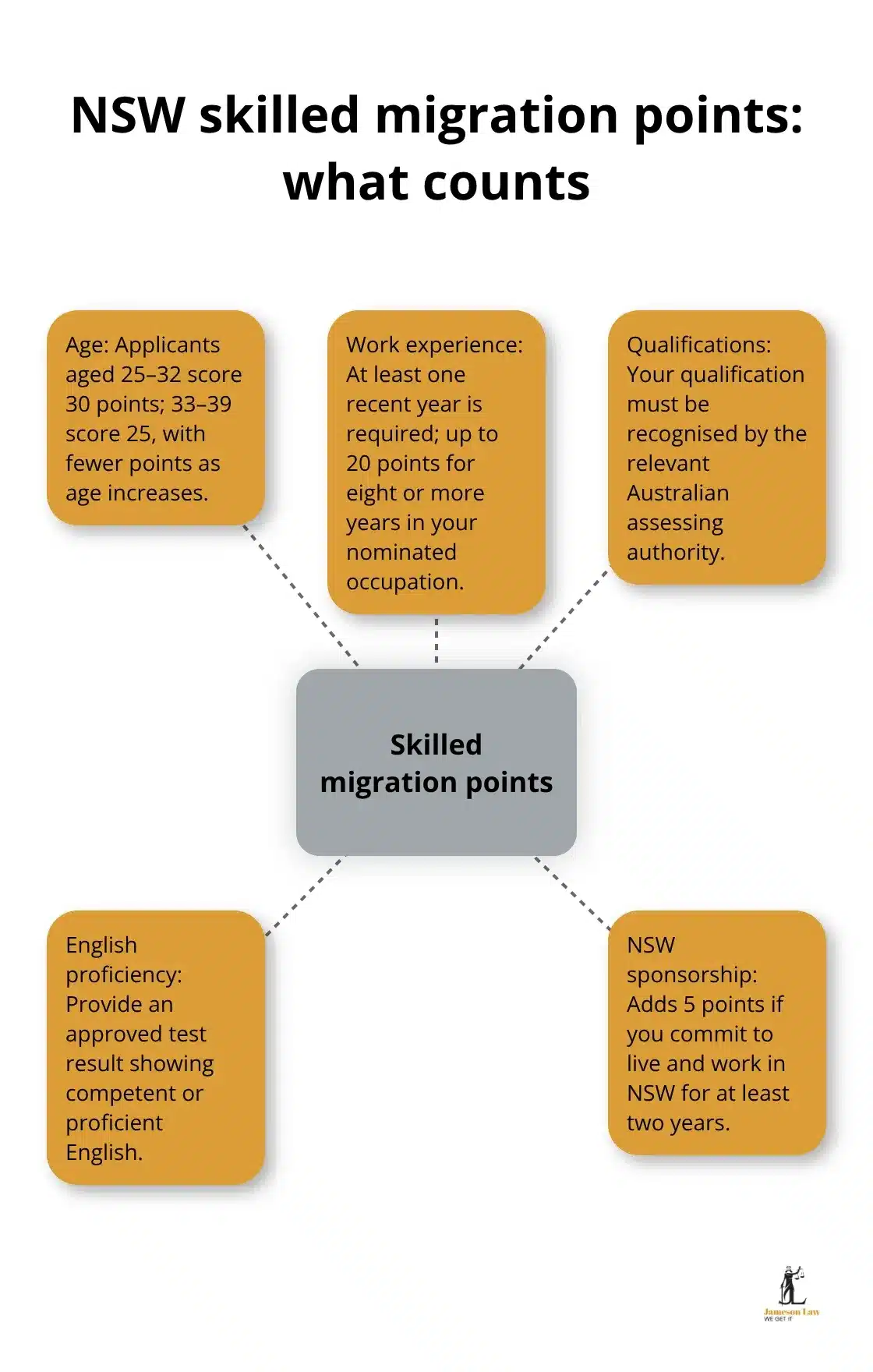
NSW offers state sponsorship which adds 5 points if you commit to living and working in the state for at least two years. Processing times for skilled independent visas currently range from 11 to 16 months, though some applications take longer depending on verification requirements.
Employment-based visas for faster outcomes
Employer sponsored visas bypass the points system entirely if a Sydney or NSW business nominates you for a specific role. These visas move faster because an employer has already committed to hiring you, reducing processing time to around 8 to 10 months for temporary skilled migration visas. This pathway avoids the points competition entirely, making it valuable if your qualifications don’t score highly or if your occupation isn’t listed on skilled occupation lists.
However, employer sponsored visas require your employer to meet strict obligations, and Home Affairs scrutinises the nomination carefully. The trade-off is clear: employment pathways offer certainty once approved, but they require an employer willing to sponsor you and commit to meeting regulatory requirements.
Family and partner visas for personal circumstances
Partner visas and family reunion visas offer another route if you have an Australian citizen or permanent resident spouse, de facto partner, or eligible family member willing to sponsor you. Partner visas typically process within 12 to 18 months, though this varies significantly based on your circumstances and whether Home Affairs requests additional information. These pathways avoid the points competition entirely, making them valuable if your qualifications don’t score highly or if your occupation isn’t listed on skilled occupation lists.
Family reunion visas have the longest waiting periods, sometimes exceeding three years, because Home Affairs considers them lower priority than skilled migration. Partner visas demand proof of genuine relationship and financial capacity from your sponsor, so documentation requirements are substantial. The advantage is straightforward: once approved, these visas provide certainty without competing against thousands of other applicants in the points system.
Understanding your next steps
Each pathway leads to permanent residency, but the requirements and timelines differ significantly. Your choice depends on whether you have employer support, family sponsorship, or strong points credentials. The next stage involves understanding how the points system works and what documentation you’ll need to strengthen your application.
Securing permanent residency in NSW
Occupation lists determine your eligibility
Permanent residency in NSW depends heavily on your points score if you pursue skilled migration, and this score determines whether Home Affairs considers your application seriously. The Department of Home Affairs maintains two critical occupation lists: the skilled occupation list and the regional skilled migration occupations list. Your nominated occupation must appear on one of these lists-this requirement is non-negotiable. If your job title doesn’t match occupations on these lists, your application fails before points calculation even begins.
The skilled occupation list contains around 400 occupations across engineering, healthcare, IT, trades and other fields. The regional list includes additional occupations for areas outside Sydney’s metropolitan zone. NSW state sponsorship adds 5 points if you commit to living in NSW for two years, which many applicants use strategically to reach the 65-point minimum.
Points competition has intensified significantly
Recent successful applications have scored considerably higher than the 65-point minimum due to competition. Many approved skilled independent visas exceeded 80 points, particularly for popular occupations like software engineers and accountants. This means achieving 65 points rarely guarantees approval; you need substantially more to remain competitive.
Work experience in your nominated occupation significantly influences your score. Home Affairs requires evidence that your work directly relates to your nominated job. They scrutinise employment letters, payslips, tax returns and work references carefully, and vague job descriptions that don’t align with your occupation title commonly result in rejected experience claims.
Documentation must be complete and precise
Home Affairs requires certified copies of your qualifications, English language test results from approved providers like IELTS or PTE, police clearances from every country you’ve lived in for more than six months, and health examinations from panel doctors. Your work experience needs supporting evidence from each employer, including detailed employment letters confirming dates, duties and salary.
Many applicants underestimate the documentation burden and lodge incomplete applications, which triggers requests for further information that delay processing by months. Submitting complete, accurate documentation upfront rather than providing information progressively as Home Affairs requests it remains the key to faster processing.
Processing timeframes vary by visa type
Skilled independent visas currently process within 11 to 16 months according to Home Affairs published data, though applications requiring additional verification or police checks from multiple countries frequently exceed these timeframes. State-sponsored applications through NSW often process faster, typically within 12 to 14 months, because the state has already assessed your occupational need.
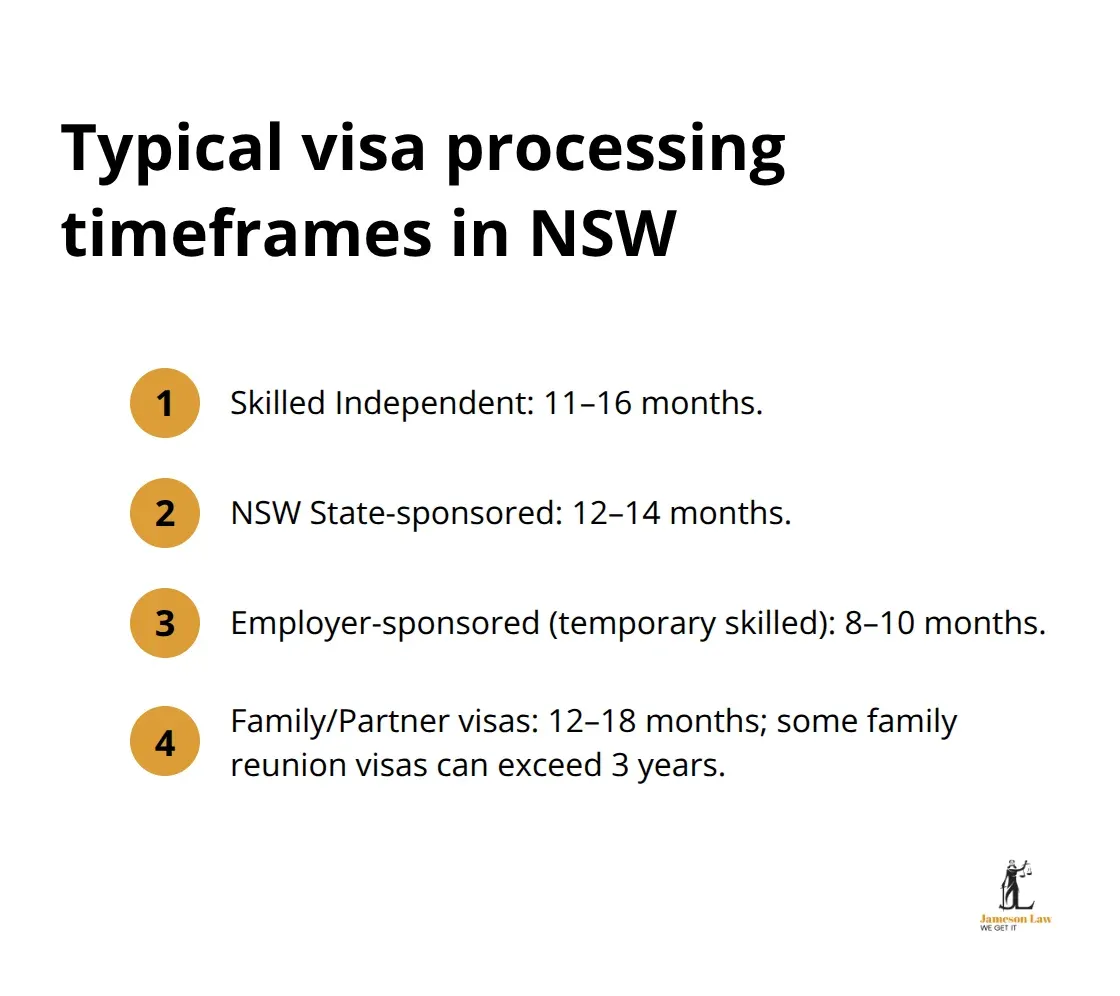
Employer-sponsored temporary skilled migration visas remain the fastest option, processing within 8 to 10 months when your employer has prepared documentation correctly. The pathway you select directly affects how long you wait for a decision.
Your next step involves understanding residency requirements
Once you secure permanent residency, your focus shifts to the obligations that come with this status and the pathway toward citizenship. The residency requirements for permanent residents differ from those applying for citizenship, and understanding these distinctions early helps you plan your long-term settlement in NSW.
From permanent residency to citizenship
Residency requirements before you apply
Permanent residency in NSW provides the foundation for settling long-term, but citizenship offers legal security that residency cannot match. You must hold permanent residency for at least four years before applying for citizenship, and within those four years you need to be physically present in Australia for a minimum of two years according to the Department of Home Affairs. This doesn’t mean you can travel freely during this period, however.
Home Affairs examines your absences carefully, and if you spend more than 12 months outside Australia during your four-year residency period, you become ineligible regardless of whether you’ve met the two-year physical presence requirement. The calculation matters enormously because a single extended overseas trip can reset your eligibility clock entirely. Your tax residency status, Medicare registration, and employment records all form part of Home Affairs’ assessment of whether you’ve genuinely settled in Australia, so maintaining these connections throughout your residency period strengthens your eventual citizenship application.
The citizenship test and English language assessment
The citizenship test itself focuses on Australian history, government, values and the rights and responsibilities of citizens. Home Affairs publishes the official study material online so you know exactly what content to prepare. The test involves 20 multiple-choice questions and you need 15 correct answers to pass.
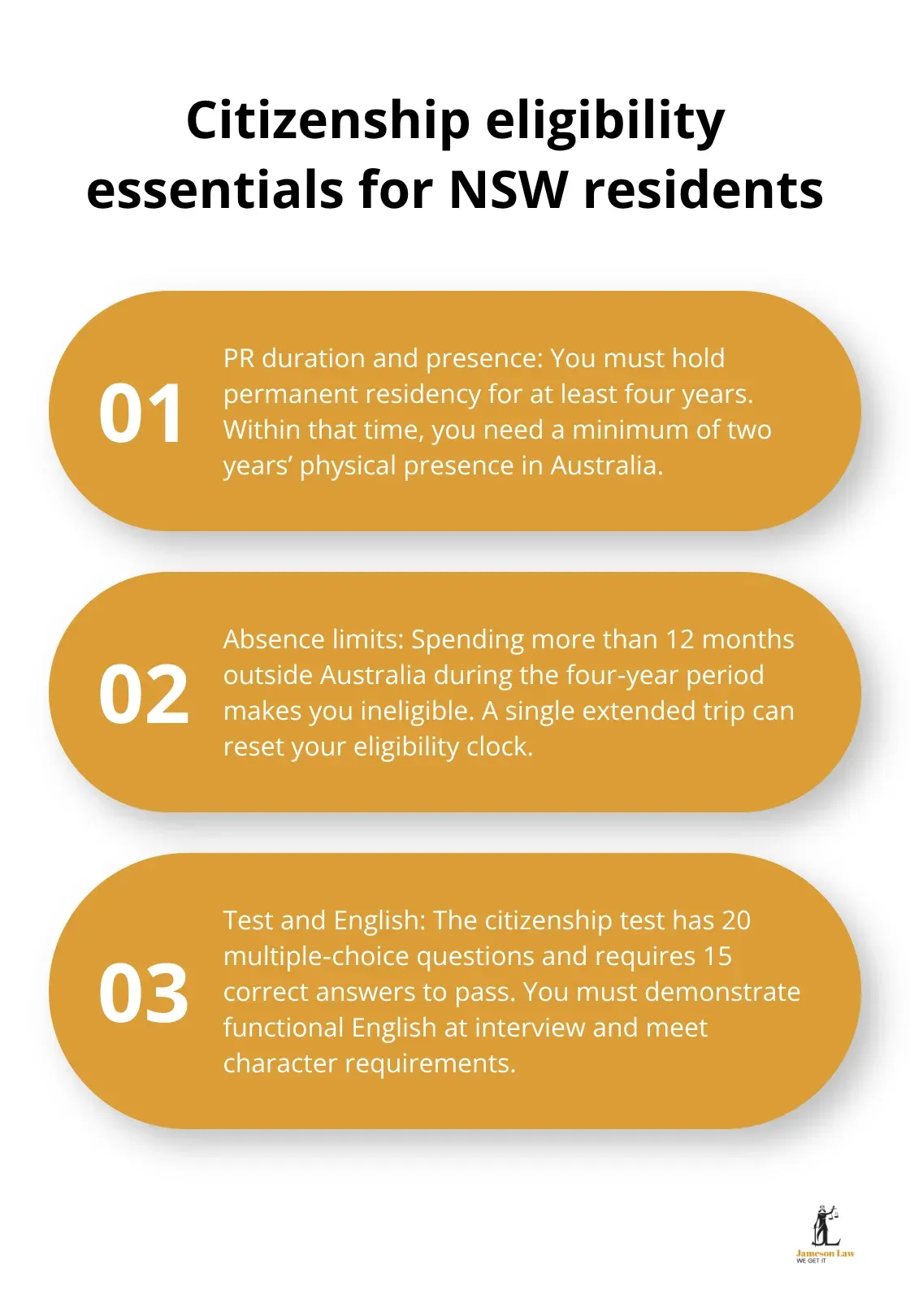
The real challenge lies in the English language requirement, which demands you can speak and understand English at a functional level during your citizenship interview. Home Affairs officers conduct this interview to assess whether you meet the character requirements for citizenship, and they’ll question you about your answers on the application form, your employment history, your ties to the Australian community, and your understanding of Australian values (including respect for the rule of law and democratic beliefs).
Character assessment and application accuracy
Character assessment involves checking your police records from every country you’ve lived in, and any criminal convictions can result in citizenship refusal. Your application form must be completed with absolute accuracy because any inconsistencies or false statements discovered during processing will result in rejection. Home Affairs takes fraud allegations seriously and will investigate discrepancies thoroughly.
You need to provide certified copies of all police clearances and declare any criminal history. Omitting information or providing inaccurate details on your citizenship application creates grounds for refusal that can be difficult to overcome.
The citizenship ceremony and your new rights
Once Home Affairs approves your application, you attend a citizenship ceremony where you take the pledge of allegiance to Australia. From that moment you hold the full rights of Australian citizenship including the ability to vote in federal and state elections, hold an Australian passport, and access government benefits available only to citizens. The transition from permanent resident to citizen represents the final step in your migration journey to NSW and Australia.
Final Thoughts
Sydney migration pathways NSW require you to make strategic decisions at each stage of your journey. Your initial visa choice determines your timeline, costs, and documentation requirements, while your permanent residency status opens the door to citizenship after four years of genuine settlement. The entire process typically spans four to six years, with skilled migration taking 11 to 16 months, employer sponsorship moving faster at 8 to 10 months, and family visas ranging from 12 to 18 months for approval.
Home Affairs scrutinises applications carefully, and incomplete documentation or inaccurate information can delay processing by months or result in refusal. Character assessments, points calculations, and English language requirements all demand attention to detail before you submit your application. Professional legal review of your circumstances, documentation, and application form protects you against costly mistakes that could derail your migration plans.
We at Jameson Law help people navigate these pathways with confidence and clarity. Contact us to discuss your specific circumstances and identify the strongest approach for your move to NSW.