Personal injury claims in NSW come with financial limits that many people don’t understand until it’s too late. These NSW personal injury limits can significantly affect how much compensation you receive, regardless of how serious your injury is.
At Jameson Law, we’ve seen countless claimants surprised by caps on weekly payments, medical expenses, and lump sum amounts. Knowing these limits upfront helps you plan your claim strategy and understand what to realistically expect.
Why NSW Personal Injury Claims Have Different Caps
Statutory caps exist because NSW law deliberately limits compensation in personal injury claims. This isn’t arbitrary-it’s a policy decision to manage insurance costs and provide predictable outcomes. The Civil Liability Act 2002 and other NSW legislation set these limits across different claim types, and they vary significantly depending on how your injury occurred. Workers’ compensation claims follow different caps than motor vehicle injuries, which follow different limits again from general civil liability claims. Understanding which regime applies to your situation is the first step to knowing what you can realistically recover.
Which Regime Governs Your Claim
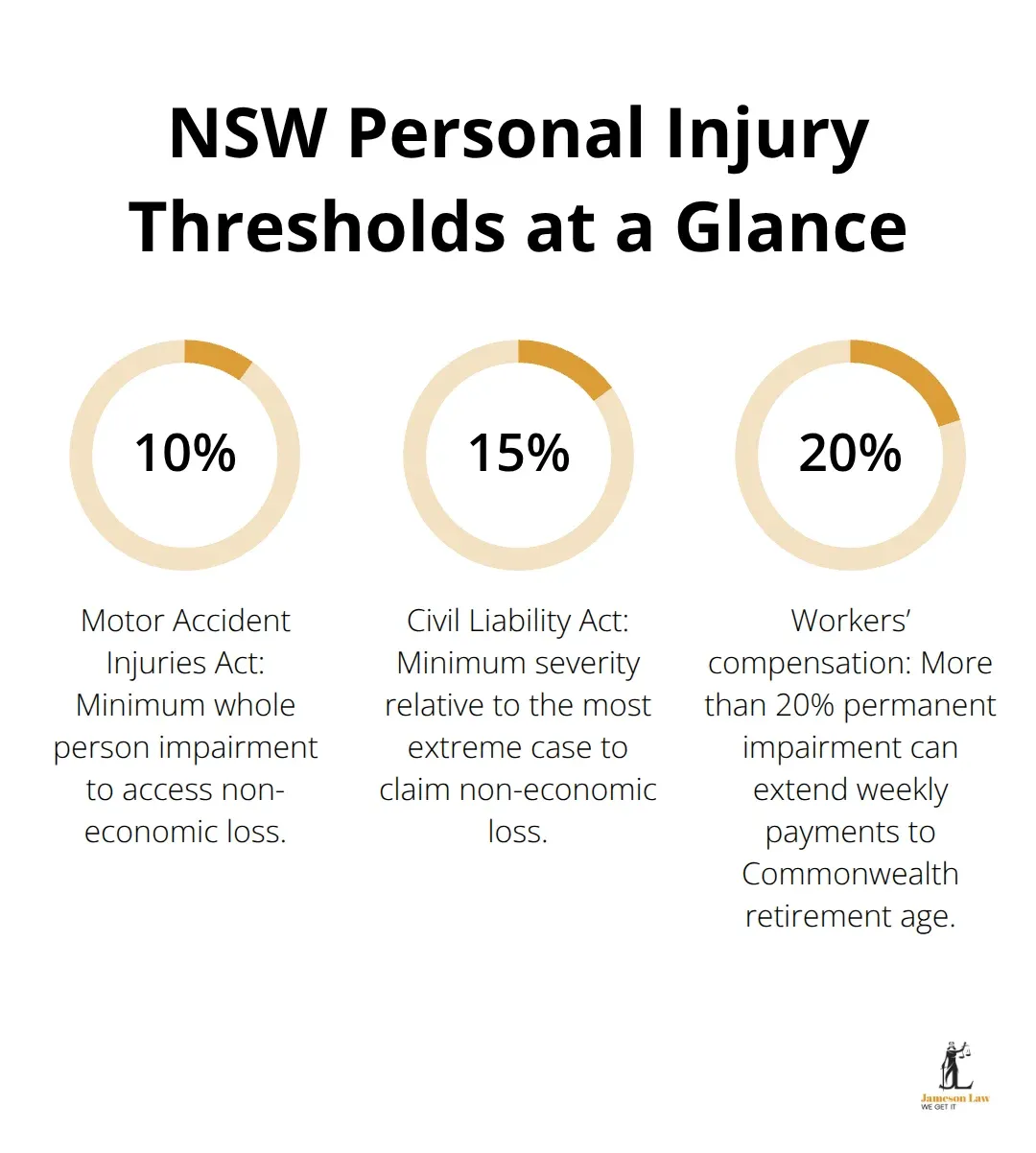
If you were injured at work, your claim falls under the Workers Compensation Act 1987, with weekly payment caps starting at up to 95% of your pre-injury average weekly earnings for the first 13 weeks, then reducing to up to 80% from weeks 14 to 130. Most workers’ compensation weekly benefits are capped at five years, though workers with more than 20% permanent impairment may receive payments until Commonwealth retirement age. If a motor vehicle accident caused your injury, the Motor Accident Injuries Act 2017 applies to accidents from 1 December 2017 onwards, providing no-fault statutory benefits but with significantly different caps for economic and non-economic loss. For other injuries-slips, falls, or negligence by a non-employer third party-the Civil Liability Act 2002 applies, capping non-economic loss at a maximum of $804,000 as at 1 October 2025, but only if your injury reaches the 15% severity threshold. Each regime has distinct thresholds and maximums, so the compensation available to you depends entirely on which law governs your circumstances.
Economic Loss Caps Differ Dramatically Between Regimes
Under the Civil Liability Act 2002, past economic loss for wages is capped at three times the NSW average weekly earnings, which was $2,010 per week around May 2025. This means if you’ve lost wages, the maximum you can recover for past income is capped at approximately $6,030 per week, regardless of what you actually earned. Motor vehicle claims under the Motor Accident Injuries Act 2017 cap damages for economic loss by disregarding any net weekly earnings above $6,334 per week. Workers’ compensation doesn’t use this earnings multiple approach at all-instead, it pays a percentage of your pre-injury average weekly earnings, capped at the weekly rate, which means your actual recovery depends on what you were earning before the injury, not on a statutory multiple. These fundamentally different approaches mean two people with identical injuries and identical income losses receive vastly different compensation depending on whether the injury came from a workplace accident, a motor vehicle crash, or a slip on a shop floor.
Non-Economic Loss Thresholds Lock Most Claimants Out
The Civil Liability Act 2002 requires your injury to reach at least 15% severity relative to the most extreme case before you can recover anything for pain and suffering, loss of amenity, or disability. This is a substantial threshold that excludes minor to moderate injuries entirely. Once you meet that threshold, the maximum you can recover is $804,000 as at 1 October 2025. Motor vehicle claims under the Motor Accident Injuries Act 2017 require a 10% impairment threshold for non-economic loss, which is lower than the Civil Liability Act but still excludes many injured people. Workers’ compensation doesn’t compensate for pain and suffering at all-instead, it provides lump sum payments only for permanent impairment assessments, calculated separately from weekly payments. This means if you suffered a moderate injury that doesn’t reach the 15% threshold under civil liability law, you receive nothing for your pain and suffering, even if the injury genuinely affects your quality of life.
How These Thresholds Affect Your Recovery Strategy
The regime that applies to your claim determines not just the dollar amounts you can recover, but whether you can recover anything at all for certain types of loss. A worker injured at work cannot pursue pain and suffering damages through workers’ compensation, but may have limited common law rights depending on the circumstances. A person injured in a motor vehicle accident can access no-fault benefits immediately, but faces different caps than someone injured through a slip and fall. Someone injured by a third party’s negligence (outside work and motor vehicles) must clear the 15% severity threshold just to access non-economic loss compensation. These different pathways mean your claim strategy must start with identifying which regime applies, because that determination shapes every aspect of what you can realistically recover. The next section outlines the specific cap amounts that currently apply across these regimes, so you can see exactly how these thresholds translate into dollar limits on your claim.
Current Cap Amounts and How They Apply
Civil Liability Act Caps on Economic Loss
The Civil Liability Act 2002 caps on economic loss for wages at three times the NSW average weekly earnings. As at May 2025, the NSW average weekly total earnings sat at $2,010 per week, meaning your past economic loss for wages cannot exceed approximately $6,030 per week, no matter how much you actually earned. This cap applies strictly to gross weekly earnings, so if you earned $5,000 per week before your injury, you can only recover damages based on $6,030 per week. If you earned $8,000 per week, your recovery still caps at $6,030. The mathematical reality is stark: claiming you lost $10,000 per week in earnings might reflect your actual income, but the law limits your recovery far lower regardless of your injury’s impact on your earning capacity.
Non-economic loss under the Civil Liability Act reaches a maximum of $691,000, but only if your injury severity reaches at least 15% relative to the most extreme case. This threshold excludes many injured people entirely. Medical and treatment expenses are recoverable as out-of-pocket costs when they are reasonable and necessary for treatment, rehabilitation, or disability aids, but they are not separately capped. Instead, the law assesses them as part of your overall pecuniary loss claim.
Workers’ Compensation Payment Structures
Workers’ compensation operates on a fundamentally different basis than civil liability claims. Weekly payments for general workers start at up to 95% of your pre-injury average weekly earnings for the first 13 weeks, then drop to 80% from weeks 14 to 130. Most benefits cap at five years unless you have more than 20% permanent impairment, in which case you may receive payments until Commonwealth retirement age. Workers with the highest needs (over 30% impairment) can receive up to $1,060 per week, with a weekly cap of $2,662.10 as at 1 April 2026. These figures shift twice yearly when indexation applies in April and October, so the amounts you see today will not match what applies to your claim settlement.
Motor Vehicle Injury Limits
Motor vehicle claims under the Motor Accident Injuries Act 2017 cap economic loss at $6,334 per week and require 10% impairment before you access any non-economic loss compensation. The maximum for non-economic loss sits at $691,000. This regime differs substantially from both civil liability and workers’ compensation, creating a third distinct pathway for injured claimants. The differences between these three regimes mean two people with identical injuries and identical income losses receive vastly different compensation depending on whether the injury came from a workplace accident, a motor vehicle crash, or a slip on a shop floor.
Gratuitous Care and Commercial Care Thresholds
Gratuitous care damages-compensation for unpaid care provided by family or friends-have strict requirements that many claimants miss entirely. You must prove at least six hours per week of care provided for six consecutive months before you can recover anything. Once you meet that threshold, the maximum rate is calculated at one-fortieth of the NSW average weekly earnings per hour if care is under 40 hours per week, or the full weekly rate if it exceeds 40 hours. As at May 2025, this means gratuitous care is capped at approximately $50.25 per hour for care under 40 hours weekly, or $2,010 per week for full-time care. Commercial care costs-paid care services-are recoverable separately and are not subject to the same hourly rate cap, but they must be reasonable and necessary for your injury.
How Indexation Changes Your Recovery Amount
These figures shift twice yearly when indexation applies in April and October, so the amounts you see today will not match what applies to your claim settlement. A claim settled six months from now will use different cap amounts than one settled today. This timing matters significantly because higher indexation rates increase the caps available to you, while lower rates reduce them. Understanding which indexation date applies to your claim-and when your settlement will be finalised-helps you anticipate the actual dollar limits that will govern your compensation. The next section examines the circumstances where claimants can exceed these standard caps and the catastrophic injury classifications that unlock higher payment thresholds.
Breaking Through Standard Caps
The caps outlined in the previous section represent the default limits, but they are not absolute ceilings for every claim. NSW law recognises specific circumstances where claimants access compensation beyond these standard thresholds, and understanding these pathways matters enormously because they can double or triple what you ultimately recover.
Higher Payments for Severe Permanent Impairment
Workers with permanent impairment ratings above 20% under workers’ compensation legislation receive weekly payments extending to Commonwealth retirement age rather than the standard five-year cap, fundamentally changing the lifetime value of their claim. Under the Civil Liability Act 2002, the non-economic loss cap applies only to claims that meet the 15% severity threshold; claims exceeding this threshold receive damages calculated according to a defined table that reflects the percentage severity relative to the most extreme case, meaning a 50% severity injury generates substantially higher non-economic loss than a 15% severity injury at the same cap level.
Exempt Worker Classifications and Alternative Payment Structures
Workers classified as exempt under the workers’ compensation scheme-police, paramedics, firefighters, and coal miners-operate under the pre-2012 scheme entirely, receiving up to $2,662.10 per week for the first 26 weeks, then up to 90% of current weekly wage with a maximum of $626.10 per week plus dependent allowances. This creates a completely different payment structure that often yields higher lifetime benefits than general workers receive.

The Dust Diseases Act 1942 provides weekly benefits up to 26 weeks at current weekly wage, then up to a maximum of $626.10 per week depending on impairment level, but critically, dust diseases claims also permit common law damages through the Dust Diseases Tribunal for permanent impairment and pain and suffering. This dual compensation pathway exists nowhere else in NSW personal injury law and can unlock six-figure awards for claimants who establish negligence before the tribunal.
Claims Excluded from Standard Caps
Certain claims fall outside the capping framework altogether. Intentional acts, sexual abuse claims, and claims arising from criminal conduct are excluded from the Civil Liability Act 2002 caps, meaning compensation in these categories may exceed the standard limits depending on the facts. Estate and dependency claims following a deceased claimant’s death operate under modified rules where the estate recovers surviving damages including medical expenses and funeral costs, while dependants pursue separate dependency claims for loss of financial support calculated on the lost earnings the deceased would have provided-these claims interact with other compensation sources but are not subject to the same per-week earning multiples that apply to living claimants.
Motor Vehicle Claims and Fault-Based Variations
Motor Accident Injuries Act 2017 claims for non-fault claimants with impairment exceeding 10% access non-economic loss compensation up to $691,000, but at-fault claimants face reduced benefits and significantly different recovery pathways. This creates a two-tiered system within a single regime. The practical reality is that identifying whether your circumstances fall into one of these higher-value categories requires detailed legal analysis of your injury type, employment status, and the specific legislation governing your claim-a miscalculation at this stage costs you tens of thousands in lost compensation. Having your claim assessed against all applicable regimes and exceptions before accepting any settlement offer matters significantly, because the difference between a standard-cap claim and an exception claim often determines whether your compensation adequately covers your long-term medical and income needs or leaves you substantially short.
Final Thoughts
NSW personal injury limits fundamentally shape what you can realistically recover, and understanding these caps before you settle your claim prevents costly mistakes. The regime that applies to your injury-workers’ compensation, motor vehicle legislation, or civil liability law-determines not just the dollar amounts available, but whether you can recover anything at all for pain and suffering or lost wages. A claim worth $500,000 under one regime might be worth $150,000 under another, depending entirely on which legislation governs your circumstances.
Your claim strategy must start by identifying which regime applies and whether your injury qualifies for any exceptions that unlock higher payment thresholds. Workers with severe permanent impairment ratings, exempt workers like police and firefighters, and dust diseases claimants access compensation pathways that exceed standard caps significantly. Indexation changes twice yearly in April and October, so the cap amounts shift throughout the year and timing your claim resolution strategically can increase what you receive.
Contact Jameson Law to have your claim assessed against the full range of applicable NSW personal injury limits and exceptions so you understand what you can realistically recover. We provide personal injury legal assistance on a no win no fee basis for plaintiff claims, meaning you pay no legal fees unless we recover compensation for you. The difference between accepting a settlement based on standard caps and having your claim properly assessed often determines whether your compensation adequately covers your long-term needs.