PUBLICATION

Slip Fall NSW Claim: How to Make a Successful Injury Claim

"Understand your slip fall NSW claim rights, gather evidence, and learn steps to build a strong personal injury case."
Slip Fall NSW Claim: How to Make a Successful Injury Claim

A slip and fall accident can happen in seconds, but the consequences often last much longer. If you’ve been injured due to someone else’s negligence in NSW, you have the right to pursue compensation.

At Jameson Law, we help injured Australians understand their slip fall NSW claim options and navigate the legal process. This guide walks you through what you need to know to build a strong case.

What Counts as a Slip and Fall in NSW

Definition and Legal Framework

A slip and fall injury in NSW occurs when you suffer harm on someone else’s property because of a hazard they failed to manage. This might be a wet floor in a supermarket, a spill in a café, an uneven surface on a footpath, or a leak that creates a slippery area. The key distinction is that the injury must result from negligence-meaning the property owner or occupier knew about the hazard, or should have known about it, and failed to take reasonable steps to fix or warn about it.

Under the Civil Liability Act 2002 (NSW), property owners and occupiers have a duty of care to keep their premises reasonably safe for visitors and invitees. If they breach that duty and you suffer injury as a result, you have grounds for a claim.

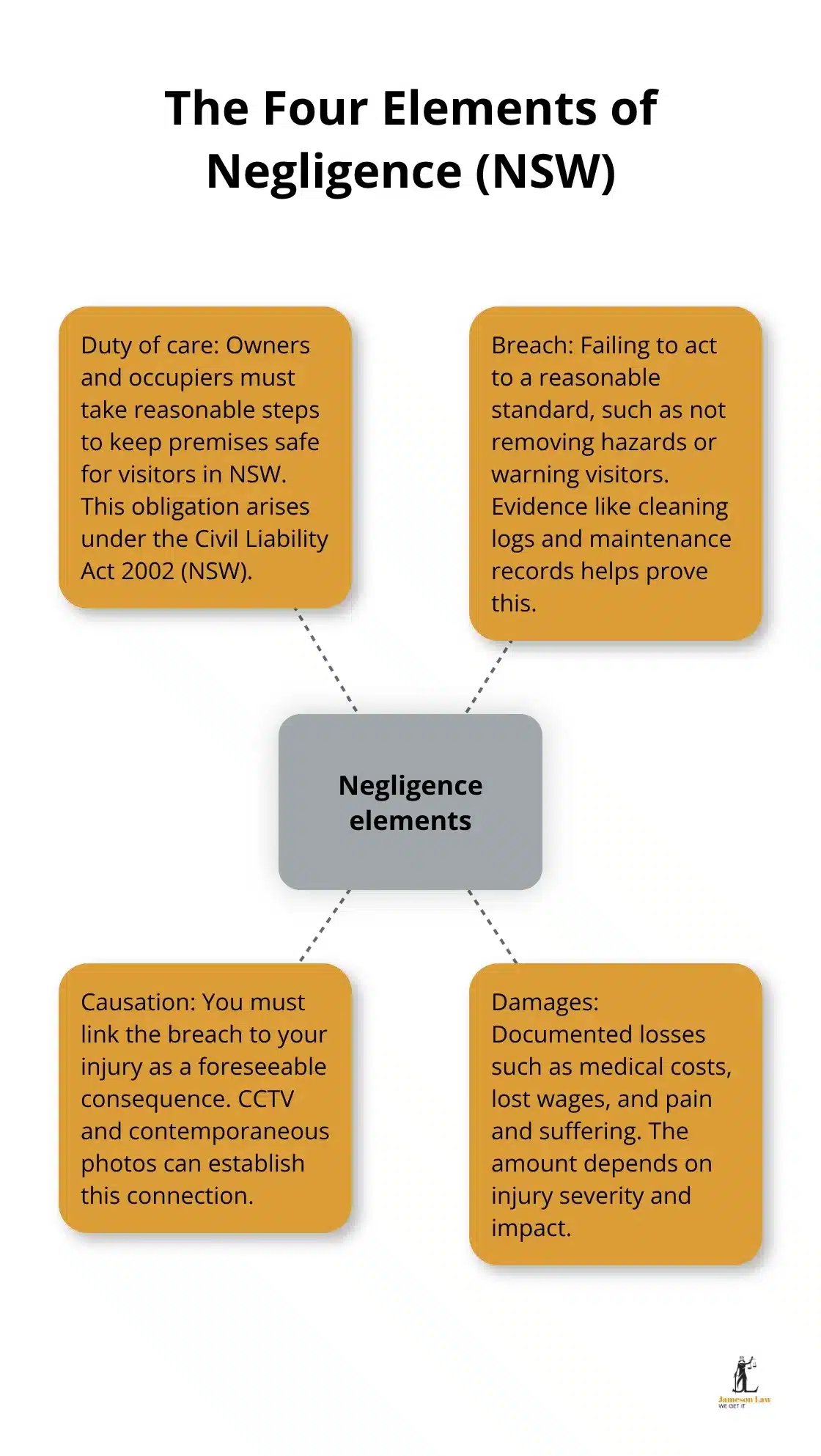
Visual summary of the four negligence elements for NSW slip and fall claims - Slip fall NSW claim

Types of Injuries and Compensation

The injury itself can range from a minor sprain to a serious fracture or head injury. Compensation covers medical costs, lost wages, travel expenses, domestic assistance, pain and suffering, and future losses related to your injury. Even delayed-onset injuries or those that seem minor initially can support a valid claim if they required medical treatment or caused lost income.

Common Locations for Slip and Fall Claims

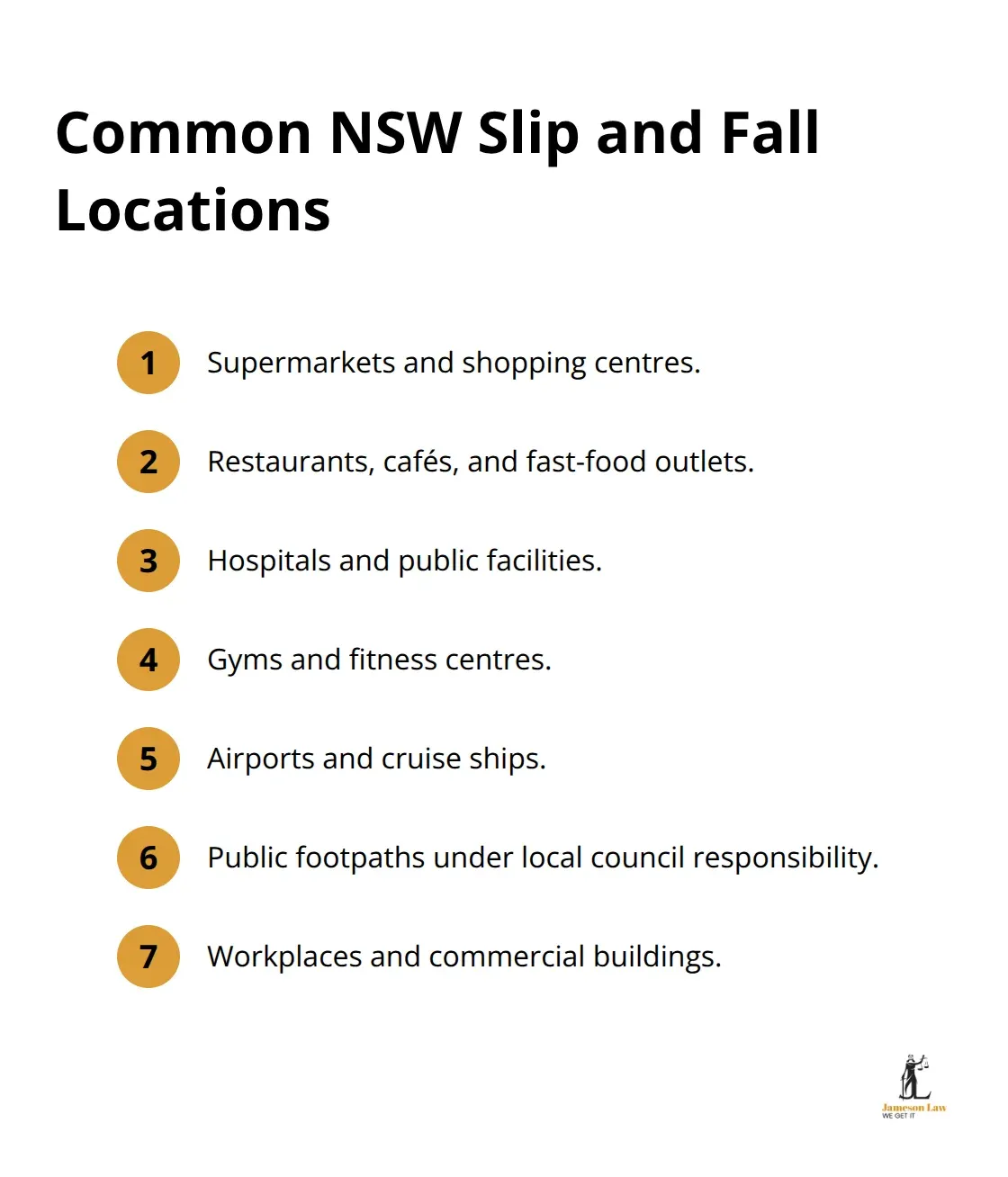
Slip and fall accidents happen across NSW in retail environments, hospitality venues, public facilities, and workplaces. Supermarkets and shopping centres account for a significant portion of these claims, particularly when cleaning procedures are inadequate or hazards aren’t cordoned off. Restaurants, cafés, fast-food outlets, and hospitals also see frequent slip incidents due to wet floors and spills. Gyms, airports, cruise ships, and public footpaths under local council responsibility are common claim locations as well.

Compact list of frequent locations for slip and fall claims in NSW

Establishing Responsibility and Liability

The venue matters because it establishes who has responsibility for maintaining safety. A retailer must address spills immediately; a building manager must maintain floors properly; a landlord must keep common areas safe. If you slipped on a public footpath in NSW, the local council is typically responsible, though council claims can be more challenging to pursue.

The type of hazard also influences your claim’s strength. Wet floors from cleaning, roof leaks, and uneven surfaces create clear liability when the occupier failed to act. Understanding who bears responsibility for the hazard and what steps they should have taken forms the foundation of your case-which is why establishing negligence becomes your next critical focus.

Establishing Negligence in Your Slip and Fall Claim

The Four Elements of Negligence

Establishing negligence in NSW slip and fall claims rests on four essential elements: duty of care, breach of that duty, causation, and damages. Property owners and occupiers owe a duty of care to keep premises reasonably safe for visitors and invitees, but this duty isn’t absolute. Courts assess whether a reasonable property manager would have identified and managed the hazard in question. A breach occurs when the occupier fails to act to a reasonable standard-either by failing to remove the hazard, failing to warn about it clearly, or failing to maintain the area properly. You must prove the breach directly caused your injury as a foreseeable consequence of their negligence, not merely that you happened to slip. Establishing this chain of causation requires concrete evidence linking the hazard to your specific injury.

What Damages Cover

Damages encompass medical costs, lost wages, travel expenses, domestic assistance, and pain and suffering. The maximum general damages payout in NSW for pain and suffering reached approximately $804,000 as of March 2026, though most claims settle for substantially less depending on injury severity and impact on your life.

Evidence That Wins Claims

The evidence you gather determines whether your claim succeeds or fails. Photograph the hazard immediately if possible, showing its exact condition and location. Obtain witness contact details from anyone who saw the incident or the hazard. Collect all medical records, accident reports, and any incident documentation the property owner created. Request CCTV footage from the location, as many retailers and facilities maintain security recordings that can prove the hazard existed and that staff failed to address it. Obtain cleaning logs and maintenance records, which often reveal whether the occupier was aware of the problem but neglected to act. Two quotes for repair costs or tax invoices for expenses you incurred demonstrate your financial losses.

Time Limits for Filing Your Claim

After a slip and fall, most NSW claims must be filed within three years from the injury date under the Limitation Act 1969 (NSW). If you’re under 18, the clock doesn’t start until your 18th birthday. Delayed onset injuries may have a later limitation date tied to when you became aware of the injury’s connection to the incident. Act promptly to preserve evidence and report the incident to the property owner or manager in writing, as this creates a documented record showing they were notified of the problem. The sooner you take action, the stronger your position becomes-and the next step involves knowing exactly what to do immediately after the accident occurs.

Steps to Take After a Slip and Fall Accident

Photograph and Document the Hazard Immediately

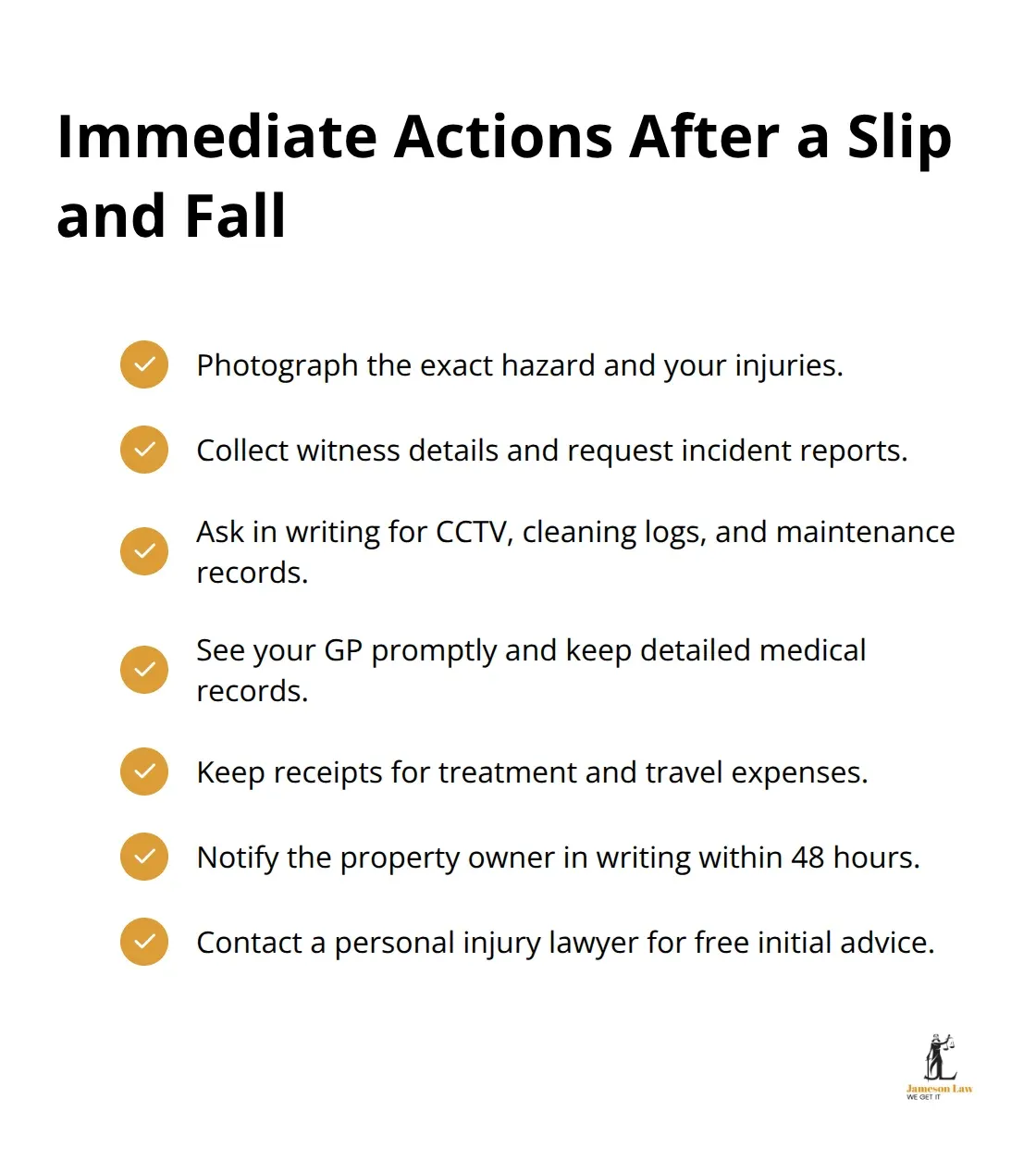
The first hour after a slip and fall accident determines how strong your claim becomes. Most people focus on their immediate pain and forget to gather the evidence that will later prove negligence. Act differently. Before you leave the location, photograph the exact hazard that caused your fall from multiple angles, showing its condition and surroundings. If the floor was wet, capture that. If there was a broken tile or uneven surface, document it clearly. Take photos of your immediate injuries as well, as visual evidence of fresh wounds supports your account.

Collect Witness Information and Request Records

Obtain the names and contact details of every person who witnessed your fall or saw the hazard beforehand-these witnesses become invaluable when the property owner later disputes what happened. Ask staff at the location for an incident report or accident book entry, as many supermarkets, cafés, and retail venues maintain these records. Request CCTV footage in writing, either by email or letter addressed to the manager, as this preserves your right to access it and creates a documented request the property owner cannot ignore. Secure cleaning logs and maintenance records if possible, as these reveal whether staff knew about the hazard but failed to address it. Do not accept vague assurances that the footage will be kept or the records are available-get written confirmation, because footage is often deleted within 30 days and records can conveniently disappear.

Seek Medical Attention and Keep Records

Seek medical attention immediately, even if your injury seems minor. Many slip and fall injuries worsen over days or weeks, and delayed medical treatment weakens your claim because insurers argue the injury wasn’t serious enough to warrant immediate care. Visit your GP first and request detailed medical records documenting your symptoms, examination findings, and any referrals to specialists. Keep all receipts for medical appointments, physiotherapy, medication, and travel to treatment, as these form part of your damages calculation.

Checklist of steps to take after a slip and fall in NSW - Slip fall NSW claim

Notify the Property Owner in Writing

Notify the property owner or manager in writing within 48 hours-email works, but a formal letter creates stronger evidence. Include the date, time, and exact location of your fall, a brief description of the hazard, the names of witnesses, and your injuries. Do not minimise your injuries or accept blame; state only the facts. If you report verbally, follow up with a written confirmation email. Many NSW claims settle within 9 to 18 months, but this timeline depends entirely on how thoroughly you document everything now.

Contact a Personal Injury Lawyer

Contact a personal injury lawyer within the first week while evidence is fresh and witnesses remain contactable. We at Jameson Law offer free initial advice by phone or online enquiry, and we handle slip and fall claims on a no win, no fee basis for injured people, meaning you pay nothing unless your claim succeeds.

Final Thoughts

A successful slip fall NSW claim rests on evidence you collect in the first hours after your accident. Photographs of the hazard, witness statements, medical records, and maintenance logs transform your account into proof that the property owner breached their duty of care and caused your injury. Without this documentation, even legitimate claims become difficult to pursue because insurers will argue the hazard wasn’t obvious or your injuries aren’t as serious as you claim.

Legal representation levels the playing field against insurers who are skilled at minimising payouts. A personal injury lawyer assesses your claim’s true value, gathers evidence the property owner might otherwise conceal, and negotiates on your behalf to secure fair compensation. Most NSW slip and fall claims settle within 9 to 18 months when handled properly, but this depends entirely on having a lawyer who understands how your injury affects every aspect of your life.

We at Jameson Law handle slip and fall claims on a no win, no fee basis, meaning you pay nothing unless your claim succeeds. Contact Jameson Law by phone or online enquiry to discuss your situation and receive free initial advice about what compensation you might expect. The sooner you act, the stronger your position becomes.

Speak to an Expert Lawyer today

Laywers-Jameson-Law-The-best-law-firm-in-Sydney- Sydney Lawyers - Sydney
BOOK NOW

WE'RE IN IT TO WIN IT

Book your consultation

Book Now
Book Now Mobile 06 02 2025

This form submission is encrypted and secured to ensure your information remains confidential.

What our Clients

Related Publications:

What our clients say

.

Jameson Law - Voted the Best Law firm in Sydney Award

Legal Answers ... In Short

We're here to help

Our mission is to ensure our client matters are resolved successfully every time. Success to us does not simply involve winning, but moreover ensuring we take the most feasible, economic and stress-free path to help our clients achieve their goals. We fight hard for our clients, and always go by the motto: we’re in it to win it.

Jameson Law - Best Law Firm in Sydney

WE'RE IN IT TO WIN IT

Book your consultation

Call us now on (02) 8806 0866 or fill out the form below

Book Now Mobile

This form submission is encrypted and secured to ensure your information remains confidential.

WE'RE IN IT TO WIN IT

Book your consultation

Book Now Mobile 06 02 2025
lock

This form submission is encrypted and secured to ensure your information remains confidential.

Our Sydney Offices

Offices Parramatta and Sydney Jameson Law
Parramatta CBD - Head Office
jameson Law - Blacktown
jameson Law - Liverpool Office
Jameson Law - Bankstown
Court Houses We Frequent Jameson Law

Court Houses We Frequent

Balmain Local Court

Registry: Monday to Friday, 9:00am to 4:30pm

Bankstown Local Court

Court Operating Hours: 9:30am-4:30pm

Blacktown Local Court

Registry Hours: 9:00 – 4:30
Telephone Hours: 8:30 -4:30
Days open: Mon-Fri

Burwood Local Court

Registry Hours: 9:00 – 4:30
Telephone Hours: 8:30 – 4:30
Days open: Mon – Fri

Campbell Local Court

Registry Hours: 9:00 – 4:30
Telephone Hours: 8:30 – 4:30
Days open: Mon – Fri

Central Local Court

Registry Hours: 9:00 – 1:00 and 2:00 – 4:30
Telephone Hours: 8:30 – 4:30

Downing Local Court

Registry Hours: 9:00 – 1:00 and 2:00 – 4:30
Telephone Hours: 8:30 – 4:30

Wollongong Local Court

Registry Hours: 9:00 – 1:00 and 2:00 – 4:30
Telephone Hours: 8:30 – 4:30

Fairfield Local Court

Registry Hours: 9:00 – 1:00 and 2:00 – 4:30
Telephone Hours: 8:30 – 4:30

Hornsby Local Court

Registry Hours: 9:00 – 1:00 and 2:00 – 4:30
Telephone Hours: 8:30 – 4:30

Liverpool Local Court

Registry Hours: 9:00 – 1:00 and 2:00 – 4:30
Telephone Hours: 8:30 – 4:30

Manly Local Court

Registry Hours: 9:00 – 1:00 and 2:00 – 4:30
Telephone Hours: 8:30 – 4:30

Newtown Local Court

Registry Hours: 9:00 – 1:00 and 2:00 – 4:30
Telephone Hours: 8:30 – 4:30

Parramatta Local Court

Registry Hours: 9:00 – 1:00 and 2:00 – 4:30
Telephone Hours: 8:30 – 4:30

Penrith Local Court

Registry Hours: 9:00 – 1:00 and 2:00 – 4:30
Telephone Hours: 8:30 – 4:30

Sutherland Local Court

Registry Hours: 9:00 – 1:00 and 2:00 – 4:30
Telephone Hours: 8:30 – 4:30

Waverley Local Court

Registry Hours: 9:00 – 1:00 and 2:00 – 4:30
Telephone Hours: 8:30 – 4:30

Windsor Local Court

Registry Hours: 9:00 – 1:00 and 2:00 – 4:30
Telephone Hours: 8:30 – 4:30

Wollongong Local Court

Registry Hours: 9:00 – 1:00 and 2:00 – 4:30
Telephone Hours: 8:30 – 4:30

Downing Centre District Court

Registry Hours: 9:00 – 4:30
Telephone Hours: 8:30 – 4:30
Days open: Mon – Fri

Parramatta District Court

Registry Hours: 9:00 – 4:30
Days open: Mon-Fri

Penrith District Court

Registry Hours: 9:00 – 4:30
Days open: Mon-Fri

Campbelltown District Court

Registry Hours: 9:00 – 4:30
Days open: Mon – Fri

Liverpool District Court

Registry Hours: 9:00 – 4:30
Days open: Mon – Fri

Wollongong District Court

Registry Hours: 9:00 – 1:00 and 2:00 – 4:30
Telephone Hours: 8:30 – 4:30

Supreme Court New South Wales

Registry Hours: 9:00 AM – 4:30 PM
Telephone Hours: 8:30 AM – 4:30 PM
Days Open: Monday to Friday

Federal Circuit and Family Court of Australia

Registry Hours: 9:00 AM – 4:30 PM
Telephone Hours: 8:30 AM – 5:00 PM
Days Open: Monday to Friday

Federal Court

Monday to Friday, 8:30 AM – 4:30 PM

High Court

Monday to Friday, 8:30 AM – 5:00 PM

Children’s Court of New South Wales

Registry Hours: 9:00 AM – 4:30 PM
Telephone Hours: 8:30 AM – 4:30 PM
Days Open: Monday to Friday

Coroner’s Court New South Wales

Registry Hours: 9:00 AM – 4:30 PM
Telephone Hours: 8:30 AM – 4:30 PM
Days Open: Monday to Friday

Industrial Relations Commission of New South Wales

Registry Hours: 9:00 AM – 4:30 PM
Telephone Hours: 8:30 AM – 4:30 PM
Days Open: Monday to Friday

Land and Environment Court of New South Wales

Registry Hours: 9:00 AM – 4:30 PM
Telephone Hours: 8:30 AM – 4:30 PM
Days Open: Monday to Friday

WE'RE IN IT TO WIN IT

Book your consultation

Book Now
Book Now Mobile 06 02 2025
lock

This form submission is encrypted and secured to ensure your information remains confidential.