PUBLICATION

Personal Injury Claims NSW: A Step-By-Step Guide

"Learn how to navigate personal injury claims in NSW with our step-by-step guide covering compensation, timelines, and your rights."
Personal Injury Claims NSW: A Step-By-Step Guide

Personal injury claims in NSW can feel overwhelming when you’re dealing with an injury and its aftermath. Whether you’ve been hurt in a workplace accident, a car crash, or due to someone else’s negligence, understanding your rights and options matters.

We at Jameson Law have helped countless NSW residents navigate the claims process and secure the compensation they deserve. This guide walks you through each step, from gathering evidence to calculating your entitlements.

What Counts as a Personal Injury Claim

The Four Essential Elements

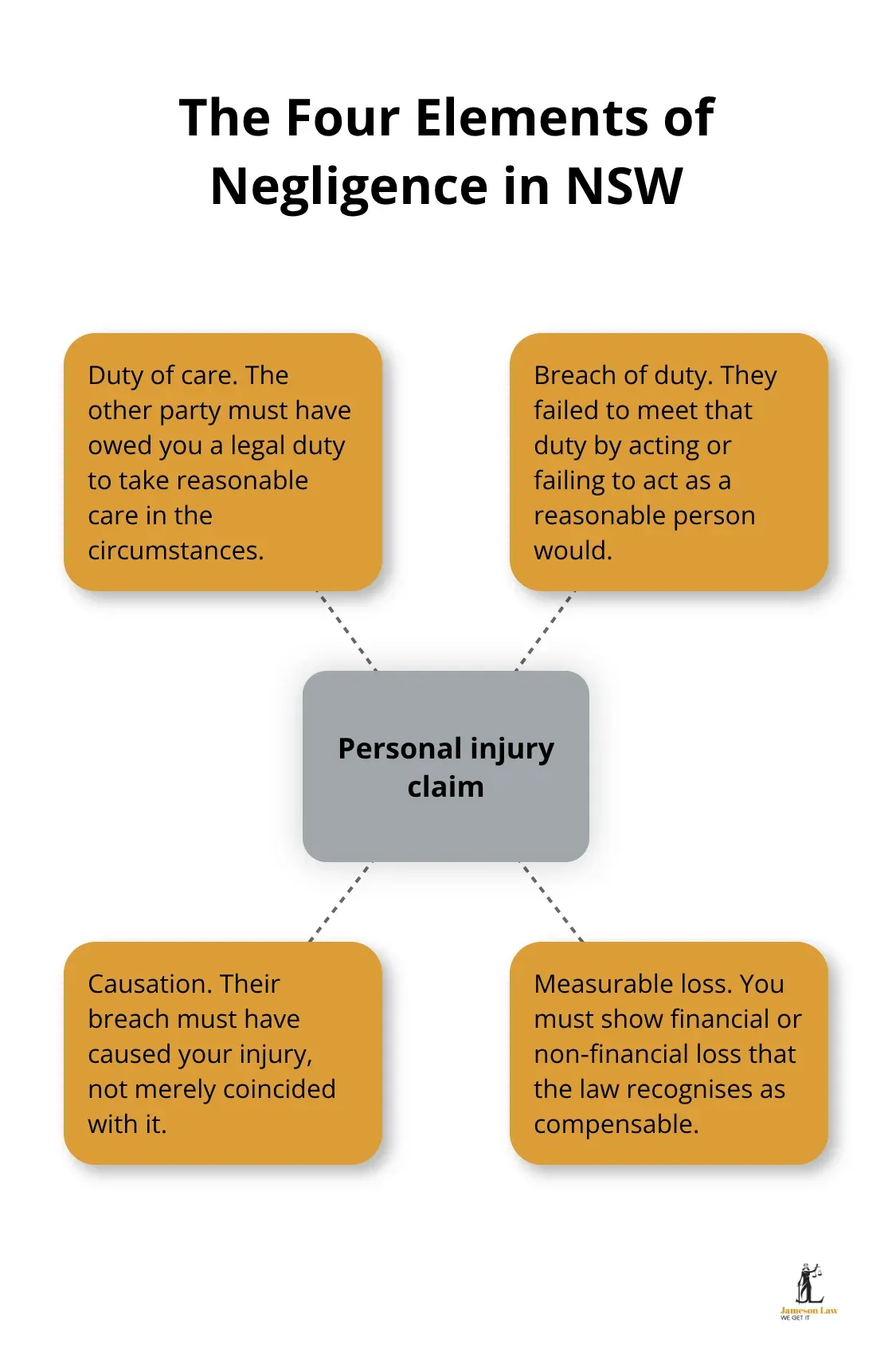
A personal injury claim arises when someone else’s negligence or wrongdoing causes you physical or psychological harm. In NSW, you must prove four essential elements: the other party owed you a duty of care, they breached that duty, their breach caused your injury, and you suffered measurable loss. The loss can be financial (medical bills, lost wages) or non-financial (pain and suffering).

Not every accident creates a valid claim. If you tripped on your own untied shoelace at home, you have no claim because the property owner owed you no specific duty. But if you tripped on a broken step at a shopping centre that management knew about and failed to repair, you have grounds for a claim because they breached their duty to maintain safe premises. The distinction matters because it determines whether you can proceed.

Visual overview of duty of care, breach, causation, and measurable loss required for a NSW personal injury claim

Motor Vehicle Claims and CTP Insurance

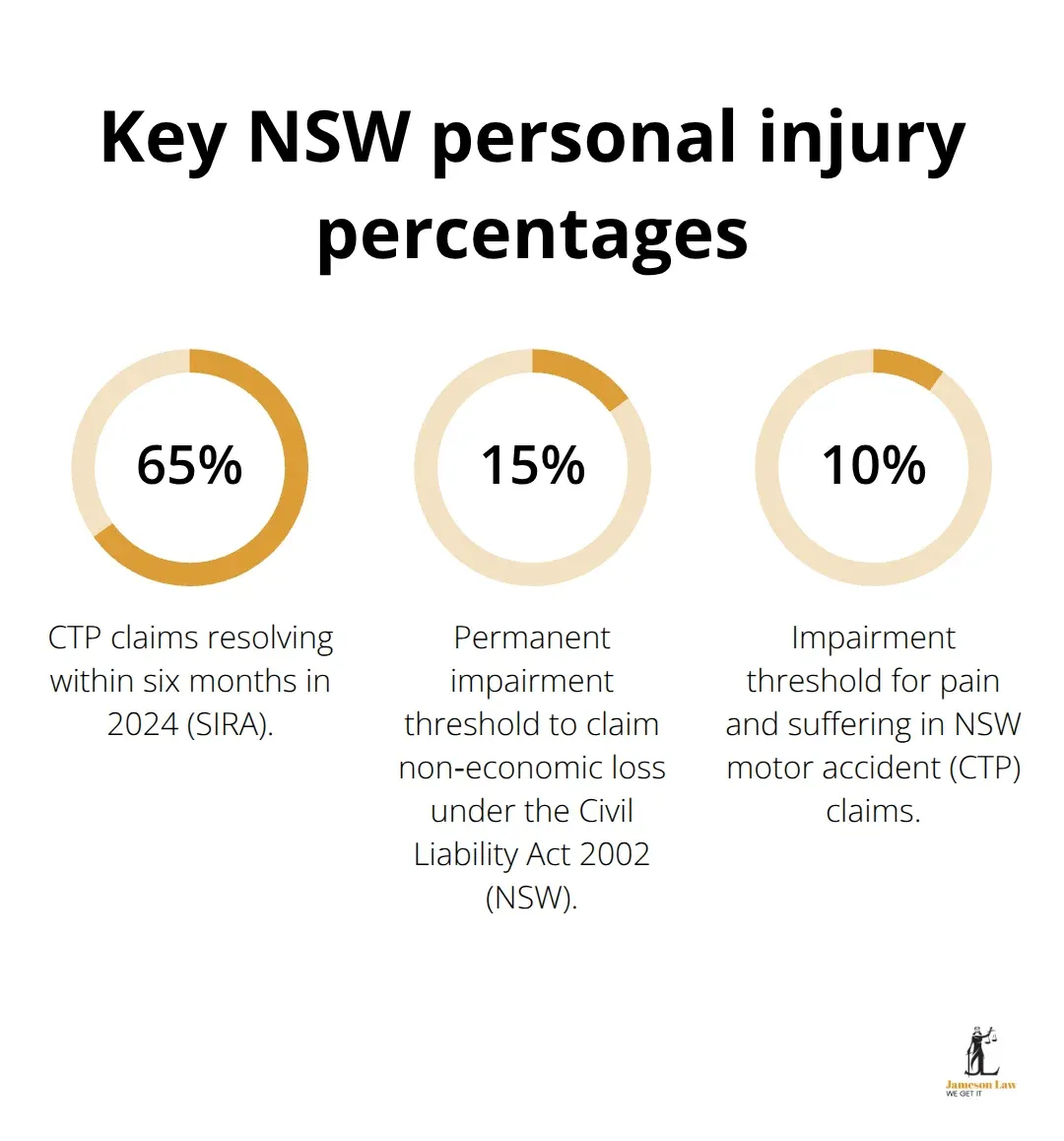
Motor vehicle accidents fall under the compulsory third-party (CTP) insurance scheme in NSW. You can claim medical expenses, rehabilitation, lost income, and pain and suffering if your impairment exceeds 10%. You must lodge a CTP claim within three months of the accident and report it to police within 28 days. Missing these deadlines can bar your claim entirely, so prompt action is not optional.

Workplace Injuries and Public Liability Claims

Workplace injuries fall under workers’ compensation legislation, which generally prevents you from suing your employer but provides structured benefits. Public liability claims cover injuries on someone else’s property or due to their negligence in non-work settings, requiring you to prove they breached a duty of care.

For public liability, you must file your claim within three years from when you became aware of the injury and its connection to negligence. For children, this period does not begin until they turn 18. Each claim type has different rules and time limits, so understanding which category applies to your situation is essential.

Building Your Claim From Day One

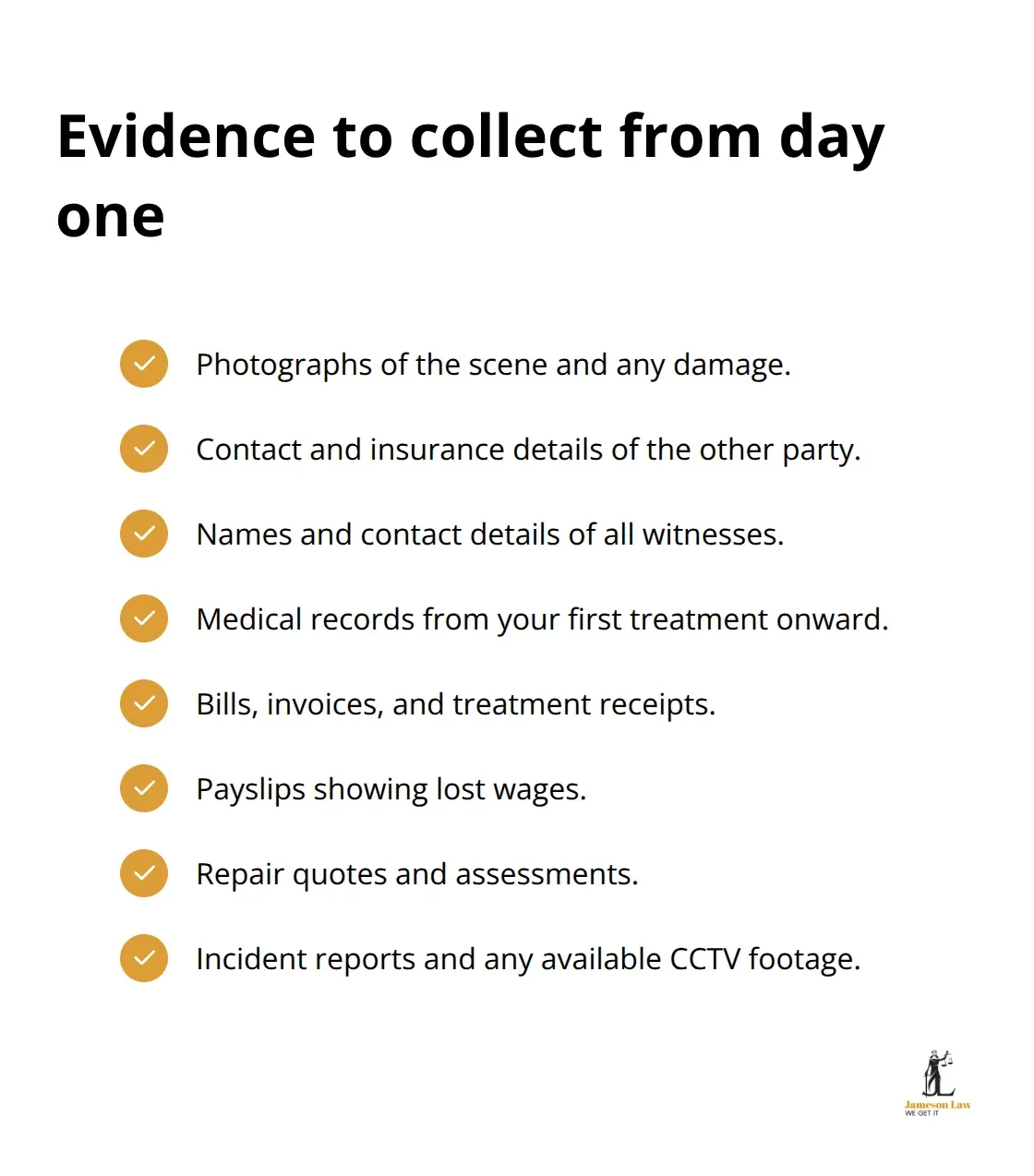
Documentation from the moment of injury strengthens your position significantly. Photograph the scene and any damage, collect the other driver’s or property owner’s details, gather witness names and contact information, and obtain all medical records from your first treatment onward. Courts in NSW rarely find in your favour without solid evidence, and insurers settle faster when you present organised, detailed documentation.

The evidence you collect at the scene (photos, CCTV footage, incident reports) forms the foundation of your case. Insurers assess claims based on what you can prove, not on what you believe happened. Your next step involves notifying the responsible party and beginning the formal claims process.

Moving From Evidence to Action

Act Within Critical Timeframes

The moment after an accident or injury determines whether most claims succeed or fail. You have a narrow window to act, and hesitation costs money. Within 24 hours of a serious accident involving injury in NSW, file a police report-this creates an official record that insurers expect to see. For car accidents under the CTP scheme, you must lodge your claim within three months of the accident. Miss that deadline and your claim is gone, regardless of how serious your injuries are.

Seek medical attention immediately, even if you feel fine. Many injuries don’t show symptoms for days or weeks, and early medical records form the backbone of your compensation claim. The insurer will assess your claim based on documented medical evidence, not on your description of pain or discomfort.

Gather and Organise Evidence Systematically

Photograph everything at the scene: vehicle damage, road conditions, your visible injuries, street signs, traffic lights, and anything else relevant. Collect the other driver’s or property owner’s details, their insurance information, and full names and contact details of every witness. Store these materials in one organised folder-digital or physical-because you’ll reference them repeatedly throughout the claims process.

Checklist of key evidence items to gather and organise for NSW personal injury claims - personal injury claims NSW

Medical bills, treatment receipts, payslips showing lost wages, and repair quotes all belong in this folder. Weak evidence drags cases out and reduces settlement amounts significantly.

Notify the Responsible Party Formally

Once you have your evidence organised, notify the responsible party’s insurer in writing. Do not rely on phone calls or informal conversations. Send a formal notification letter that includes the date and location of the incident, a brief description of what happened, details of your injuries, and confirmation that you’re pursuing a claim. Keep a copy for your records.

The insurer will acknowledge receipt and assign a claims manager. From this point forward, all communication goes through that manager. Many people try to negotiate directly with insurers, thinking they’ll save money on legal fees. This almost never works. Insurers employ experienced claims assessors trained to minimise payouts, and they’ll offer you a settlement figure that’s substantially lower than what you’d receive with legal representation.

Navigate Medical Assessments and Settlement Offers

The insurer will request medical assessments to determine the extent of your injuries. You’ll undergo an Independent Medical Examination, and the insurer may require additional assessments depending on the claim type. Bring a support person to these appointments and request copies of all medical reports. Never sign anything without reading it thoroughly, and if you don’t understand medical terminology, ask for clarification.

After assessments are complete, the insurer will make a settlement offer. At this stage, negotiation becomes critical. Most claims settle through negotiation rather than court action, but only if you have a strong position backed by evidence and medical support. If the insurer’s offer falls short of your actual losses-medical expenses, lost income, rehabilitation costs, and pain and suffering if applicable-your lawyer will counter-offer with detailed calculations showing why a higher figure is justified.

Prepare for Negotiation or Court Action

Settlement negotiations typically take weeks or months. Some cases resolve quickly; others require multiple rounds of offers and counter-offers. If negotiations stall and the insurer refuses to budge, court action becomes necessary. Court cases are relatively uncommon in NSW personal injury claims because most settle beforehand, but they do happen when liability is disputed or damages are contested. Your lawyer will handle all court representation and procedure, and the next stage involves understanding exactly what compensation categories apply to your specific situation.

Compensation and Damages

Economic and Non-Economic Losses

Personal injury compensation in NSW falls into two distinct categories: economic losses and non-economic losses. Economic losses cover everything with a dollar figure attached-medical expenses, rehabilitation costs, lost wages, and future earning capacity. Non-economic losses cover pain and suffering, but only if your injury meets a specific threshold. Under the Civil Liability Act 2002 (NSW), you can claim non-economic loss only if your injury results in at least 15% permanent impairment. This threshold exists because NSW legislation aims to prevent minor injury claims from clogging the system.

SIRA reported over 7,000 CTP claims lodged in 2024, with roughly 65% resolving within six months. This data shows that claims with clear, documented losses settle faster than those relying on subjective pain descriptions. The maximum weekly compensation for non-economic loss in 2024–2025 is $2,523.00 according to SIRA, though this applies primarily to motor vehicle claims under the CTP scheme. Public liability claims follow similar principles but operate under different caps and assessment methods.

Percentages for NSW personal injury claims: settlement speed and impairment thresholds - personal injury claims NSW

What Medical Expenses Cover

Medical expenses form the foundation of every economic loss claim. Hospital stays, surgeries, physiotherapy sessions, medications, and specialist consultations all count toward your compensation. Keep every receipt and invoice, because the insurer will scrutinise each one. If you needed a private physiotherapist instead of public services, that cost is claimable if it was medically necessary.

Your actual compensation depends entirely on what you can prove with medical records, invoices, and payslips-not on how much you believe you deserve. The insurer will assess your claim based on documented evidence, and weak documentation reduces settlement amounts significantly.

Lost Income and Future Earning Capacity

Lost income claims require payslips showing your pre-injury earnings and documentation from your employer confirming the dates you couldn’t work. If your injury prevents you from returning to your previous role, you can claim the difference between your old salary and whatever you can earn in a reduced-capacity position going forward. The calculation of future economic loss is not as simple as multiplying an individual’s average weekly earnings by the remaining years of their working life.

Care provided by family members is also compensable if the care is necessary due to your injury and provided for at least six hours per week over six consecutive months. You must document this carefully with dates and hours to support your claim.

How Insurers Assess Your Entitlements

The insurer will make an initial offer, often deliberately low, expecting you to negotiate upward. Without professional assessment of your true entitlements, you’ll accept an offer that falls short of what the law actually allows you to claim. Calculating every provable loss requires detailed analysis of medical evidence, income records, and case law precedents specific to your injury type and circumstances. Comparing your claim against similar cases determines what settlement figure an insurer should reasonably accept.

Final Thoughts

Personal injury claims in NSW require immediate action, careful organisation, and realistic expectations about compensation. The process moves faster when you collect evidence at the scene, notify the responsible party in writing, and engage legal representation early. Most claims settle through negotiation rather than court action, but only if solid documentation and medical evidence support your position.

Your next step depends on your current situation. If you’ve been injured and haven’t yet notified the insurer, send that notification immediately in writing. If you’ve received a settlement offer that seems low, obtain a professional assessment before you accept it. If you’re unsure whether you have a valid claim or what compensation applies to your circumstances, contact a lawyer without delay, as time limits exist and missing them eliminates your entire claim.

We at Jameson Law handle personal injury claims across NSW on a No Win No Fee basis, which means you pay nothing unless we recover compensation for you. Our team will calculate your true entitlements, negotiate on your behalf, and handle court representation if needed. Contact Jameson Law for a free assessment of your personal injury claims NSW situation, and we’ll tell you honestly whether you have a viable claim and what compensation you can realistically expect.

Speak to an Expert Lawyer today

Laywers-Jameson-Law-The-best-law-firm-in-Sydney- Sydney Lawyers - Sydney
BOOK NOW

WE'RE IN IT TO WIN IT

Book your consultation

Book Now
Book Now Mobile 06 02 2025

This form submission is encrypted and secured to ensure your information remains confidential.

What our Clients

Related Publications:

What our clients say

.

Jameson Law - Voted the Best Law firm in Sydney Award

Legal Answers ... In Short

We're here to help

Our mission is to ensure our client matters are resolved successfully every time. Success to us does not simply involve winning, but moreover ensuring we take the most feasible, economic and stress-free path to help our clients achieve their goals. We fight hard for our clients, and always go by the motto: we’re in it to win it.

Jameson Law - Best Law Firm in Sydney

WE'RE IN IT TO WIN IT

Book your consultation

Call us now on (02) 8806 0866 or fill out the form below

Book Now Mobile

This form submission is encrypted and secured to ensure your information remains confidential.

WE'RE IN IT TO WIN IT

Book your consultation

Book Now Mobile 06 02 2025
lock

This form submission is encrypted and secured to ensure your information remains confidential.

Our Sydney Offices

Offices Parramatta and Sydney Jameson Law
Parramatta CBD - Head Office
jameson Law - Blacktown
jameson Law - Liverpool Office
Jameson Law - Bankstown
Court Houses We Frequent Jameson Law

Court Houses We Frequent

Balmain Local Court

Registry: Monday to Friday, 9:00am to 4:30pm

Bankstown Local Court

Court Operating Hours: 9:30am-4:30pm

Blacktown Local Court

Registry Hours: 9:00 – 4:30
Telephone Hours: 8:30 -4:30
Days open: Mon-Fri

Burwood Local Court

Registry Hours: 9:00 – 4:30
Telephone Hours: 8:30 – 4:30
Days open: Mon – Fri

Campbell Local Court

Registry Hours: 9:00 – 4:30
Telephone Hours: 8:30 – 4:30
Days open: Mon – Fri

Central Local Court

Registry Hours: 9:00 – 1:00 and 2:00 – 4:30
Telephone Hours: 8:30 – 4:30

Downing Local Court

Registry Hours: 9:00 – 1:00 and 2:00 – 4:30
Telephone Hours: 8:30 – 4:30

Wollongong Local Court

Registry Hours: 9:00 – 1:00 and 2:00 – 4:30
Telephone Hours: 8:30 – 4:30

Fairfield Local Court

Registry Hours: 9:00 – 1:00 and 2:00 – 4:30
Telephone Hours: 8:30 – 4:30

Hornsby Local Court

Registry Hours: 9:00 – 1:00 and 2:00 – 4:30
Telephone Hours: 8:30 – 4:30

Liverpool Local Court

Registry Hours: 9:00 – 1:00 and 2:00 – 4:30
Telephone Hours: 8:30 – 4:30

Manly Local Court

Registry Hours: 9:00 – 1:00 and 2:00 – 4:30
Telephone Hours: 8:30 – 4:30

Newtown Local Court

Registry Hours: 9:00 – 1:00 and 2:00 – 4:30
Telephone Hours: 8:30 – 4:30

Parramatta Local Court

Registry Hours: 9:00 – 1:00 and 2:00 – 4:30
Telephone Hours: 8:30 – 4:30

Penrith Local Court

Registry Hours: 9:00 – 1:00 and 2:00 – 4:30
Telephone Hours: 8:30 – 4:30

Sutherland Local Court

Registry Hours: 9:00 – 1:00 and 2:00 – 4:30
Telephone Hours: 8:30 – 4:30

Waverley Local Court

Registry Hours: 9:00 – 1:00 and 2:00 – 4:30
Telephone Hours: 8:30 – 4:30

Windsor Local Court

Registry Hours: 9:00 – 1:00 and 2:00 – 4:30
Telephone Hours: 8:30 – 4:30

Wollongong Local Court

Registry Hours: 9:00 – 1:00 and 2:00 – 4:30
Telephone Hours: 8:30 – 4:30

Downing Centre District Court

Registry Hours: 9:00 – 4:30
Telephone Hours: 8:30 – 4:30
Days open: Mon – Fri

Parramatta District Court

Registry Hours: 9:00 – 4:30
Days open: Mon-Fri

Penrith District Court

Registry Hours: 9:00 – 4:30
Days open: Mon-Fri

Campbelltown District Court

Registry Hours: 9:00 – 4:30
Days open: Mon – Fri

Liverpool District Court

Registry Hours: 9:00 – 4:30
Days open: Mon – Fri

Wollongong District Court

Registry Hours: 9:00 – 1:00 and 2:00 – 4:30
Telephone Hours: 8:30 – 4:30

Supreme Court New South Wales

Registry Hours: 9:00 AM – 4:30 PM
Telephone Hours: 8:30 AM – 4:30 PM
Days Open: Monday to Friday

Federal Circuit and Family Court of Australia

Registry Hours: 9:00 AM – 4:30 PM
Telephone Hours: 8:30 AM – 5:00 PM
Days Open: Monday to Friday

Federal Court

Monday to Friday, 8:30 AM – 4:30 PM

High Court

Monday to Friday, 8:30 AM – 5:00 PM

Children’s Court of New South Wales

Registry Hours: 9:00 AM – 4:30 PM
Telephone Hours: 8:30 AM – 4:30 PM
Days Open: Monday to Friday

Coroner’s Court New South Wales

Registry Hours: 9:00 AM – 4:30 PM
Telephone Hours: 8:30 AM – 4:30 PM
Days Open: Monday to Friday

Industrial Relations Commission of New South Wales

Registry Hours: 9:00 AM – 4:30 PM
Telephone Hours: 8:30 AM – 4:30 PM
Days Open: Monday to Friday

Land and Environment Court of New South Wales

Registry Hours: 9:00 AM – 4:30 PM
Telephone Hours: 8:30 AM – 4:30 PM
Days Open: Monday to Friday

WE'RE IN IT TO WIN IT

Book your consultation

Book Now
Book Now Mobile 06 02 2025
lock

This form submission is encrypted and secured to ensure your information remains confidential.