PUBLICATION

Personal Injury Compensation NSW: Your Rights and Steps

"Learn your rights and claim personal injury compensation in NSW with our step-by-step guide to the claims process and what you're entitled to."
Personal Injury Compensation NSW: Your Rights and Steps

A personal injury can happen in seconds, but the path to fair compensation often feels complicated. At Jameson Law, we’ve helped countless NSW residents understand their rights and recover what they’re entitled to.

This guide walks you through what counts as a personal injury claim, what compensation you can pursue, and the practical steps to take right now.

What Counts as a Personal Injury Claim in NSW

The Foundation: Negligence and Duty of Care

Under NSW law, a personal injury claim exists when someone suffers physical or psychological harm because another person or organisation failed in their duty of care toward you. This failure is called negligence, and it means failure to exercise reasonable care and skill. It forms the foundation of most compensation claims in NSW. The injury itself must be real and documented-not speculative or minor. NSW courts recognise injuries from car accidents, workplace incidents, slip-and-fall accidents, medical malpractice, and institutional abuse, among others. What matters is that someone else’s carelessness or breach of duty caused your harm.

Time Limits That Apply to Your Claim

The three-year time limit applies to most personal injury claims from the date of the accident, though child sexual abuse claims have no time limit. This means you have a defined window to act, which is why early legal advice matters. The clock starts ticking immediately, and missing the deadline can bar your claim entirely.

Types of Injuries and Recoverable Losses

The types of injuries covered are broad, but they must meet a threshold of seriousness. Medical expenses, lost wages, ongoing treatment costs, pain and suffering, and future care needs are all recoverable if your claim succeeds. NSW has different compensation schemes depending on how you were injured: workers’ compensation for workplace injuries, motor accident schemes for vehicle-related incidents, and civil liability claims for other negligent acts. Each scheme has different caps and rules.

Compensation Caps Across NSW Schemes

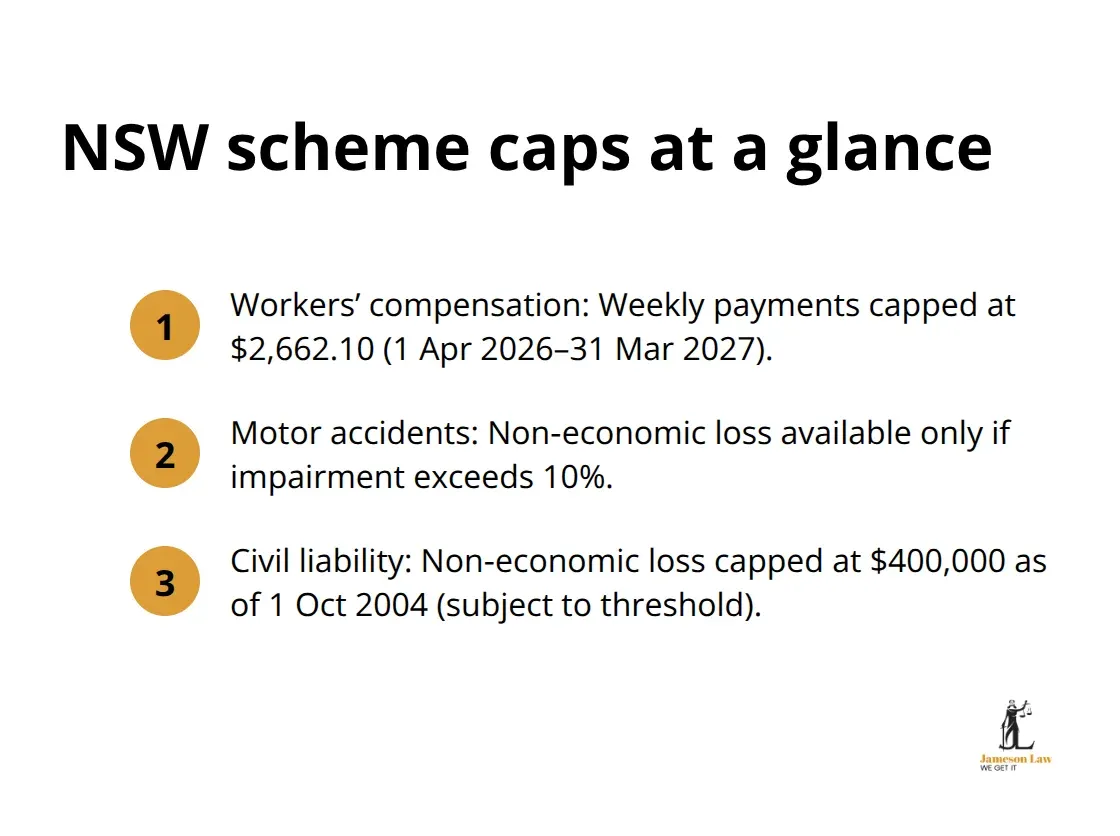
Workers’ compensation in NSW provides weekly payments up to 95% of your pre-injury earnings for the first 13 weeks, then up to 80% from weeks 14 to 130, with a maximum weekly payment capped at $2,662.10 from 1 April 2026 to 31 March 2027. Motor accident claims have a non-economic loss cap if your impairment exceeds 10%. Civil liability claims cap non-economic loss at $400,000 as of 1 October 2004 if impairment meets the threshold. These figures change annually, so knowing which scheme applies to your situation directly affects what you can recover.

Summary of NSW compensation caps and thresholds across workers’ compensation, motor accidents and civil liability.

Evidence That Strengthens Your Claim

The strongest claims have clear evidence: medical records, accident reports, witness statements, photographs, and documentation of financial losses like wage slips and receipts. Without solid evidence, even legitimate claims struggle to succeed. You’ll need to establish not only that you suffered harm, but that another party’s negligence caused it-and that connection requires documentation. The next section explains your specific rights and entitlements under NSW law, and how to identify which compensation pathway applies to your injury.

What You Can Actually Claim

Workers’ Compensation Entitlements

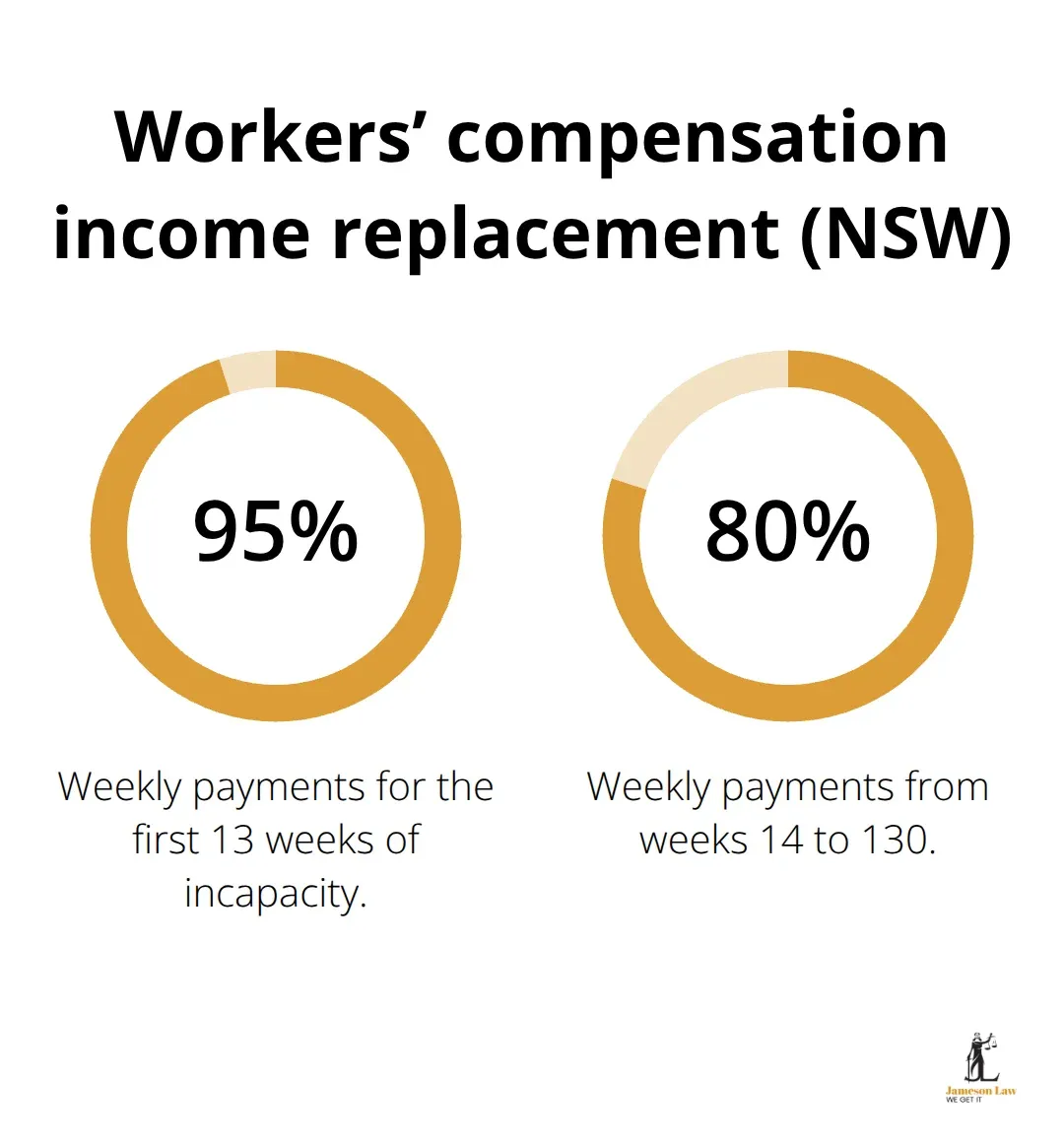
Under NSW workers’ compensation law, you can recover weekly payments up to 95% of your pre-injury earnings for the first 13 weeks, then up to 80% from weeks 14 to 130, with a maximum weekly payment of $2,662.10 from 1 April 2026. Medical and rehabilitation expenses are paid directly to approved providers, so you avoid paying upfront and claiming back later.

Percentage of pre‑injury earnings paid under NSW workers’ compensation over time. - personal injury compensation NSW

Permanent impairment lump sums are calculated using the NSW Whole Body Impairment guidelines once your condition stabilises. Many workers underestimate their entitlement by accepting initial offers without challenging low assessments, which costs them thousands in lost compensation.

Motor Accident and Civil Liability Compensation

Motor accident claims operate under different rules than workplace injuries. Non-economic loss caps are fixed at $691,000, and economic loss is capped based on a fixed net weekly earnings threshold of $6,334. Civil liability claims cap non-economic loss at $804,000 as of 1 October 2025 if impairment meets a 15% threshold. These caps change annually, and understanding which scheme applies directly determines what you can recover.

What Losses You Can Recover Across All Schemes

NSW law compensates you for losses caused by someone else’s failure to exercise reasonable care. You can claim for medical expenses, lost wages, ongoing treatment costs, pain and suffering, and future care needs if negligence caused your injury. However, each compensation scheme has its own maximum payouts and eligibility thresholds. A workplace injury falls under workers’ compensation, a car accident falls under motor accident legislation, and other negligent acts fall under civil liability laws. The scheme that applies to your situation determines both what you can claim and the limits on those claims.

Critical Time Limits That Bar Your Claim

The three-year time limit from the date of the accident applies to most personal injury claims, but child sexual abuse claims have no time limit at all. This deadline is absolute, and missing it bars your claim entirely. Special time rules apply to medical negligence, institutional abuse, and workplace injuries, so you need to verify specifics with a lawyer before your window closes. Dust disease claims operate under different timeframes and entitlements than standard workplace injuries. Medical negligence claims often have shorter effective timeframes because the injury date can be difficult to establish, making early legal advice essential.

Why Acting Fast Protects Your Rights

The moment you are injured, the clock starts ticking. Notifying your employer within 30 days of a workplace injury and formally lodging your claim within six months of becoming aware of the injury protects your rights. For motor accidents, you must lodge your claim within three years of the accident date. Delaying action weakens your position because evidence degrades, witness memories fade, and you risk losing documentation. Early action also means early legal advice, which prevents costly mistakes like accepting inadequate settlement offers or failing to maintain records that strengthen your case. The next section explains the practical steps you must take immediately after your injury to preserve your claim and build a strong case.

What to Do Immediately After Your Injury

Collect Evidence at the Scene

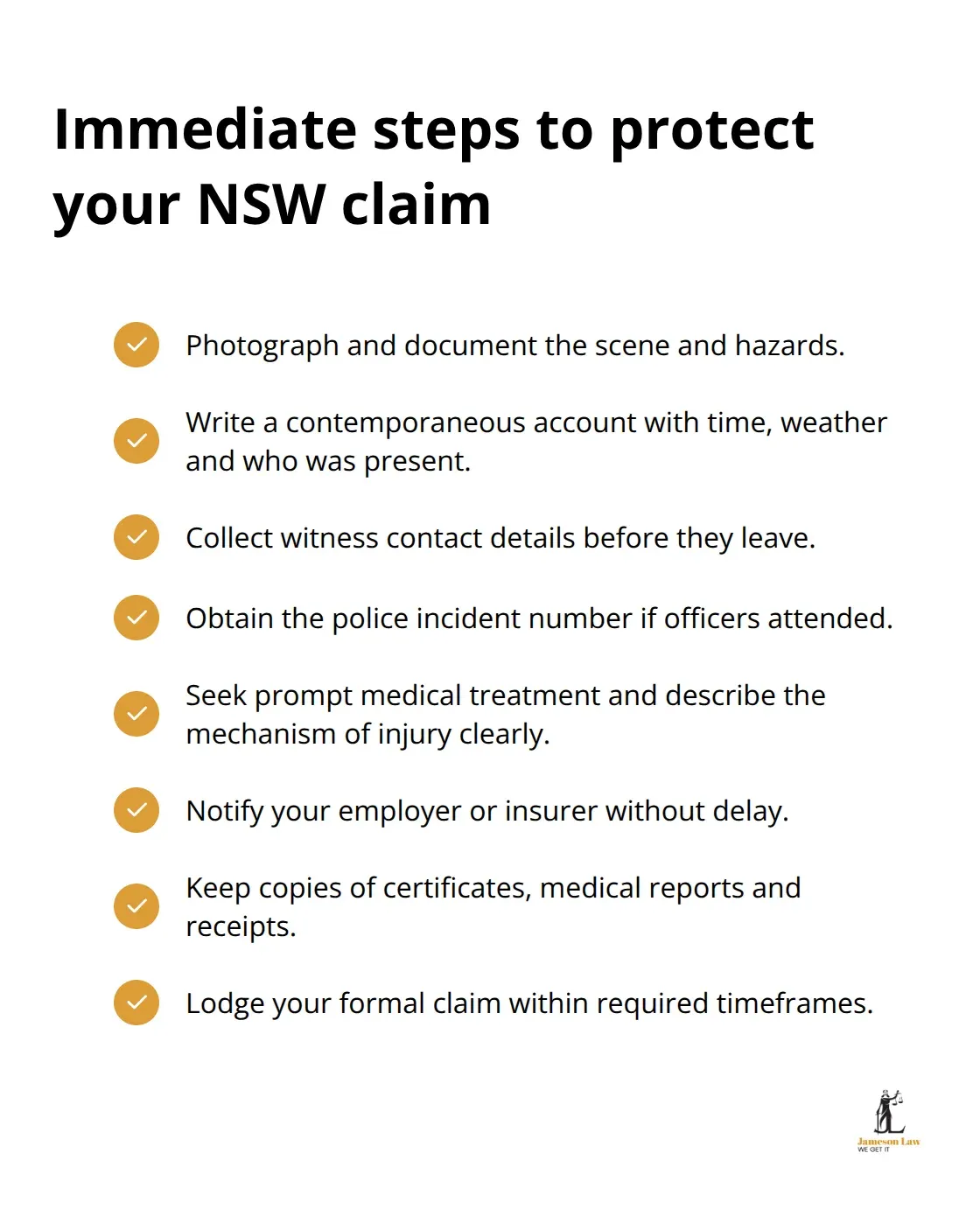
The first hours and days after a personal injury determine whether your claim succeeds or fails. Most injured people focus on pain and recovery, but evidence collection and formal notification happen right now, not later. At the scene or immediately after, photograph and document everything relevant to your injury: the location where you fell, the wet floor that caused it, the vehicle damage from a collision, or the equipment that malfunctioned. Your phone timestamps these photographs and provides objective proof that courts and insurers trust far more than memory. Write down what happened while it is fresh, including the exact time, weather conditions, who was present, and what you were doing. Get contact details from witnesses before they leave, because tracking them down weeks later is nearly impossible and their statements become vague. If police attended, obtain the incident report number immediately and request a copy from NSW Police.

Checklist of urgent actions to take after a personal injury in NSW. - personal injury compensation NSW

Notify Your Employer or Insurer Without Delay

For workplace injuries, your employer is legally required to notify their workers compensation insurer within 48 hours, but you should notify them in writing within 30 days to protect your claim. Motor accident claims require you to lodge within three years, but the sooner you notify the insurer, the sooner they investigate while evidence is fresh. Delaying notification weakens your position because insurers assume you are fabricating or exaggerating injuries if you wait weeks to report them.

Obtain Medical Documentation That Supports Your Claim

Seek medical treatment immediately, even if you feel fine, because some injuries develop over days or weeks and early medical records establish causation. Provide your doctor with detailed information about your job duties, the accident mechanism, and exactly how the injury occurred, because vague medical records undermine compensation claims. Your doctor must issue a Certificate of Capacity that documents your medical condition and what work you can safely perform, which becomes critical evidence for wage loss claims. Obtain copies of all medical reports, imaging results, and treatment receipts because these documents form the foundation of your claim.

Lodge Your Formal Claim With Supporting Documents

Lodge your workers compensation claim within six months of becoming aware of the injury, submitting the claim form, Certificate of Capacity, and all supporting medical records to the insurer. The insurer must decide within 21 days, and you can request an independent review through the Independent Review Office with ILARS funding if they deny your claim without valid reason. For motor accidents, contact the insurer within 30 days and provide a detailed account of the incident.

Seek Legal Advice Before Speaking With Insurers

Legal advice early in the process prevents costly mistakes like accepting inadequate settlement offers or signing documents that waive your rights. Insurers are trained to minimise payouts, and early legal guidance protects your position before you communicate with them.

Final Thoughts

Your rights under NSW personal injury compensation law are clear, but they only protect you if you act within the three-year deadline that bars your claim entirely if missed. Workplace injuries, motor accidents, slip-and-fall incidents, and medical negligence all follow different compensation pathways, yet they share one critical requirement: early action preserves evidence and strengthens your position. The moment after your injury is when your claim is strongest, as photographs remain sharp, witness memories stay accurate, and medical records establish causation without gaps.

Delaying notification to your employer or insurer signals weakness and undermines your negotiating position with them. Accepting an early settlement offer without legal advice often means accepting far less than you are entitled to recover, costing you thousands in lost compensation. Personal injury compensation NSW claims succeed when you gather evidence immediately, notify relevant parties within required timeframes, obtain thorough medical documentation, and seek legal advice before speaking with insurers (since insurers are trained to minimise payouts).

We at Jameson Law have helped countless NSW residents navigate personal injury claims and recover fair compensation. Contact Jameson Law to discuss your situation and understand exactly what you can recover under NSW law. Your claim has a deadline-do not let it pass.

Speak to an Expert Lawyer today

Laywers-Jameson-Law-The-best-law-firm-in-Sydney- Sydney Lawyers - Sydney
BOOK NOW

WE'RE IN IT TO WIN IT

Book your consultation

Book Now
Book Now Mobile 06 02 2025

This form submission is encrypted and secured to ensure your information remains confidential.

What our Clients

Related Publications:

What our clients say

.

Jameson Law - Voted the Best Law firm in Sydney Award

Legal Answers ... In Short

We're here to help

Our mission is to ensure our client matters are resolved successfully every time. Success to us does not simply involve winning, but moreover ensuring we take the most feasible, economic and stress-free path to help our clients achieve their goals. We fight hard for our clients, and always go by the motto: we’re in it to win it.

Jameson Law - Best Law Firm in Sydney

WE'RE IN IT TO WIN IT

Book your consultation

Call us now on (02) 8806 0866 or fill out the form below

Book Now Mobile

This form submission is encrypted and secured to ensure your information remains confidential.

WE'RE IN IT TO WIN IT

Book your consultation

Book Now Mobile 06 02 2025
lock

This form submission is encrypted and secured to ensure your information remains confidential.

Our Sydney Offices

Offices Parramatta and Sydney Jameson Law
Parramatta CBD - Head Office
jameson Law - Blacktown
jameson Law - Liverpool Office
Jameson Law - Bankstown
Court Houses We Frequent Jameson Law

Court Houses We Frequent

Balmain Local Court

Registry: Monday to Friday, 9:00am to 4:30pm

Bankstown Local Court

Court Operating Hours: 9:30am-4:30pm

Blacktown Local Court

Registry Hours: 9:00 – 4:30
Telephone Hours: 8:30 -4:30
Days open: Mon-Fri

Burwood Local Court

Registry Hours: 9:00 – 4:30
Telephone Hours: 8:30 – 4:30
Days open: Mon – Fri

Campbell Local Court

Registry Hours: 9:00 – 4:30
Telephone Hours: 8:30 – 4:30
Days open: Mon – Fri

Central Local Court

Registry Hours: 9:00 – 1:00 and 2:00 – 4:30
Telephone Hours: 8:30 – 4:30

Downing Local Court

Registry Hours: 9:00 – 1:00 and 2:00 – 4:30
Telephone Hours: 8:30 – 4:30

Wollongong Local Court

Registry Hours: 9:00 – 1:00 and 2:00 – 4:30
Telephone Hours: 8:30 – 4:30

Fairfield Local Court

Registry Hours: 9:00 – 1:00 and 2:00 – 4:30
Telephone Hours: 8:30 – 4:30

Hornsby Local Court

Registry Hours: 9:00 – 1:00 and 2:00 – 4:30
Telephone Hours: 8:30 – 4:30

Liverpool Local Court

Registry Hours: 9:00 – 1:00 and 2:00 – 4:30
Telephone Hours: 8:30 – 4:30

Manly Local Court

Registry Hours: 9:00 – 1:00 and 2:00 – 4:30
Telephone Hours: 8:30 – 4:30

Newtown Local Court

Registry Hours: 9:00 – 1:00 and 2:00 – 4:30
Telephone Hours: 8:30 – 4:30

Parramatta Local Court

Registry Hours: 9:00 – 1:00 and 2:00 – 4:30
Telephone Hours: 8:30 – 4:30

Penrith Local Court

Registry Hours: 9:00 – 1:00 and 2:00 – 4:30
Telephone Hours: 8:30 – 4:30

Sutherland Local Court

Registry Hours: 9:00 – 1:00 and 2:00 – 4:30
Telephone Hours: 8:30 – 4:30

Waverley Local Court

Registry Hours: 9:00 – 1:00 and 2:00 – 4:30
Telephone Hours: 8:30 – 4:30

Windsor Local Court

Registry Hours: 9:00 – 1:00 and 2:00 – 4:30
Telephone Hours: 8:30 – 4:30

Wollongong Local Court

Registry Hours: 9:00 – 1:00 and 2:00 – 4:30
Telephone Hours: 8:30 – 4:30

Downing Centre District Court

Registry Hours: 9:00 – 4:30
Telephone Hours: 8:30 – 4:30
Days open: Mon – Fri

Parramatta District Court

Registry Hours: 9:00 – 4:30
Days open: Mon-Fri

Penrith District Court

Registry Hours: 9:00 – 4:30
Days open: Mon-Fri

Campbelltown District Court

Registry Hours: 9:00 – 4:30
Days open: Mon – Fri

Liverpool District Court

Registry Hours: 9:00 – 4:30
Days open: Mon – Fri

Wollongong District Court

Registry Hours: 9:00 – 1:00 and 2:00 – 4:30
Telephone Hours: 8:30 – 4:30

Supreme Court New South Wales

Registry Hours: 9:00 AM – 4:30 PM
Telephone Hours: 8:30 AM – 4:30 PM
Days Open: Monday to Friday

Federal Circuit and Family Court of Australia

Registry Hours: 9:00 AM – 4:30 PM
Telephone Hours: 8:30 AM – 5:00 PM
Days Open: Monday to Friday

Federal Court

Monday to Friday, 8:30 AM – 4:30 PM

High Court

Monday to Friday, 8:30 AM – 5:00 PM

Children’s Court of New South Wales

Registry Hours: 9:00 AM – 4:30 PM
Telephone Hours: 8:30 AM – 4:30 PM
Days Open: Monday to Friday

Coroner’s Court New South Wales

Registry Hours: 9:00 AM – 4:30 PM
Telephone Hours: 8:30 AM – 4:30 PM
Days Open: Monday to Friday

Industrial Relations Commission of New South Wales

Registry Hours: 9:00 AM – 4:30 PM
Telephone Hours: 8:30 AM – 4:30 PM
Days Open: Monday to Friday

Land and Environment Court of New South Wales

Registry Hours: 9:00 AM – 4:30 PM
Telephone Hours: 8:30 AM – 4:30 PM
Days Open: Monday to Friday

WE'RE IN IT TO WIN IT

Book your consultation

Book Now
Book Now Mobile 06 02 2025
lock

This form submission is encrypted and secured to ensure your information remains confidential.