
Lodging a visa in NSW requires careful planning and attention to detail. Many applicants miss critical steps that delay their applications or lead to rejections.
We at Jameson Law have helped hundreds of people navigate the visa process successfully. This guide walks you through each stage, from understanding visa types to submitting your application with confidence.
Visa Types That Matter in NSW
Australia offers distinct visa pathways, and selecting the right one determines your success before you even lodge. Skilled migration visas provide the most direct route for professionals already in demand. The NSW Skilled Nominated visa (subclass 190) stands as the primary pathway-it leads to permanent residency if approved, and the Australian Government Department of Home Affairs reports that the median processing time for skilled permanent visas reaches around 11 months. Your occupation must appear on the NSW Skills List, which changes based on workforce demand, so you should verify your role before paying for a formal skills assessment. If NSW invites you to apply, you have exactly 14 days to respond with a complete application; this window cannot be extended. The invitation system is highly competitive-NSW selects candidates based on age, English proficiency, education, points score, and years of skilled work experience.
Understanding Skilled Migration Pathways
Three fundamentals drive success in skilled migration: you must understand your visa pathway, prepare meticulous documentation, and seek professional guidance when your circumstances are complex or borderline. The NSW Skills List changes with dynamic workforce demand, so you should check your occupation’s status before committing to assessment costs. If you receive an invitation to apply, respond within the 14-day window with all supporting documents ready. The selection process favours higher-ranked applicants, so your age, English proficiency, education level, and verified work experience all influence your chances.
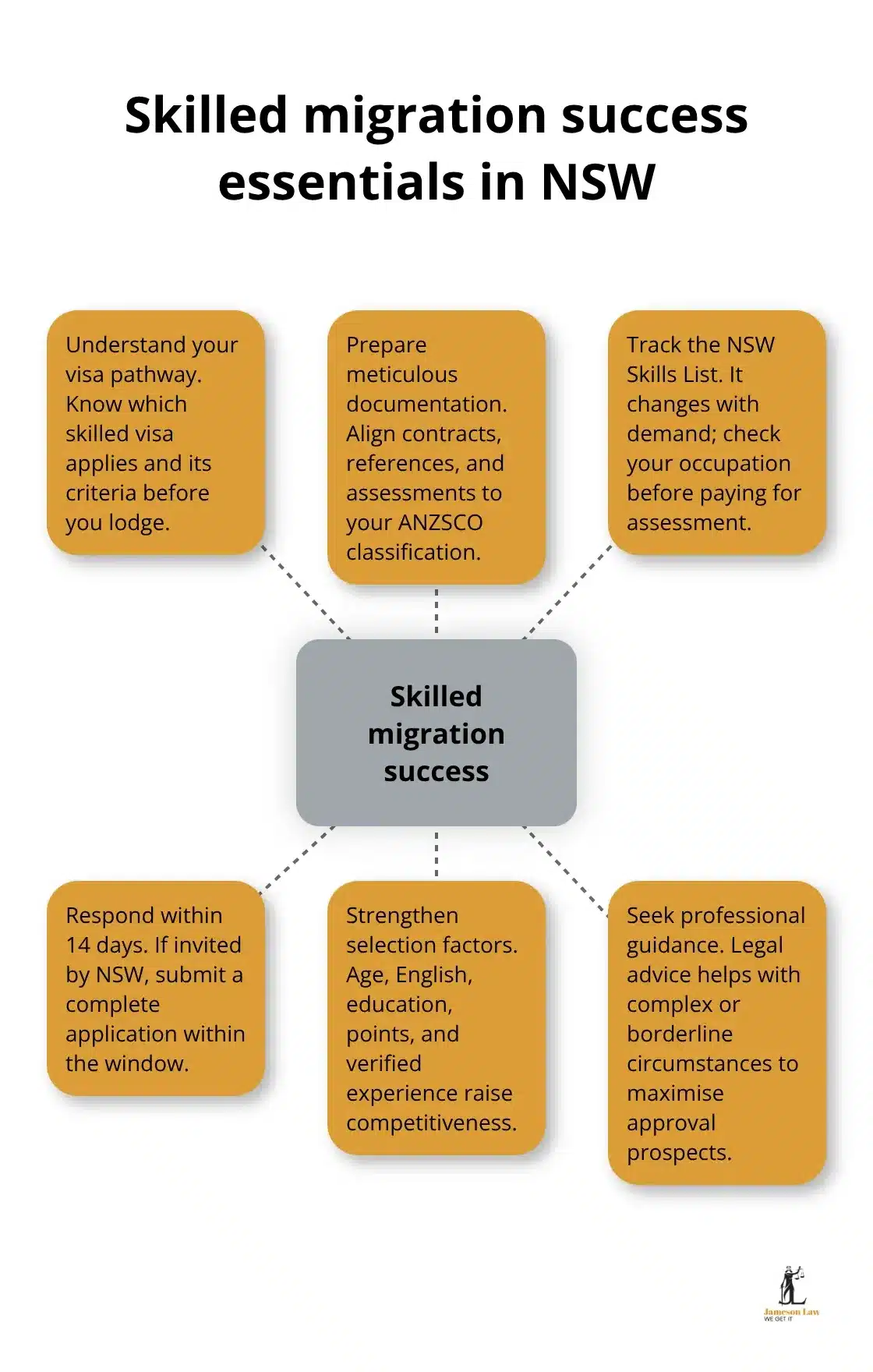
Professional legal advice strengthens your application when circumstances are uncertain or when you need to maximise your approval prospects.
Family Sponsorship and Temporary Visas
Family sponsorship visas operate on different principles. These pathways rely on an Australian citizen or permanent resident sponsor and follow their own timelines and requirements. Temporary and work visas serve specific purposes-they allow you to work for a defined period but do not lead to permanent residency. Student visas, for example, require Overseas Student Health Cover for the entire duration of your stay and demand demonstrated funds to cover course fees and living costs according to the Department of Home Affairs. The key distinction lies in permanence: skilled and family visas build toward indefinite residence in Australia, while temporary visas remain time-bound.
Documentation and Eligibility Differences
Each pathway demands different documentation and carries different health, character, and financial thresholds. You must select the right visa type before you invest time and money into preparation. Skilled visas require skills assessments and points calculations; family visas require sponsorship documentation and relationship proof; student visas require enrolment confirmation and health cover evidence. The consequences of choosing incorrectly extend beyond wasted resources-you may face months of delay or application rejection.
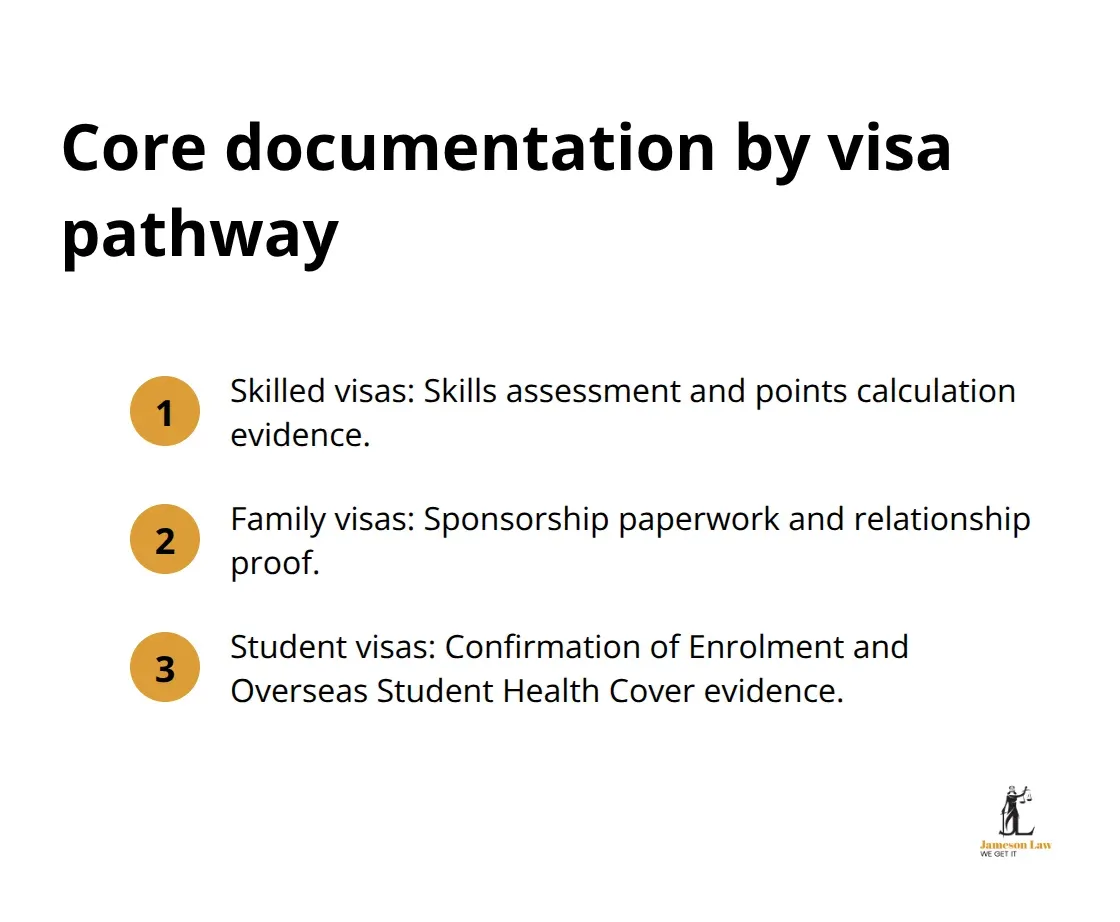
Professional legal advice clarifies which pathway suits your circumstances before you commit to a particular route, and this clarity prevents costly missteps as you move forward with gathering documentation and completing your application.
Building Your Application From Start to Finish
The gap between understanding your visa type and submitting your application is where most applicants falter. This stage demands precision because the Department of Home Affairs receives thousands of applications monthly, and incomplete or disorganised submissions face immediate delays or requests for further information that can add months to processing times.
Download Your Official Checklist First
Start by downloading the official checklist for your specific visa subclass from the Department of Home Affairs website. This checklist is not optional advice-it is your roadmap. You tick items as you prepare them, which prevents you from overlooking requirements that assessors will scrutinise. For skilled visas, you need certified employment contracts that clearly state your job title, duties, and dates of employment aligned with your ANZSCO classification. Reference letters from employers matter far more than generic statements; they must confirm your role, responsibilities, and the period you worked in that position. If your qualifications came from overseas, you obtain NAATI-certified translations before you lodge anything.
Prepare Documentation That Matches Your Visa Type
Student visas demand different documentation than skilled visas. You will need your Confirmation of Enrolment from your education provider, proof of Overseas Student Health Cover for your entire stay, and demonstrated funds showing you can cover course fees plus living costs. The Department of Home Affairs specifies at least $29,710 in accessible funds for living expenses, though this varies by location and course duration. Consistency across all documents matters intensely; if your employment dates shift between your skills assessment and your application form, assessors will scrutinise your entire submission. You cross-check every claim against supporting evidence before you touch the ImmiAccount system.
Navigate ImmiAccount With Precision
Lodging through ImmiAccount is straightforward but unforgiving. You attach documents in the correct format-PDF files work best-and verify each attachment uploads fully before you submit. Payment issues frequently block submissions, so you confirm your payment method works and check your bank statement immediately after attempting payment. Common error messages during lodging often relate to incomplete fields or attachment problems; you capture the exact error text if issues arise so you can troubleshoot or seek assistance. Once you lodge, the Department of Home Affairs typically processes skilled permanent visas within about 11 months, though health and character checks conducted overseas can extend this significantly.
Monitor Your Application and Respond Promptly
You do not contact NSW or Home Affairs during the assessment period unless explicitly requested; these departments operate on strict timelines and unsolicited contact can actually delay your case. Instead, you monitor your application status through ImmiAccount and respond immediately to any information requests-delays in your responses directly extend processing times. For student visas, you ensure your OSHC remains active throughout your entire stay and update your contact details if you move. If your circumstances are complex, borderline, or if you face potential refusal grounds, professional legal guidance from an experienced immigration lawyer strengthens your position substantially and can mean the difference between approval and rejection.
When Professional Guidance Makes the Difference
Your application now sits with the Department of Home Affairs, but the work does not end at lodgement. The next critical phase involves understanding what happens after submission and how to respond if the department requests additional information or conducts further checks.
Where Visa Applications Fail Most Often
The difference between approval and rejection often comes down to details that seem minor until the Department of Home Affairs flags them. Incomplete information tops the list of reasons applications stall or face refusal outright. You might think you have completed every field in ImmiAccount, but assessors interpret completeness strictly. If you leave a field blank because you assumed it did not apply to you, the department will request clarification rather than assume your intention.
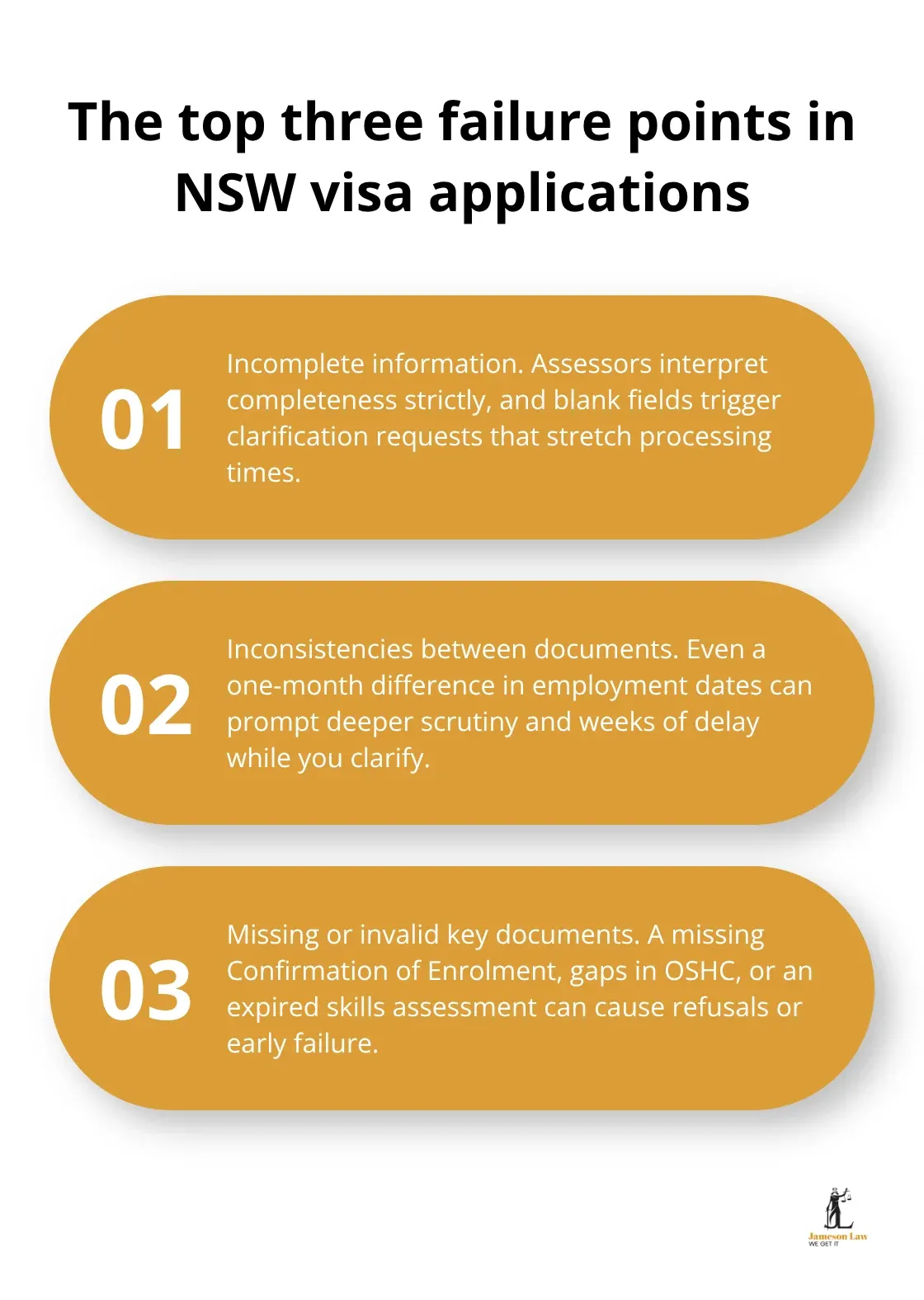
This creates delays that stretch processing times well beyond standard windows.
Inconsistencies That Trigger Deeper Scrutiny
For skilled visas, inconsistency between your skills assessment and your application form triggers deeper scrutiny. If your employment dates shift by even a month between documents, assessors question whether your work experience genuinely matches the ANZSCO classification you claimed. Your employment contract states you worked from January 2020 to June 2023, but your reference letter says January 2020 to July 2023. The department will ask you to clarify the discrepancy, and you lose weeks waiting for their request and preparing your response. Cross-check every claim against every supporting document before you lodge to prevent this entirely.
Verification of your work history matters more than you might expect. The Department of Home Affairs contacts previous employers to confirm employment details, and if those employers cannot verify the dates or duties you listed, your application faces serious risk. Provide certified employment contracts that explicitly state your job title, responsibilities, and employment period. Generic reference letters that say you worked hard and performed well carry almost no weight. Strong reference letters confirm specific duties that align with your ANZSCO classification and address the actual role requirements assessors evaluate.
Documents That Applicants Frequently Overlook
Missing supporting documents represents the second major failure point, and this problem compounds because the department does not always flag missing items immediately. You might lodge your application thinking everything is attached, only to discover months later that a critical document failed to upload. For student visas, the Confirmation of Enrolment from your education provider is non-negotiable, yet applicants frequently lodge without it, assuming they can provide it later. You cannot. The department will request it, and delays follow.
Overseas Student Health Cover documentation must cover your entire visa duration without gaps. If your OSHC policy expires before your course ends, you face refusal. Check your OSHC certificate now and confirm the end date matches or exceeds your course completion date. For skilled visa applicants, a valid skills assessment sits at the foundation of your entire application. If your assessment has expired or does not match the occupation you are claiming, your application fails at the first stage. Verify your skills assessment validity before you invest time in gathering other documents.
NAATI-certified translations of overseas qualifications are mandatory if you hold education from outside Australia, yet many applicants submit uncertified copies and then face requests to resubmit. Obtain certified translations before you touch ImmiAccount. These translations cost money and time, but they prevent rejection and resubmission delays that cost far more.
Health and Character Requirements You Cannot Ignore
Health and character requirements represent the third critical area where applications derail. The Department of Home Affairs requires health examinations for most visa types, and you cannot skip this step or delay it until after lodgement. Use the My Health Declaration service to complete required health checks before you submit your application. This service identifies which health examinations you actually need based on your circumstances, and you obtain them through approved panel doctors. Do not assume you are healthy enough to skip checks; the department makes that determination, not you.
Character requirements demand police background checks from every country where you have lived for more than 12 months in the past 10 years. If you have lived in three countries, you need police clearances from all three. Delays in obtaining overseas police clearances can extend your processing time by many months because the department will not finalise your application until all character checks arrive. Start these checks immediately after you lodge, or better yet, obtain them before lodgement if your circumstances allow.
Dishonesty and Non-Disclosure Lead to Refusal
Failing to disclose relevant information is treated as dishonesty and leads to refusal and potential visa cancellation. If you have a criminal record, declare it. If you have been refused a visa before, declare it. If you have overstayed a previous visa or breached visa conditions, declare it. The department knows how to investigate, and they will discover undisclosed information that you tried to hide. Honesty, even when it reveals problems, gives you a chance to explain your circumstances. Dishonesty guarantees rejection.
Final Thoughts
Visa lodgement succeeds when you understand your pathway, prepare meticulous documentation, and recognise when professional legal advice matters. Skilled migration visas demand consistency across every document, student visas require health cover and financial proof, and incomplete applications trigger delays that stretch well beyond standard processing windows. The Department of Home Affairs processes thousands of applications monthly, and your submission competes for attention through clarity and completeness alone.
The mistakes outlined in this guide are preventable-incomplete information, missing documents, and undisclosed circumstances result from rushing preparation or underestimating what assessors scrutinise. You possess the tools to succeed: official checklists, ImmiAccount, the My Health Declaration service, and the NSW Skills List. However, visa law contains complexities that generic guides cannot address, and your circumstances may be borderline, span multiple countries, or involve qualifications that do not align neatly with ANZSCO classifications. These situations demand professional legal advice from someone who understands how the Department of Home Affairs evaluates applications and identifies where your specific case faces risk.
After you lodge your application, your role shifts from preparation to monitoring-you respond promptly to information requests, maintain required documentation like OSHC coverage, and update your contact details if circumstances change. If your situation involves complexity, uncertainty, or potential refusal grounds, contact Jameson Law to discuss how professional legal guidance strengthens your application and maximises your approval prospects.