


Being taken into police custody is a confronting experience. In New South Wales, the law strictly balances police enforcement powers against your fundamental common law right to personal liberty. Understanding the exact statutory thresholds for an arrest without warrant NSW ensures you know what police can legally require of you and how to protect your position.
At Jameson Law, our criminal defence team regularly scrutinises police procedures to determine whether arrests and subsequent evidence-gathering complied with the law. This guide explains police powers under the Law Enforcement (Powers and Responsibilities) Act 2002 (NSW) (LEPRA), custody timeframes, and your fundamental rights.
What Makes an Arrest Without Warrant NSW Lawful Under LEPRA?
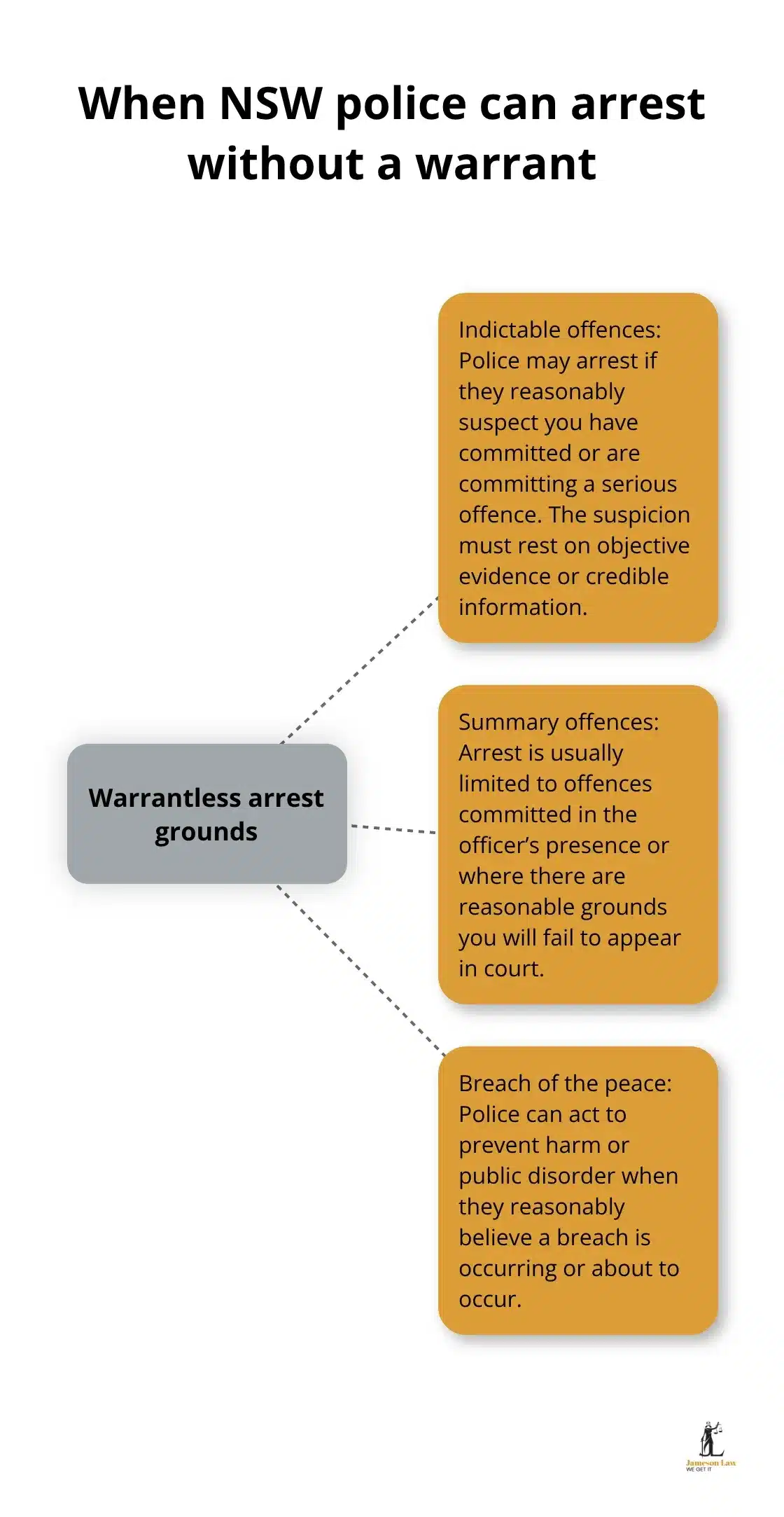
Arrest is an extraordinary power and a measure of last resort. Under Section 99 of the Law Enforcement (Powers and Responsibilities) Act 2002 (NSW), an officer cannot arrest you simply to investigate or question you. A two-stage statutory test must be satisfied:
- Reasonable Suspicion: The police officer must suspect on reasonable grounds that you are committing or have committed an offence; and
- Statutory Necessity: The officer must be satisfied that the arrest is reasonably necessary for one or more specific statutory reasons:
- To stop you from fleeing or committing/repeating the offence.
- To enable inquiries to be made to establish your identity if it cannot be readily established.
- To ensure you appear before a court in relation to the offence.
- To obtain property in your possession connected with the offence.
- To preserve evidence or prevent the fabrication of evidence.
- To prevent the harassment of, or interference with, any witness.
- To protect the safety or welfare of any person (including yourself).
- Because of the nature and seriousness of the offence.
Alternatively, an officer may arrest you if directed by another officer who has formed those requisite grounds.
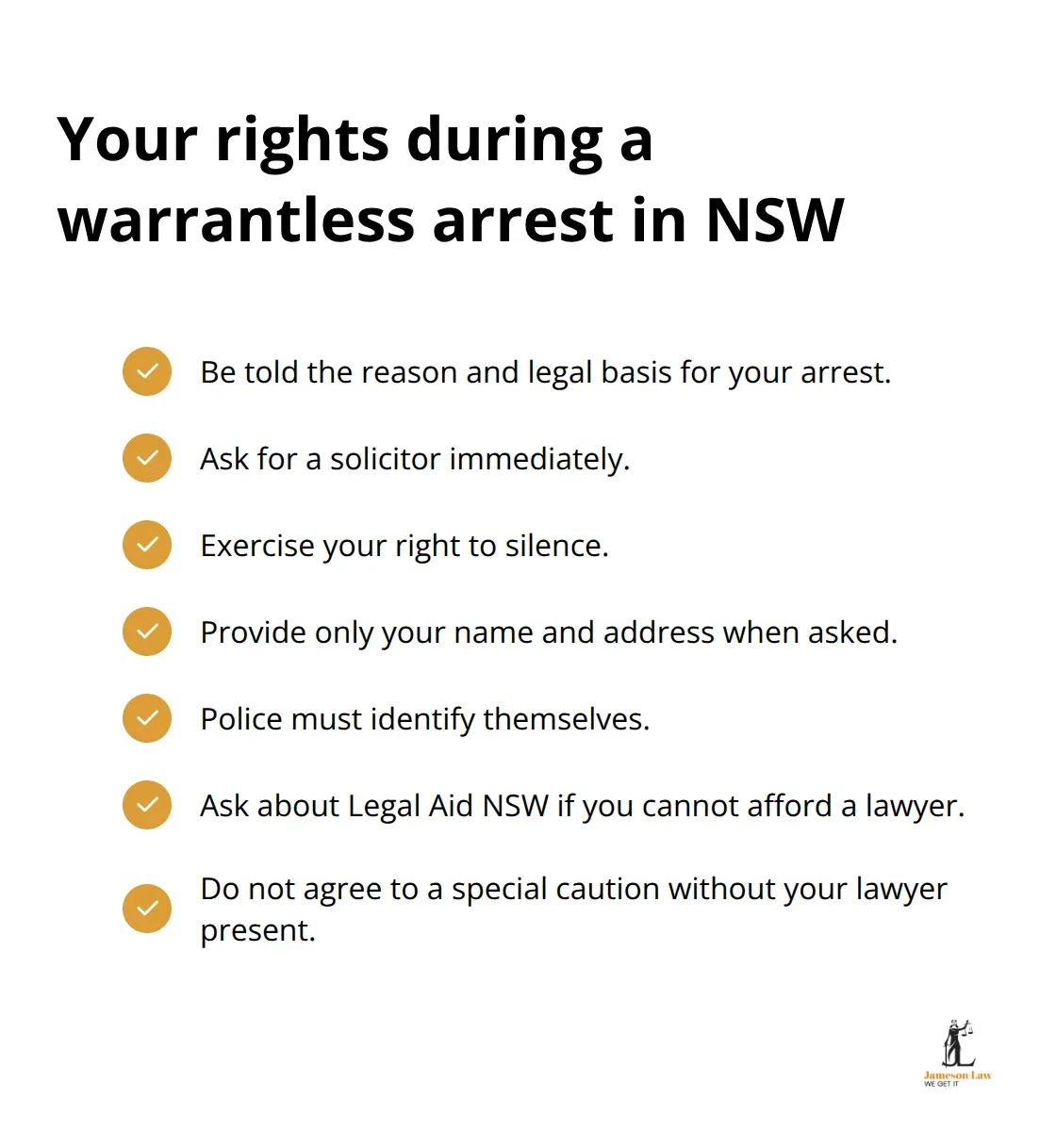
Police Safeguards (LEPRA Section 201)
When exercising an arrest power, police must comply with mandatory statutory safeguards under Section 201 of LEPRA. Unless impracticable, the officer must provide:
- Evidence that they are a police officer (if not in uniform).
- Their name and place of duty.
- The reason for the exercise of the power (the specific offence suspected).
Use of Force and Search Powers on Arrest
Under Section 231 of LEPRA, police may use such force as is reasonably necessary to exercise the arrest. Once arrested, police have statutory powers under Section 23 to search you for weapons, items capable of being used to escape, or evidence related to the offence. Under Section 24, if you are subsequently detained in custody at a police station, police may conduct a search and seize items in your possession for safekeeping.
Your Rights in Custody: Silence, Legal Advice, and Investigation Time
Upon arrival at a police station, you are placed into the care of a Custody Manager. The Custody Manager is legally separate from the investigating officers and must provide you with a verbal and written summary of your rights under Part 9 of LEPRA.
The Right to Communicate With a Lawyer (LEPRA Section 123)
Under Section 123 of LEPRA, you have the right to communicate with—or attempt to communicate with—an Australian legal practitioner of your choice, as well as a friend, relative, or guardian, and to have them present during any questioning. The custody manager must defer questioning for a reasonable time to allow you to consult with a lawyer.
If you cannot afford a private solicitor, you may seek assistance from Legal Aid NSW or the Aboriginal Legal Service (ALS), depending on eligibility.
The Right to Silence and Police Cautions
You have a fundamental common law right to silence, reflected in Section 122 of LEPRA and the Evidence Act 1995 (NSW). Police must give you a standard caution: that you do not have to say or do anything, but anything you do say or do may be used in evidence. Except for providing your basic identifying details (such as your name and residential address), you are not required to participate in a formal record of interview or answer investigative questions.
In serious indictable offence investigations, police may give a “special caution” under Section 89A of the Evidence Act 1995. However, a special caution can only be validly administered if an Australian legal practitioner was present at the time the caution was given and you were allowed a reasonable opportunity to consult with that lawyer in private.
The Part 9 Investigation Period, Extensions, and “Dead Time”
Police cannot detain you indefinitely without charge. Under Part 9 of LEPRA, custody is governed by a strict statutory framework:
- The Maximum 6-Hour Period: Under Section 115, the standard maximum investigation period is 6 hours from the time of arrest.
- Detention Warrants: Under Section 118, police may apply to an authorised officer (such as a Magistrate) for a detention warrant to extend the investigation period by up to a further 6 hours (making a potential total of 12 hours).
- “Dead Time” (Times Not Taken into Account): Crucially, Section 117 specifies categories of time that do not count towards the 6-hour limit. This includes time spent transporting you to the station, waiting for a lawyer or interpreter to arrive, receiving medical attention, or allowing you to rest. Consequently, the actual time spent in custody before being charged or released may legally exceed 6 clock hours.
Challenging an Unlawful Arrest in the Local Court
If police fail to satisfy the two-part test under Section 99, fail to provide Section 201 warnings, or hold you beyond the lawful investigation period, the arrest may be determined to be unlawful.
However, an unlawful arrest does not mean your criminal charges are automatically dismissed. Instead, your defence lawyer can challenge the admissibility of evidence obtained as a consequence of the unlawful conduct under Section 138 of the Evidence Act 1995 (NSW). The Judicial Commission of NSW outlines that under Section 138, the court has a statutory discretion to exclude improperly or illegally obtained evidence (such as admissions or seized physical items) unless the prosecution proves that the desirability of admitting the evidence outweighs the undesirability of admitting evidence obtained in that manner.
Frequently Asked Questions
When can police make an arrest without a warrant in NSW?
Under Section 99 of the Law Enforcement (Powers and Responsibilities) Act 2002 (NSW), a police officer may arrest a person without a warrant only if they suspect on reasonable grounds that the person is committing or has committed an offence, and they are satisfied the arrest is reasonably necessary for one or more statutory reasons (such as to stop the person fleeing, establish identity, preserve evidence, or protect safety).
How long can police hold you in custody for investigation in NSW?
Under Part 9 of LEPRA, the standard maximum investigation period is 6 hours. However, this does not represent a flat limit: specific ‘times not to be taken into account’ (dead time—such as waiting for a lawyer, medical treatment, or rest breaks) do not count towards the 6 hours, and police may apply to an authorised officer for a detention warrant to extend the period by up to an additional 6 hours.
Does an unlawful arrest automatically get criminal charges dismissed?
No. An unlawful arrest does not result in an automatic dismissal of charges. However, under Section 138 of the Evidence Act 1995 (NSW), evidence obtained improperly or in consequence of an unlawful arrest may be excluded by the court if the desirability of admitting the evidence is outweighed by the undesirability of how it was obtained.
Final Thoughts
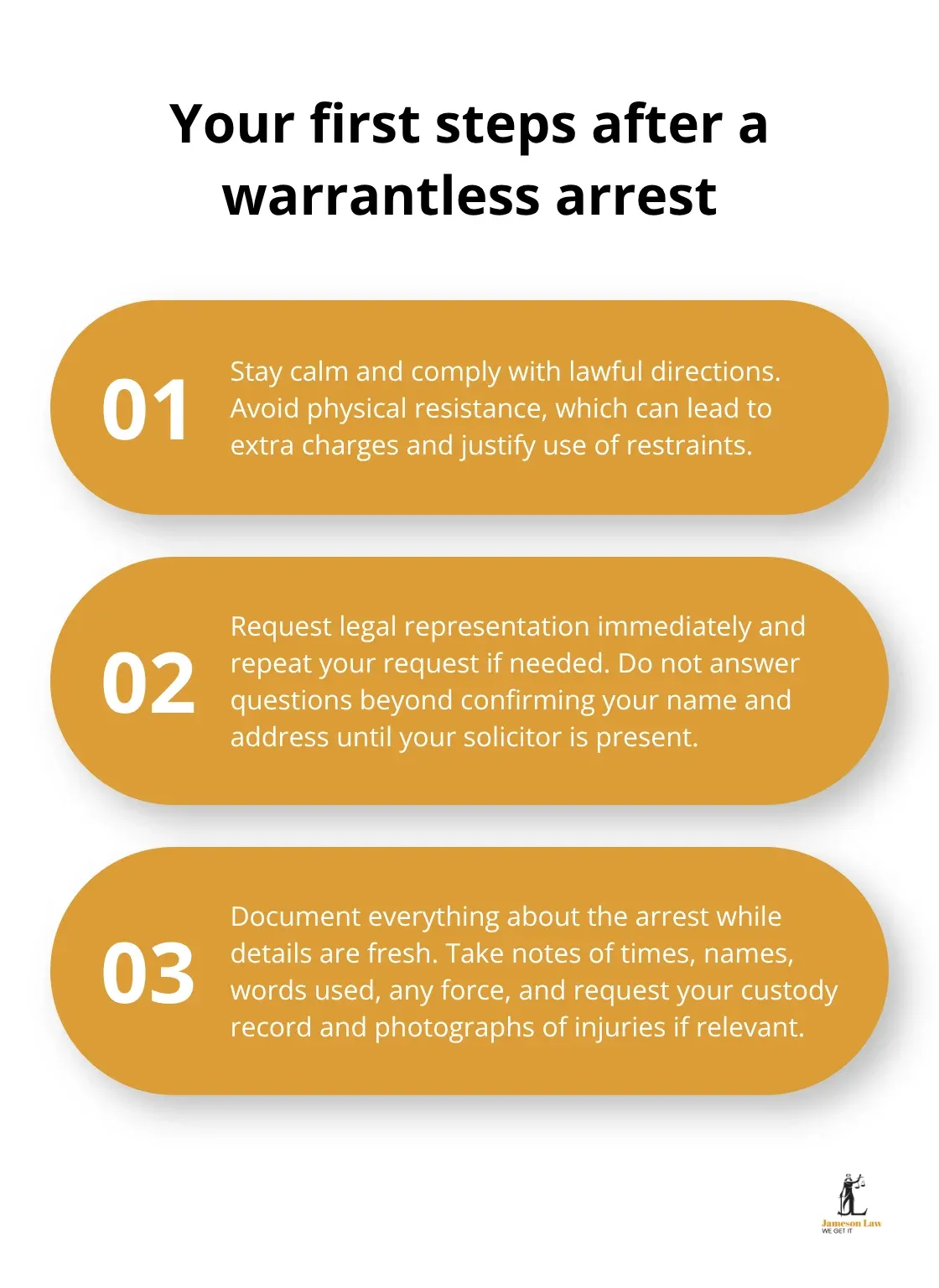
Facing an arrest without warrant NSW requires an immediate, disciplined exercise of your legal protections. The statutory constraints placed on police under LEPRA exist to prevent arbitrary detention and ensure procedural fairness.
Exercising your right to silence and requesting immediate legal representation before participating in any interview or providing formal statements is the most effective way to safeguard your position. Your legal team can review the custody log, examine whether Section 99 thresholds were met, and determine whether any evidence obtained can be challenged under Section 138.
If you or a family member have been arrested, charged, or require advice on Local Court bail proceedings, contact the criminal defence team at Jameson Law for urgent, confidential assistance.