


Student visa English requirements can feel overwhelming, but they’re straightforward once you understand what’s needed. We at Jameson Law help international students navigate this process every day, and we’ve seen how clarity makes all the difference.
NSW institutions and the Department of Home Affairs set specific benchmarks you’ll need to meet. This guide breaks down exactly what those benchmarks are, how to prepare, and alternative pathways that might work for your situation.
What English Tests Does Australia Accept for Student Visas
Accepted Tests and Formats
The Department of Home Affairs recognises a specific set of English language tests for student visa applications. IELTS, TOEFL, PTE Academic, and Cambridge English qualifications form the primary options, though IELTS dominates the Australian student visa landscape because it remains the most widely available and understood by NSW education providers.
IELTS operates in two formats: Academic and General Training. You need the Academic version for student visas, and the test costs around AUD $330. TOEFL iBT runs approximately AUD $285 and attracts increasing numbers of students applying to Australian universities, particularly those with strong US connections.
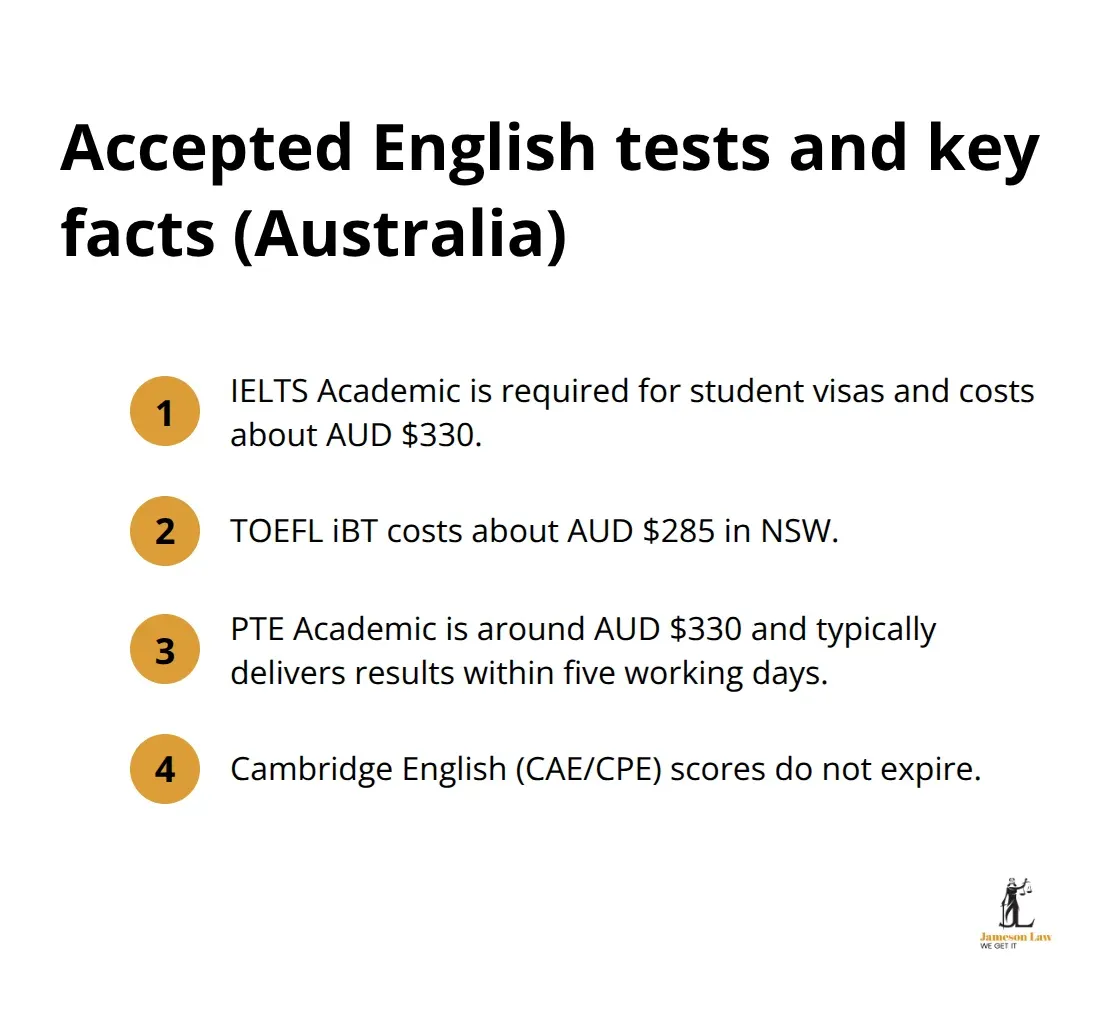
PTE Academic sits at roughly AUD $330 and offers faster results-typically within five working days compared to IELTS’s ten to thirteen days. Cambridge English qualifications like CAE and CPE remain valid indefinitely, unlike TOEFL and PTE scores which expire after two years, making Cambridge worth considering if you apply well in advance.
Score Requirements by Visa Type
Minimum score requirements vary significantly by visa subclass and institution type. Student visa holders pursuing higher education generally need IELTS 5.5 overall with no band lower than 5.0, though many universities demand IELTS 6.0 or higher for competitive programs. VET and Foundation programs typically accept IELTS 5.5, while postgraduate research positions sometimes require IELTS 6.5. PTE Academic equivalents run roughly 42 for basic student visas and 58 for higher-level study.
The Department of Home Affairs publishes these benchmarks, but institutions frequently set their own thresholds above the minimum. Different NSW institutions hold different preferences, so checking your specific university’s website before registering for a test saves both time and money. Direct contact with your chosen university matters more than relying on generic requirements.
Exemptions From English Testing
Several pathways exempt you from taking an English test altogether. If you completed your final twelve months of secondary school or at least two years of tertiary study in English at a recognised institution in Australia, Canada, New Zealand, Ireland, South Africa, the UK, or the USA, you qualify for exemption. Many students overlook this option and spend money on tests they don’t need.
Additionally, some Australian institutions offer their own English language assessments that can replace formal tests, particularly through recognised pathway providers. Professional qualifications can also count-if you hold a degree from a university ranked highly according to international rankings, certain exemptions may apply (though this varies by institution). Your chosen university can confirm whether your specific qualifications meet their exemption criteria.
Understanding which test suits your situation and whether you actually need to sit an exam at all sets the foundation for your application. The next section covers how to prepare effectively once you’ve selected your test.
Preparing for English Language Tests
Registration Timelines and Test Availability
Registration deadlines matter more than most students realise, and starting early prevents the panic that derails applications. IELTS in NSW offers multiple test dates monthly, with registration typically closing two weeks before your chosen date. You can book through IELTS Australia and expect to sit the exam within three to four weeks of registering. TOEFL iBT operates similarly, offering test dates throughout NSW with registration windows of around two weeks. PTE Academic moves faster-you can often register and test within one to two weeks, which appeals to students working on tight timelines.
The critical advantage PTE holds is result delivery within five working days, compared to IELTS taking ten to thirteen days. If your university application deadline looms within eight weeks, PTE becomes the practical choice over IELTS or TOEFL. Each test provider maintains its own scheduling system, so checking availability in your area before committing to a test type prevents unnecessary delays.
Structuring Your Study Timeline
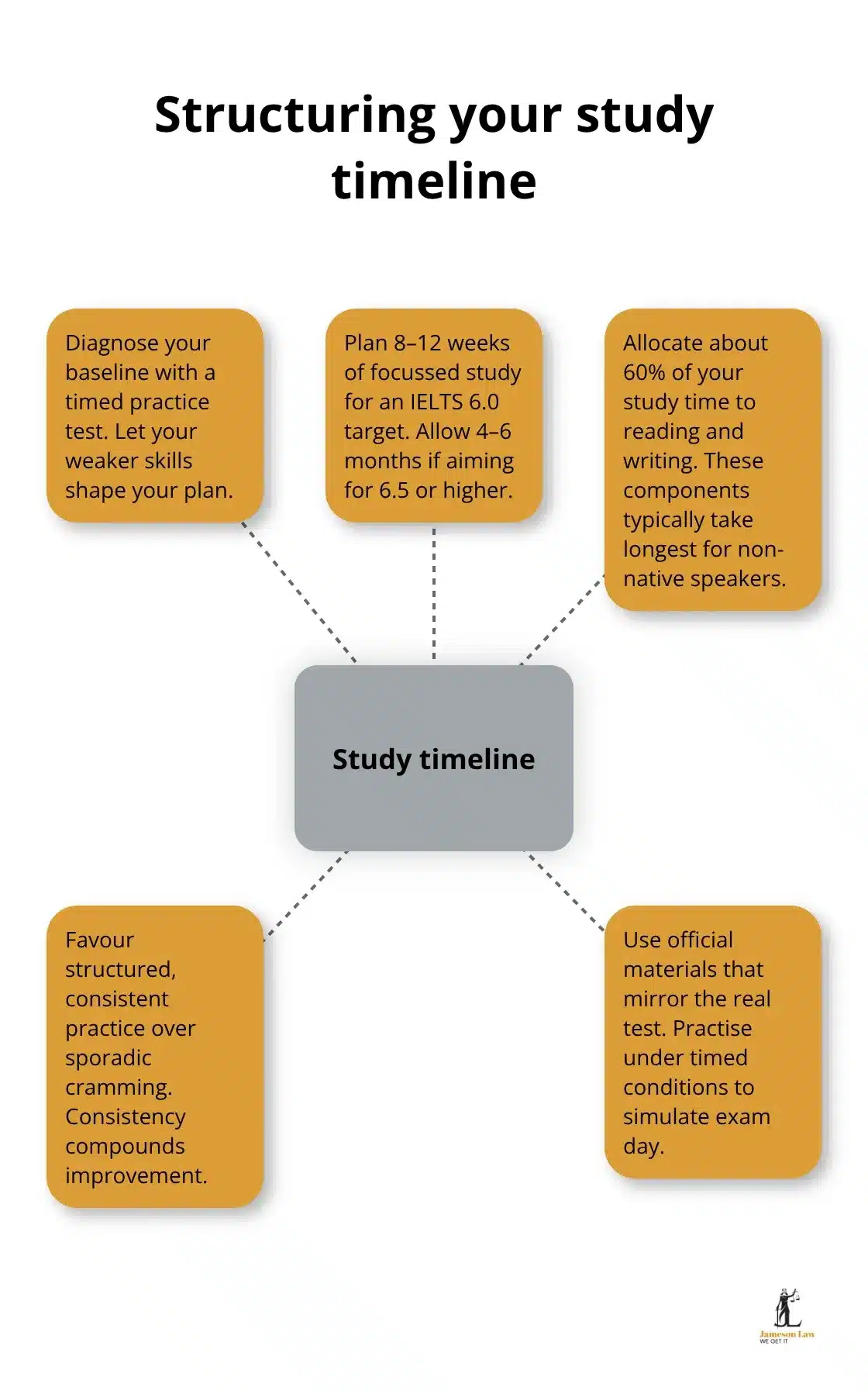
Preparation timelines depend entirely on your current English language level and target score. Students trying for IELTS 6.0 typically need eight to twelve weeks of focussed study, while those targeting 6.5 or higher often require four to six months. Students spending time on structured practice improve faster than those attempting sporadic cramming.
Start with a diagnostic test under timed conditions to establish your baseline, then target the specific skills holding you back rather than studying everything equally. Reading and writing typically demand the longest preparation for non-native speakers, so allocating sixty percent of study time to these sections produces better results than spreading effort evenly across all four components.
Using Official Practice Materials Effectively
Official practice materials make the difference in your preparation. IELTS publishes past papers through their website, TOEFL offers full-length practice tests on their platform, and PTE provides mock exams matching the actual test format exactly. Many NSW universities now partner with test providers to offer free or discounted practice sessions for enrolled students, so confirming this benefit before paying for external resources saves money.
Working through authentic materials under timed conditions trains you for the actual test experience. Reviewing your mistakes after each practice session (rather than simply completing more tests) accelerates improvement. This targeted approach to practice beats generic study guides that lack real test content.
Moving Forward With Your Application
Once you’ve selected your test and mapped out your preparation timeline, the next step involves understanding whether your chosen university accepts alternative pathways to meet English language skills requirements. Some institutions recognise qualifications earned through Australian education itself, which can eliminate the need for formal testing altogether.
Meeting Requirements Through Australian Education
Satisfying English Requirements With Australian Qualifications
Completing secondary or tertiary study in English at a recognised institution offers the most direct route to bypassing formal English testing altogether. The Department of Home Affairs recognises qualifications from eight specific countries, and Australia sits at the top of that list. If you finished your final twelve months of secondary school in Australia or completed at least two years of tertiary study here, you have already satisfied the English requirement without needing IELTS, TOEFL, or PTE. This exemption applies regardless of your test scores or language background.
Many students waste hundreds of dollars on English tests when their existing Australian education qualifications already meet the standard. Universities in NSW actively use this pathway, and checking whether your previous study qualifies takes five minutes through your institution’s admissions office.
Pathway Programs and English Preparation Courses
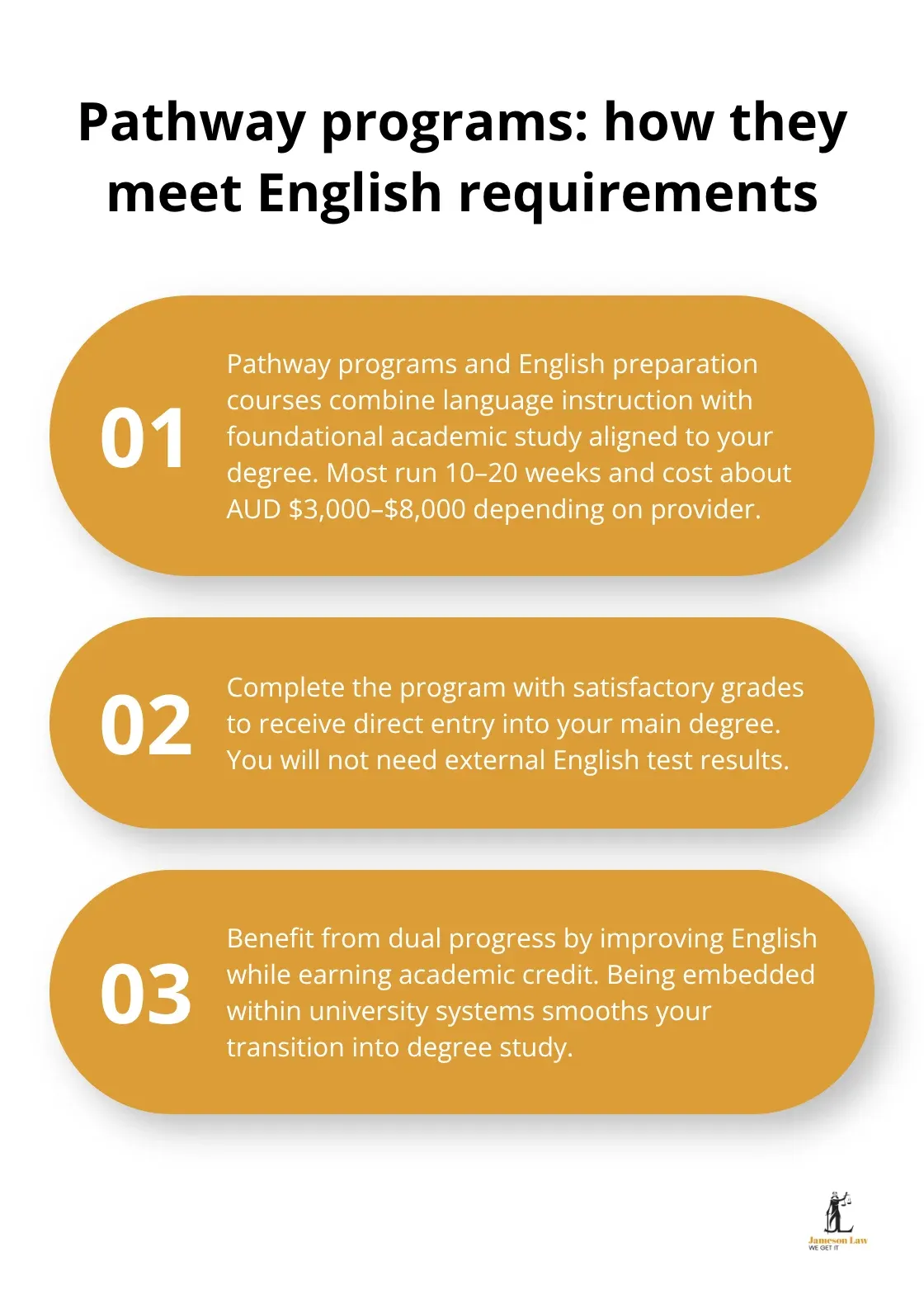
Australian pathway programs and English preparation courses offer another practical option for students who have not yet completed formal study here. These programs, delivered through recognised providers at NSW universities and private institutions, combine English language instruction with foundational academic study tailored to your chosen degree. Most run between ten to twenty weeks and cost between AUD $3,000 and $8,000 depending on intensity and provider.
Students who complete these programs with satisfactory grades receive direct entry into their main degree without needing external English test results. The advantage here sits in dual progress-you simultaneously improve your English and earn academic credit toward your qualification.
University-Delivered Pathway Options
Universities like UNSW Sydney, University of Sydney, and Macquarie University operate accredited pathway programs specifically designed to transition international students into degree-level study. These programs work genuinely well because they sit embedded within university systems rather than operating as standalone services. Upon completion, your pathway provider issues a certificate that directly satisfies the English requirement, eliminating the need for separate testing entirely.
Starting a pathway program twelve to eighteen months before your intended degree commencement gives you realistic time to develop academic English skills without rushing. This timeline allows you to build confidence in reading, writing, and academic discussion before you enter your main degree program.
Final Thoughts
Student visa English requirements form just one component of your overall application, but meeting them removes a significant barrier to studying in NSW. You now understand which tests Australia accepts, what scores you need, and whether your existing qualifications might exempt you from testing altogether. Many students find they don’t need to sit an exam at all, while others find that pathway programs offer a more practical route than standalone language tests.
Your next step depends on your current situation. If you’ve completed secondary or tertiary study in English at a recognised institution in Australia, Canada, New Zealand, Ireland, South Africa, the UK, or the USA, contact your chosen NSW university to confirm your exemption status before spending money on tests. If you’re taking an English language test, register at least four weeks in advance to secure your preferred date and allow adequate preparation time. For students considering pathway programs, reach out to your target university’s international admissions team to understand program timelines and entry requirements.
The Department of Home Affairs website provides official information on accepted tests and minimum scores, while individual NSW universities publish their specific requirements on their admissions pages. If your student visa application involves complex circumstances or you need guidance on meeting requirements alongside other visa conditions, Jameson Law can help you navigate the process with our immigration law team.