


Facing assault allegations in New South Wales can be daunting. Understanding the essential prosecution elements and preparing a robust common assault defence NSW strategy is critical to protecting your rights and ensuring a fair hearing.
At Jameson Law, our criminal defence team regularly guides clients through the Local Court process. This legal information guide examines the statutory definitions, available legal defences under NSW law, and how evidence is assessed by the court.
Common Assault Defence NSW: What Must Be Proven?
Under section 61 of the Crimes Act 1900 (NSW), common assault carries a maximum penalty of two years imprisonment. It is ordinarily dealt with summarily in the NSW Local Court, and an assault can occur with or without physical contact.
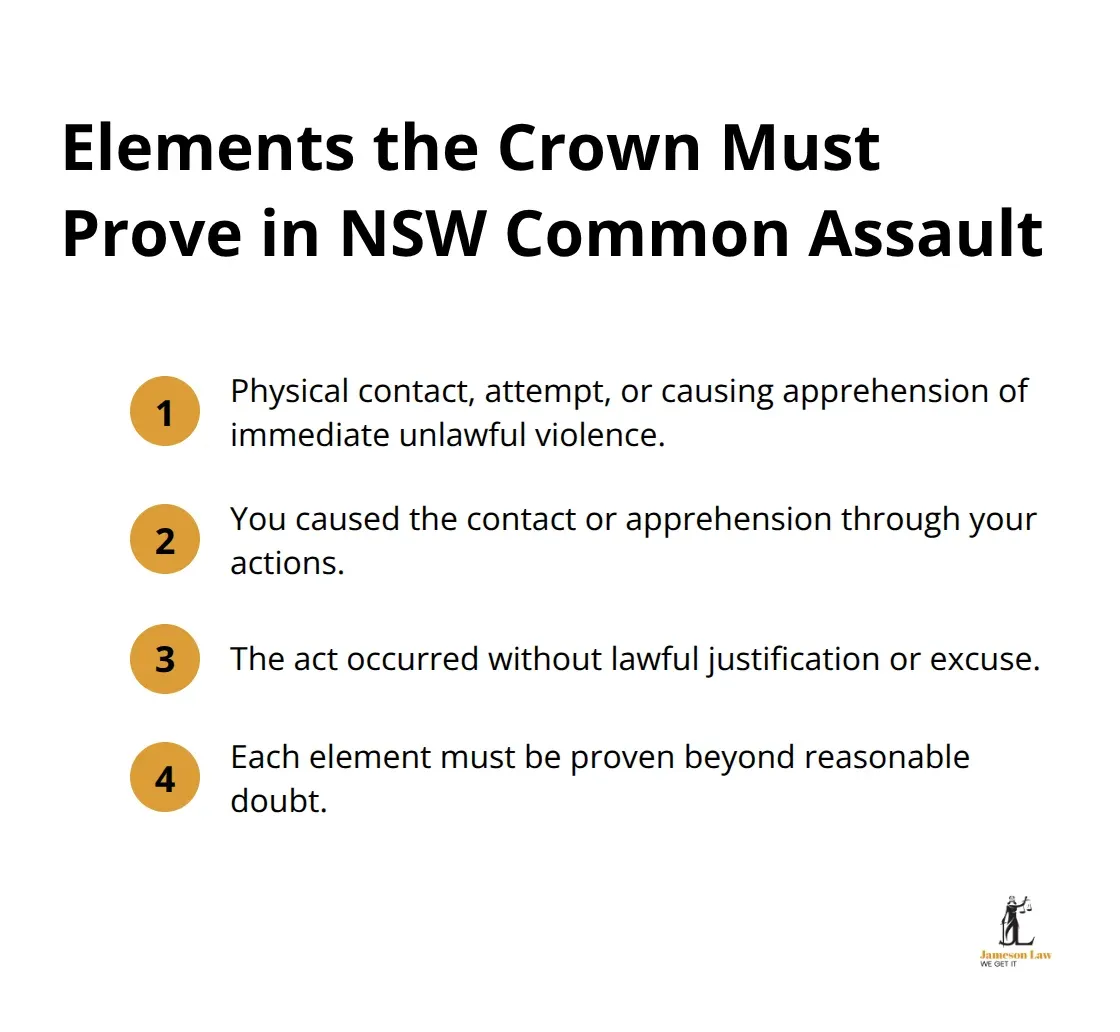
Elements the Prosecution Must Prove
According to principles set out in the Judicial Commission of NSW Criminal Bench Book, to secure a conviction for common assault, the prosecution must prove each of the following elements beyond reasonable doubt:
- Actus Reus (The Act): The accused committed an act that caused the complainant to apprehend immediate and unlawful violence, or applied unlawful physical force to the complainant’s person.
- Absence of Consent: The act was committed without the complainant’s lawful consent.
- Mens Rea (Mental Element): The accused acted intentionally or recklessly (meaning they foresaw the possibility of causing apprehension or physical contact and proceeded regardless).
- No Lawful Justification: The conduct was carried out without lawful excuse or justification.
The Burden and Standard of Proof
Under Australian common law and the Evidence Act 1995 (NSW), the accused is presumed innocent. The prosecution carries the entire legal burden to prove every element of the charge beyond reasonable doubt. The defence is not required to prove innocence.
Recognised Legal Defences to Common Assault in NSW
1. Lawful Self-Defence
Statutory self-defence is governed by Part 11 Division 3 (Section 418) of the Crimes Act 1900 (NSW). Under section 418, a person is not criminally responsible for an offence if they carried out the conduct in self-defence to protect themselves, another person, or property, or to prevent unlawful deprivation of liberty.
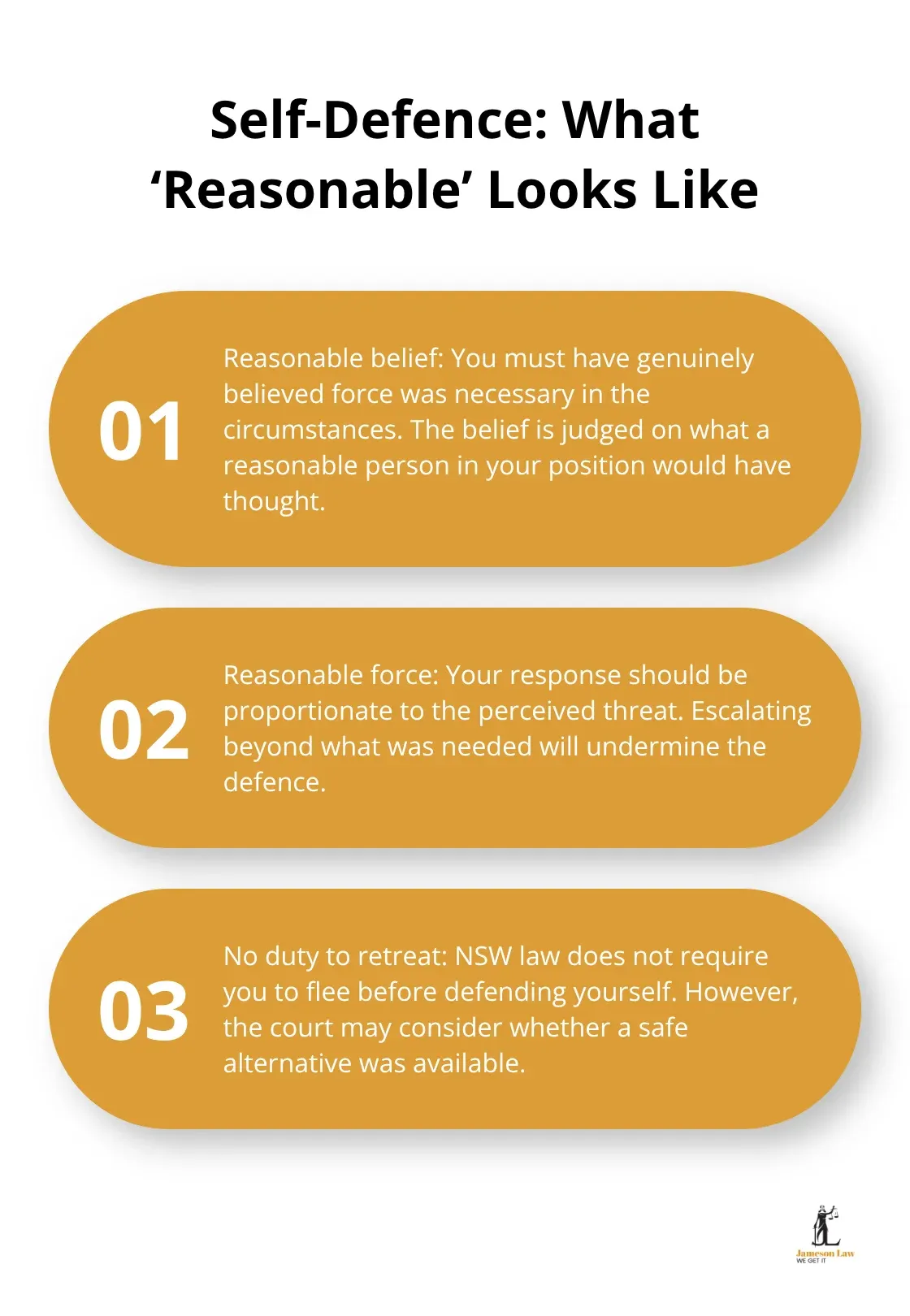
The test for self-defence involves two stages:
- Subjective test: Did the accused genuinely believe the conduct was necessary to defend themselves or another person?
- Objective test: Was the conduct a reasonable response in the circumstances as the accused perceived them?
Once self-defence is fairly raised on the evidence, the prosecution must exclude self-defence beyond reasonable doubt.
2. Lawful Consent
Physical contact that occurs with genuine, voluntary consent is not unlawful assault. This principle applies to ordinary everyday social contact, sanctioned contact sports, and lawful medical procedures. However, the law limits the scope of consent; a person cannot legally consent to the infliction of actual bodily harm or grievous bodily harm without a recognised lawful exception.
3. Mistaken Identity and Alibi
In cases occurring in crowded venues, poorly lit areas, or chaotic environments, identification evidence may be unreliable. The defence may challenge visual identification, photographic line-ups, or circumstantial evidence under the Evidence Act 1995 (NSW) to demonstrate that the prosecution cannot prove beyond reasonable doubt that the accused was the person who committed the offence.
4. Lack of Intent or Pure Accident
Because common assault requires either intention or recklessness, genuine accidents lacking any subjective foresight of unlawful contact or apprehension do not satisfy the mental element (mens rea) required for a conviction.
Preparing Evidence and Navigating the NSW Local Court Process
Gathering and Preserving Evidence
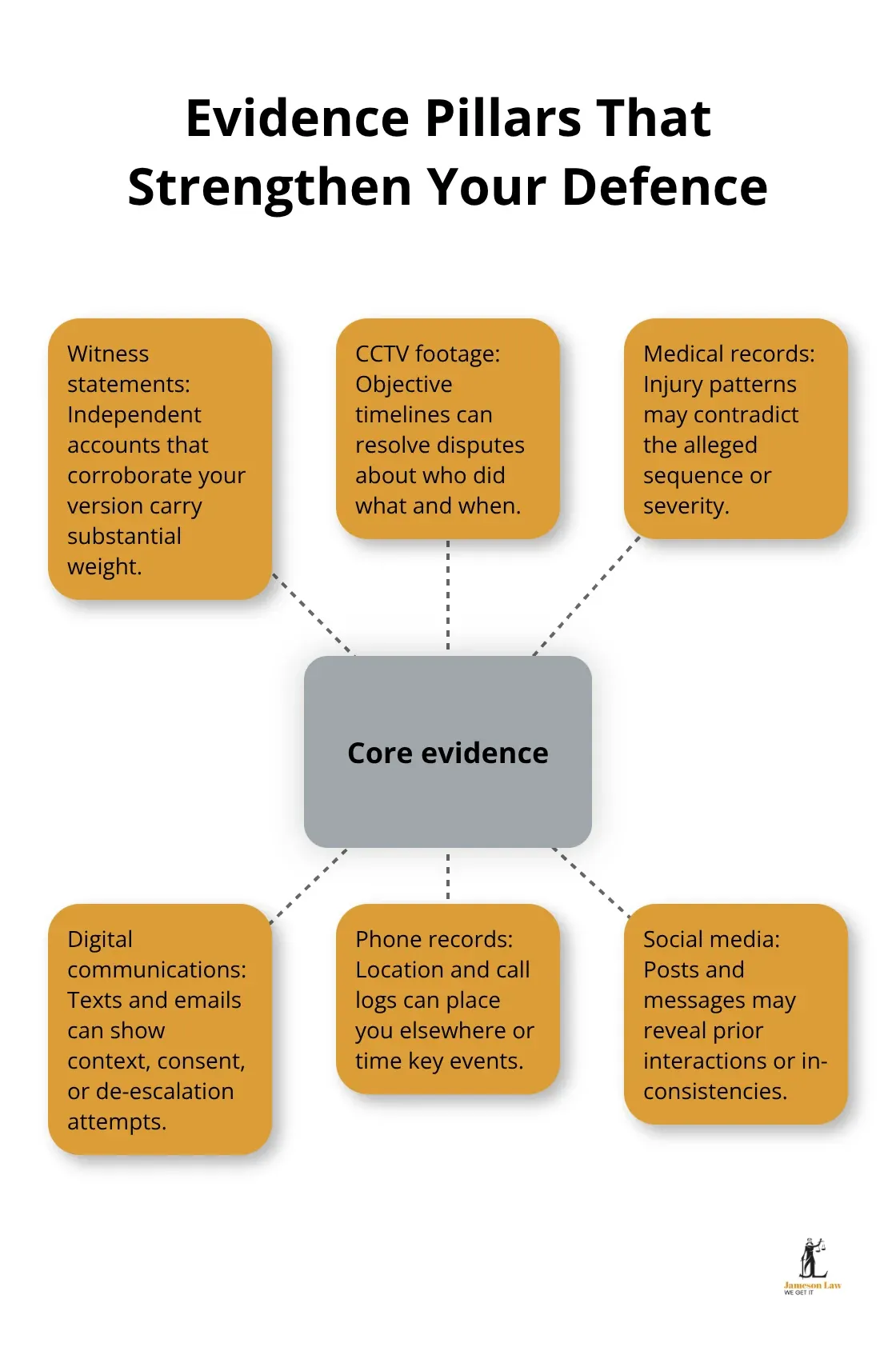
The viability of any defence relies on admissible, reliable evidence. Key steps in preparing a defence include:
- CCTV and Digital Footage: Requesting footage from venues, transport authorities, or dashcams before recording loops are overwritten.
- Independent Witness Statements: Obtaining signed, contemporaneous statements from third-party witnesses.
- Communications Records: Preserving text messages, emails, and social media interactions that provide context to the interaction.
- Medical and Photographic Records: Documenting defensive injuries, bruises, or scratches sustained during the incident.
The Court Process: Mentions, Pleas, and Hearings
Common assault matters follow a structured procedure in the NSW Local Court:
- First Mention: The initial court date where the accused confirms their identity and decides whether to enter a plea of guilty or not guilty, or seek an adjournment to obtain legal advice.
- Plea of Not Guilty: If a not guilty plea is entered, the court will make brief service orders directing police prosecutors to serve the complete brief of evidence, and set the matter down for a defended hearing.
- Defended Hearing: The Magistrate hears evidence from prosecution witnesses, defence witnesses (if called), and considers cross-examination and legal submissions before delivering a verdict.
- Sentencing / Section 10 Dismissals: If a person pleads guilty or is found guilty, the Magistrate considers sentencing options under the Crimes (Sentencing Procedure) Act 1999 (NSW), which may include conditional release orders, fines, community correction orders, or dismissals without conviction under Section 10(1)(a).
Frequently Asked Questions
What constitutes common assault under NSW law?
Under Section 61 of the Crimes Act 1900 (NSW), common assault occurs when a person intentionally or recklessly causes another person to apprehend immediate and unlawful violence, or applies unlawful physical force without consent, even if no bodily injury results.
How does self-defence operate in a common assault case in NSW?
Under Part 11 Division 3 (Section 418) of the Crimes Act 1900 (NSW), a person is not criminally responsible if they carried out the conduct in self-defence. Once raised, the prosecution must prove beyond reasonable doubt that the accused did not genuinely believe the conduct was necessary, or that the response was not a reasonable response in the circumstances as the accused perceived them.
Where are common assault charges heard in NSW?
Common assault under Section 61 of the Crimes Act 1900 (NSW) carries a maximum penalty of two years imprisonment. It is ordinarily dealt with summarily in the NSW Local Court, although the procedural pathway can depend on the charge and any applicable election.
Final Thoughts
Defending a common assault charge in NSW requires a rigorous assessment of the prosecution’s brief, early preservation of objective evidence, and a clear understanding of statutory defences. Because every criminal matter turns on its unique factual matrix, obtaining tailored legal advice from an experienced practitioner ensures your case is properly evaluated.
For strategic advice and representation in NSW Local Court proceedings, contact Jameson Law to discuss your matter with our defence team.