


Bail conditions breached can turn a difficult situation into a far worse one. When you’re released on bail, the court sets specific conditions you must follow, and breaking even one of them carries serious consequences.
At Jameson Law, we’ve seen how quickly a bail breach can derail a case. Understanding what you’re obligated to do-and what happens if you don’t-is essential to protecting your legal position.
What Bail Conditions Actually Mean in NSW
The Legal Nature of Bail Conditions
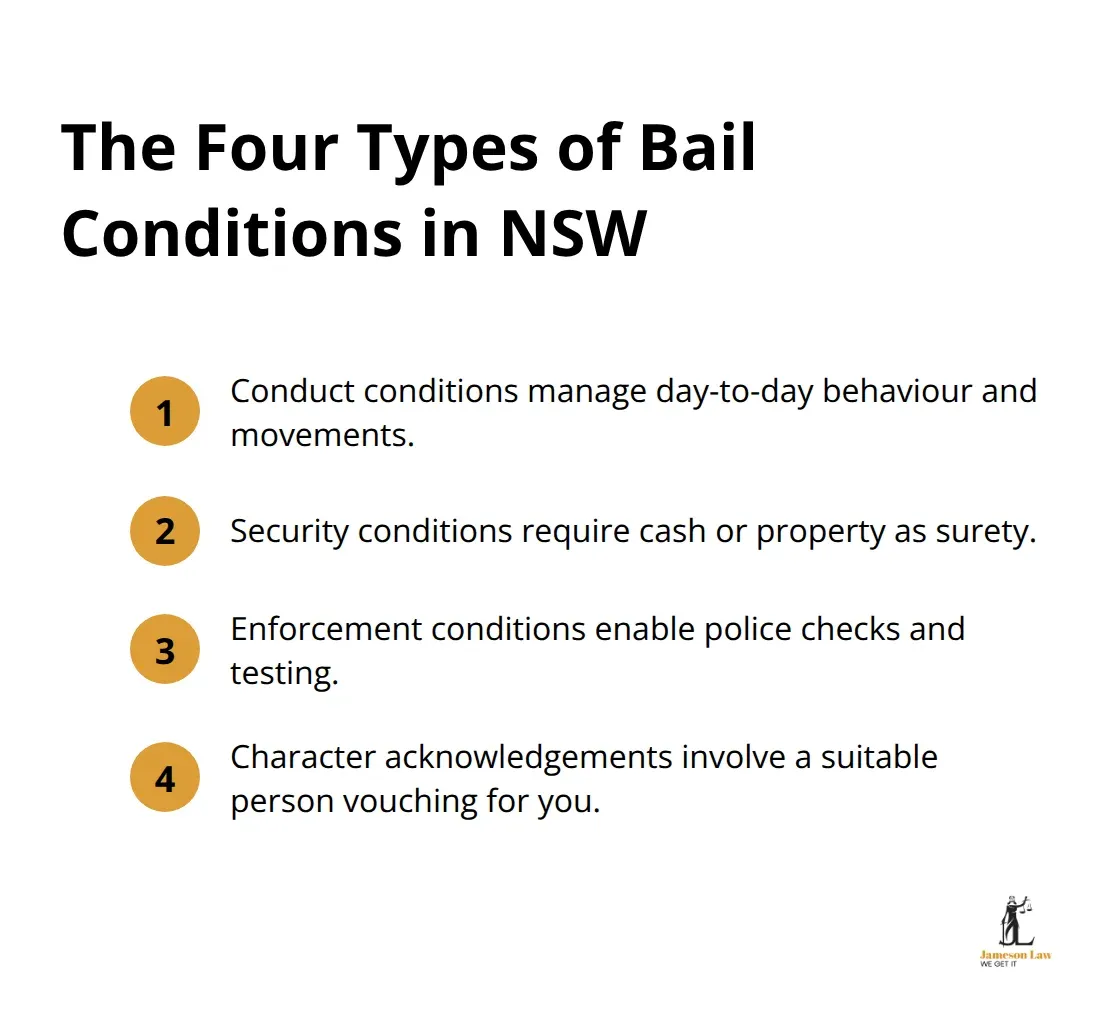
Bail conditions are not suggestions. They are court-ordered requirements that form a binding legal obligation, and NSW courts take them seriously. When a magistrate or judge grants you bail, they attach specific conditions designed to address concerns about your likelihood of reoffending, failing to appear in court, or endangering the community. Under the Bail Act 2013 (NSW), these conditions fall into four distinct categories: conduct conditions, security conditions, enforcement conditions, and character acknowledgements.
The Four Types of Bail Conditions
Conduct conditions are the most common and typically include requirements like reporting to police at set intervals, living at a designated address, surrendering your passport, avoiding contact with specific people, staying away from certain locations, observing curfews, not driving, abstaining from alcohol, or attending rehabilitation programs. Security conditions require you to provide cash or property as a bail surety, with the court needing proof of funds through bank statements or receipts, and for property, evidence of value and bank approval. Enforcement conditions allow police to monitor your compliance through urine testing, random breath tests, and routine checks. Character acknowledgements involve a third party with good character providing a signed reference promising you will obey bail and attend court.
How Courts Set Your Conditions
The court does not set these conditions arbitrarily. NSW legislation requires that conditions be no more onerous than necessary to manage the identified risk, and the court must consider the least restrictive option first. A magistrate will start with your own undertaking without money, then progress to requiring money or security, then a surety, and finally money plus a surety only if lower-level options are insufficient. The Bail Act 2013 (NSW) also allows courts to impose special conditions including prohibitions on entering licensed premises, time and place restrictions, and electronic monitoring devices if warranted by the circumstances.
Modifying Conditions You Cannot Meet
If you cannot comply with your conditions, you have a formal right to apply to the court to vary them. You must provide evidence of changed circumstances such as employment loss or medical issues. The Registrar at the court can vary bail conditions with prosecution agreement, which means you do not always need a full court hearing. Most people do not know this option exists, and many struggle silently with impossible conditions rather than seeking modification. If you genuinely cannot meet a condition, applying for variation is far better than breaching it-and this distinction becomes critical when you understand what actually happens if you fail to comply.
What Happens Immediately When You Breach Bail
Police Arrest and Court Appearance
Bail breach triggers an immediate chain of events that moves quickly. Once police identify a breach, they can arrest you without a warrant if they have reasonable grounds to believe you failed to comply. The law requires that you appear before a court as soon as possible, typically within one to two business days depending on court availability. This is not a warning stage or an opportunity to explain yourself later.
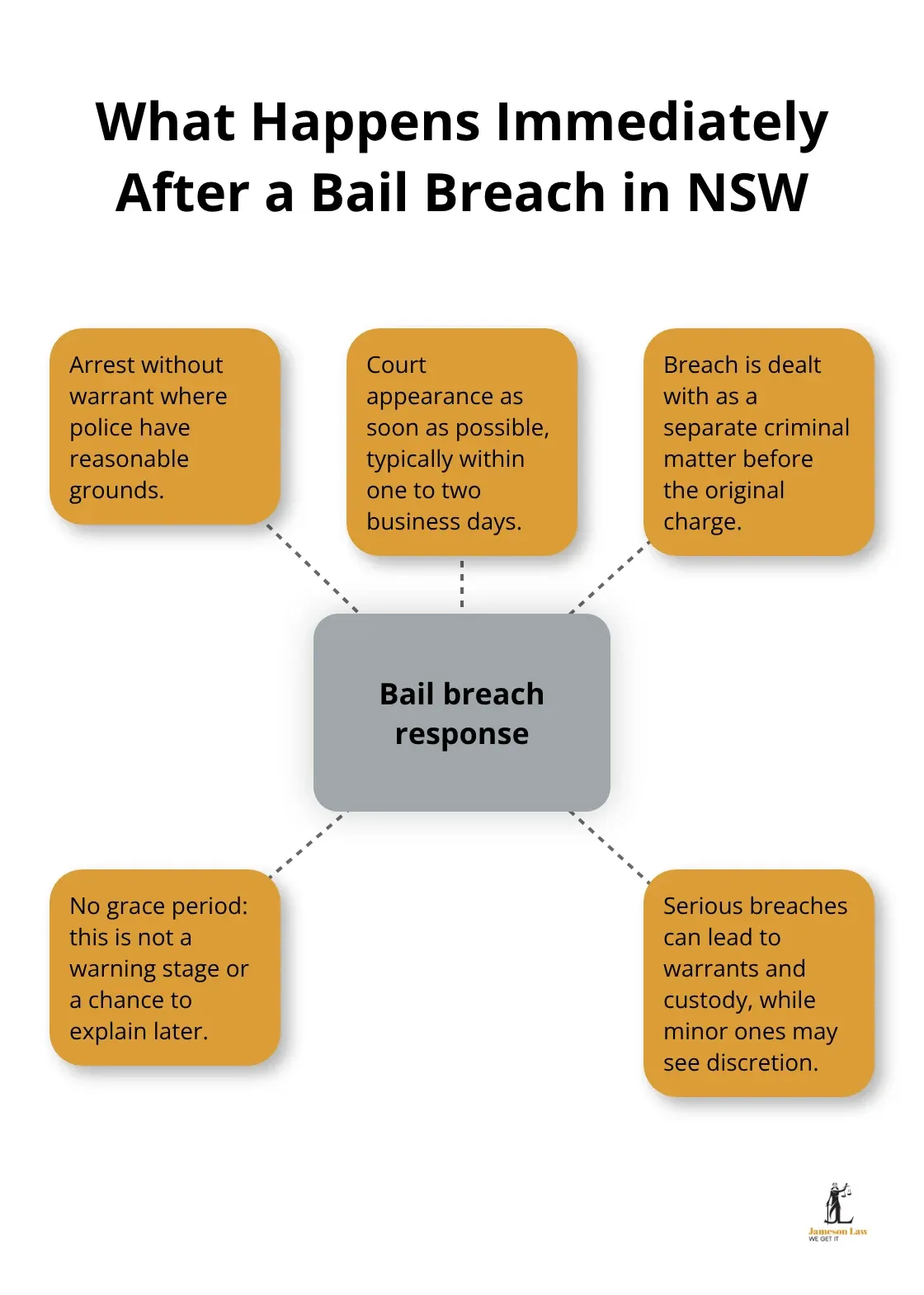
The breach itself becomes a separate criminal matter that the court will address before dealing with your original charge.
Criminal Penalties for Bail Breach
Under the Bail Act 2013 (NSW), breaching bail conditions is an offence with a maximum penalty of imprisonment not exceeding 3 years. The severity matters because it sits alongside your original charge, not instead of it. Police discretion does play a role here-minor breaches may attract little action, but serious breaches will trigger arrest warrants and custody.
Financial Consequences and Surety Impact
If you posted a security deposit as part of your bail arrangement, that money faces immediate forfeiture. If a surety provided funds on your behalf, those funds are also at risk. The court can order the surety to pay the forfeited amount, and if payment does not occur within 28 days, it can be recovered like a fine. This creates a ripple effect where your breach affects not just you but anyone who stood surety for you.
How Bail Breach Affects Your Original Case
The impact on your criminal case becomes significant once a breach is established. Courts view bail breaches as a demonstration that you cannot be trusted to follow court orders, and this perception directly influences how they treat your original matter. When you appear for the breach hearing, the court will evaluate whether to revoke your bail entirely (which means remand in custody until your trial or next court date), or whether to vary the conditions or rebail you on different terms. If bail is revoked, you lose your freedom pending trial, which can stretch for months depending on case complexity. This affects your ability to prepare your defence, maintain employment, and support your family.
Sentencing Implications and Domestic Violence Complications
The court may also view the breach as evidence of character or compliance issues relevant to sentencing on your original charge if you are ultimately convicted. A person with a history of breaching court orders often receives harsher sentencing than someone without that history. If your breach occurred in a domestic violence context, the consequences intensify significantly. Breaching bail in domestic violence cases often mirrors a breach of an Apprehended Domestic Violence Order, carrying penalties up to $5,500 and up to 2 years imprisonment. The compounding nature of these penalties means your original charge, the breach charge, and potentially an AVO breach charge can all stack together in sentencing. Understanding these layered consequences is essential before you face additional charges on top of your existing matter.
How to Stay Compliant With Your Bail Conditions
Treat Your Conditions as Legal Obligations
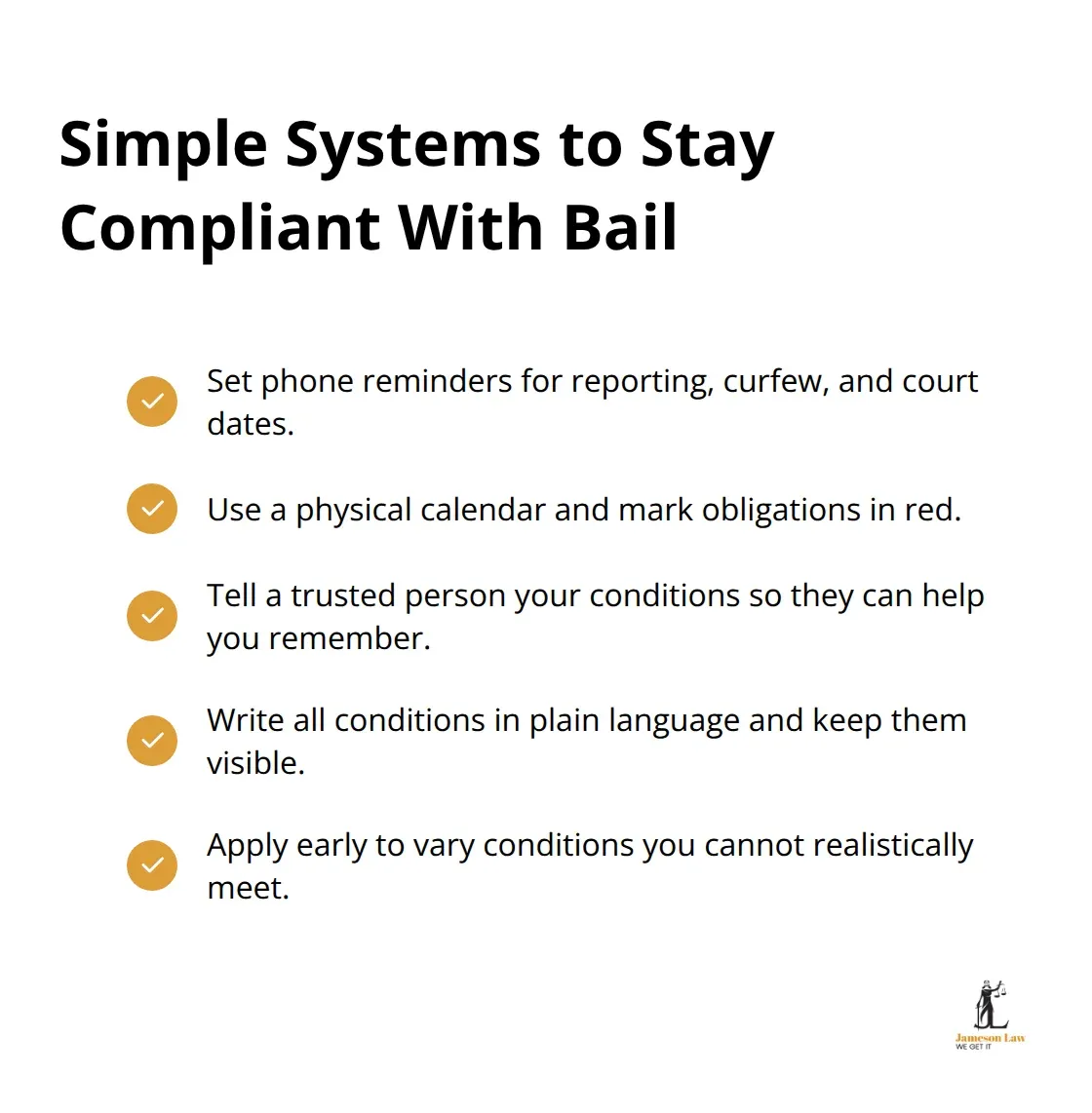
Compliance starts with treating your bail conditions as non-negotiable legal obligations rather than guidelines you can work around when convenient. Write down every single condition in plain language and post it somewhere you see daily, not buried in court documents you might misplace. Many people breach bail simply because they forget a minor requirement or misunderstand what a condition actually means.
Understand What Each Condition Requires
If your bail requires you to live at a specific address, you cannot stay elsewhere, even for one night at a friend’s place. If you have a curfew of 8pm to 6am, you must be inside at 8pm sharp, not 8:05pm. If you must report to police on Mondays and Thursdays, missing one session because you were busy or forgot counts as a breach. The court does not care about your reasons unless they constitute a genuine emergency like hospitalisation.
Create a System to Track Your Obligations
Set phone reminders for reporting dates, curfew times, and any court appearances. Use a physical calendar and mark every obligation in red. Tell someone you trust about your conditions so they can help you remember. This sounds straightforward, but many people lose their freedom over breaches that would have been prevented by a simple phone alarm.
Apply to Vary Conditions Before You Breach
If you cannot meet a condition, act immediately rather than hoping the situation resolves itself. Many people breach bail passively by struggling with an impossible requirement instead of asking the court for help. You have a legal right to apply to vary your conditions if your circumstances have changed. This application works best when you have concrete evidence of why compliance is now impossible.
If your condition requires you to live at a specific address but you have lost your job and can no longer afford that location, bring proof of job loss and evidence of alternative accommodation. If a condition prohibits you from working in a certain industry but your only employment opportunity falls within that restriction, bring the job offer letter. If you must attend rehabilitation but the nearest facility has a waiting list of six months, bring documentation from the facility. The Registrar at your local court can vary conditions with prosecution agreement, which often happens without a contested hearing. This process typically takes two to three weeks once you file the application. Courts recognise that circumstances change and are often willing to adjust conditions to remain realistic. The critical point is that you must apply before you breach, not after. Once you have already breached, the court views your situation as demonstrating you cannot be trusted to comply, and your application for variation becomes far harder to win.
Final Thoughts
Bail conditions breached transform your legal situation from manageable to severe within days. The consequences extend far beyond the immediate penalties for the breach itself-you face potential imprisonment up to three years, forfeiture of any security deposit, damage to your original case, and the real possibility of losing your freedom while awaiting trial. Courts view bail breaches as evidence that you cannot follow court orders, and this perception directly influences how they handle both your breach and your underlying criminal matter.
The most important step you can take is understanding exactly what your conditions require and treating them as binding legal obligations rather than flexible guidelines. If circumstances change and compliance becomes impossible, apply to vary your conditions before you breach. The court recognises that situations evolve and will often adjust conditions with prosecution agreement, which works far better than hoping to explain yourself after you have already failed to comply.
When bail conditions are breached, the damage compounds quickly. Your surety faces financial loss, your defence preparation suffers if bail is revoked, and sentencing on your original charge becomes harsher. We at Jameson Law understand how overwhelming bail conditions can feel when you are already dealing with criminal charges, and if you are uncertain about what your conditions mean, cannot comply with them, or have already breached bail, contact us to discuss your situation with someone who can review your specific circumstances and help protect your legal position.